If you’re looking to integrate a retail ERP solution, you’ve likely seen the top-10 lists that rank popular platforms based on their feature sets.
But there’s one big caveat those lists won’t tell you. Picking the “best” all-in-one system for your business today doesn’t mean that system will still fit in 18 months.
For fast-growing ecommerce and omnichannel brands, vendor comparison isn’t the first decision you should make. The architecture underneath is what determines whether a platform will still fit once you’ve outgrown your current shape.
This guide walks through why this decision matters and what to ask vendors first.
What You’ll Learn
-
Why most “retail ERP solutions” lists compare the wrong thing
-
The real question: Retail operations vs. all-in-one ERP
-
The hidden cost of choosing ERP by feature list alone
-
Choosing a retail operations system that grows with you
Why Most “Retail ERP Solutions” Lists Compare the Wrong Thing
You’ve probably already noticed that pretty much every comparison list ranks ERP vendors (like NetSuite, Dynamics, and SAP) against each other according to how much each platform can do (in other words, feature breadth).
But there’s one big problem with the way these lists are set up. They all assume that an ERP functioning as one bundled system that does everything will work for every brand. And in the fast-growing retail industry, that simply isn’t the case.
-
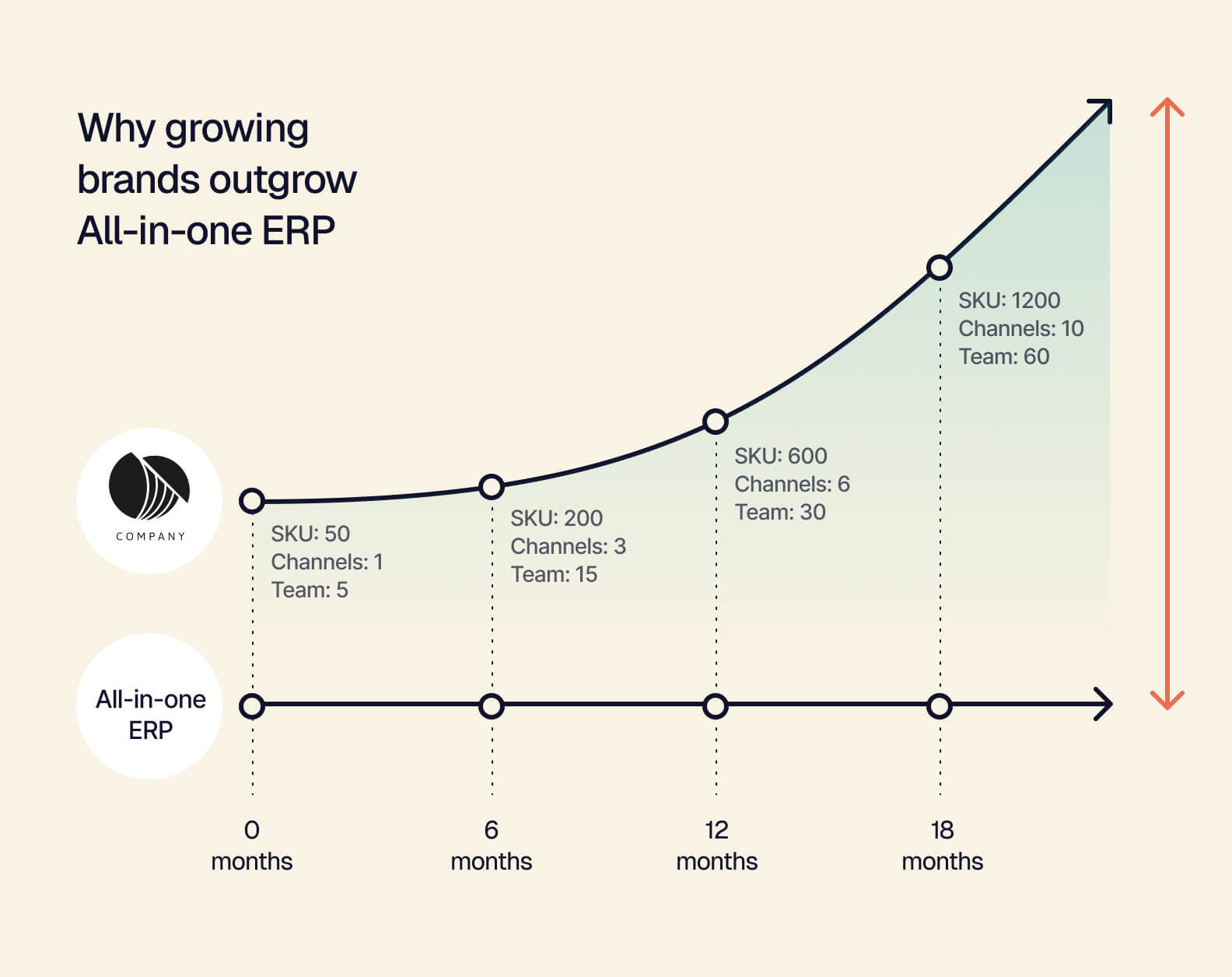
The problem: A brand picks the “best” all-in-one system for what their organization looks like today: current SKU count, current channel count, current team size. This is a logical choice — it’s the only data they have. But time passes, and a year or two later, growth shows up.
-
The consequence: The brand’s checkout, inventory, and personalization needs have changed faster than the monolithic ERP can flex. Growth outpaces the bundle.
-
The result: When the brand chose this ERP, they thought they were making a long-term ERP decision. But really, they made a short-term one. And now they’re already counting down to the next rebuild. The clock is ticking on their “best ERP for retail.”
The Real Question: Composable Retail Operations vs. All-in-One ERP
Before jumping straight to comparing specific platforms, there’s an earlier decision that growing brands need to make. Do they want a single rigid, bundled system, or a flexible operations layer assembled from pieces they can shape independently as they scale?
What “Headless, Composable” Actually Means for Retail Ops
It’s helpful to understand the terms “headless” and “composable” and what they actually change for a retail team day-to-day.
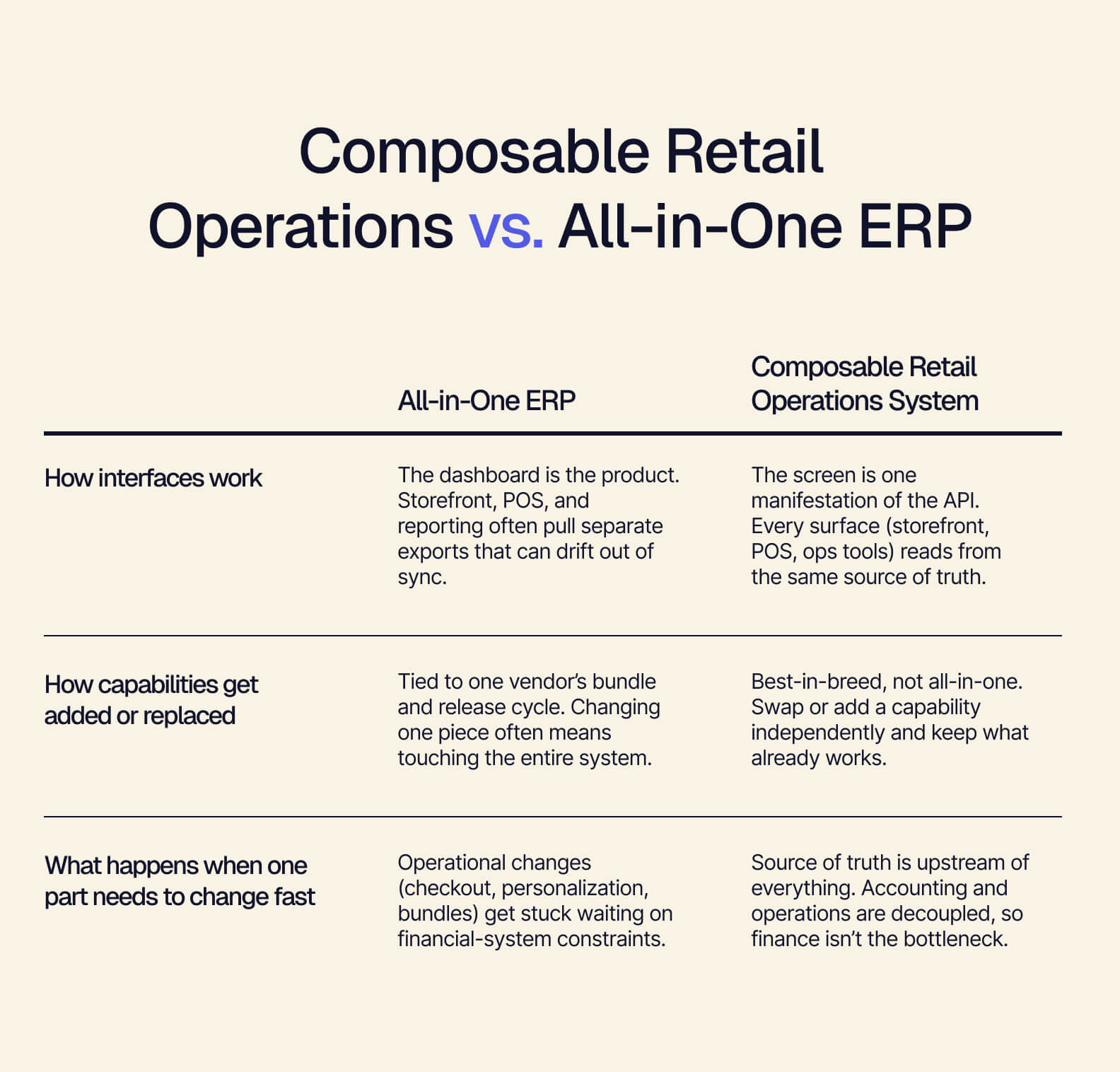
Headless. In a traditional ERP, the interface and business logic are integrated. The dashboard itself is the product. Each surface (storefront, POS, internal reporting) often ends up working from its own export of the data, and those exports get out of sync. “Headless” is the opposite. The business logic and data live behind an API and the interface is just one way of reading it. With a single API, every surface reads from the same source of truth.
- Why it matters for retail: A brand’s storefront, in-store POS, and ops team often need to do different things with the same inventory and order data. A headless ERP lets them all read from that single source, not three versions of data that can disagree.
Composable. A best-in-breed (composable) ERP lets you assemble capabilities from independently swappable pieces instead of getting them bundled into one vendor’s release. Say your fulfillment tool is working fine, but your inventory-to-storefront sync is being held together by manual workarounds. A composable system means you can swap out the broken piece without having to also replace what’s already working.
- Why it matters for retail: Retail brands rarely have everything break at once. Usually, it’s just one piece that’s struggling. A composable ERP prevents you from having to undertake a full re-platform just to solve one problem.
Source of truth upstream of everything. A bundled ERP often puts financial/accounting logic and operational logic in the same system. As a result, an operational change can require approval from finance. Decoupling means operations can move at its own speed, eliminating the financial bottleneck.
- Why it matters for retail: Retail moves fast. There’s no time to wait for finance when you’re restructuring a bundle or launching a new promotion. When operational data isn’t caught up with accounting logic, those changes can go live on the team’s timeline instead of waiting for a green light that’s really about protecting the books.
The Hidden Cost of Choosing ERP by Feature List Alone
Feature lists ask a basic yes/no question: “Does this ERP support bundles/variants?” They don’t typically ask, “How much custom integration work does it take to keep the system usable as your catalog grows?”
-
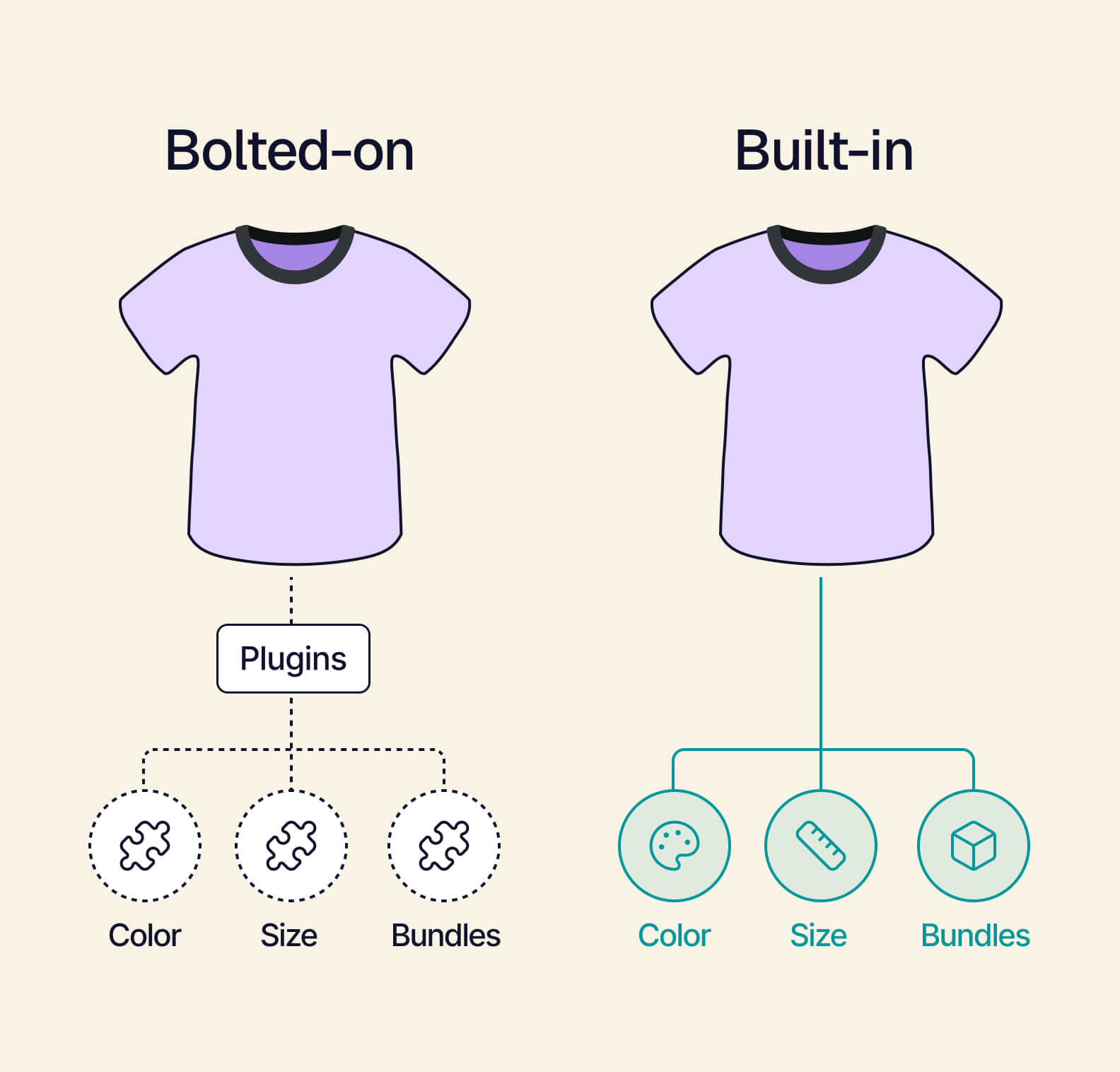
The problem: Most retail ERPs think of a “product” as a single, straightforward object. Retail-specific complexity is not built into the foundational data model. It’s treated as an edge case, requiring a plugin or a workaround.
-
The consequence: When the data model doesn’t do a good job of natively supporting variants/bundles, that translates into ongoing labor and risk spent maintaining spreadsheets and middleware just to keep the system accurate.
With a data model that is designed for retail variants and personalization, bundles and variants are structural — not something you have to configure around. The system already understands a bundle as a relationship between components, so inventory and personalization read directly off that relationship instead of off a workaround.
Even with the right architecture and data model, however, brands still need to know what to actually evaluate when choosing.
Choosing a Retail Operations System That Grows With You
The right evaluation question isn’t “what does this platform include.” It’s, “What happens when we outgrow our current shape?” Asking vendors these questions will help you get a broader picture:
-
Can capabilities be added or swapped independently? This is the difference between fixing one broken piece and re-platforming the whole system to fix it.
-
Is AI agentic and supervised, or just a dashboard feature? Look for AI that includes humans in the loop and acts on data with oversight, not AI that just summarizes a report.
-
Does the data model treat bundles and variants as core structure, or as a configuration workaround? If the vendor can’t answer this without describing a spreadsheet or plugin, that’s your answer.
-
Is accounting logic decoupled from operational logic, or will finance need to sign off on operational changes? A source of truth upstream of everything else means operations can move without waiting on the books.
-
What does a typical implementation timeline actually look like? Vague promises of “fast” implementation aren’t a reassurance. The answer should give you realistic timelines, but specific ones.
The benefit of implementing a composable retail operations system is that it takes weeks, not months to get everything running. By focusing on incremental, phased go-lives, retailers that use these types of systems avoid a single cutover at the end where everything goes live at once.
Your team should also be able to take the lead with hands-on support from the vendor, rather than experiencing a black-box process where you’re essentially locked out.
Tailor and the Composable Path Forward for Retail Operations
Most comparisons for retail ERP solutions start with vendors. The right one starts with architecture. Get that question right, and everything downstream — including which platform you ultimately pick — gets easier.
See what a composable retail operations system looks like in practice by booking a Tailor demo today.