Crunching the numbers is a tough job and without an expert accounting team, no scaling company can last long. But even your all-star, efficiency-forward accounting team needs powerful tools and data they can trust. Unfortunately, many teams rely on spreadsheets, disconnected tools, and hacked-together workflows to keep things moving. So when something breaks, you’ll see huge disruptions to your daily operations, suffer organizational confusion, and find that your momentum has slowed to a crawl.
You can put a stop to these types of experiences with the right tools. Good tools, solving spreadsheet problems, and getting back to efficient tasking means very little if you’ve got no idea what your teams need — especially when it comes down to how an EPR will affect your current accounting tools.
This guide is designed to help you break these negative cycles and understand how ERP accounting software can solve many of your biggest growth hurdles.
What You’ll Learn
-
What you should look for when shopping for ERP accounting software
-
How ERPs help you escape from overusing spreadsheets
-
Why your accounting team needs a single source of truth
-
What headless ERP software can do for your business
-
Why composability enables exponential growth
What You Need to Know About Your Accounting Tools and ERP Integration
Your accounting tools are the lifeblood of your business finances: they need to be powerful, scale with your needs, and keep your data clean. But at some point, you’ll likely come to a crossroad where your business needs more than your tools could offer; this is when it’s time for an ERP integration.
Before you choose to integrate an ERP software, though, you should know exactly what you need to keep your accounting running flawlessly.
You Need to Be Able to Keep Your Tools
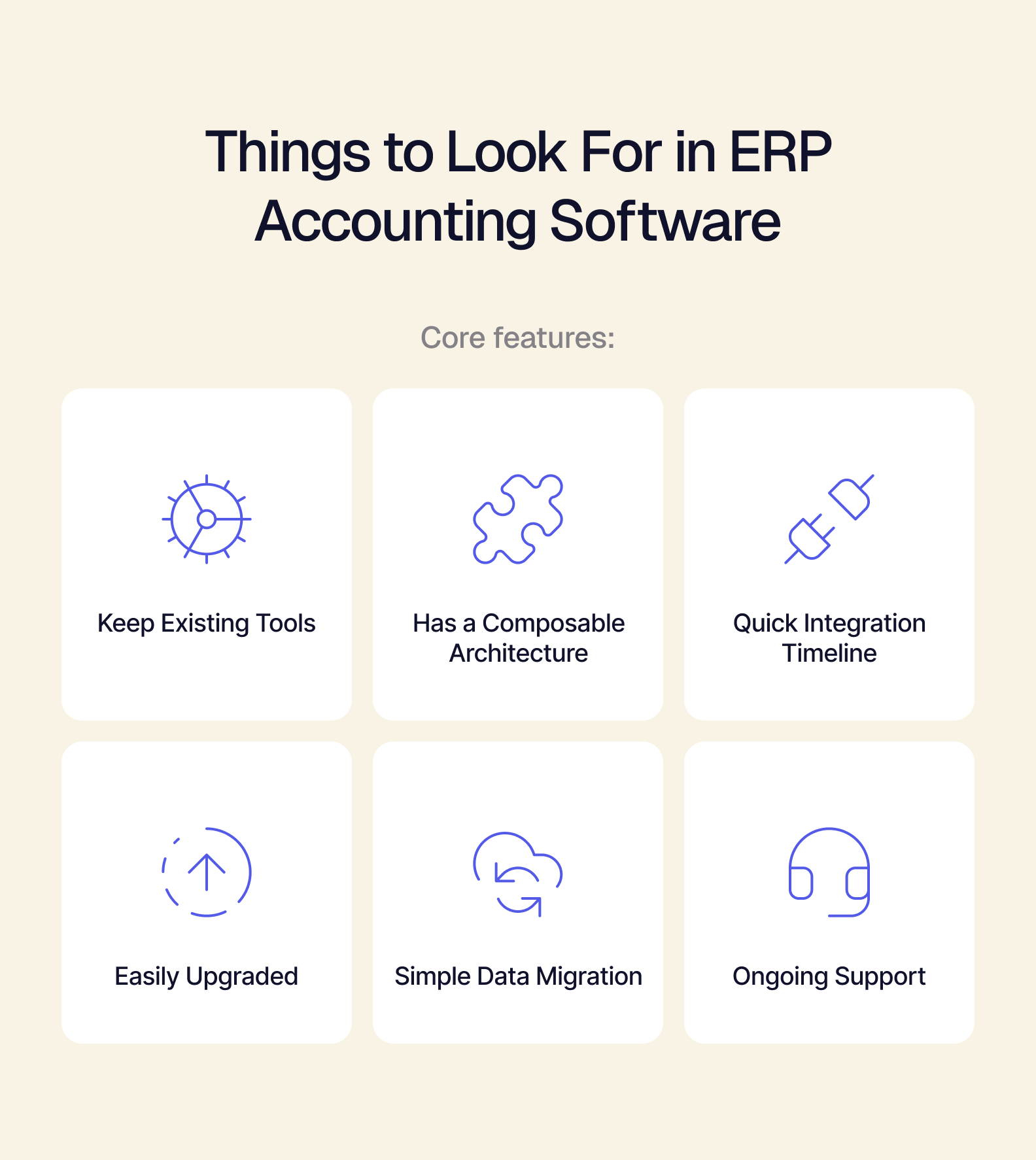
Part of integrating an ERP solution into your business is preserving your accounting tools. Whether it’s QuickBooks, Xero, Sage, Zoho (or another popular tool) it shouldn’t have to be replaced by your ERP integration. When shopping for an ERP accounting tool you should consider:
-
Does the ERP work with your current tools?
-
Will the ERP force you to upgrade to a new version when the old one is working?
-
Does it have an easy pathway for migrating your core accounting data?
-
Will it remain supported for a long time (so you don’t have to integrate a new ERP later)?
Your ERP Accounting Software Should Be Composable
A composable architecture (or how your tool is designated on its backend) is what enables you to keep your tools. The core defining feature of a composable ERP is that it’s modular, allowing you to plug into API-enabled software (like QuickBooks) so you get access to the tools functionality with a custom interface that works for your workflows. Composability also enables:
-
Incremental upgrades to keep your business running smoothly
-
Headless front-end design that delivers customized UI for your teams
-
A unified business backend to brings all your data together
Your ERP Accounting Software Should Be Quick to Integrate
Some Rigid ERP (suites such as 4/SHANA, NetSuite) can take months to over a year to fully integrate, which eats up a ton of time from your already busy Ops team, and capital that you can’t put to use elsewhere. When looking at integration times you should also consider:
-
Can your ERP solution let you pilot new features to limit customer impact?
-
Your integration time needs to be fast (weeks, not months) to limit negative long-term business impact.
-
How much does the product cost? It needs to be able to provide immediate value to justify it.
The Difference Between ERP Tools and Continuing to Use Standalone Software
Sometimes an ERP may not feel like the answer for your growth — but every business gets to a point where they need to improve their backend to scale and keep up in the market. It’s one thing to operate with disconnected accounting tools, but it’s another to have all your company data flowing right into your accounting ERP module.
Here’s when standalone tools work:
-
If you’re a small, lean business with a small team and your operation is running smoothly already
-
Your operations are specialized and you need a near-custom or fully-custom ERP solution to unify your tools
-
Your core tools are proprietary or would break your operations if they were updated to a version that enables API-integration
This is why unified ERP accounting is better:
-
All your data lives in one place. A unified backend means that your operation runs smoothly day in and day out, with fewer instances of missing mistakes.
-
Your workflows become efficient. Unified data means less friction in daily tasking, which means more time for your accounting team to focus on the projects that matter most.
-
Powering up your tools is a breeze. By bringing all your tools together, you get to use them at their maximum potential. This could mean greater increases in revenue, new market opportunities, and better customer experiences.
How ERP Accounting Software Helps Escape the Spreadsheet Trap
Spreadsheets are a powerful tool often spread too thin. They offer a great way to keep complex data managed at a small scale, but after a point it becomes a tar pit; a place where data slowly gets lost, productivity vanishes, and patience withers away.
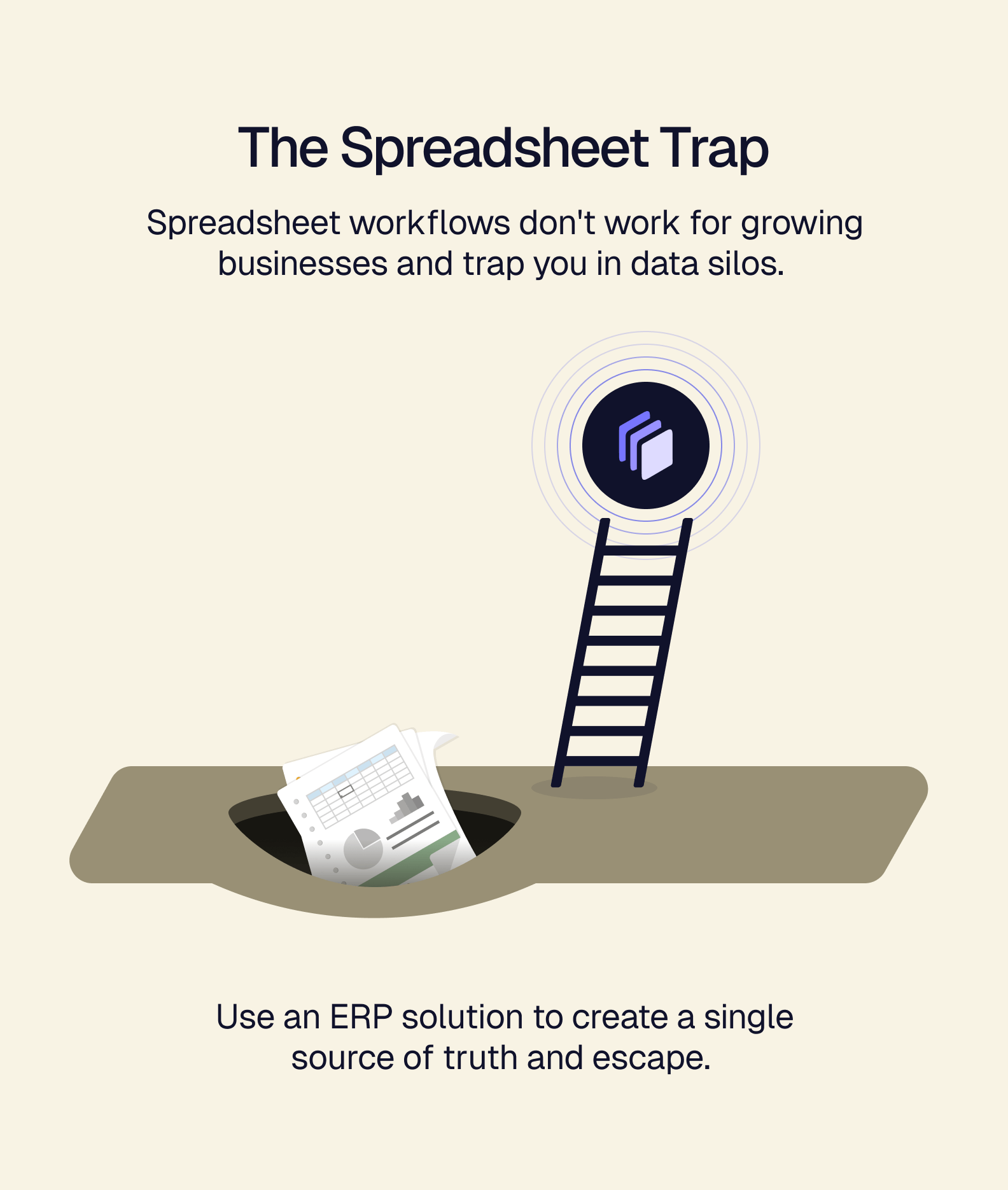
Slow, clunky, and the opposite of user friendly, building your business on the back of a spreadsheet network is a massive trap that can be difficult to escape. The solution is an ERP, but there’s a small catch:
If that ERP is a rigid ERP suite, you might find that it makes the spreadsheet problem worse.
-
Rigid UIs frustrate teams. By offering inflexible tools and user interfaces, many teams may opt to go back to spreadsheet workflows to save time — at the expense of your capital and data integrity.
-
Spreadsheet workflows need to be transposed. These new tools require your teams to learn new workflows, but often have clunkier systems — so they try to force the tools to work with the old spreadsheets networks.
The spreadsheets themselves aren’t bad, they’re just an easy crutch to return to. Thankfully, composable ERP solutions are much better for your business than spreadsheets in the long-term.
Composability and Creating a Single Source of Truth
To resolve spreadsheet woes, a business needs to figure out the best way to solve the problem that necessitates the spreadsheets in the first place. For accounting teams this is solving data silos. Accounting teams need a verifiable single source of truth in order to operate confidently. Spreadsheets were the primary way to compile this data from disconnected tools, but that doesn’t have to remain the status quo.
A composable ERP solution allows accounting teams to get a constant stream of accurate data in real-time, all in one custom interface. They can say goodbye to spreadsheets, and do their work with the certainty that their numbers are correct.
With trustworthy data, your accounting team can create strategic analysis procedures as another means to position the business for exponential growth.
The Future of ERP Accounting Software is Going Headless
Earlier, when digging into composability, it was mentioned that a core aspect was having a customized UI: this idea comes from the categorization of headless construction.
Headless basically means that your backend system (your tools, ERP, etc.) is decoupled from the “front end” or user interface. A headless ERP solution allows you to have custom UIs for your teams. This means your production team only has to see (and use) production tools, while your accounting team can focus on their tools and the real-time data they need to see.
Too often management systems allow different teams to see all the tools and data they don’t need — wading through shared storage networks can be a massive slog. By going headless, you can streamline your team’s workflows and increase your scalability by reducing tasking complexity.
When less time has to be spent on reconciling data and digging through endless files and folders, your accounting team can stay dialed in on work that matters.
Why Composable Architecture Unlocks Exponential Growth
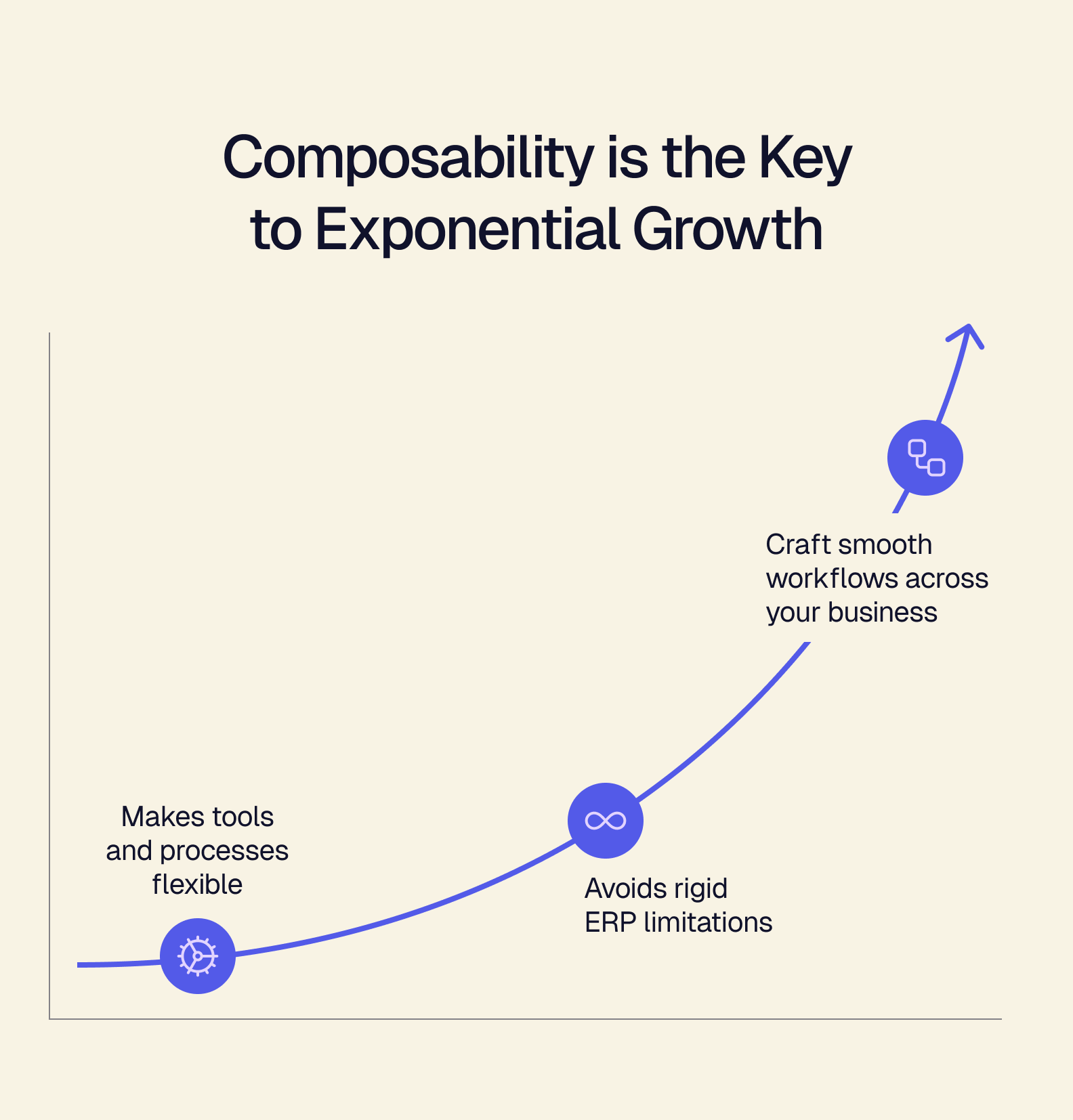
Shifting your business to a composable architecture is about more than just solving your present problems. Because you’re always driving forward, your business’s future must also be considered. The flexibility that a composable ERP accounting solution offers can:
-
Enable exponential growth. By keeping your tools and processes flexible, you can more easily seize opportunities, enter new markets, or easily pivot when things aren’t working as well as they should.
-
Avoid the pitfalls of rigid ERP solutions. When a rigid ERP breaks, it can put your entire operation on hold. But when something goes wrong with a system built with composable architecture, you can unplug the problem, fix it, and put it back in without your business screeching to a halt — making you far more agile than your competition.
-
Craft businesswide workflows. With a unified backend, you can facilitate greater sustainability and efficiency by continually improving workflows. Because rigid ERPs struggle to do this, workflows naturally grow more complicated and inefficient — a net loss for high-performance teams.
Integrate Composability into Your Accounting Toolkit
Finding the right ERP accounting software for your business doesn’t need to be hard. By focusing on composability, you can streamline your operations, maintain your favorite tools, and set your business up for exponential growth. Whether that’s by adding new product lines, creating new teams, exploring new markets, or saying yes to large retailer orders — a composable ERP is the answer.
With Tailor, you can explore an out-of-the-box, customizable solution through our headless, composable ERP, Omakase. Meaning “chef’s choice”, Omakase delivers a curated ERP solution for your business that prioritizes speed, efficiency, and enables you to get the most out of your existing tech stack.
Embrace your operational potential and book a demo with Tailor today. We can show you a composable future: one where you’re a significant player in your core markets.