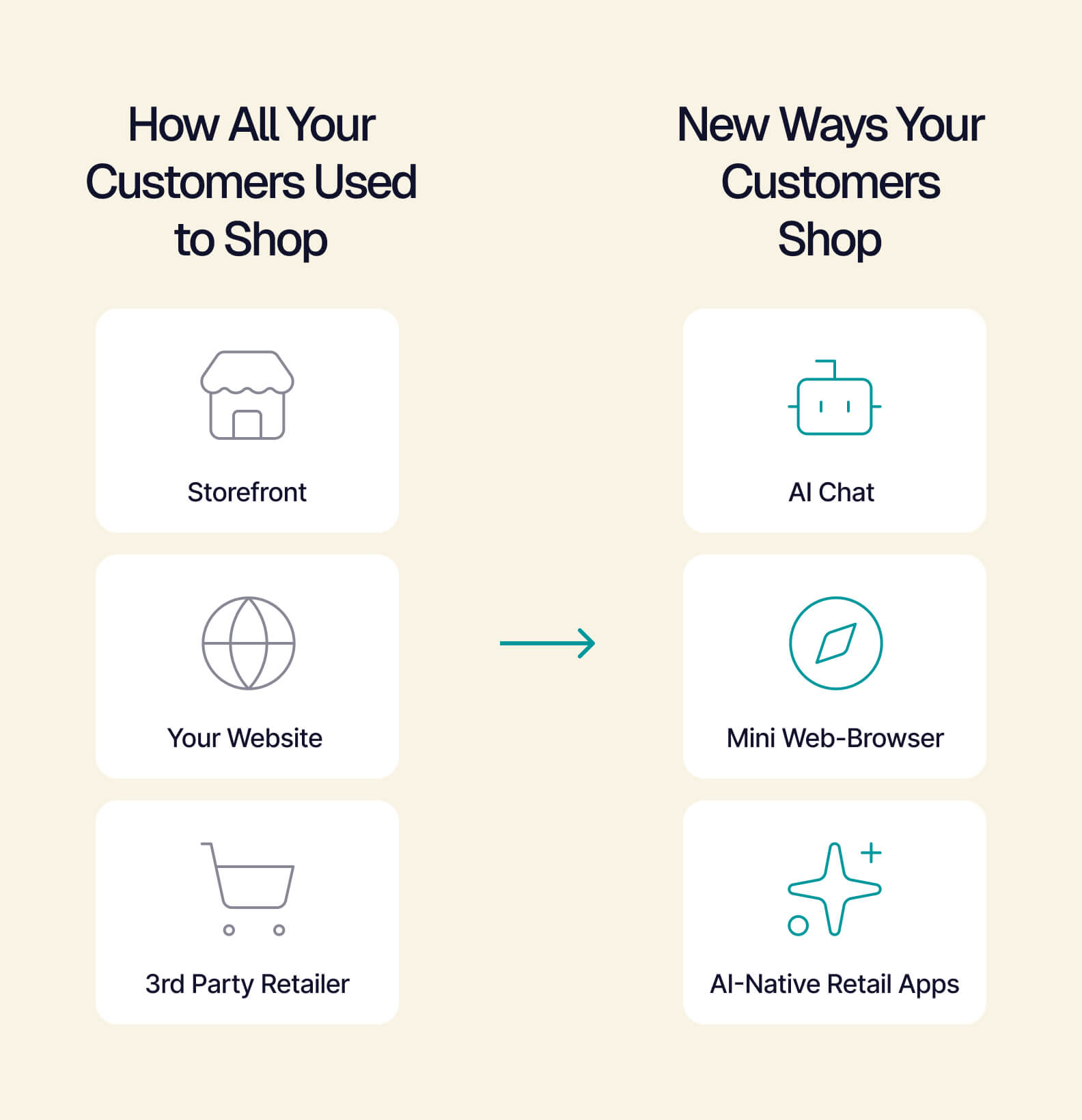
Agentic commerce is the modern evolution of the “traditional” ecommerce experience. Before AI chat, customers used to exclusively shop at your stores, websites, or retail partners, anywhere you had your products for sale. Now, shoppers can use AI chat and AI agents to shop, without ever typing in your website’s URL, navigating your catalog, or entering your checkout process.
Thankfully, it’s fairly simple to deploy agent-ready storefronts to take advantage of agentic commerce — you simply need to know the rules and have the right software necessary to support the shift.
What you’ll learn:
-
Why agentic commerce is changing how your customers shop
-
How a headless, AI-native ERP can speed up your agent-ready storefront development
-
What you’ll need to kickstart an agent-ready storefront
-
How headless architecture supports agentic commerce
How AI Chats Are Changing Ecommerce
Depending on your customer’s AI experience of choice (Gemini, Perplexity, ChatGPT, Claude, etc.), they’ll encounter different shopping interfaces — some rely on API systems to translate a website’s shopping experiences to the chat interface, others feature retailer-built apps for shopping within a chat, and a few open a mini web-browser and access your site as they normally would.
If you’re tech-minded (or in Marketing, Sales, and Ops), you may already be cringing at the wrinkle to this new convenience: purchases that happen outside your curated experience disrupt your funnels, data tracking, and customer retention strategies.
Before you panic, no, you don’t have to lose your tracking data, new customers don’t have to miss your post-purchase funnel, and you certainly don’t have to worry about fulfillment woes losing your new customer.
Here’s a high-level look at how you can shift your ecommerce strategy:
Kickstarting Your Agent-Ready Storefront: What You Should Know
Before we dig into the more technical aspects of how agent-ready storefronts, agentic commerce, and headless ERP interact, let’s take a look at a few of the key changes you’ll need to consider when developing your existing storefronts to accommodate AI agents:
1. Pretty Interfaces Won’t Woo Agents
Your store might look incredible, but there’s a chance it ends up looking like a mess to an AI agent. Brilliant graphic design and avant-garde typography choices may win over customers and solidify your brand, but these choices might steer agents in the wrong direction — frustrating your potential customer and creating a data point that may prompt that AI chat tool to not recommend your products in the future.
2. Frictionless Navigation Keeps the Ball Rolling
Designing your storefronts for human customers is always the right move, but it’s important not to get caught up in the flourishes that make a site feel great to browse — because many of the design choices made to appeal or make a site more accessible to humans are confusing for AI agents. Creating an agent-ready storefront means having a site that looks good while removing friction and barriers for agents. This may look like:
-
Implementing clean CSS and other code elements within the website that are clearly sign-posted for agents
-
Removing difficult-to-resolve pop-ups that would require human customers to enter information to proceed
-
Simplifying UX elements that follow a logical flow from adding items to cart to checking out
3. Other AI Standards to Keep in Mind
Clean code, logical UX, and peeling back design flourish are all great starts, but there are a few other AI-related standards that can make or break your agent-ready storefront:
-
Keep your copy descriptive and focused on the features of the product, making things easier for agents to parse.
-
Ensure your web developers have the right documentation available on your site, so agents know how to maneuver and whether they’re even allowed to operate for their user (these files are called llms.txt and robots.txt, respectively).
-
Ensure you have attribution fields set up so that AI agents operating through API connections deliver all the data you would usually get from a customer browsing — and making a purchase on — your site.
API Functionality is the Key to Supporting Agent-Ready Storefronts
Earlier, we touched on the need for integrating UCP and ACP protocols into your website to ensure you can support different types of AI agent interactions — but for businesses that are just starting to scale to a size where implementing agent-ready storefronts is a necessity, supporting a sudden expansion into API tools might be a bit of a shock.
This is where headless and composable tools can help. Headless software provides flexibility through a decoupled backend and frontend, allowing you to develop additional features without being limited by a set-in-stone UI. Composable modules are easily attached and detached pre-built tools that provide additional functionality to your tech stack.
Often, businesses will grow out of their early-day tech stack and feel they need to start acquiring expensive software suites — like monolithic ERPs: systems that come packaged with tools, modules, and mandatory workflows built for much larger businesses.
In this era of agentic commerce, you ought to consider choosing an AI-native ERP system that will enable you to scale by giving AI agents what they need to succeed. Tailor’s headless, composable ERP will prepare your storefronts and backend for API-powered workflows, without bogging down your budget and day-to-day operations.
Features Built with Your Future in Mind
Let’s dig into some of the ways a headless ERP like Tailor can directly enable you to build agent-ready storefronts and support operations across your company:
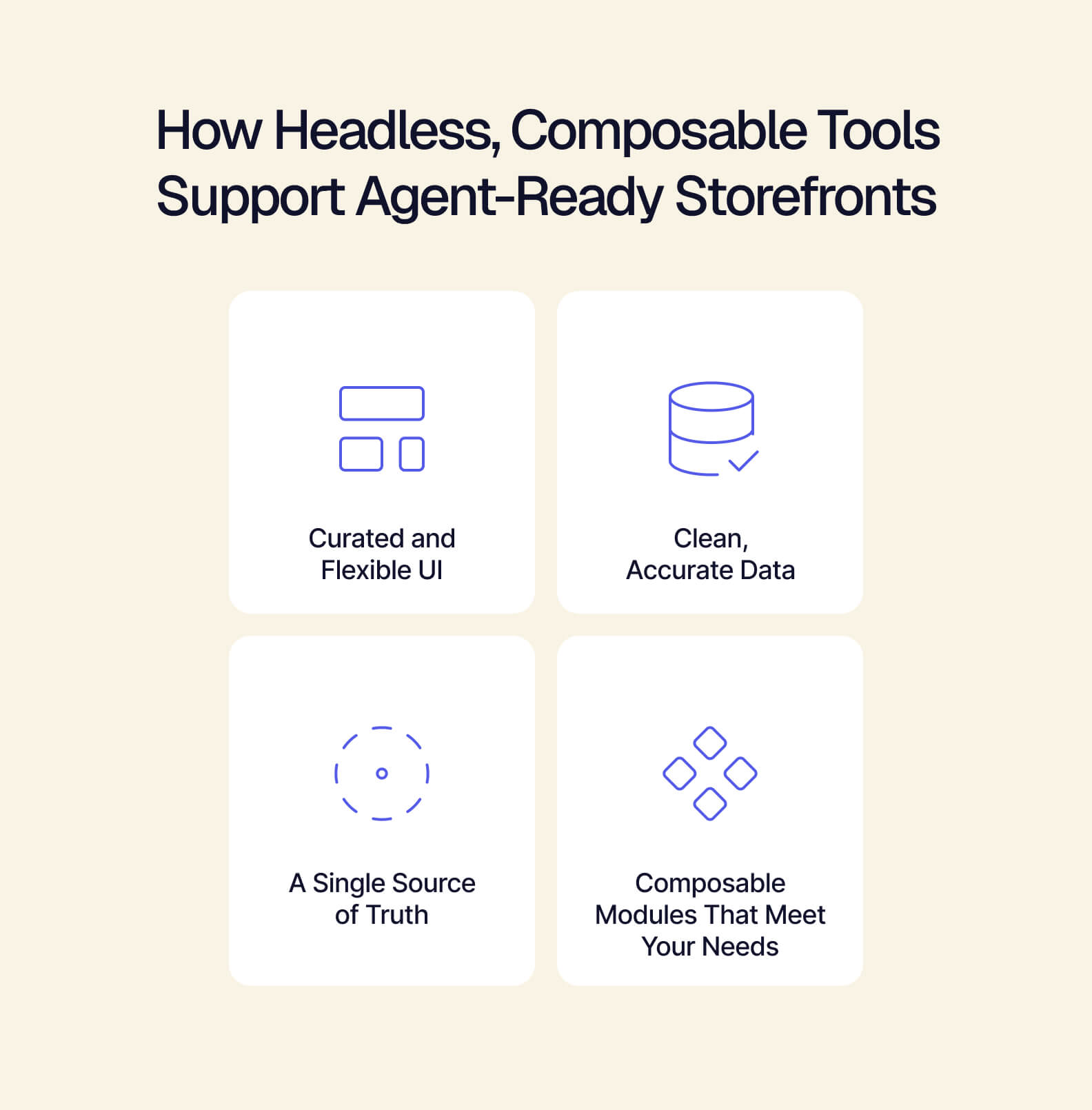
Curated and Flexible UI
Tailor features an out-of-the-box UI that’s built to help you manage your systems, without getting buried in menus. Despite being a curated experience, the UI is flexible and can be adjusted to suit your more niche needs and workflows.
Clean, Accurate Data
The quality of your data matters. If you’re trying to operate with incorrect inventory numbers, lagging reports, and manual data reconciliation, you’re going to run into data-related headaches sooner or later. A headless ERP like Tailor boosts your data management with real-time sync, automatic data reconciliation, and greater visibility across your storefronts — which keeps your data clean, accurate, and usable.
A Single Source of Truth
You need to know that every piece of data, number, and report is true and up-to-date when making critical ops decisions. Headless ERPs offer a single source of truth by bringing the data streams from your tech stack, tools, and apps into a single screen. This helps to expose silos in your business and get everyone on the same page.
Composable Modules That Meet Your Needs
Composable modules can be thought of as building blocks. Rather than being a mess of wires, your tech stack can look like a neatly-built stack of interlocking bricks — resulting in the easy removal (and addition) of new bricks, without bringing your entire business to a screeching halt when you need to replace a tool or upgrade core functionalities.
How Does All This Factor Into Agent-Ready Storefronts?
When your business is running smoothly, the effort needed to accommodate new AI standards is a breeze. By building your business around an AI-native, API-powered headless ERP, you’re already set up to build out the structure that AI agents need to access your storefronts.
How Headless Architecture Brings Agent-Ready Storefronts to Life
In this era of agentic commerce, rigidity and unnecessary complexity are massive roadblocks to creating shopping experiences for your customers. If your system, tech stack, and internal workflows are slow to change, plagued with incompatibility issues, and held together by antiquated workarounds, how are you supposed to deliver a frictionless shopping experience?
Let’s reframe the benefits of having a headless ERP to take a look at how it supports the creation of agent-ready storefronts:
-
Flexibility in your tech stack enables easy website traversal for agents, while also making it possible to offer agent-curated experiences without disrupting the way your human customers shop.
-
Clean data and accurate inventory mean agents’ shopping won’t fail due to inaccurate product availability. Plus, when you have a storefront operating with good data, you can ensure your customers get the best deals and offer more of what they love.
-
Composable modules mean you can update your storefronts quickly as new agentic commerce standards emerge. You can also quickly integrate new features to improve engagement with your customers.
Your Agent-Ready Storefronts are Just a Few Weeks Away
For many retail businesses, making an internal pivot takes months, or even quarters of planning and preparation. Making external pivots can take even longer and have more room to break. And with agent-ready storefronts being an increasingly important shift in ecommerce strategy, you can’t afford to take the rest of the year just to get ready to make the change.
In just weeks, Tailor can get your business’s backend ready for exponential scaling with better workflows, a curated UI that works for your needs, and a single source of truth that removes the friction from your day-to-day operations. This will enable you to have the infrastructure necessary to support agent-ready storefronts and deploy them with speed — catching the wave instead of being left behind.
Book a demo with us today to see how our AI-native, headless ERP can bring your ecommerce strategy into the future.