Every ERP project builds toward go-live day. For a fast-growing retail brand, however, the version of your business that you have on launch day will look very different 18 months later. By then, you might have new wholesale accounts, a TikTok Shop storefront, a second 3PL, and a bundle program that nobody planned for.
Most ERP systems treat launch as the finish line, with every change after that considered an entirely new project.
But the biggest payoff of a headless, composable ERP actually comes after launch, in how easily the system continues to adapt as the business grows. This guide shows what that looks like day-to-day.
What You’ll Learn:
-
Why composable ERP delivers its biggest value after you launch
-
Five growth moments your system can handle with ease
-
Who drives change in a composable ERP?
-
Tips for planning your composable ERP roadmap
Why Composable ERP Delivers Its Biggest Value After Go-Live
Traditional ERP is designed around a fixed launch state. Composable architecture is designed for the changes that come afterward, so its value grows the longer you use it. You don’t have to worry about keeping your business exactly the same to complement your day-one go-live.
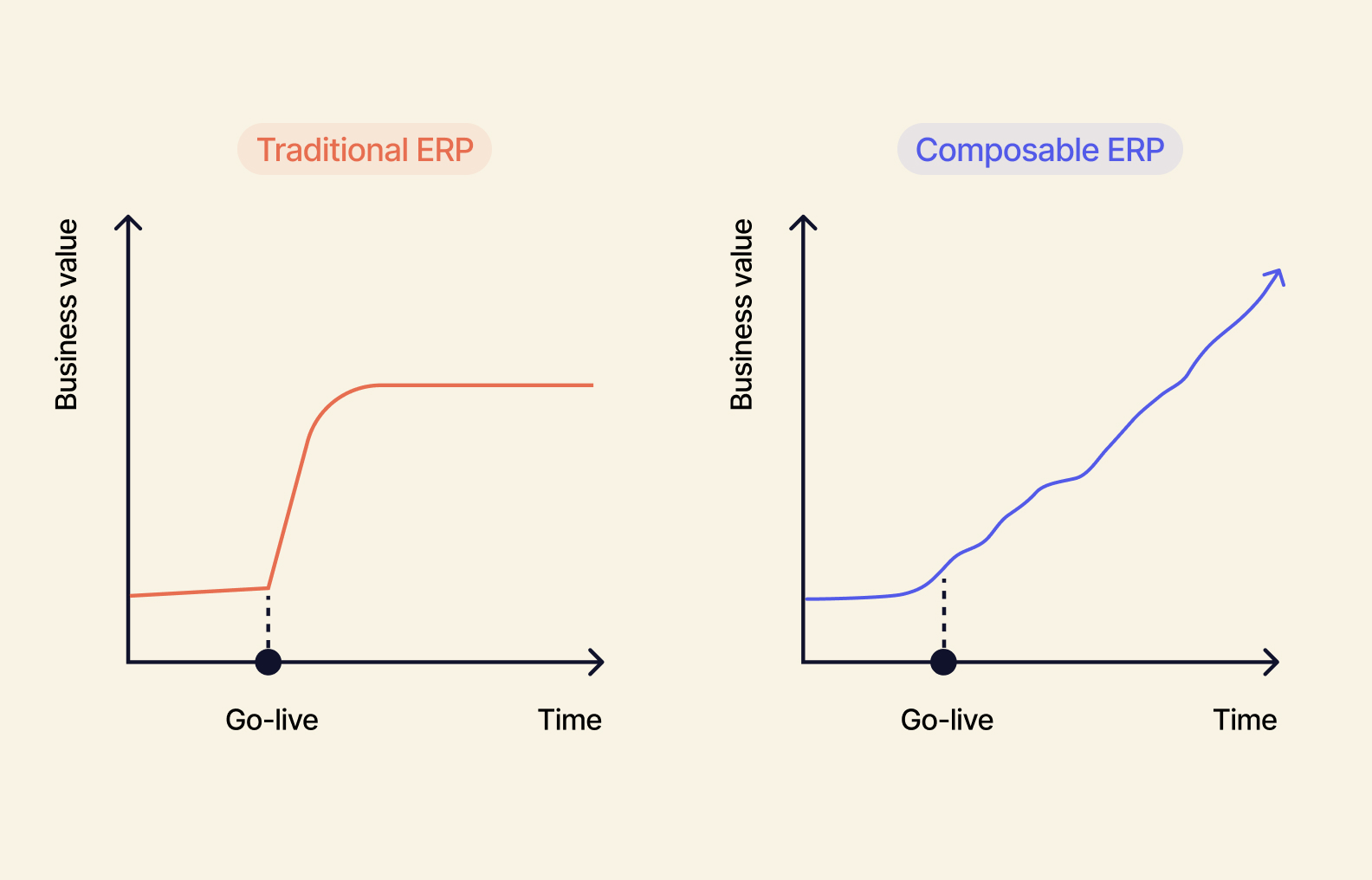
Composable ERP was defined around change. Composable ERP is a strategy for gradual, continuous value. It’s built to keep pace with business change, not deliver everything through a one-time launch.
Fixed systems get stuck. When the system’s logic and data model are fixed at launch, each new requirement turns into a change request. All of those change requests form a backlog. Teams try their best to work through that backlog with spreadsheets and manual workarounds.
For example, say a brand wants to add a wholesale price tier before an upcoming trade show. In a fixed system, that request gets added to the backlog behind several others. The team builds a spreadsheet price list to cover the gap. By next season, that spreadsheet has become the real system and the ERP no longer reflects how the business truly runs.
Composability changes the math. Because the source of truth sits upstream of everything, new tools and channels connect to the same records instead of creating their own copies. A change becomes a routine adjustment, not an entire project.
With the example above, the wholesale tier becomes a configuration on the same product records. There’s no spreadsheet and no second copy of the data. The change happens in days instead of waiting an entire season.
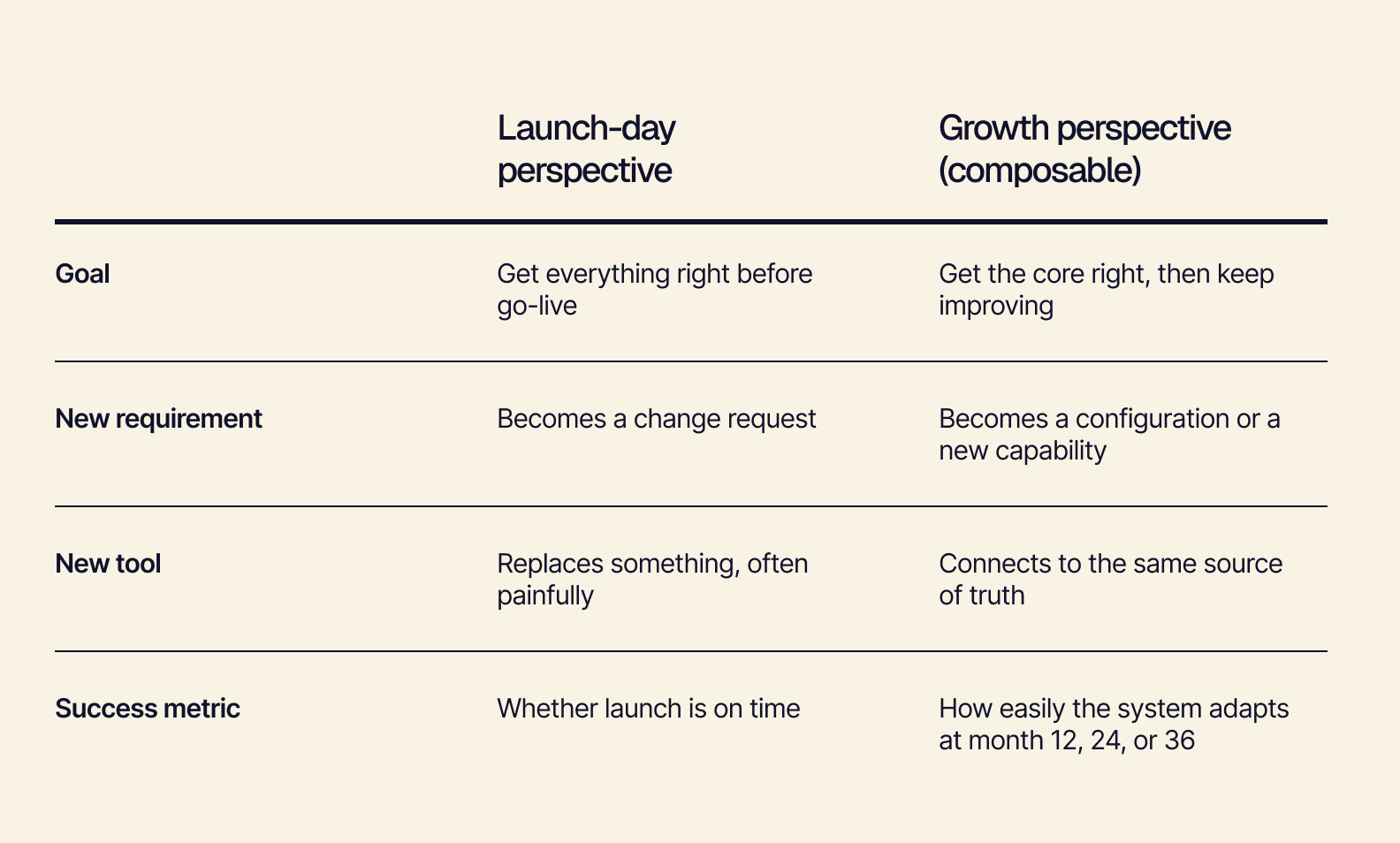
That’s why composable approaches go live in phases, split into six-week increments. This method assumes from the start that the system will keep evolving. Here’s how the two mindsets compare:
Composable ERP in Action: Five Growth Moments Your System Can Handle With Ease
A system that’s built for change reveals its true value when changes start to arrive. Here are five growth moments common among fast-growing ecommerce and omnichannel brands, and how composable ERP architecture supports each one.
Adding a New Sales Channel
With a new channel — perhaps a brand introducing wholesale — customers are appearing in more places.
-
What usually happens: Each channel keeps its own inventory and order data. This leads to oversells, manual syncs, and delayed launches.
-
What composable makes possible: With headless architecture, the new channel pulls from the same inventory, order, and product records as every other channel.
Opening a Warehouse or Switching 3PLs
Perhaps a brand outgrows its single warehouse and adds a second 3PL on the opposite coast to accelerate delivery.
-
What usually happens: Fulfillment logic is tightly tied to the ERP, so switching providers means re-implementing a large part of the system, leading brands to often stick with a 3PL that no longer fits.
-
What composable makes possible: You swap or add the fulfillment capability while the inventory record stays upstream and unchanged. Both warehouses read from and write to the same stock count.
Launching Bundles, Kits, and Personalized Products
An example is a holiday gift set made up of three existing SKUs sold as one, or an item that can be monogrammed.
-
What usually happens: A rigid data model — one that’s built for single, standard items — can’t represent a kit or a personalized variant. Teams track these items in spreadsheets and component inventory gets out of sync.
-
What composable makes possible: Bundle and kit handling, and a data model designed for retail variants and personalization. Selling one gift set, for example, automatically brings down the stock of each individual component.
Outgrowing a Tool
Outgrowing a tool is a sign that your business is scaling at a healthy pace. Maybe your helpdesk was built for 50 tickets a day, but is now handling 500.
-
What usually happens: With a tightly bundled system, replacing a single piece can mean reworking everything else. You end up dealing with a tool you’ve outgrown for longer than you should.
-
What composable makes possible: Replace the one tool that’s struggling and keep everything else.
Changing How Finance Runs
Maybe you open an international entity, or finance switches to a new accounting software as your reporting needs become more complex.
-
What usually happens: When accounting and operations are in a tightly coupled system, a finance change can also require an operations change, and vice versa.
-
What composable makes possible: Decouple your accounting from your operations. Each team can upgrade on its own schedule. Shared records keep them in agreement.
Who Drives Change in a Composable ERP?
In a headless, composable ERP, change isn’t limited to IT or an outside consultant. The people closest to the work can shape the system. AI helps and humans make the final call.
At one time, routing ERP changes through IT or through an outside consultant may have made sense. You didn’t have many changes to make, and the ones you did were risky and expensive.
But for a fast-growing brand today, the people who know what needs fixing often aren’t the people who are allowed to do it. The ops lead can see what needs to change, but the change waits in a queue for weeks — and in the meantime, the team works around the issue by building spreadsheets, which eventually become a permanent process.
-
Operators adjust rules in the system rather than requesting them. For example, an ops lead might change the backorder logic before peak season without opening a ticket.
-
Developers extend the system through documented APIs and build custom screens for specific teams. - A developer might create a simplified packing view for the warehouse team that shows only the order number, items, and shipping method. Because every screen draws from the same API, a custom view never creates a separate copy of the data.
-
Human-in-the-loop AI. With an AI-native ERP, the agent spots patterns and suggests fixes. A person makes the final decision. For example, an agent notices the same inventory exception recurring every week and drafts a rule update. The ops lead knows this is happening because of a supplier’s packaging change. They adjust and approve the agent’s draft.
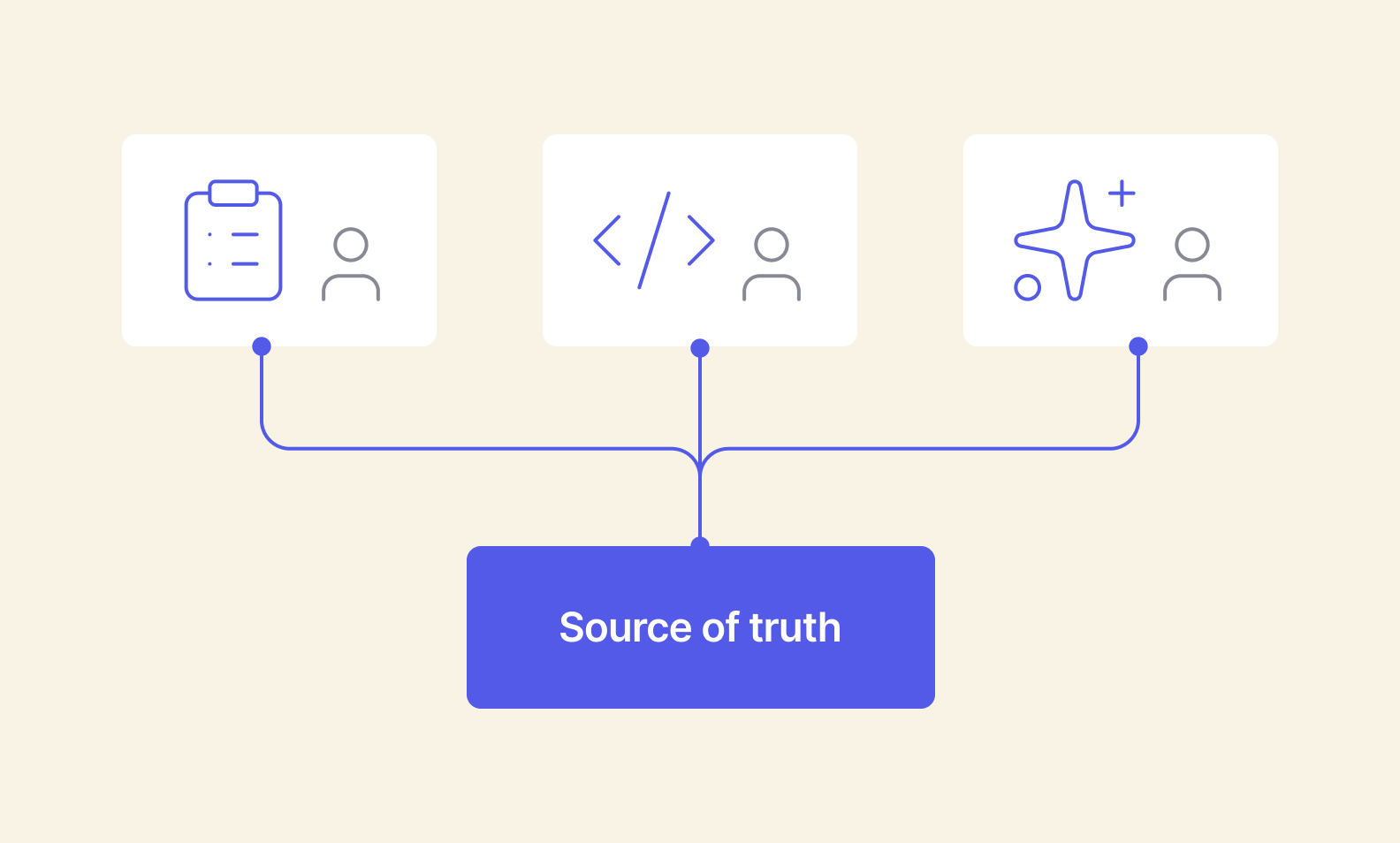
Every change is visible against a shared source of truth. This allows many people to make changes against those same shared records, avoiding chaos thanks to roles that determine who can change what. Over time, the team will become comfortable with change instead of dreading it, and you can focus on what to build next.
Planning Your Composable ERP Roadmap
A good composable ERP roadmap gets the core right first, and deliberately leaves room for growth. Here’s an example of what that might look like with Tailor — a flexible, customizable, intelligent retail operations system made for fast-growing ecommerce and omnichannel brands.
Start with the source-of-truth layer. This is made up of inventory, orders, and product data. Everything else connects to this layer, so it has to come first. Tailor uses a configurable data model designed for retail variants and personalization to create this source of truth upstream of everything and give you real-time sync across channels.
Keep what’s working. There’s no need to replace QuickBooks, Shopify, or any other tool your team already likes. Tailor runs alongside existing systems and connects to familiar tools.
Go live in phases. Launch gradually, with phased implementation in roughly six-week increments, instead of doing one big cutover at the end. Your team leads, with hands-on support from ours.
Set up a regular “recompose” check-in. The system is built to change, so be proactive and put a quarterly review on the calendar. Ask questions like:
-
What’s working well that we should leave alone?
-
Which rule changes or requests came up more than once this quarter?
-
What’s next on the growth plan — a channel, market, or product line — and what should we adjust before it happens?
-
What have customers or wholesale accounts asked for that we can’t easily offer yet?
-
Which team has outgrown its current screen or workflow?
Each check-in gives you an opportunity to further mold the system to your business and its needs.
Built for the Brand You’re Becoming
Most ERP projects are measured for success on launch day. But an ERP truly earns its value over the months and years to come. And with a composable ERP, you’ll have a steady, single source of truth able to support a brand that keeps evolving.
Book a demo to see how Tailor grows with your brand.