Like most growing retail brands, you’ve outgrown your original workflows and many of your early software integrations, like Shopify’s Grow plan or ShipStation. Because of this, you’ve started the process of transforming the operations for your stores, but walked right into an unavoidable snag:
Your rigid system architecture is getting in the way.
You need to add new tools and remove some old ones, but the way they’re integrated into your system is messy and tangled. It’s just not possible to complete this transformation without grinding your processes to a halt.
But you don’t have to stay stuck. With the right tools, you can unpause your processes and complete your retail operations transformation.
What you’ll learn from this blog:
-
How to get unstuck from your transformational pause
-
What you need to speed up your software integrations
-
Why headless, composable software is necessary to complete your transformation
-
How rigid system architecture is holding back your retail brand
Stuck on Pause: Why Your Software Integrations Are Taking Too Long
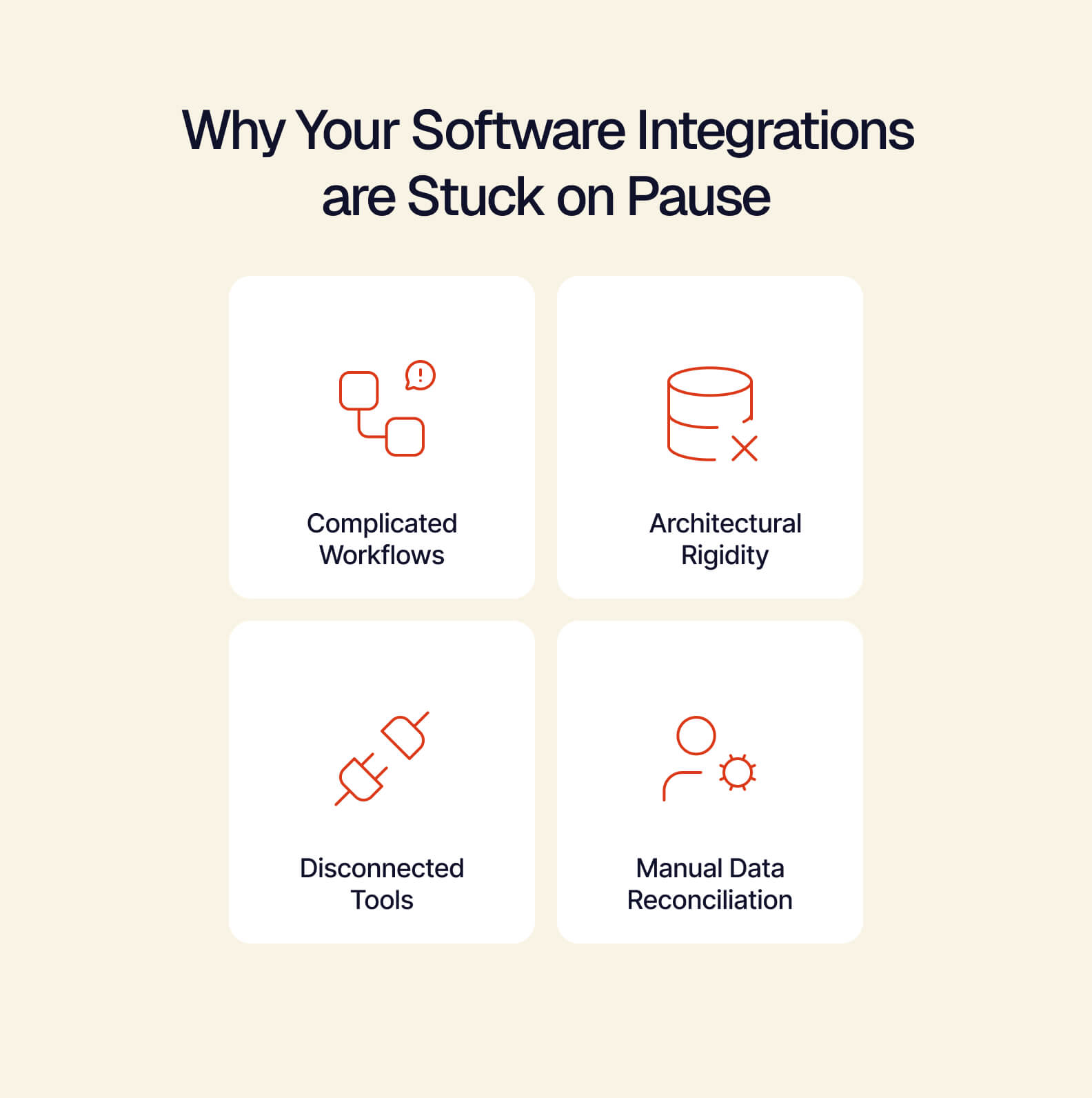
Your software integrations may be slowed down by a few different factors that are difficult to control unless you know how to identify them early:
-
Complicated workflows. Complicated workflows result in workarounds that get increasingly unclear and inefficient as you add more tools to your system.
-
Architectural rigidity. Architectural rigidity limits the types of solutions you can add to your tech stack to solve problems and makes those integrations increasingly difficult.
-
Disconnected tools. Disconnected tools lead to patchwork solution-seeking that bolts on features, making your reactions to market changes sluggish.
-
Manual data reconciliation. When your data can’t be kept as a single source of truth, your ops team spends far more time reconciling numbers, instead of putting them to work.
How to temporarily solve these problems varies from brand to brand.
However, to permanently solve them, you will need to rebuild your architecture with headless, composable software. This will help you eliminate workflow complexity, connect your tools, help data get where it needs to go, and give your system the flexibility it needs.
Rigid Software Baggage
Retail brands often wonder why things are going wrong, especially when operations are running smoothly at first. But as they’ve scaled, they’ve run into both hardcoded roadblocks and unintended limits of their chosen software.
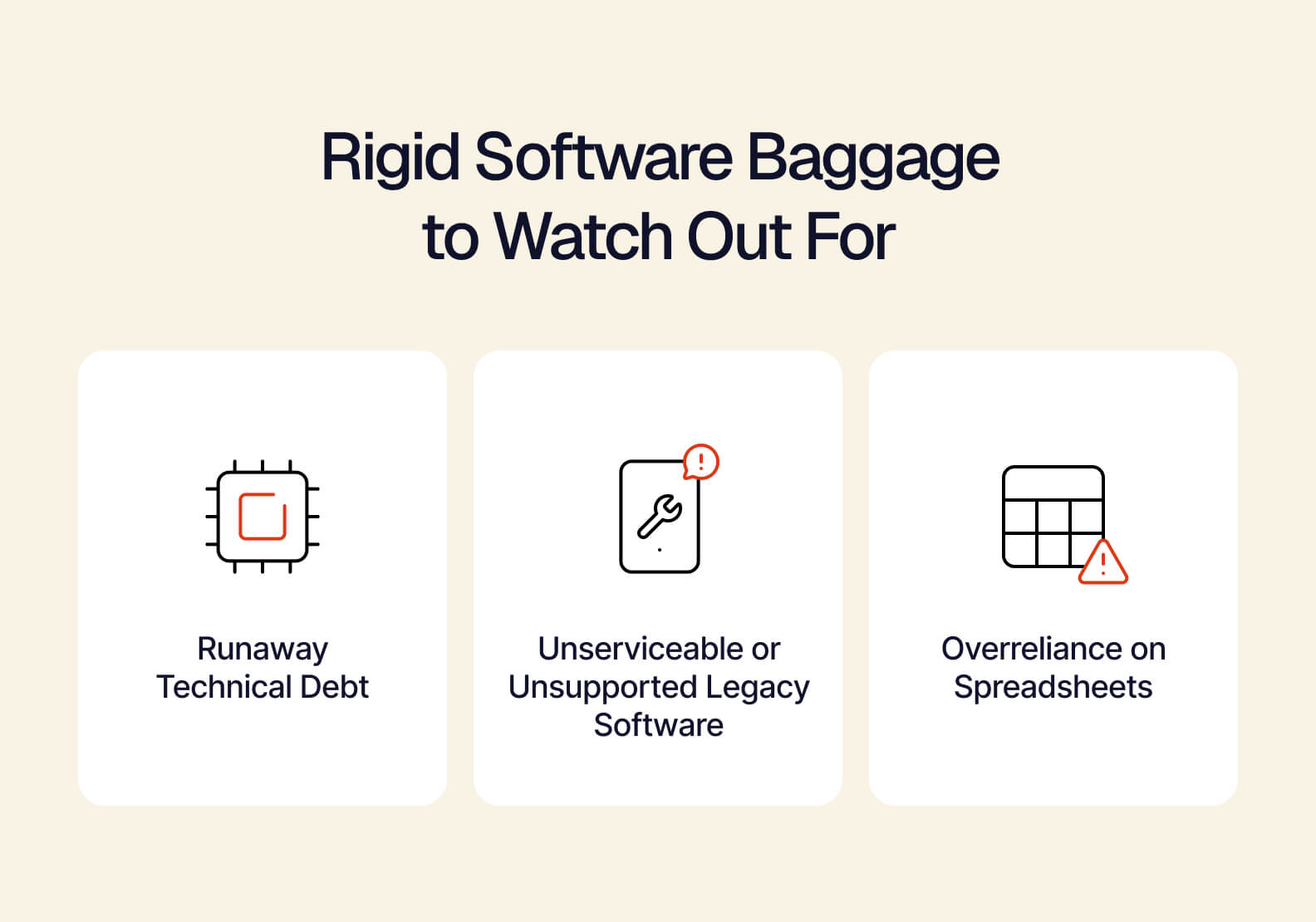
When you know the right questions to ask and which features to actually look for to achieve long-term stability, you can address the roadblocks from the start. And while this guide will help you going forward, you still need to address your rigid software baggage. This comes in three forms.
Runaway Technical Debt
The first source of baggage for brands that rely on rigid software is the persistence of technical debt (and its tendency to continually grow and get worse every time there’s an update). Technical debt arises from a few sources:
-
Workarounds that circumvent necessary software functions or avoid triggering bugs that can’t be fixed.
-
Bolting on functionality to a system that doesn’t technically support that feature, or performing tasks the software wasn’t meant to.
-
Bad updates that can’t be rolled back without severe operational disruption, which leads to building on that update.
Unserviceable or Unsupported Legacy Software
Alongside technical debt is an issue that many scaling retail brands encounter: a necessary (often legacy) software reaches “end of service”, leading to it no longer getting updates from its vendor. Now, you’re left in a situation where you need to find technical support to try and deliver custom patches, or continue to operate, knowing the software’s performance will continuously degrade as time goes on.
Overreliance on Spreadsheets
Spreadsheets can be the source of a lot of operational strife. Of course, they’re rather handy for keeping data, processes, and certain workflows organized and functioning. However, they’re often pushed beyond their intended uses. This leads to workflows breaking, incorrect data flowing into your system, and unnecessary frustrations for your ops team.
Your System Isn't Prepared for Transformation
With all this baggage comes a secondary roadblock for transforming your retail store operations: your system just isn’t prepared for it. You wouldn’t go for an 8-mile mountain hike without plenty of gear, fluids, and food to support the journey — so you shouldn’t try to transform your operations without a similar level of architectural support.
How do you achieve this? You support your system with headless, composable tools and modules, or ERP integration. Shifting your system to be headless and composable addresses many of your potential pain points:
-
Headless architecture is designed to decouple your backend and frontend, leading to easier implementation of new tools, without being limited by the UI and UX of your system. This can immediately simplify your complicated workflows by removing a core reason for why they exist in the first place. This change can also make it possible to bring your most important data into a single screen, so you don’t have to use spreadsheets to track what’s happening in your business.
-
Composable (or modular) tool design helps you seamlessly add new features to your system without them feeling bolted-on, awkward, or prone to breaking. By making your system modular, you reduce its rigidity and make it easy to connect your software so they can directly work together, instead of relying on ad-hoc workflows.
How Headless, Composable Software Shortens Integration Timelines
The goal of integrating new software solutions is to solve operational problems. Unfortunately, most retail brands’ integration timelines end up causing even more frustration — which can easily turn into a firefighting emergency. You need to be able to integrate key software quickly — you can’t afford 6 months to get a solution in place for a problem that could spiral out of control at any time.
However, catastrophically long integrations and disrupted budgets are worst-case scenarios. Here’s a more likely picture of what happens with slow integration timelines:
-
Non-emergency problems build up bad habits (or annoying workarounds), causing persistent operational difficulties.
-
You miss opportunities to move into new markets because your system needs an upgrade to handle the change.
-
You’re working through a lengthy integration to solve one problem, while market conditions create a new problem that your current integration won’t solve.
So what can you do to speed up your software integration to properly achieve a transformation of your retail store operations? Change your architecture and lean into modular design.
Architecture Improvements Reshape Your Foundation
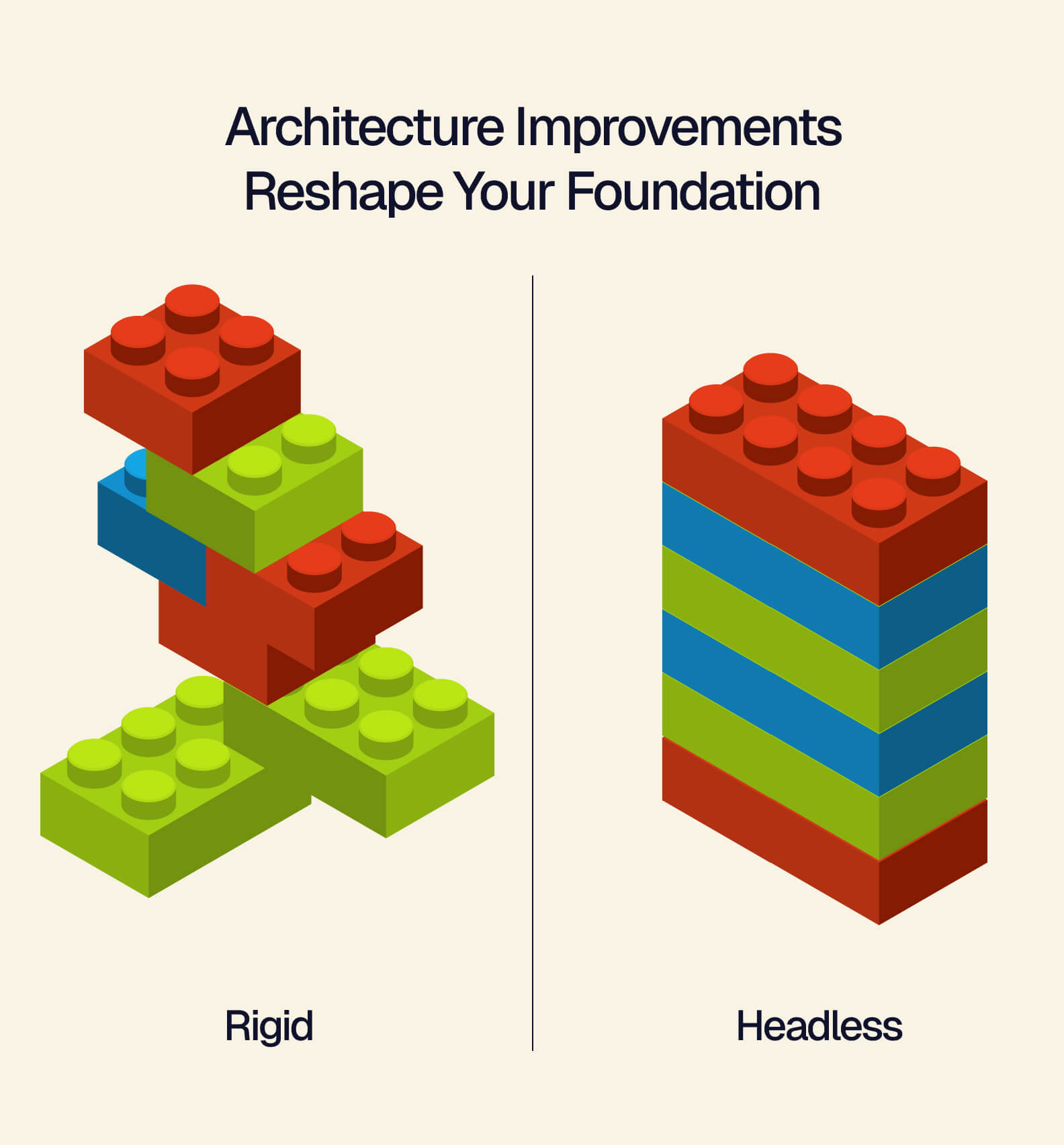
When we think about software integration, it’s important to consider it as a foundation. With a rigid architecture, you’re often trying to build on something messy and convoluted. Because there’s little room to work, it’s difficult to figure out how to add to the tangle of connections, software, and workflows.
Rather than trying to integrate software under those conditions, it makes sense to clear away your foundation — but this isn’t going to look like starting from scratch. Instead, you would untangle the wires, keep the software and workflows that actually work for your retail brand, and connect them into a headless, composable system. This will reshape your system foundation by:
-
Providing your business with a flexible, adaptable system that can add new connections via API, or integrate software into your tech stack in weeks, not months.
-
Acting as a single source of truth for all your data, creating more sustainable workflows, and providing your business with a steady flow of numbers you can trust.
-
Adding inherent modularity to your tech stack, allowing for the easy plugging and unplugging of your software and tools — avoiding costly rip-and-replace cycles.
Modular Design Reduces Friction
One of the core issues with slow integration times (and something that headless, composable ERP can speed up) is the amount of friction that it can cause in your day-to-day operations. This friction can cause collateral damage like all-hands-on-deck emergencies and system downtime — which can be prevented by leaning into modular design.
With a headless, composable system like Tailor, you can reduce integration friction by directly removing the bloat of your tech stack. Rather than having to work around antiquated software or app suites that require finicky workarounds to avoid triggering bugs, a modular system allows you to directly plug new tools into the heart of your system (like an ERP).
This avoids a few different friction points:
-
You don’t have to consider pass-through connections to make new tools work.
-
You can add any tool you want, even API-enabled or AI-native solutions, rather than choosing from a small list of known compatible software.
-
If something isn’t working, you can easily service your system, or disable software that needs to be fixed — without shutting down your entire system.
Rigid Software vs. Headless, Composable ERP
You can use the following table as a quick way to reference the differences between rigid software and headless, composable ERP, with a focus on how each might impact your operational transformation process.
Transform Your Retail Store Operations
Better operations start at the source: your system architecture. If your tech stack is a mess, how can you improve it to enable transformation at the store level? The retailers who win in these market conditions prioritize composability and flexibility, which makes the transformation of retail operations possible.
If you’re ready to make the change, consider choosing Tailor’s headless, composable ERP as your starting place. Its headless architecture, composable design, and pre-built user interface set you up to transform your operations, without locking you into a suite of mandatory software integrations or poorly designed UI/UX.
Transform your retail operations by booking a demo with Tailor today.