Quickbooks. Shopify. Klaviyo. Salesforce. You're managing a whole list of tools that each perform a separate function to help keep your business running.
But none of these platforms "talk" to each other. Your data lives in siloes. You might find yourself trying to make decisions based on competing data — which is nearly impossible — or dealing with compounding errors.
Manual work eats up your employees' time. Meanwhile, your customers are experiencing this friction as refunds and lost trust. And ultimately, your business isn't able to scale.
You need to get your ERP integrations right. But not all ERP integration models are alike — and choosing the right one makes all the difference in whether you'll see the chaos-free growth you're aiming for.
Ready to learn how to get there? Here's what a unified backend can unlock for your business.
What You'll Learn
-
What ERP integrations are (and why they matter)
-
How ERP integration works
-
ERP integration vs. unification
-
The composable integration model: What changes when your backend is unified first
-
What a unified backend unlocks for your business
What ERP Integrations Are (And Why They Matter)
ERP integration connects your business systems so data flows automatically, eliminating manual work and creating one source of truth.
Application Programming Interfaces (APIs) or Integration Platforms as a Service (iPaaS) enable your ERP to communicate with your other software, like your CRM, ecommerce, or finance. ERP integration also introduces automation to reduce errors and give employees time for higher-value work.
By integrating your ERP system, you'll be able to enjoy benefits such as:
-
Improved productivity and operational efficiency
-
Reduced errors
-
Real-time visibility and data
-
Faster, more confident decision-making
-
Cost savings
For companies running on 10+ tools, ERP integrations really aren't a choice: It's a must-have. It's critical that your tools work together. Integration is what enables growth, making complexity manageable through consistent data, real-time decisions, and a reduced error risk.
How ERP Integrations Work
There are multiple technical approaches to integration, each with different tradeoffs.
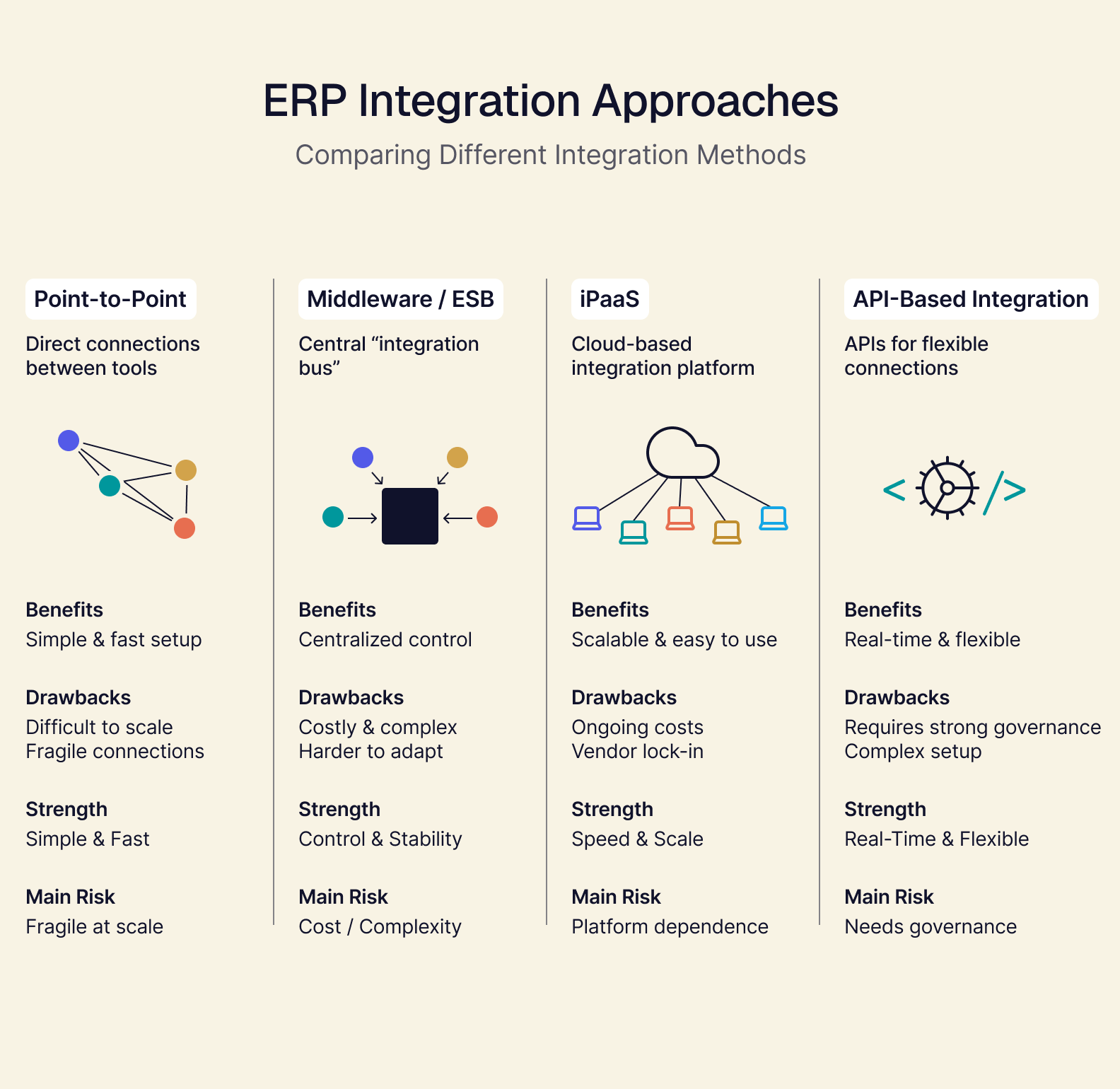
Point-to-point integration
Point-to-point creates direct connections between tools, with each separate connection maintained using a custom script. This is a quick, affordable option for low-complexity environments. But it's hard to monitor and doesn't scale.
Middleware and ESB
An Enterprise Service Bus (ESB) is like a central hub: Every other tool connects to the ESB, which handles all of the data. While this approach can provide support for complex legacy environments, it's expensive and specialized to maintain.
iPaaS
iPaaS is a cloud-based integration layer that manages data flow. Systems connect to the iPaaS. SaaS businesses looking for an agile option might benefit from iPaaS integration. But the approach is limited, specifically around custom logic and vendor lock-in.
API-Based Integration
API integrations can be point-to-point, managed via middleware, or orchestrated through an iPaaS. Whatever the case, APIs control your data — what's shared and how it's accessed. This method needs strong design, governance, and security. But it's more flexible and modular, enabling a scalable architecture.
ERP Integration vs. Unification
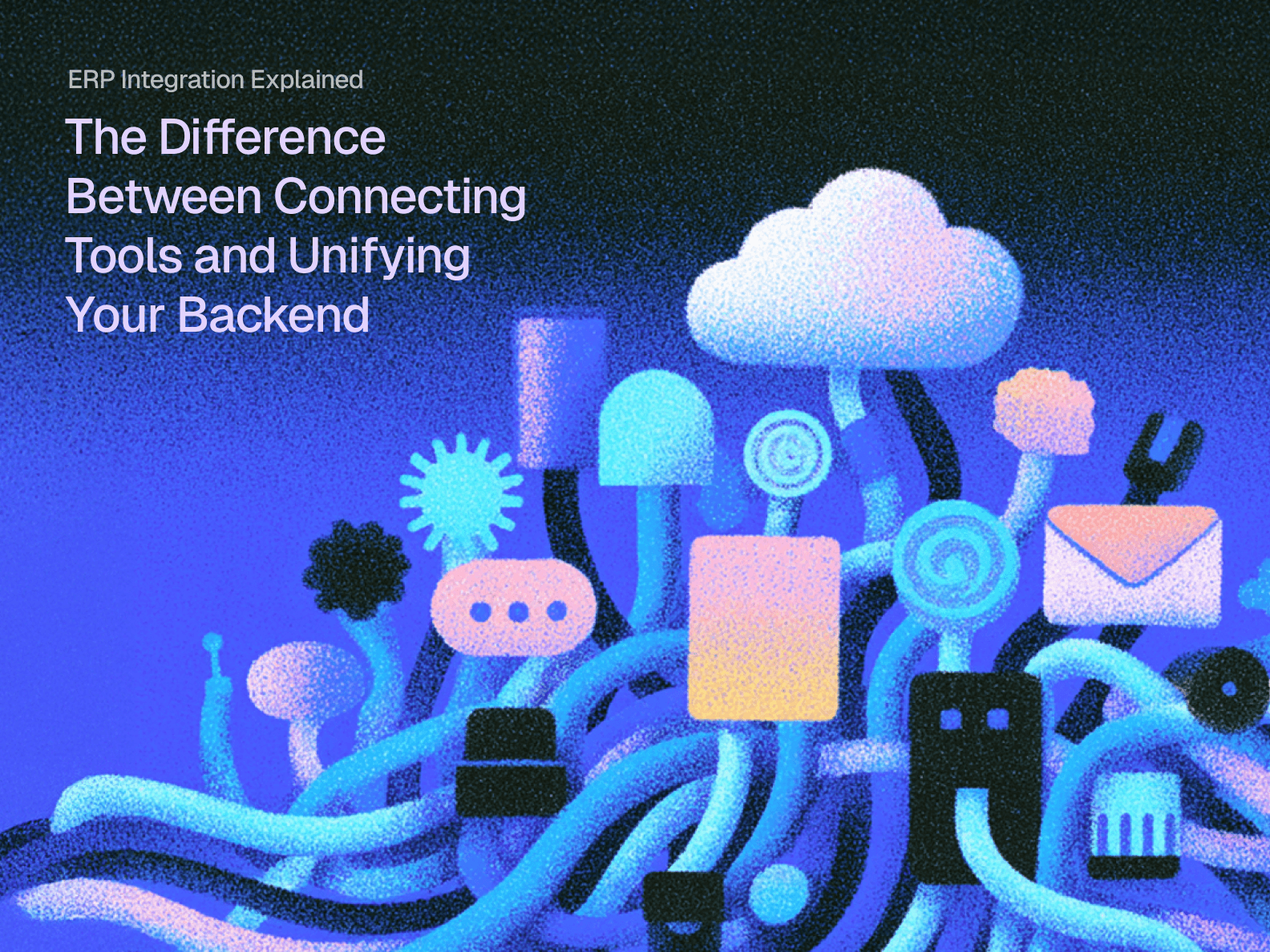
Most integration strategies share a major downfall: They connect tools to each other instead of unifying the backend.
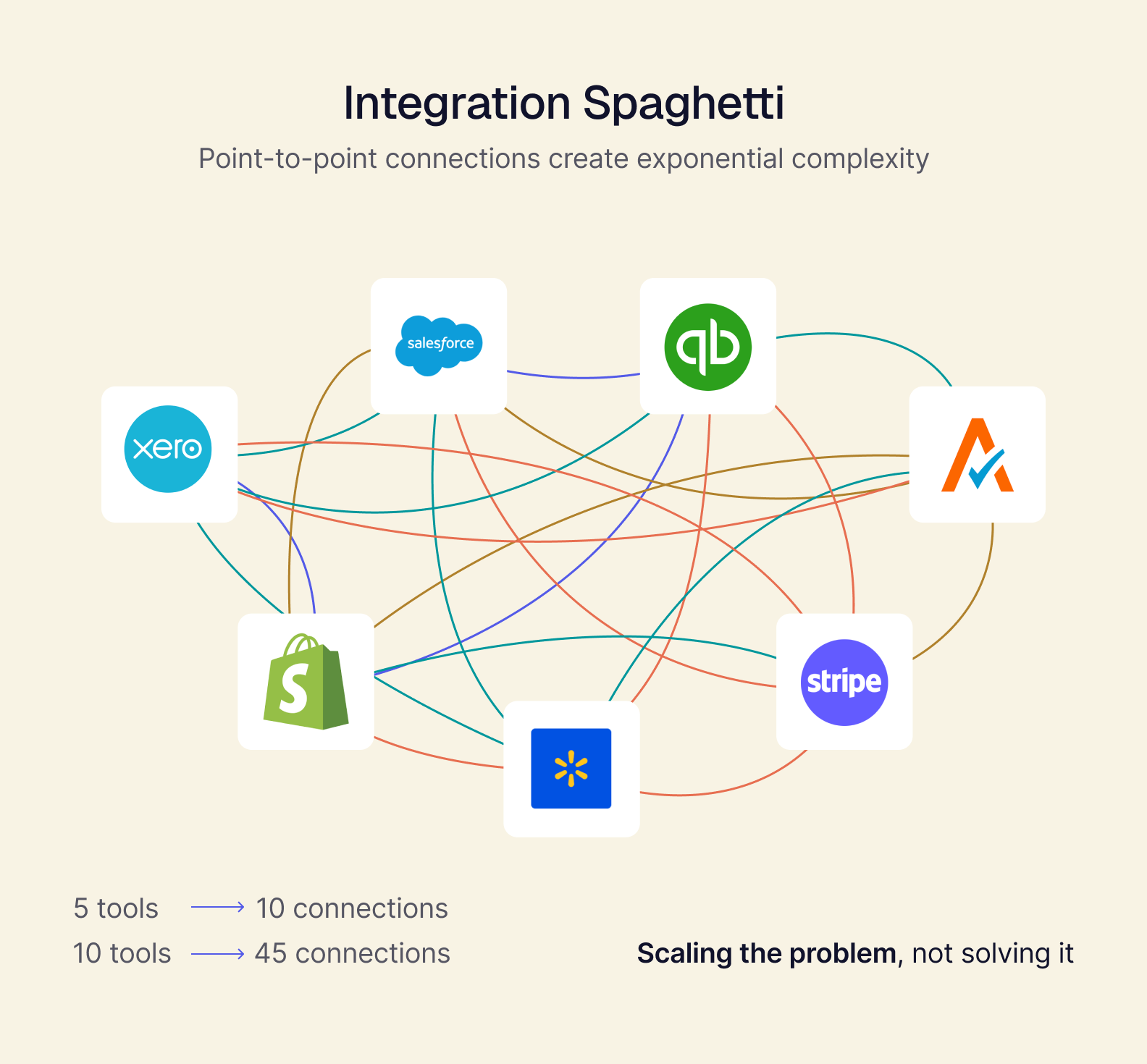
Connecting tools point-to-point creates exponential complexity, or "integration spaghetti." Each new tool multiplies your integration points (5 tools = 10 connections, 10 tools = 45 connections). You're scaling the problem, not solving it.
Ultimately, this means that every approach will fail at scale.
A unified backend approach is what makes composable ERP different from traditional integration.
Common ERP Integration Challenges
With ERP integration, businesses often face challenges with data mapping, maintenance burden, or fragile dependencies. When every system represents data differently, you're going to deal with inconsistent reports and dashboards you can't trust. What's more, point-to-point connections come with a heavy maintenance load since every connection is managed independently. And when systems depend on each other in specific sequences, failures can easily domino.
Integration debt also comes with a cost. When problems aren't addressed, the result is manual reconciliation, delayed decisions, and team friction when you attempt to scale.
The good news? There's a better model: a unified backend.
The Composable Integration Model: What Changes When Your Backend Is Unified First
A composable ERP integration model changes the entire architecture of your system. Instead of connecting tools to each other, connect them all to one unified backend — a single source of truth.
With this approach, complexity doesn't multiply with every new tool you add. Now, you're able to keep your existing tools knowing complexity will stay linear. Your ERP is the system of coordination (centralized business rules, standard APIs for data exchange, etc.) and all front-end applications are interchangeable. This allows you to:
Data mapping only needs to happen once. And if one tool fails, it won't affect the others.
No more integration spaghetti. Instead, think of composable integration like lasagna: structured layers, clear boundaries, and much easier to maintain as you scale.
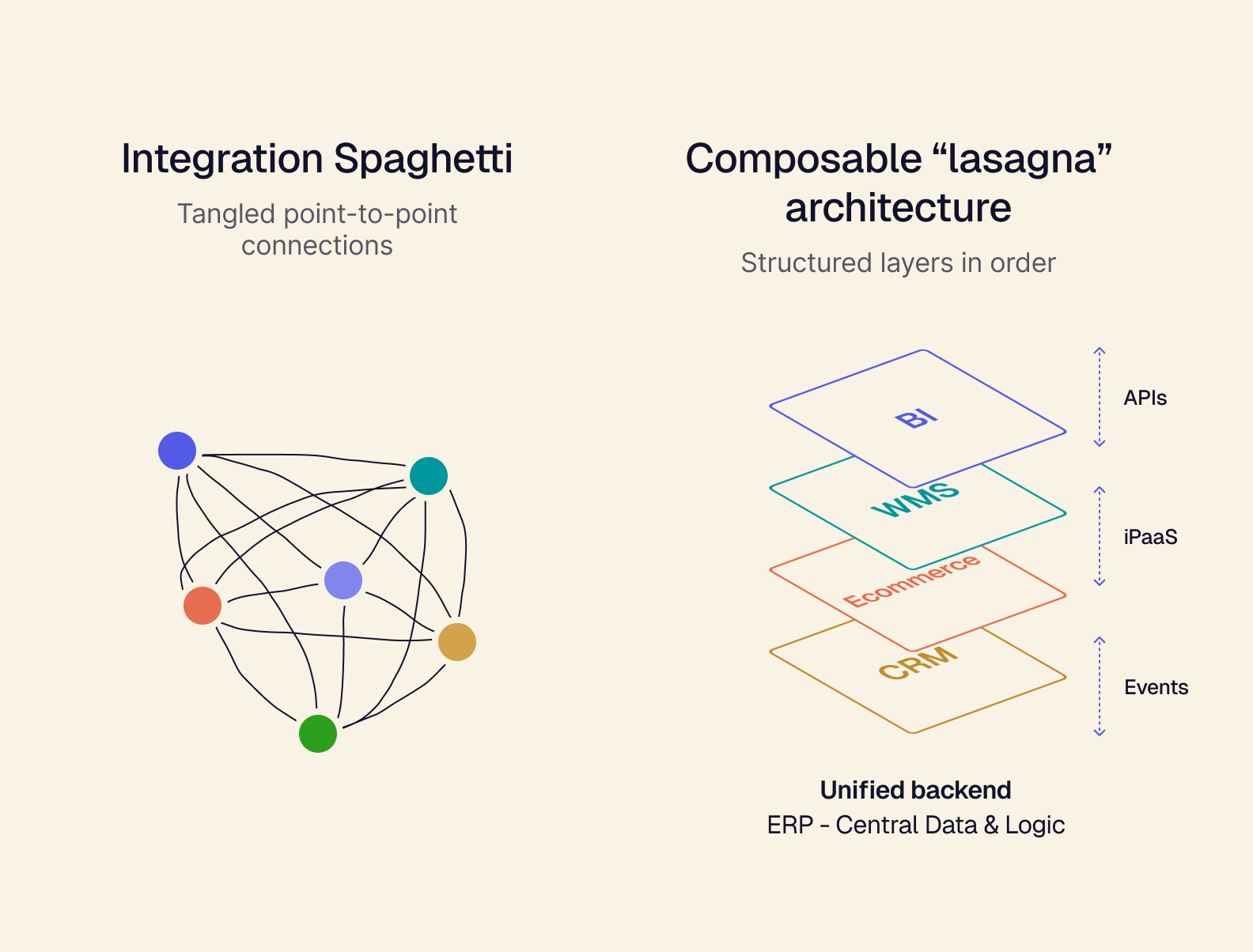
A headless + composable backend creates unified business logic with cross-system visibility. It allows you the flexibility to create tailored experiences for any team, channel, or customer.
The term "headless" simply means the frontend is decoupled from the backend. Once your backend is unified as a single source of truth across all systems, you can build any frontend on top. For example, create a dashboard that pulls from Shopify, QuickBooks, and ShipStation in one view. Since the backend isn't tied to the frontend, there's no chance it will break.
A headless ERP is flexible, consistent, and agile — all the things you need to effectively scale your business.
What a Unified Backend Unlocks for Your Business
When your tools share a unified backend instead of fragile point-to-point connections, you'll unlock the revenue growth blocked by tool chaos. Now, you have one source of truth — no more manual reconciliations trying to figure out which number is correct.
There won't be any complex rip-and-replace migrations, either: Your tools stay put, and a composable ERP integration model like Tailor's unifies them. Plus, implementation happens in mere weeks, not the 12-18 month nightmares of traditional ERP.
A unified backend enables you to move forward with initiatives like:
-
Adding five new sales channels (without also needing five new ops people)
-
Making confident decisions at scale thanks to consistent, quality data
-
Finally greenlighting that wholesale channel that's been on hold for 18 months
Whatever's on your docket, you can accomplish it with a composable, headless backend helping you unlock growth at scale.
Next Steps
No more chaos. No more spaghetti. It's time to unify.
Book a demo to see how Tailor unifies your existing tools without rip-and-replace. Or learn more about ERP integration and composable ERP architecture.
With a unified backend, you have the freedom and agility to achieve growth like never before.