Composable ERP Definition: What It Is, Real Examples, and Why It Matters for Your Business
If you're researching ERP systems, you've probably seen the term "composable ERP" popping up everywhere. But depending on who you ask, the composable ERP definition can be complex, vague, or full of buzzwords that really don't mean anything at all.
In reality, composable ERP is more than just a different software architecture. It's an entirely new way of designing your business — one that enables constant change. Your composable ERP is the layer of technology that lets you execute a composable business.
In this article, you'll learn about these nuances, what they look like in the real world, and whether a composable ERP is the right choice for your business right now.
What You'll Learn
- Composable ERP definition: What it actually means
- Composable ERP vs. composable business architecture
- The "why" behind composable ERP
- What composable ERP looks like in practice
- How to evaluate composable vs. traditional ERP
- The composable spectrum: Implementing little by little
- What composable ERP unlocks
Composable ERP Definition: What It Actually Means
A composable ERP is the system layer that enables a modular, change-ready business architecture by giving you the freedom to assemble, swap, and evolve system components without rebuilding core operations.
With traditional ERPs, everything comes bundled together. But a composable ERP connects only the tools you choose, using a unified data layer to centralize data from distributed tools.
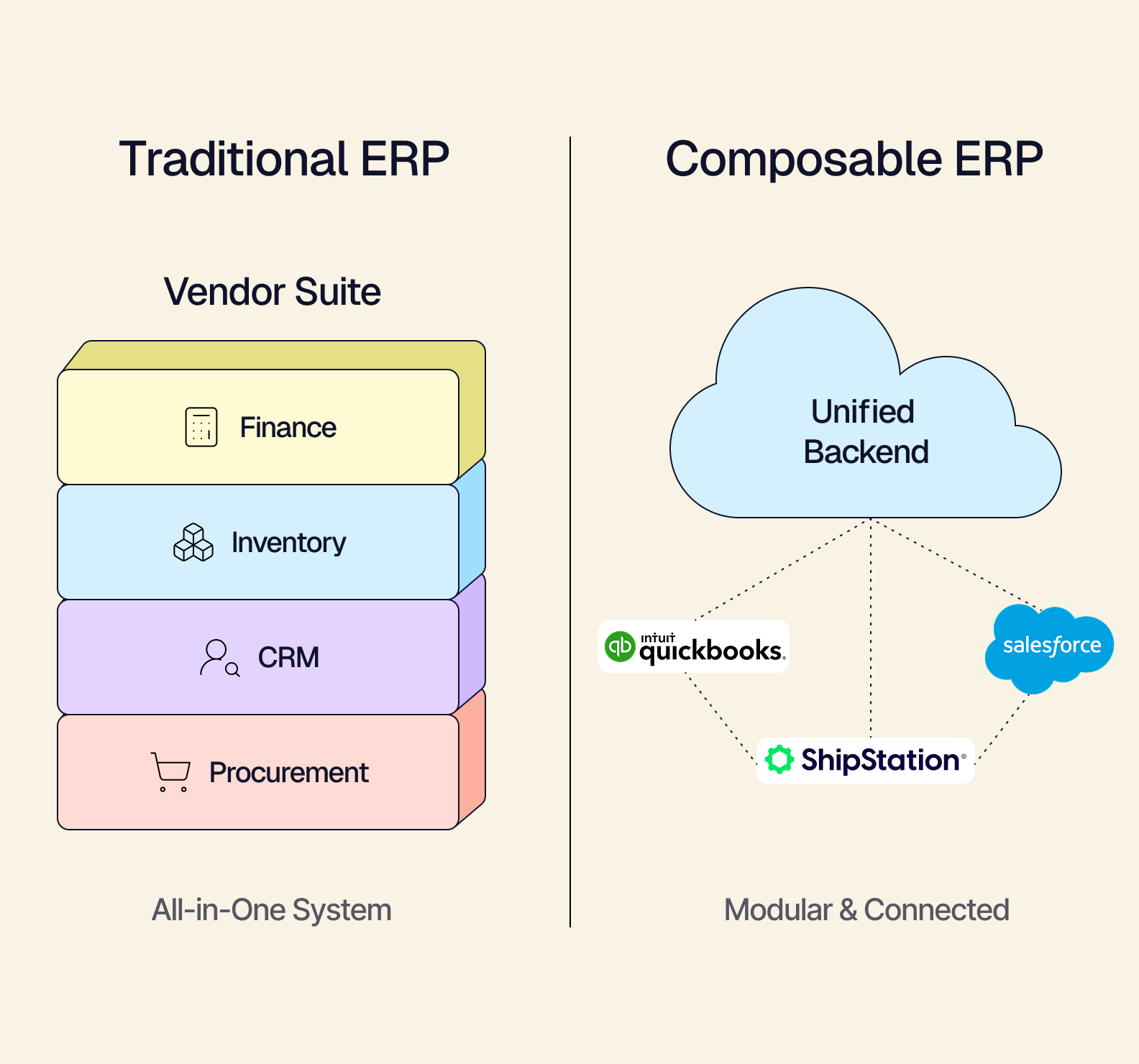
Thanks to API-first connectivity, you benefit from:
- Modularity. If you outgrow QuickBooks, move to NetSuite without disturbing the rest of your system.
- Interoperability. Interoperable systems share data and logic in standardized ways, helping strengthen dependencies and data flow.
- Flexibility. Adjust workflows or reconfigure processes, with no replatforming or data migration needed.
Tailor enables composable ERP by providing a unified backend that connects tools already in use.
But composable ERP is more than just a different integration model. If we zoom out, it demonstrates a much larger change in how to think about business design from the ground up.
Composable ERP vs. Composable Business Architecture
Your composable ERP isn't your strategy. It's the execution layer.
- Composable business architecture is how a company is designed to respond to change.
- Composable ERP is the system that gets that architecture up and running.
With continual changes in technology, business models, and consumer expectations, The Wall Street Journal has called disruption "the only constant" (Succeeding in a World Where Disruption is The Only Constant, The Transformation Imperative). But responding to disruption by simply returning to the status quo won't help your growth.
Composable businesses look at disruption as an opportunity. They use composable thinking, composable business architecture, and composable technology to create a business model that lets them respond to disruption with defense (learning, adapting, improving) or offense (unlocking new growth).
Think of this as dynamic recomposition — the ability to rapidly re-assemble processes, tools, data, and workflows when something changes. Maybe you acquire 200 new stores or add a new sales channel.
And a technology layer like Tailor — something that's headless and API-first, with a unified backend that lets you swap components whenever you want — is what enables you to continuously recompose.
The "Why" Behind Composable ERP
Most composable ERP definitions don't account for change.
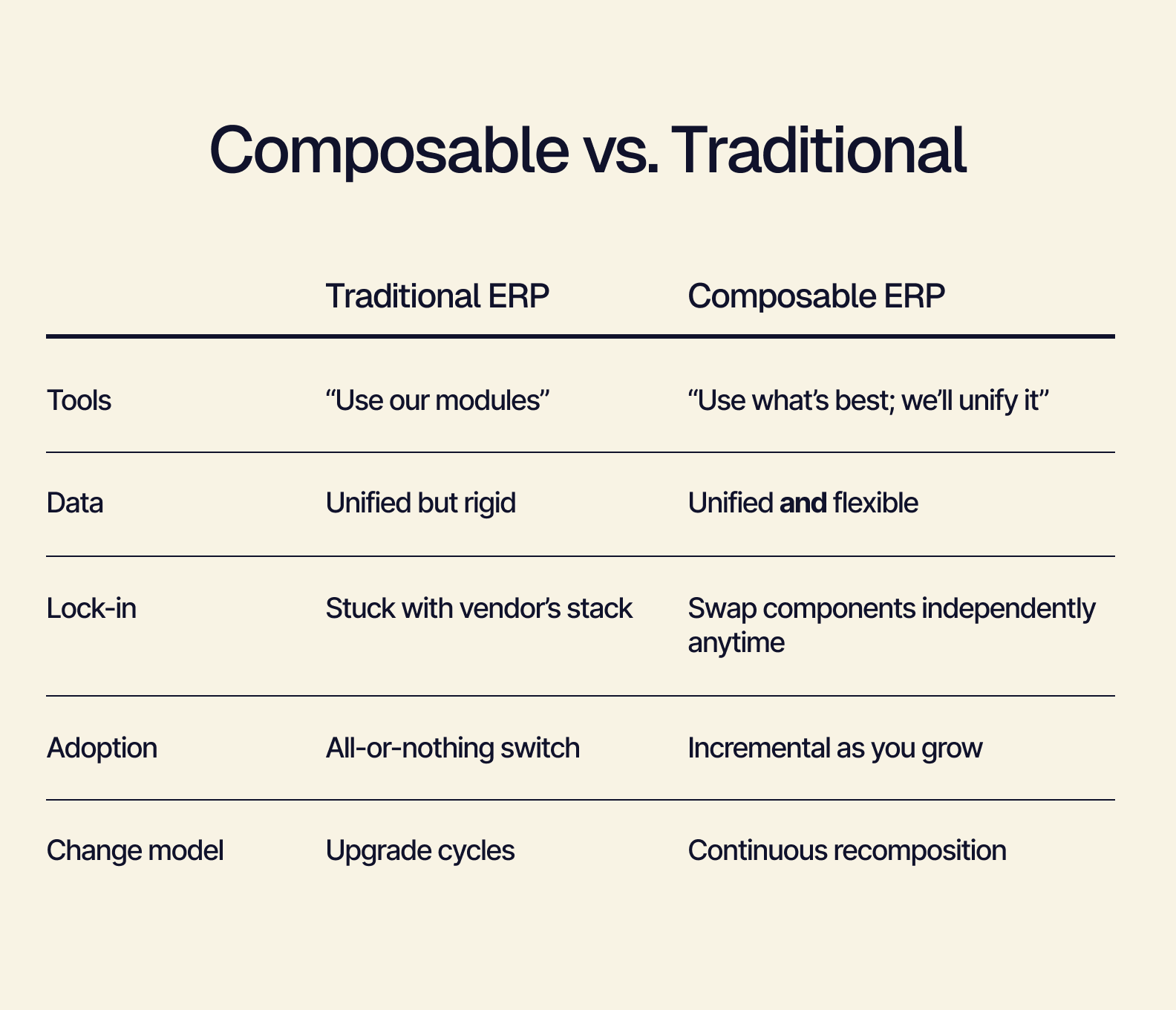
Composable ERP exists because static systems break down when disruption or change becomes constant. When your tools, workflows, or business model need to evolve, traditional ERPs — which were designed for stability, not ongoing recomposition — aren't going to keep up.
Traditional ERP and composable ERP are designed to answer two fundamentally different questions.
- Traditional ERP asks: "Which vendor's suite should we adopt?"
- Composable ERP asks: "Which tool is best for each job, and how do we unify them?"
When you're locked into a vendor's suite and forced to use their tools, any and all change will be risky, slow, and expensive. Composable ERP reduces the risk. It lets you evolve parts of your system without having to completely rebuild.
What Composable ERP Looks Like in Practice
How does this change-ready architecture actually play out in the real world? Take a look at this before-and-after example.
-
Before (with traditional ERP): Your team uses QuickBooks for accounting, ShipStation for fulfillment, and Salesforce for CRM. With a traditional ERP, you'd have to replace all three tools using its modules. The result: a complex 12-18 month migration, team-wide retraining, and a loss of tools people know.
-
After (dynamic recomposition): With a composable ERP, you'd be able to keep QuickBooks, ShipStation, and Salesforce as Tailor connected the three tools into one unified backend. Implementation would be complete in just weeks. Your team would keep working in familiar tools, but have one source of truth across everything. You experienced change without disruption, and evolution without replatforming. This is what composability looks like.
The composable difference:
- Keep the tools your team already knows
- Enjoy unified data without forced migration
- Swap tools independently, without breaking the rest
How to Evaluate Composable vs. Traditional ERP
That's how composable ERP works. Is it the best choice for your business, right now? Here's a helpful checklist of questions to run through:
- Do we have tools our team loves that we don't want to replace?
- Have we been burned by vendor lock-in before?
- Do we need the ability to modernize systems little-by-little?
- Are we currently using spreadsheets or Airtable for operations that need to scale?
- Do we expect our workflows to evolve as our business grows?
- Are we operating in an environment where change is constant?
If you answered "yes" to the majority of these questions (three or more), composable ERP is likely a good fit for you.
If you want a composable backend but need a frontend fast, Tailor Omakase gives you both: pre-configured modules that are ready in weeks, yet remain fully customizable as needs evolve.
The Composable Spectrum: Implementing Little By Little
Composable isn't an on-and-off switch. It's something you build toward, not something that happens overnight.
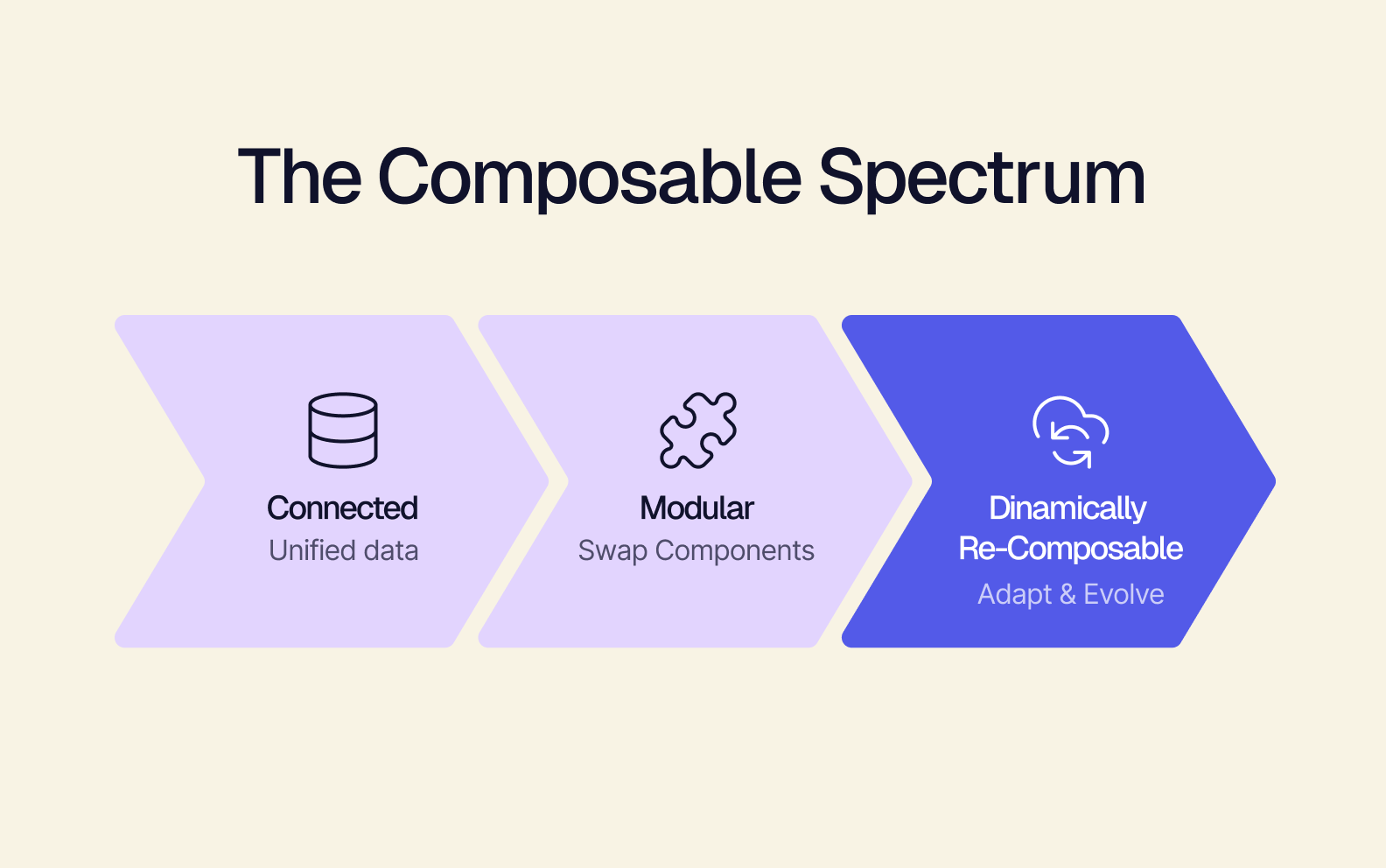
Most companies start by initially connecting their best tools, then adding independent components incrementally as needs emerge. For example:
-
Start with what you have — Connect QuickBooks and ShipStation into unified data. Keep working in tools your team knows.
-
Add as needs emerge — Need better operations visibility? Add Tailor Omakase's pre-built modules for procurement, sales, inventory, and manufacturing.
-
Swap when it makes sense — Outgrow QuickBooks? Switch to NetSuite. Your data stays unified — no migration project necessary.
Incremental matters because you don't have to deal with a risky, 18-month bet-the-company project. Your team can adapt gradually without rebuilding, not all at once. Even small composable investments help improve your resilience to change and ability to recompose. And you're never locked in — components can change as your business evolves because you've designed for change.
What Composable ERP Unlocks
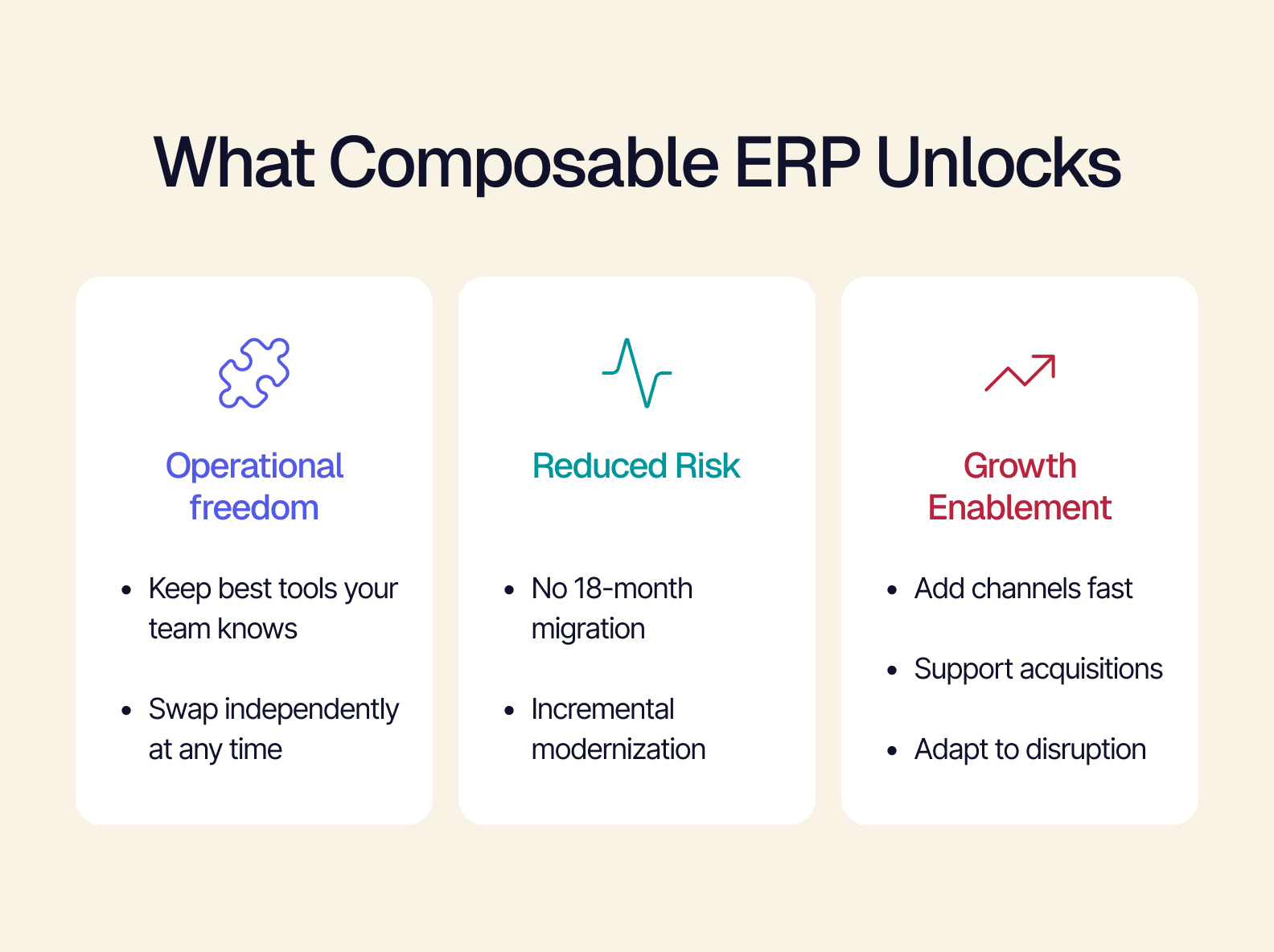
Composable ERP lets you master the capability for change. By keeping your best tools and unifying data, you can:
- Upgrade infrastructure without betting the company on 18-month migration
- Keep tools your team knows while gaining enterprise-grade unified data
- Change components as your business evolves — no vendor lock-in
Composable ERP is about designing a business that can turn disruption into opportunity, over and over and over again.
Want to see what composable ERP looks like in practice? Learn about Tailor Omakase, the pre-built composable ERP experience. Or book a demo to see how Tailor connects your existing tools.