Retailers spend an entire quarter solving a visibility problem. Then a tariff shock exposes a sourcing problem, and a peak-season spike exposes a fulfillment problem. Each of these problems get treated like a brand-new fire that needs a fresh (and often expensive) fix.
But most retail supply chain challenges aren’t actually separate problems, showing up in whichever system happens to be under the most stress at the time. Fixing the symptom in front of you simply results in it resurfacing somewhere else a few months later, because the fix never actually addressed the core issue.
In this guide, you’ll learn why the standard fixes never quite stick and where to start if you’re rebuilding your foundation after constantly fighting fires.
What you'll learn:
-
The cause of common retail supply chain challenges
-
Why these supply chain challenges keep coming back
-
What changes with a composable, AI-native ERP
-
Where to start rebuilding
Common Retail Supply Chain Challenges
You likely have firsthand knowledge of demand shifts and complex sourcing. But before jumping into causes and solutions, let’s run through a quick refresher. Here’s the shortlist of retail supply chain challenges, and how teams typically address them:
Each “fix” in the right-hand column is nothing more than a bandage that only treats a symptom where it showed up. None of those fixes address why the symptom keeps appearing somewhere new.
Why These Supply Chain Challenges Keep Coming Back
When the same problems keep coming back over and over, it’s not bad luck. It’s your architecture.
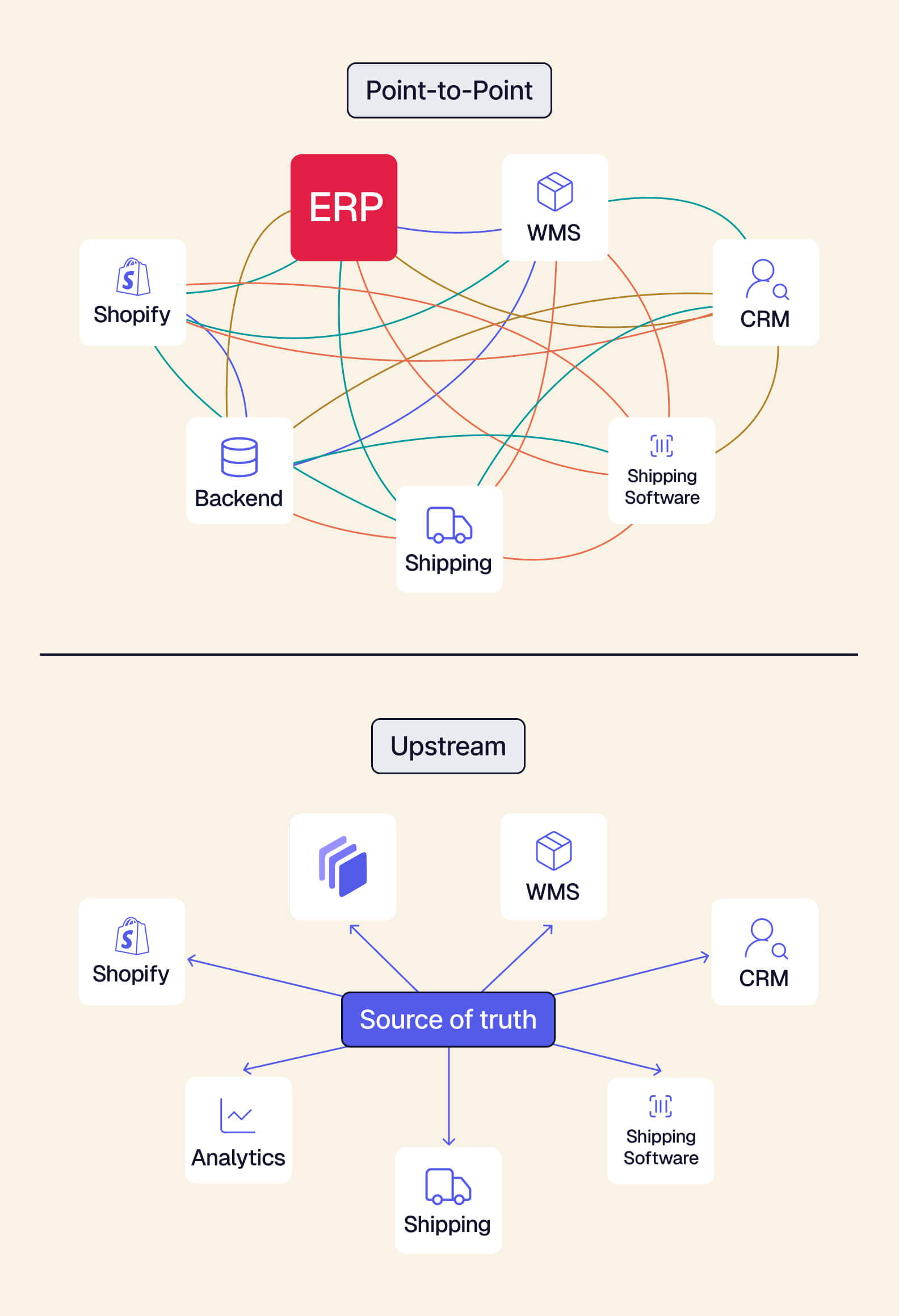
Most retail stacks are collections of systems bolted together point-to-point. Instead of extending a shared foundation, every new integration, channel, or vendor adds another brittle connection. There are two types of architectures that tend to enable these problems:
Point-to-point integrations: When systems aren’t built on a shared foundation, you have to build a direct link between each pair to connect them (ERP to WMS, WMS to OMS, ERP to OMS, and so forth). Each connection is built and maintained separately, and the number of connections you have multiplies much faster than your number of systems. Worse, each system has its own copy of data — its own partial version of the truth. As a result, no one place reflects what’s actually happening and every disruption requires manual reconciliation before anyone can decide what to do.
Monolithic: All-in-one systems bundle accounting, inventory, and fulfillment logic together. With everything interdependent, changing one element (even in a small way) risks breaking something else. This drives teams to delay changes and upgrades because they’re nervous about destabilizing the system. The business can’t move and scale at the speed it otherwise would be.
Retailers need a single source of truth and independent, swappable (also known as composable) systems. The way to get there? Position your source of truth upstream of everything. Instead of each system syncing its version of the data with the others, a single authoritative layer sits upstream, and every other system reads from and writes to that layer. An upstream source of truth solves the problem at the architecture level.
What Changes With a Composable, AI-Native ERP
This is what a composable, AI-native ERP, like Tailor, actually changes when it’s built this way from the ground up.
Decouple Accounting From Operations
In a monolithic system, accounting and operational logic are fused. Decoupling separates the two, allowing them to become independent layers that share data through the upstream source of truth — rather than being built on top of each other. If you need to make a change to fulfillment logic (such as adding a new pickup method or adjusting how returns are processed), you no longer risk touching the general ledger.
Best-in-Breed, Not All-in-One
Because the source of truth lives upstream (vs. being inside any one application), you can independently swap, add, or remove individual systems. Nothing has to be ripped out and replaced wholesale, because nothing was ever welded to anything else in the first place.
The Screen Is One Manifestation of the API
If the operational logic and data live in an API layer rather than being locked inside a specific application's interface, then any front-end — a dashboard, a mobile app, a new sales channel, or an AI agent — is just one way of viewing and acting on that same underlying system. Building a new channel or interface doesn’t mean re-platforming. It means building a new “view” on top of infrastructure that already exists. With a headless, composable ERP like Tailor, you get an out-of-the-box UI that can bring all your tools into a single screen using APIs — showing you exactly what you need, and leaving out what you don’t.
Human-in-the-Loop
AI-native means agents can read live, accurate data and act on it when needed, flagging a reorder or adjusting an allocation. But it doesn’t mean the system is fully autonomous. Humans can still review decisions, seeing what the AI agent is proposing (and why) and stepping in before it executes.
Where to Start Rebuilding
Start by asking which system has the most conflicting or duplicated data flowing through it. For most retailers, that’s inventory or order data. Starting there fixes the problem that’s currently causing the most daily friction.
Next, keep what works and remove the “duct tape.” There’s no need to rip out every system at once; a WMS that’s working fine can stay in place and connect to the upstream layer while you address whatever is actually broken.
With an ERP like Tailor, a realistic timeline for implementation can look like features going live in weeks, with phased go-lives, instead of a single cutover at the end. Your team will take the lead with hands-on support from ours.
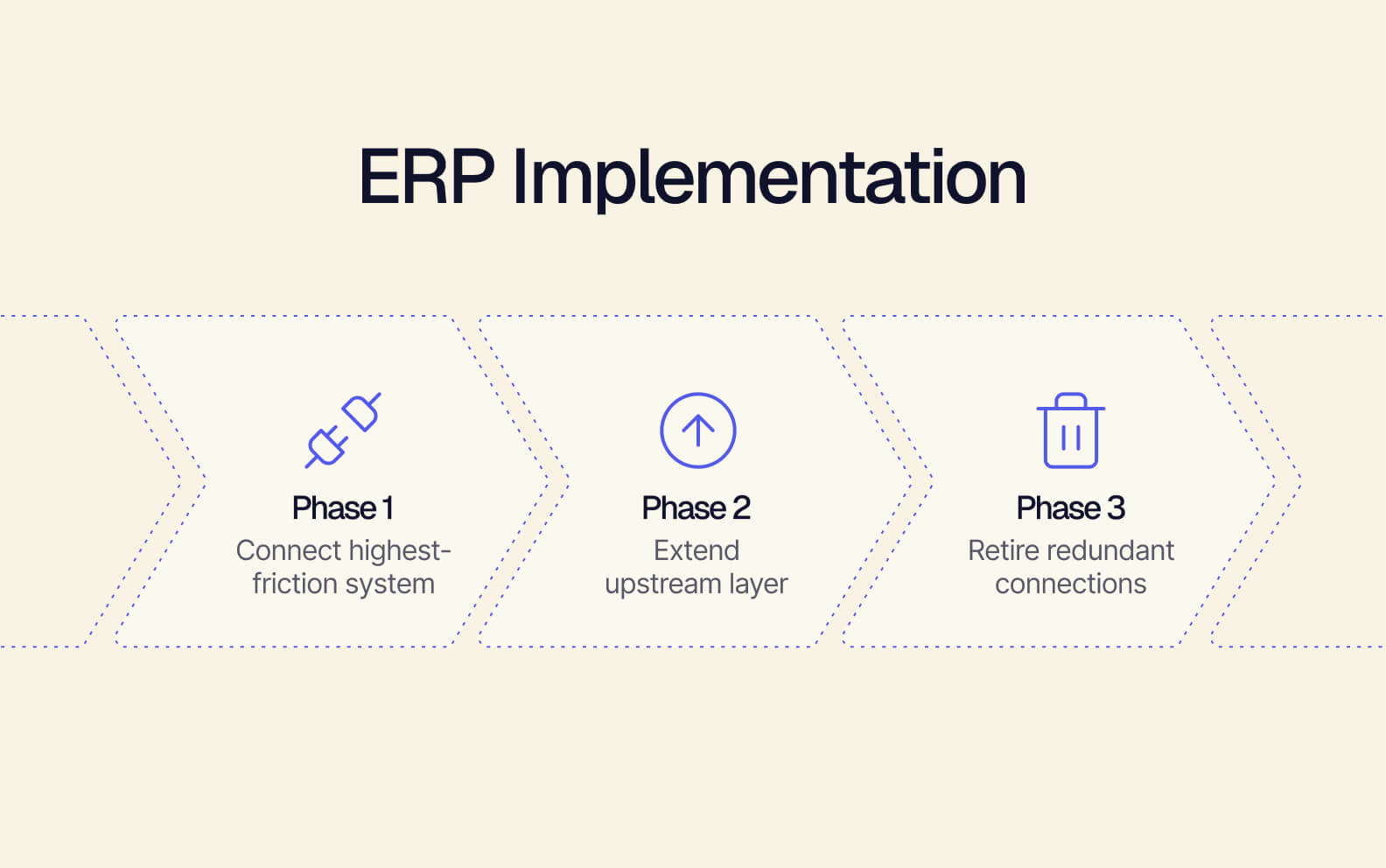
The goal is to build a system that can absorb the next challenge without having to jump into a new firefighting cycle.
Stop Solving the Same Problem Twice
For a while, every fix in that first table will work. But eventually, the pressure will show up somewhere else and the cycle begins again.
The fastest way to break out of this cycle is to uncover the root cause behind why disruption keeps finding a new system to break. And rebuilding your architecture is the difference between a supply chain that survives the next disruption, and one that’s just waiting for it.
Talk to our team and see how Tailor’s architecture holds up under pressure.