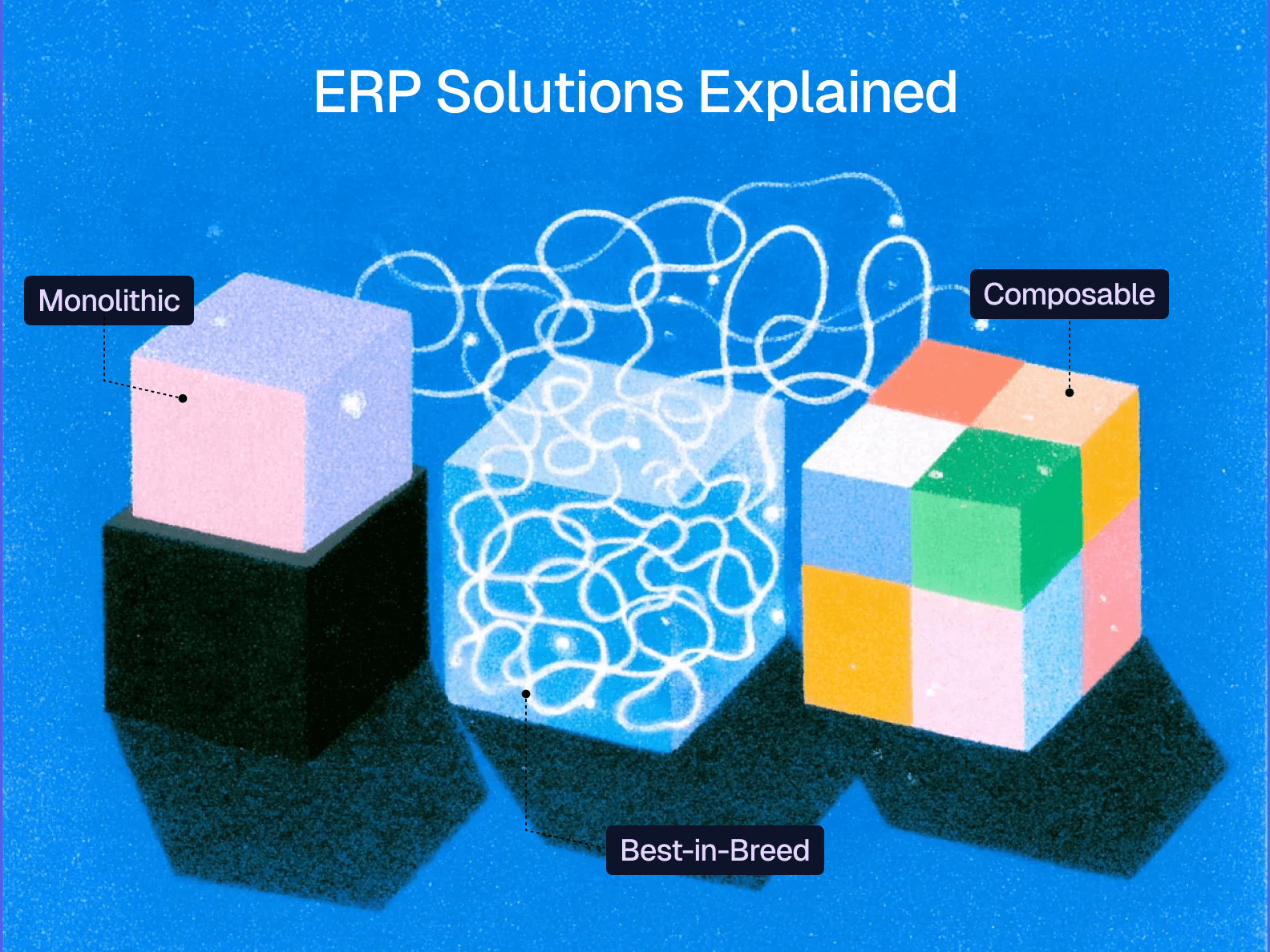
In the market for a new ERP solution? You might be spending your time comparing ERP features, measuring one platform's inventory management capabilities against another's or contrasting production management tools.
But if you want a truly flexible ERP that you can start building on right away, this isn't the right way to shop.
Instead, you need to be making decisions at the architectural level: Do you need a monolithic, best-in-breed, or composable ERP?
Once you've answered that question, it's much easier to narrow down the options and settle on your final ERP solution.
This article breaks down the three primary ERP architectures and how they differ to help you understand which one is right for you. We also guide you through a simple self-assessment to determine whether you'd benefit from a composable ERP solution.
What You'll Learn
- What ERP Solutions Actually Do
- The Three ERP Architectures, Explained: Monolithic vs. Best-in-Breed vs. Composable
- 5 Myths About ERP Solutions (And What Actually Matters)
- How to Know If Composable Is Right For You, Right Now
What ERP Solutions Actually Do
If you need to upgrade your ERP solution, you're clearly already familiar with what these platforms do. But it never hurts to refresh — especially before we dive into the nitty-gritty architectural stuff below the surface.
Enterprise Resource Planning (ERP) systems help you automate and optimize business processes. They pull together every department (finance, supply chain, HR, inventory) for unified data and communication. As a result, you see higher productivity, reduced costs, and smarter decision-making.
ERPs include features like:
- Integration capabilities with other business processes and systems
- Real-time data access and analytics
- Flexibility to adapt to your changing needs
- Customization and configuration to meet unique business needs
- Affordable cloud-based technologies
The Three ERP Solution Architectures: Monolithic vs. Best-in-Breed vs. Composable
Every ERP solution is built on an architecture. This architecture is the underlying system design that affects how the data, integrations, and components are structured and how they interact. But not every ERP architecture is alike.
There are three primary architecture types that an ERP solution can have: monolithic, best-in-breed (sometimes called "postmodern"), and composable.
Monolithic ERP Solution
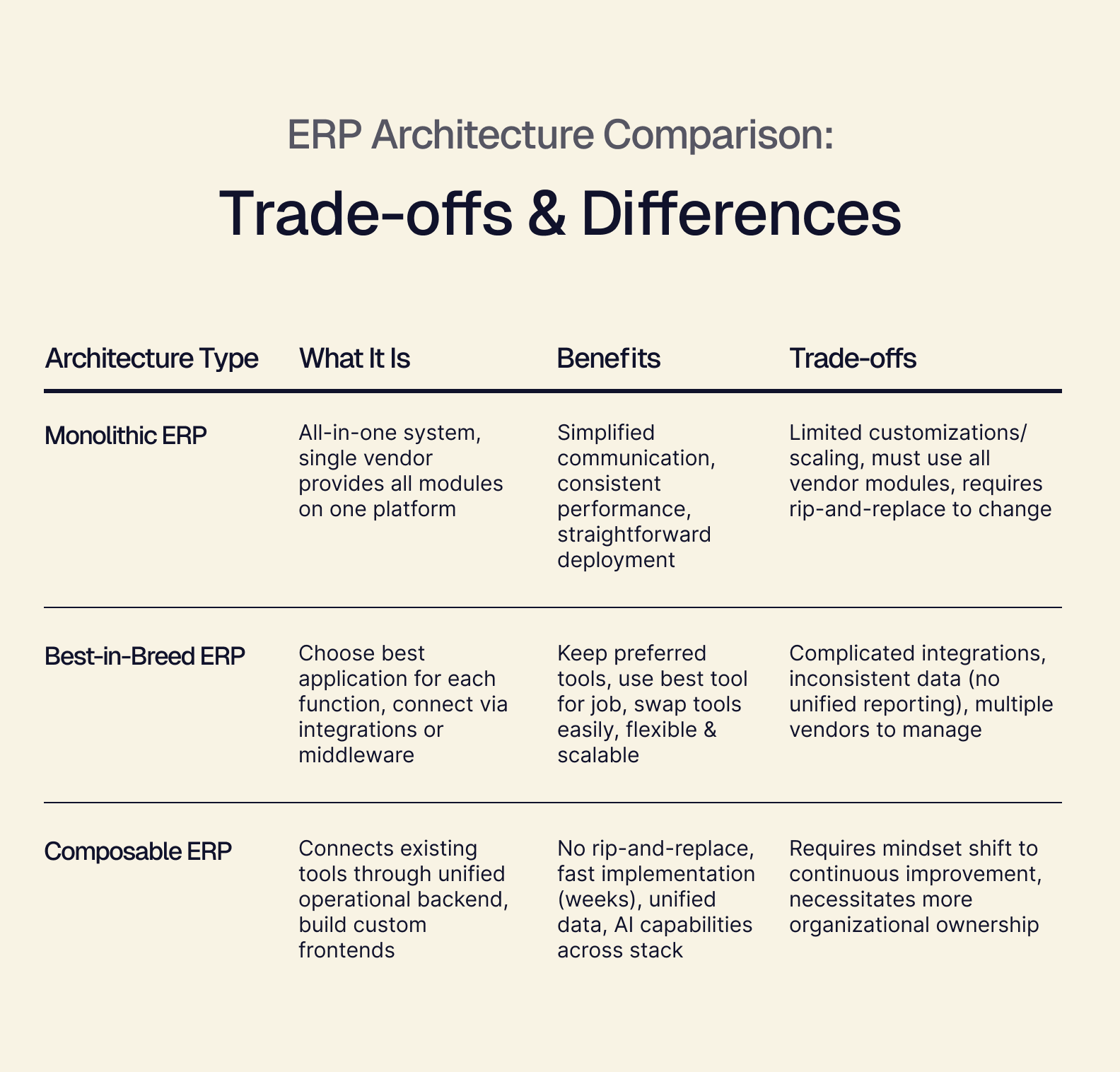
What it is: An ERP with a monolithic architecture is an all-in-one system where one vendor provides all modules on a single platform. (Examples include SAP, Oracle, and NetSuite.) Modules are functionally distinct, but technically connected — they share data, logic, and deployment.
Benefits and trade-offs: The idea is that communication is simplified, with a consistent, reliable performance and straightforward deployment. But it comes with several trade-offs, too. Monolithic ERPs are very limited with customizations and scaling. You're required to use all of that one vendor's modules. And if you want to move to something else, you have to completely rip-and-replace and start from the beginning with brand new vendors.
Who it's best for: This type of ERP architecture may be a good fit for established enterprises with standardized processes; companies with long planning cycles that are okay not having the next best innovation; or highly regulated industries where the vendor has deep specialization.
Best-in-Breed ERP Solution
What it is: With a best-in-breed architecture, you choose the best application for each core ERP function (finance, inventory, CRM, etc.) and connect them using integrations or middleware. This ERP approach is not a single product. Instead, you put together a connected ecosystem with the top tools available, with everything communicating via APIs or middleware.
Benefits and trade-offs: Ideally, a best-in-breed ERP solution lets you keep the tools your team likes, use the best tool for each job, and swap tools anytime. This kind of architecture can handle more complex workflows and is more flexible, scalable, and innovative. But it has drawbacks, too. Integrations are complicated and it's hard to keep data consistent because there isn't unified reporting. You also have a lot more vendors to manage, which can create drag on the user experience.
Who it's best for: Best-in-breed ERP might work well for mid-market businesses with evolving workflows; teams with strong IT capabilities; or companies in search of tool flexibility over unified data.
Composable ERP Solution
What it is: A composable ERP architecture lets you keep your best-in-breed tools (ecommerce platforms, WMS, 3PLs, accounting systems) but connect them through a unified operational backend like Tailor. Tailor acts as the system of orchestration: It synchronizes data, enforces business logic, and coordinates workflows across every system. You can build on that foundation to add custom frontends, internal tools, and dashboards that meet your business needs.
Benefits and trade-offs: There's no rip-and-replace necessary with composable ERP. Keep your current tools and simply compose them into a single system. Implementation happens in just weeks, and Tailor keeps your data unified as AI works across the stack. Keep in mind, however, you may need a mindset shift for a composable approach: Continuous improvement is a must, and with more vendors involved, more organizational ownership is necessary too.
Who it's best for: A composable ERP solution is a good fit for businesses that have outgrown spreadsheets; companies that have tools they love, but need unified data; businesses that can't afford 12-18 months of implementation; and teams that need custom interfaces.
5 Myths About ERP Solutions (And What Actually Matters)
There are plenty of myths floating around boardrooms and the internet about ERP solutions and architecture. Take a look at a few of the most common, and the reality you should know.
- Myth #1: Cloud vs. on-premise is the most important decision. Your deployment model matters for security and access. But cloud vs. on-premise is just about where the data lives. An ERP's architecture model determines how the system is built — and its level of flexibility.
- Myth #2: "Integrated" ERP means no more data silos. Traditional "integrated" ERPs claim to eliminate silos. But if these ERPs still enforce rigid data models, this creates functional silos through modules.
- Myth #3: There's no way around a lengthy ERP implementation. The reason ERP implementations commonly take 12-18 months is because traditional ERPs require a full rip-and-replace. When you go with a composable approach instead (keeping existing systems and adding capabilities incrementally), suddenly your timeline gets a whole lot faster — weeks instead of months.
- Myth #4: Customization is too expensive. Vendor customization can be expensive — if you use a monolithic system that forces you into their interface. But with headless architecture, you build interfaces with no need for vendor approval. You don't have to settle for generic ERP screens.
- Myth #5: You have to choose between unified data or flexible tools. This is no longer true. Composable ERP gives you the best of both worlds. Thanks to API-first design and event-driven workflows, you can keep your flexible tools (like QuickBooks, ShipStation, and Salesforce) and get unified data.
How to Know If a Composable ERP Solution Is Right For You
Is a composable ERP solution the best next step for your team? Read through these questions and answer yes or no to each one:
- Have your operations changed meaningfully in the last 12–24 months?
- Are you frequently forced to "work around" your systems instead of configuring them?
- Do you already rely on multiple best-in-breed tools (ecommerce, WMS, 3PLs, accounting)?
- Are integrations currently brittle, manual, or hard to change?
- Do different teams rely on different "versions" of operational data?
- Does reporting lag behind real-time operations?
- Do peak seasons, promotions, or growth strain your systems?
- Would scaling one part of the business (orders, inventory, SKUs) strain everything else?
- Would better system flexibility create competitive advantage?
- Are you comfortable evolving systems continuously?
If you answered yes to more than half of these questions, your business is ready to seriously evaluate composable ERP solutions.
Start with a Composable ERP Solution, Go Anywhere
Implementing a composable architecture could enable you to launch that wholesale channel that's been on hold for 18 months. Or to open in three new markets this year instead of "maybe next year." You've been ready for the next level, but your systems haven't… until now.
Tailor can orchestrate your existing systems into a composable ERP that grows right along with your business. Keep the tools you love while adding the flexibility, AI capabilities, and unified data you need to grow faster. Book a demo to see how it works for yourself.