The widespread adoption of AI tools across the retail industry has led to the creation of a new category of ecommerce called agentic commerce. With AI chats and AI agents becoming more widely adopted by online shoppers, new opportunities open up to get your products in front of these customers.
With agentic commerce being relatively new, it’s natural to be skeptical about planning agentic commerce into your retail strategy. Fortunately, this guide will help you understand what agentic commerce can do for your business and teach you how to make the most of it with composable software solutions.
What you'll learn:
-
How agentic commerce could impact your retail ops
-
Why composable software and AI tools work together
-
The benefits of native agentic commerce implementation
-
Answers to some common questions about agentic commerce
Building Your Business for the Future
Many retail brands get locked into focusing on managing the present, with very little focus on the future. Whether they’re trying to find a solution to reduce customer returns, prevent inventory management headaches, or struggle through fixing their rigid ERP integrations, it’s too easy to get absorbed by problem-solving while ignoring problem prevention.
You may be fighting against similar pressures, but you can’t lose sight of the future of your business operations.
While that future may seem quite far away, the proliferation of more powerful agentic commerce tools is much closer than you might think.
What Agentic Commerce Does for Retail Brands
Rather than human shoppers clicking onto your website, placing orders, and paying, agentic commerce is the process of AI chat interfaces showing your products to their users — allowing them to purchase your products while not being on your website. Another aspect of agentic commerce is the potential for customers to use AI agents to make purchases on their behalf, navigating your websites without human input.
So what does investing in agentic commerce do for your retail brand?
-
Provides access to new customers. Rather than trying to target ideal customers through ad spend or word-of-mouth habits, agentic commerce gives businesses the ability to reach new customers through AI chat interfaces — potentially leading to exact-fit customer acquisition for businesses that properly optimize for agentic commerce.
-
Gives you new, powerful UX opportunities to pursue. While some AI chat platforms open up mini-web browsers for their users to browse recommended products through, others, like ChatGPT, also feature AI-native shopping apps created by retailers. These allow for curated shopping experiences for AI chat users, giving you more control over the items they might purchase from you.
-
Encourages better SEO and web-design habits. Another key aspect of agentic commerce is maximum visibility. This means that retailers focused on thorough product descriptions and low-friction web design (no pop-ups, redirects, or login blockers) are more likely to have their websites understood by AI agents, which will have a direct impact on their products being recommended to these chat users.
Why Composability and Agentic Commerce Go Hand-in-Hand
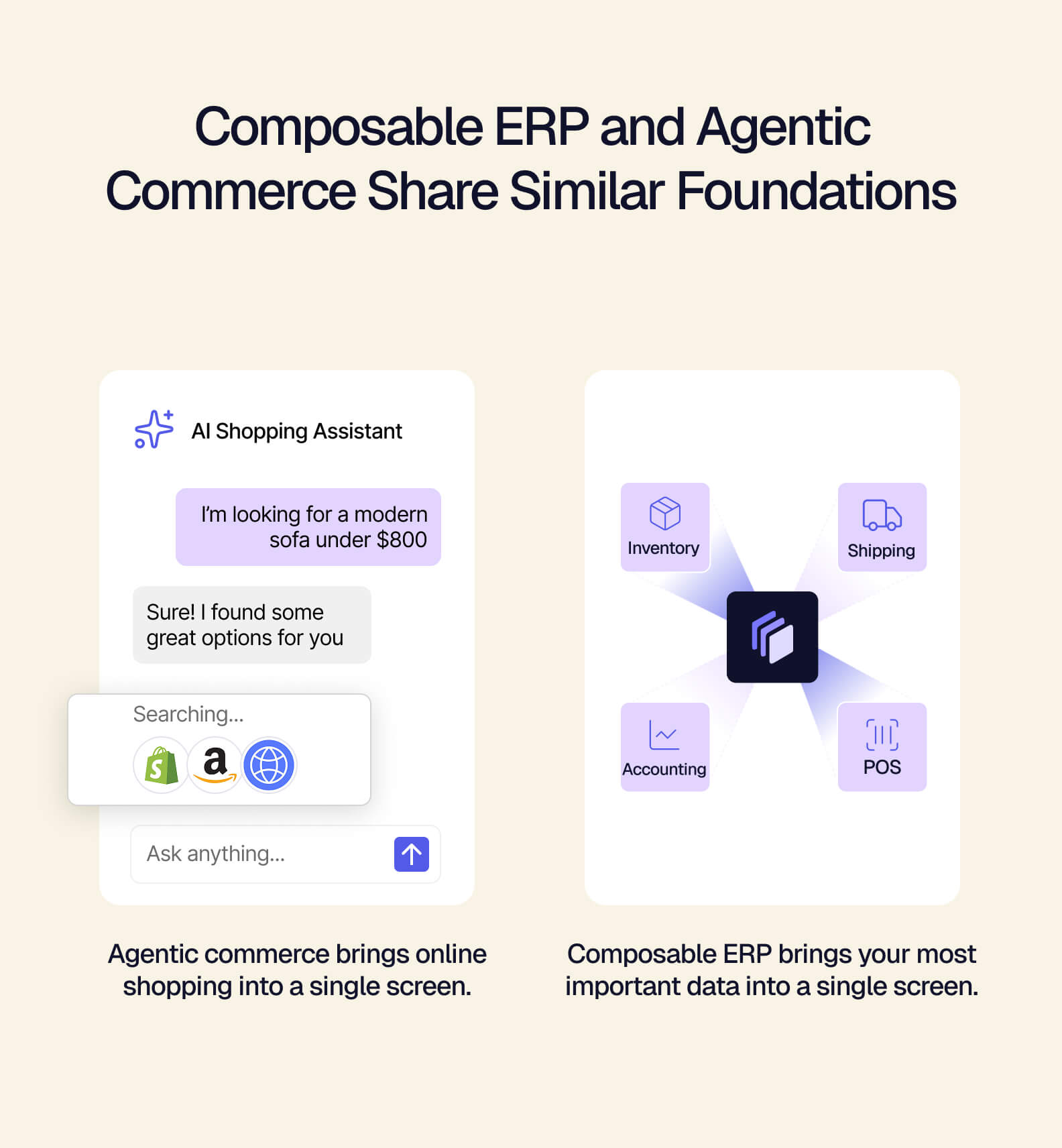
Consider what composability means for retail operations: modular design with a focus on easy adding and removing of feature sets. Composable systems can be assembled in whichever way works best for your workflows. A direct benefit of shifting your tech stack to focus on composability is that your entire system becomes connected and accessible by a unified interface.
This is fairly similar to the promise of agentic commerce — offer an open, modular connection to AI chat users so they can bring shopping experiences into a single screen. With agentic commerce standards encouraging easy plugging and unplugging of tools built to take advantage of AI agents, you can achieve a highly synergistic, AI-native system.
A rigid system might struggle to integrate agentic commerce — resulting in a bolted-on and clunky experience — while a composable, AI-native system would seamlessly handshake with agentic commerce.
The Benefits of Combining Agentic Commerce with Composable Systems
With the basics of agentic commerce and composability covered, grappling with the benefits of embracing both should be a breeze. These benefits come in a few different forms, and in the right hands, can create some powerful synergies between a composable system and AI-powered tools.
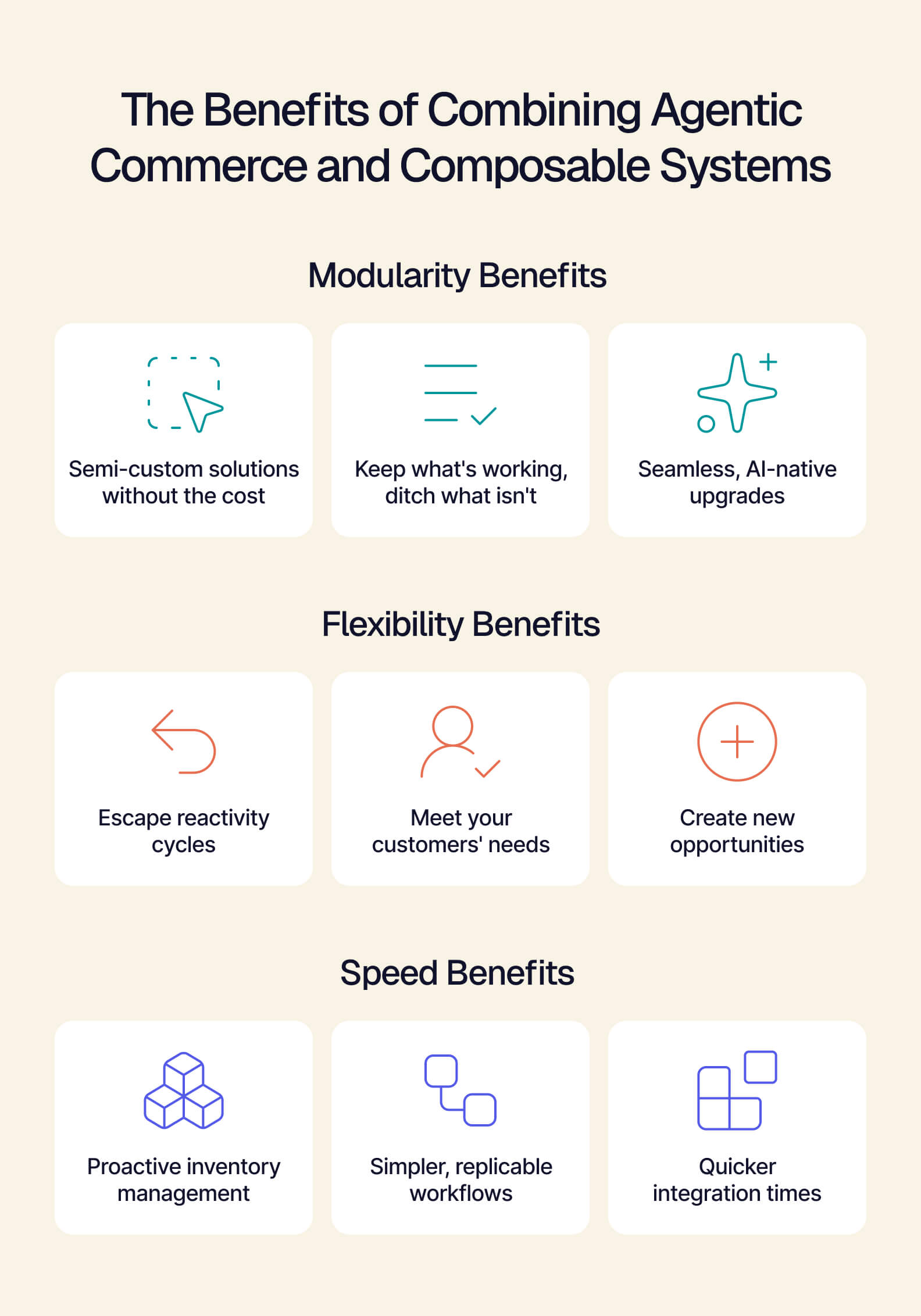
The benefits your retail operations can enjoy when they combine a composable system with agentic commerce can be broken into three categories: modularity, flexibility, and speed. Each meets a different need for this increasingly chaotic market and equips your retail brand to thrive when facing down new challenges.
Agentic commerce and composability boost your modularity.
-
Semi-custom solutions without the cost. When you have a composable system that syncs with agentic commerce standards, you get access to a wide range of semi-custom solutions (modules that are designed to meet your business needs or serve your customers). Because composable systems designed for agentic commerce are lightweight and forgo rigid system trappings, creating solutions for them is much easier and doesn't require lengthy, fully custom development to integrate new functionality.
-
Keep what's working, ditch what isn't. Another core benefit of this inherent flexibility is the ability to keep what’s working and remove what isn’t. Rigid systems suffer from mandatory software integrations and workflows that don’t work. With a composable system, you can easily change your workflows and remove software you don’t need.
-
Seamless, AI-native upgrades. Your modularity directly impacts how easily you can adapt to new standards. A composable system that supports agentic commerce standards can be easily upgraded with new AI tools, making it perfect for retail brands that want to stay on the cutting edge of tech integrations.
Agentic commerce and composable systems increase your flexibility.
-
Escape reactivity cycles. Part of being flexible is being able to pivot before market chaos affects your business negatively. Often, retail brands with rigid systems and workflows get caught off guard, which causes fires to erupt behind the scenes. With a composable system and agentic commerce support, you can see problems coming, pivot, and avoid firefighting and constantly reacting.
-
Meet your customers’ needs. Few things are more agitating to customers than difficult UX and forcing them to shop in ways they simply do not want to. With agentic commerce standards integrated into your day-to-day operations, you can meet your customers where they prefer to shop, while offering the exact items they’re looking for.
-
Create new opportunities. Composability and agentic commerce work together to open your business up to the future: this means you can take on new opportunities without concern. You have the budgetary freedom to test new markets, and you more easily develop new, curated shopping experiences for your customers through AI-powered tools.
Agentic commerce and composable systems speed up your business.
-
Proactive inventory management. One of the major bottlenecks for scaling retail brands is sluggish inventory workflows. Constant manual inventory recounts, waiting for data to reconcile, and managing your inventory ops through spreadsheets all work together to keep things crawling at a snail’s pace. However, with a composable system, you’re able to cut out spreadsheets, sync data in real time, and trust that your inventory is correct — wherever your customers shop.
-
Simpler, replicable workflows. AI-ready systems — like those that support agentic commerce — are encouraged to reduce workflow complexity so that tasks are easily replicated by AI tools. With fewer points of friction, you can move faster and avoid common operational bottlenecks that face scaling retailers.
-
Quicker integration times. When your system is composable, you can cut out much of the headache that plagues rigid operations when adding new software or tools. Composable systems that are optimized for agentic commerce can slot in new software more quickly, and have larger system upgrades live in weeks instead of months.
Your Questions About Agentic Commerce Answered
Q: What’s a clear signal I should invest in agentic commerce integrations?
A: If you’re seeing orders coming through that lack the typical tracking you’d expect — like if they ordered through your website or a partner — it’s likely that it was purchased via an AI chat portal. If this is happening consistently, it means that your products are being recommended reliably and it’s time to look into adopting agentic commerce into your ecommerce strategy.
Q: Is agentic commerce really worth making the change?
A: For most retailers, especially those that are looking to scale quickly — yes. Having a new sales avenue, and one that will recommend items on your behalf, could become a strong catalyst for growth. Plus, making the platforms you control AI agent-friendly also creates easier browsing for new customers. Embracing agentic commerce can benefit both your human customers and AI agents navigating your webpages.
Q: Does Tailor work with agentic commerce solutions?
A: Tailor is an AI-native, headless, composable ERP system that is built with your business in mind. Featuring an out-of-the-box UI that easily integrates your existing tools, you can quickly give your business a composable core that can effortlessly adapt to AI tools — including agentic commerce solutions. Tailor enables your business to scale without difficulty, ensuring you can keep the workflows and tools that help your brand operate.
If you’re looking to transform your retail brand into an industry player that’s AI-native, agentic commerce-ready, and fully composable, book a demo with Tailor today.