Just-in-time ecommerce expectations have been a boon for customers and retailers alike, but a very costly and unintended consequence has emerged: uncontrollable returns.
As customer behavior has shifted toward bulk ordering SKUs to find the perfect fit, then sending the rest back, small retailers are left with a quickly growing mountain of merchandise they’re not sure what to do with, and the return shipping fees chipping away at their operating budgets.
What if there were a way to position returns as a profit center, rather than a source of increasing costs? Let’s find out what it takes to get there.
What you’ll learn:
-
How you can break your current returns cycle
-
What you can do to shift your customer behavior
-
Why you should consider headless, composable software to support any new returns infrastructure
-
The scaling impact of keeping returns a cost center vs. a profit center
Four Ways to Break Your Costly Returns Cycle
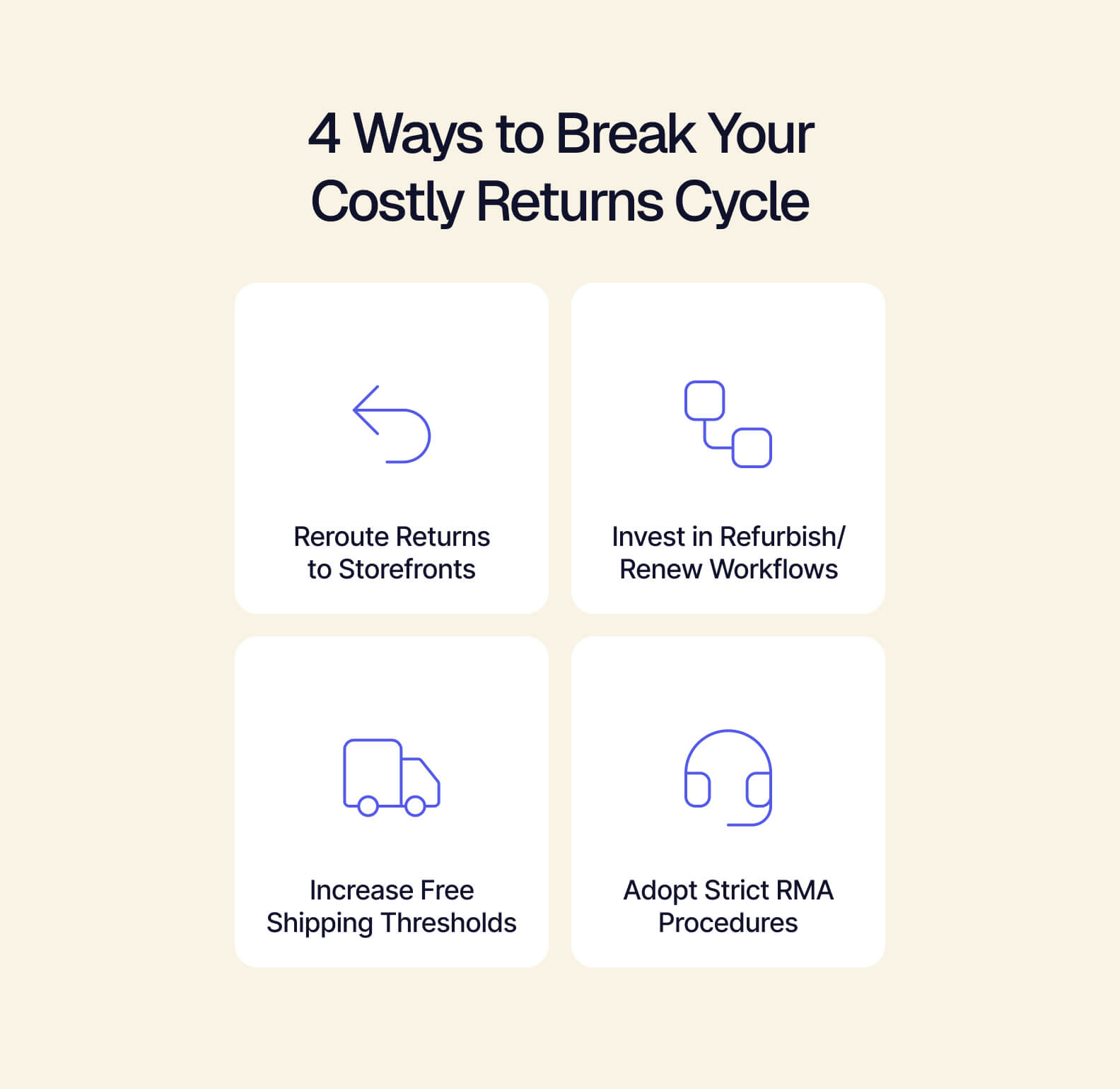
Before you can reconfigure your returns workflows, you need to staunch the budgetary drain from excessive returns. There are four measures you can take to slow down your returns and get a handle on the situation:
-
Reroute returns to physical (or partner) locations
-
Invest in refurbishing and renewal workflows
-
Increase your free shipping thresholds
-
Adopt stricter RMA standards
Let’s explore how these can work for you and positively impact your retail brand over the long haul.
Reroute Returns to Physical Stores or Partner Locations
One of the higher-impact steps you can take is to cut down your returns costs by changing where your returns are going. If you’re a retail brand with a brick-and-mortar location (or have a partner with one), you can redirect your returns there, cutting a few steps out of the process. A typical returns process might look like this:
-
Customer contacts your customer service team
-
Customer service generates a shipping label
-
Customer ships their items back to your warehouse
-
Your warehouse has to receive and process the item
Then your warehouse team has to assess the item and decide where to store, donate, or trash the item(s). This is where the cost potential starts to build up — you’ve now had to eat a series of unexpected shipping and handling costs with no immediate path to recoup those costs.
But when you reroute these items to a physical location, you open up some new avenues to recoup those shipping fees. Physical shopping locations can:
In both situations, your business is able to absorb some of the cost associated with return cycles, without having to sit on potential dead stock or get rid of otherwise viable merchandise.
Invest in Refurbish/Renew Workflows
Another high-impact way to reduce the overall cost of returns is to invest in creating the process and receiving pipeline necessary to QA returned items, fix them up, and resell them from your own brand’s online stores. By offering renewed, refurbished, or even “open-box” options for a slightly reduced cost, you can keep a strong sales flow, without ending up with a mountain of unsellable returns piling up.
Where rerouting can help greatly in the short term, having a dedicated refurbishing system at your warehouse ensures that only truly defective or unsellable returns are thrown away.
While this requires additional upfront investment, it can support your long-term growth by:
-
Giving you increased inventory flexibility as you scale
-
Boosts your overall sales throughput, making your business more attractive for potential acquisitions
-
Improves inventory management workflows and resource management to open the door for new market opportunities
Increase Free Shipping Thresholds
While the first two ways are significant operational changes, you can also moderate your customer behavior to prevent excessive returns. The first is a simple one: raise the bar for free shipping.
According to EightX (a fractional CFO consulting firm), increasing your free shipping threshold up to 25% above your AOV (average order value) could help to offset end-to-end shipping costs. This number is worth exploring further, and might look different for your business and customer needs.
When you increase this threshold, you encourage shoppers to add a few extra products to their order. And while this won’t completely discourage overordering and returning behaviors, you can at least increase your margins to help absorb unexpected return expenses.
Adopt Strict RMA Procedures
Finally, another way to set new expectations with your customers is to adopt strict RMA (return merchandise authorization) standards and procedures. Your current returns cycle may be no-questions-asked, but with RMA workflows, it looks more like this:
-
Customer contacts you to make a return
-
Customer service speaks with the customer to determine whether a return is valid
-
If the return is valid, customer service provides the shipping labels necessary
-
Customer ships the item back
The strength of an RMA system is that you can reject returns for items that don’t meet specific requirements (such as damage or incorrect SKUs). This also creates an opportunity to offer an exchange before you undergo a full return + refund cycle.
Take Control of Your Returns with More Powerful Software
Once you’ve decided on a solution to slow down returns using a combination of the solutions presented above, you’ll need to set up the infrastructure necessary to support them. This often comes in the form of additions to your tech stack that provide you with the system flexibility needed to accommodate the necessary changes to your returns processes.
Tailor believes the best tools for the job are going to be headless, composable software. These types of solutions are designed to easily slot into your existing software, connect with them, and unlock the functionality you need to transform your returns into a profit center.
Before we explore how this happens, let’s get clear on what headless and composable mean:
-
Headless means that software front-end and back-end systems are decoupled from each other, allowing you to add functionality without being limited by a rigid user interface.
-
Composable means that software is built modularly, and should be thought of as a building block that can be added or removed easily with little operational consequence.
How Headless, Composable ERP Unlocks Flexible Returns Systems
Retailers often know exactly what they’d like to do to fix their returns system, but their tools either aren’t equipped to handle the changes or actively resist implementing those changes. This is called rigidity, and it’s one of the biggest friction points for growing retail brands. When your software isn’t letting you operate in the ways that would be best for your business, your problem-solving options become increasingly limited.
So, how does implementing headless, composable architecture, ERP, and modules help you position your returns as a profit center?
-
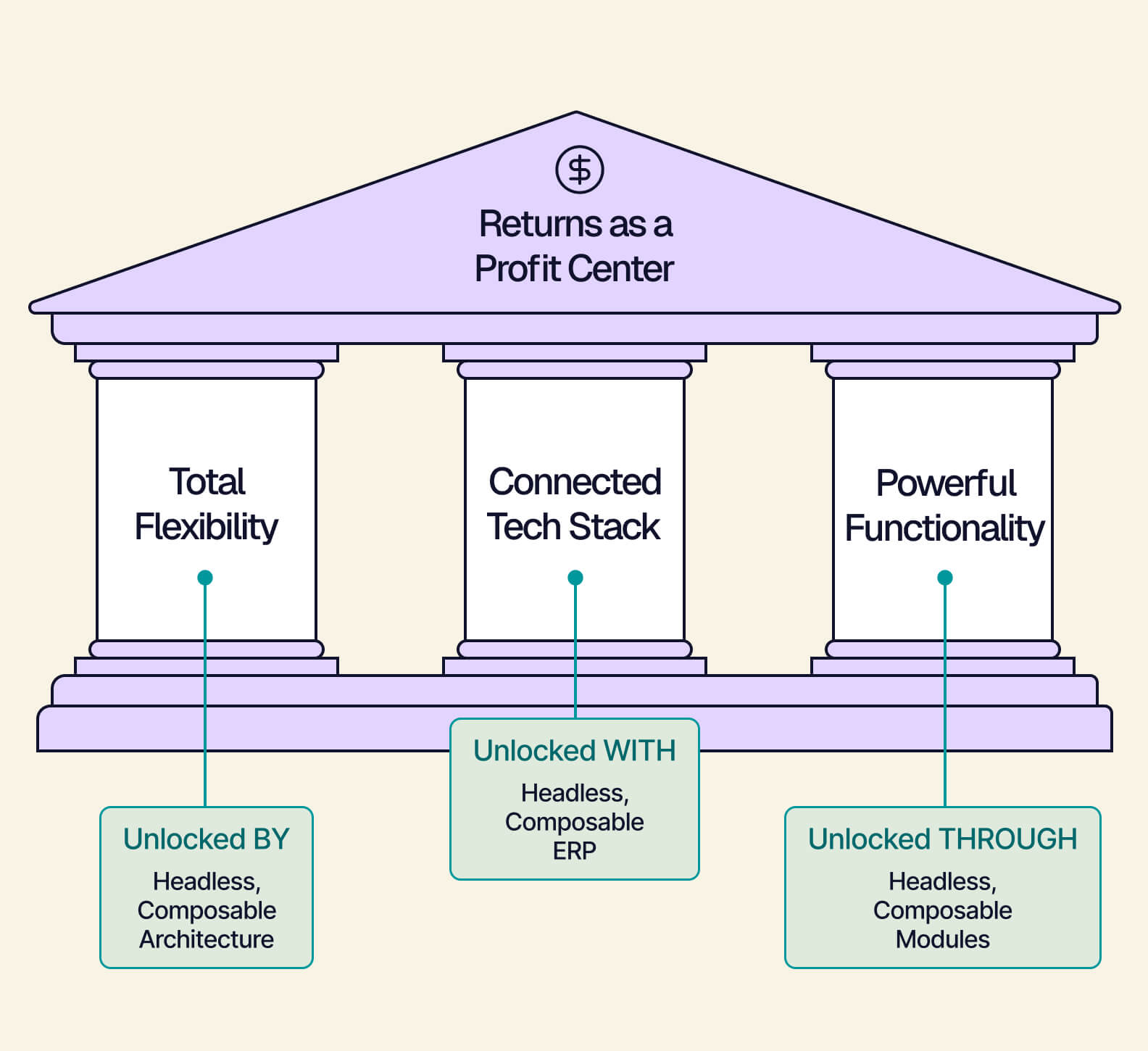
Total flexibility. Headless, composable architecture frees your system from rigidity by providing flexible UI and UX experiences, while making adding new features a breeze. This results in your technical teams having the ability to reconfigure your workflows to accommodate return changes.
-
Connected tech stack. Many retailers struggle with disconnected tools, modules, or software solutions that make implementing changes a high-friction headache. Headless, composable ERP helps bring the functions and workflows of your whole tech stack into one screen — cutting out workarounds and spreadsheets, while enabling your tools to “talk” to each other.
-
Powerful functionality. When you’ve got the architecture and connections you need to support your returns as a profit center shift, you can implement headless, composable modules to unlock new features so that you can continue to evolve your returns processes to meet the moment.
How Turning Returns into a Profit Center Supports Your Scaling Efforts
Some retailers might see that they have to invest more into their returns before it gets better and decide to try powering through it. However, it’s highly likely that leaving returns functioning as a cost center will cause the drain to get worse long before it gets better.
Scaling when returns are negatively impacting revenue makes the process much harder than it needs to be:
-
Returns eat up time. The scalability impact of an unchanged returns process is that more returns = more wasted time. Your warehouse workers are spending more time relocating returns than working on fulfillment. Then, your Ops team has to reconcile returns, and Accounting needs to adjust sales projections.
-
Returns absorb operating budgets. Instead of paying, for example, $15 to ship a customer’s order and making a profit, you’re spending $30 or more to round-trip the products, refund the customer, and pay processing fees from payment vendors. These fees add up and limit your options.
-
Returns trap you in reactivity. The end result of the old returns system is being trapped in reactive loops, where you have to constantly anticipate costly returns. In turn, you have to be ready to update your budget at any time — making long-term planning more difficult than it should be.
However, scaling becomes exponentially easier when you invest in making your returns a profit center:
-
Returns can offset themselves. Because you have the systems available to properly handle and resell your returns, you can either fully absorb return costs or even make a profit. This removes constant budgetary pressure for your day-to-day operations.
-
Your workflows become flexible. When you have a headless, composable system at the heart of your business, your returns strategy remains adjustable, upgradable, and even reducible, as conditions shift and change.
-
Predictability becomes the focus. Rather than watching returns drain your budgets and causing a random influx of product that needs to be handled immediately, you can trust in your workflows to keep your operating budgets within projections.
Make the Shift Today
Whether you’re struggling to break your returns cycle or you’re ready to implement the infrastructure needed to support a new process, Tailor’s headless, composable modules and ERP can help. Positioning your returns as a profit center doesn’t have to be a change you’ll make someday — you can get started in just a few weeks.
Book a demo with Tailor today to learn how headless, composable software can transform your returns so you can save money and scale your retail brand without endless headaches.