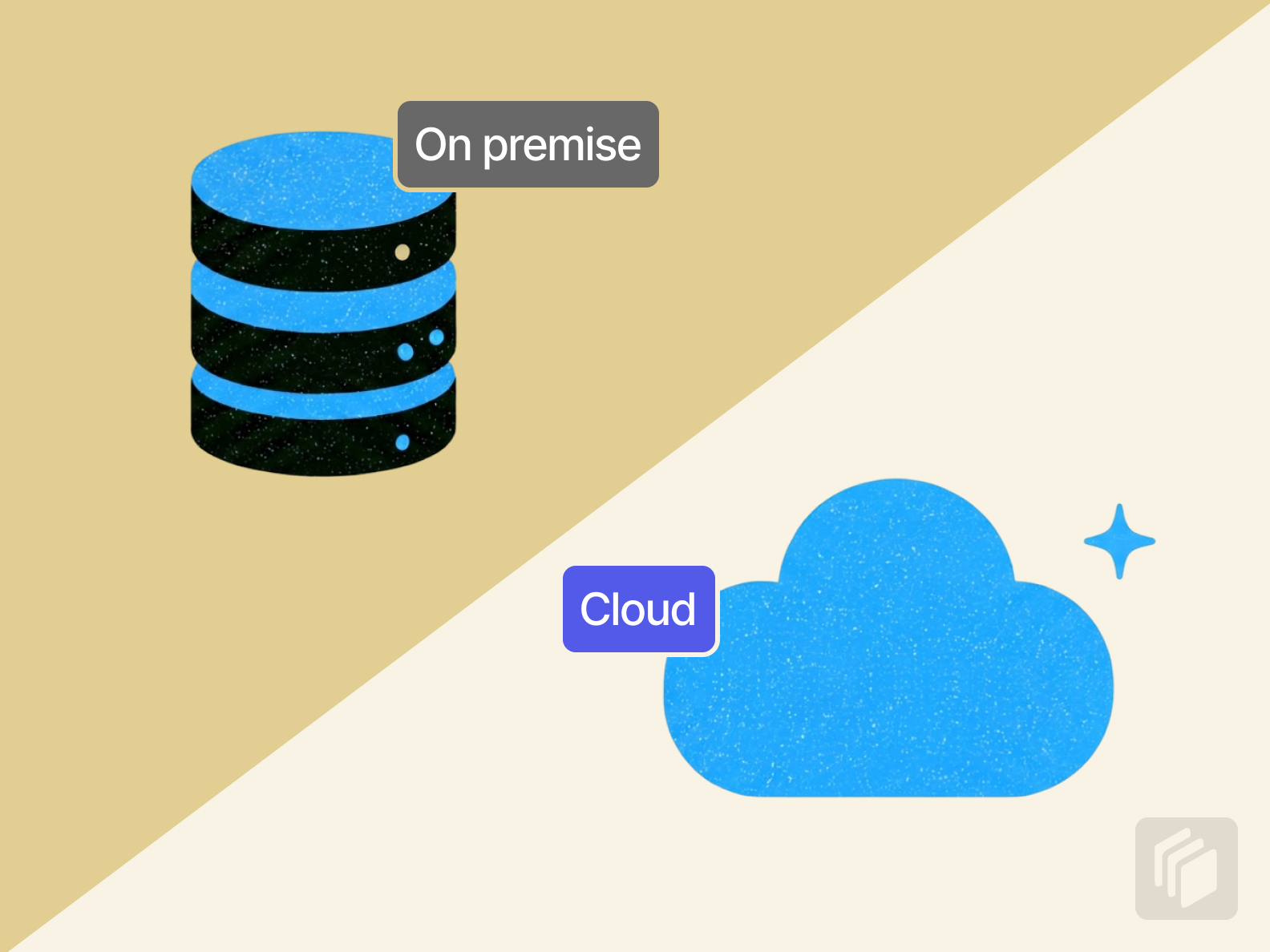
At some point, every retail business hits a snag that none of its existing tools can fix. Sometimes this is a capacity ceiling; other times, it’s workflow limitations caused by old, stretched-beyond-their-limits tools from years past. When these problems strike, it’s time to consider an ERP implementation.
But there’s a catch — not all types of ERP are meant for every size retail brand, and knowing which will work best for yours will save you a lot of time, money, and stress.
In this guide, you’ll learn:
-
Which businesses benefit from an on-premise ERP software integration
-
Why most ecommerce brands need cloud ERP
-
How headless, composable ERP improves on cloud-based ERP
Why On-Premise ERP Software Might Be Good for Your Retail Brand
On-premise ERP software solutions are built with enterprise businesses in mind. They offer an all-in-one, bundled approach to operating your retail brand. Whether or not your operations would benefit from these monolithic, rigid ERP solutions comes down to three key differentiators:
On-Premise ERP Software Needs Security and Hardware
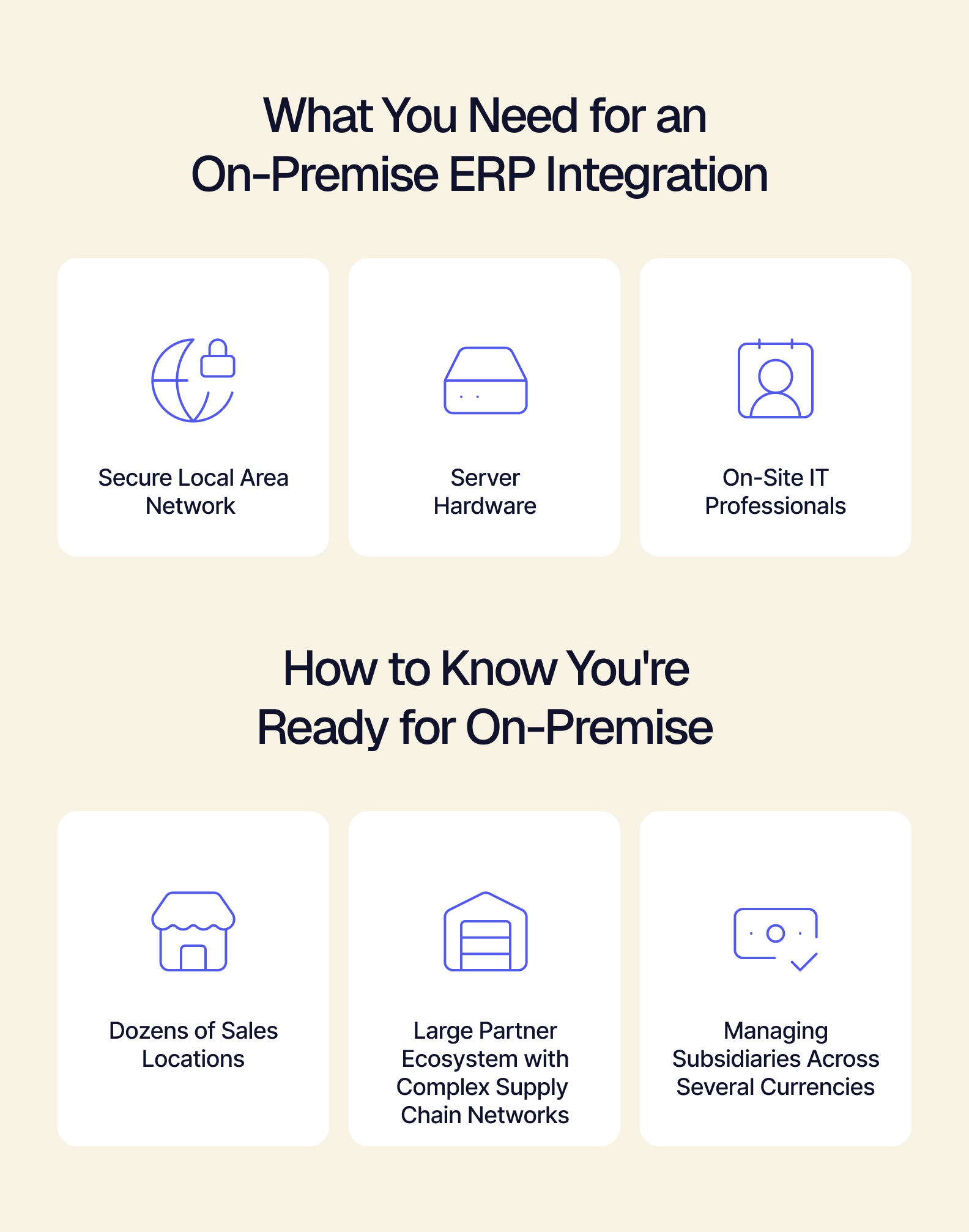
One of the largest demands an ERP needs is a physical location to store the hardware that runs the on-premise ERP. It also needs to be secure from a network standpoint. Storing your on-premise needs:
Secure Local Network Infrastructure
A local area network (LAN) that enables company systems and computers to access and communicate with each other. Whether these networks are wireless or wired, you’ll need to have these networks secured from the outside to prevent your ERP data from being accessed by unauthorized parties.
Having the Space and Hardware to Host It
An on-premise ERP software integration requires you to manage physical servers and the backup infrastructure necessary to ensure it’s always up and running — so your operations are not impacted by outages.
One Benefit to Consider and a Problem to Watch For
The benefit: Off-premise ERP systems (like cloud ERPs) can be hit with vendor downtime, which could disrupt your daily operations if your system requires 100% vendor uptime to perform.
What to watch for: On-premise ERP systems can go down, be disrupted, or break. When this happens, the responsibility to get things back online falls on your IT professionals. Solving these problems could be expensive and slow.
On-Premise ERP Software Requires Expansive Business Infrastructure
With on-premise systems being built for enterprise operations, they can leave big shoes to fill. However, for brands that are about to hit enterprise levels of revenue or have infrastructural needs on par with an enterprise business, an on-premise ERP is one of the few ways to ensure you have the means to support your continued growth and increasingly complex workflows.
These needs could look like:
-
Operating with dozens of sales locations, with significant revenue and a large regional or national footprint.
-
Managing a large partner ecosystem that requires rigid ERP tools.
-
Growing multiple subsidiaries across several currencies.
On-Premise ERP Software Works Best with an In-House IT Team
One thing this type of system absolutely needs: a dedicated, in-house IT team. Unlike cloud ERP integrations, upgrading, adding features, and general ERP maintenance must be handled by your own team. This means that you need to have professionals you can trust to help keep your business operations running smoothly.
You can certainly support an on-premise integration with an outsourced team, but when something breaks, you might be looking at lackluster support, long waits for technicians to get to your location, and protracted outages that will directly impact your brand and customers.
However, with an in-house team that operates on location, you can catch problems fast and test upgrades and feature adjustments at the source.
What Makes On-Premise Difficult for Most Growing Retailers
For the right retailer, an on-premise ERP software integration makes a lot of sense — but that’s not going to be most retail brands. Many operations would actually be slowed down and put under extreme pressure by integrating an on-premise ERP. If these tools are supposed to be powerful and trusted by some of the largest corporations in the world, what makes them difficult to use for smaller businesses?
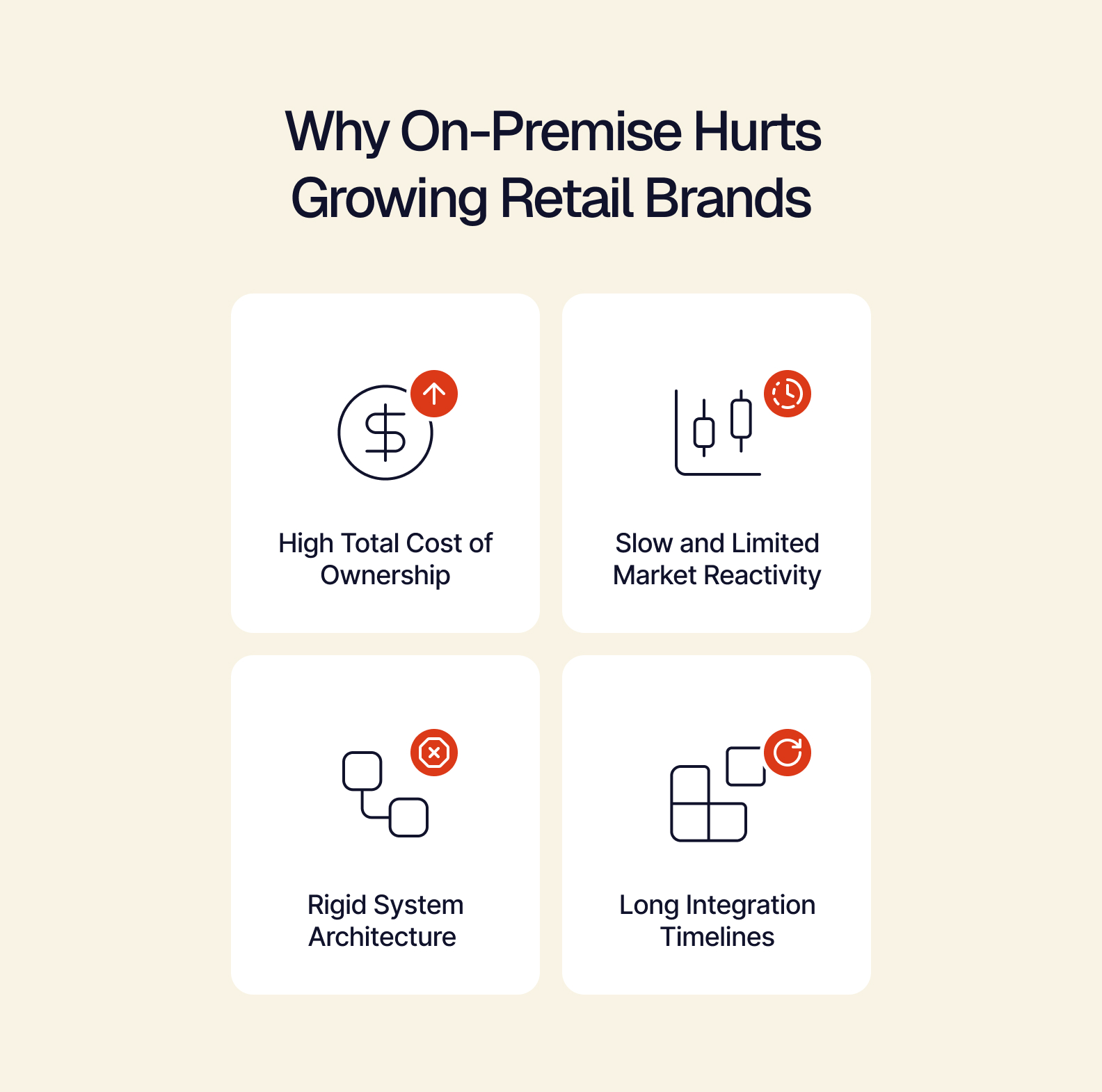
This comes down to three factors: high (and unaccounted for) costs, rigid system architecture, and long integration timelines. Let’s dig into why each can be problematic for growing retailers:
High costs limit your ability to act fast. The overhead of integrating an on-premise system like NetSuite or SAP can put an oversized financial burden on your operating budget. Acquiring the hardware and support staff is expensive already, but then you add in initial integration costs, ongoing consulting fees for the integration, and a notably high long-term TCO (total cost of ownership). This all works together to depress your financial flexibility, which can cost you new markets or viable opportunities later.
Rigid system architecture. Power means nothing if it can’t be put to good use. Many businesses that integrate rigid ERPs like SAP or NetSuite struggle to make use of every feature they pay for. This can create a situation where smaller retailers try to expand their operations to fit the ERP — in an attempt to get their money’s worth — rather than operating in the ways that make the most sense for their current capabilities.
Long integration timelines. When integrating an on-premise ERP system, the integration timeline can take anywhere from 6 months to 2 years. For a small business that needs to move quickly, adapt on the fly, and jump into new markets fast, a lingering on-premise integration can leave them in a lurch. Putting these capabilities on pause for a system that likely won’t be rolled out over time — and could have significant problems during its go-live phase — is problematic. What happens when something needs to be fixed after up to 2 years of waiting? More unplanned delays and expenses.
Why Cloud Software Wins Over Ecommerce Retail Operations
On-premise ERP software suites were built for large enterprises and a 1990s business model. These outdated systems that rigid ERPs are built on (no matter how good they look today) are inherently at odds with the demands of a modern ecommerce retail operation. In some ways, the on-premise ERP response to an ecommerce problem is very similar to consulting a dictionary to find a definition, when a quick web search would suffice; there’s a time and place for the power of an on-premise ERP (or that dictionary), but for most ecommerce businesses, that time is not right now.
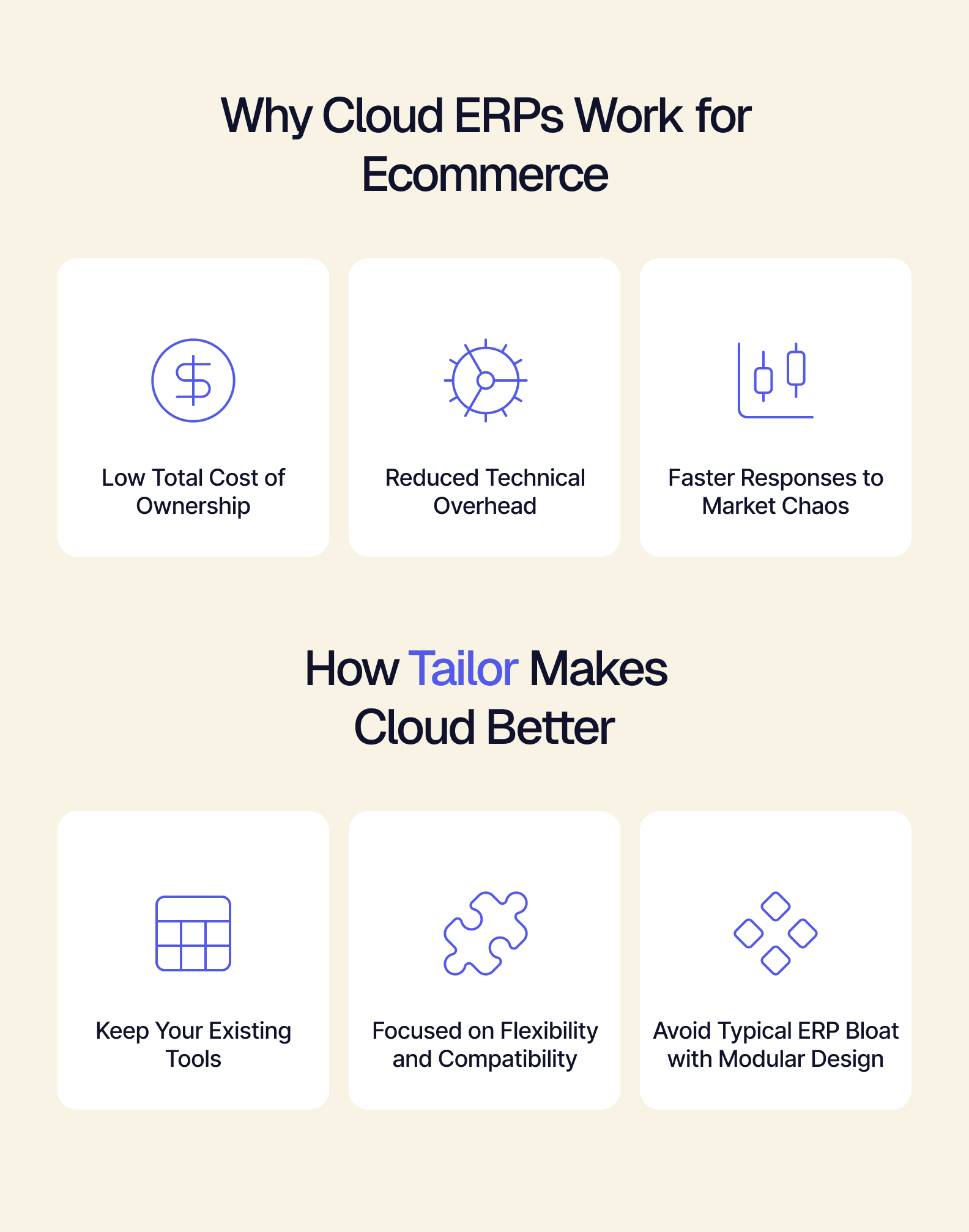
Here are a few reasons that cloud ERP software is better positioned to meet the needs of growing ecommerce brands:
-
Low TCO, with more predictable costs and quicker integration timelines.
-
Reduced technical overhead, since vendors handle the deployment and maintenance of the ERP integration.
-
Faster response times to market chaos.
How Headless, Composable ERP Rapidly Scales Your Business
Falling under the category of cloud ERP, Tailor’s headless, composable ERP offering is designed to meet your business where it’s at now, while providing lasting support into the future. What makes Tailor different from other cloud ERP offerings is that it’s designed from the ground up for flexibility, customization if you need it, and speed.
But that begs the question: Does Tailor just accomplish what other cloud ERPs do? Not quite.
Many cloud ERPs are just cloud versions of on-premise tools (SAP and NetSuite both offer cloud variants) or are built with the same rigid principles that have driven the industry for the last several decades. What this culminates in is slightly lower cost iterations of the same problems that plague growing retailers that choose to integrate on-premise and rigid systems. They’re saddled with a system that forces them to conform to it, rather than the system conforming to their needs.
Tailor disrupts this dynamic by providing its users with headless architecture and composable design. Headless architecture enables a decoupling of the backend and frontend systems, which has a twofold effect:
-
Your backend systems can be developed independently of your UI, allowing for both to change without unintentionally impacting other parts of your tech stack.
-
Decoupled systems don’t force bundled features you won’t need, saving you time and money.
Composable design allows you to treat your tech stack like uniform, interchangeable building blocks. You can add or remove parts of your system with minimal downtime and impact to your business, selectively upgrade parts of your stack, and easily connect new features later when you’re ready. Composable design helps you:
-
Reduce integration times and unnecessary tech support headaches.
-
Keep what’s working for your business without saddling you with tech bloat.
-
Avoid complicated workflows and hacked-together workarounds.
With Tailor, you can take on new markets and move at the speed you should be for your size. Because of the way Tailor functions, it’s able to continually grow and adapt with your trajectory — helping you scale faster, without having to worry about your system suddenly failing you.
Making the Best Choice for Your Business
You don’t have to get caught up in analysis paralysis while choosing the right ERP software for your business. You can consult our Software Evaluation Guide if you’ve already got some choices in mind. But if you’re still wondering if you’re ready for an ERP integration (and what type), you can choose based on some simple criteria:
If you’re managing subsidiaries across multiple currencies and engaging with large partner ecosystems, an on-premise ERP or cloud solution from SAP, NetSuite, or another legacy ERP vendor makes the most sense.
If you’re a growing retail brand operating with $10M to $500M in revenue, Tailor’s headless, composable ERP is right for you.
But you don’t have to commit to Tailor without seeing it in action. Book a demo with us today to see the difference that headless, composable could make in your day-to-day operations.