Supply chain management for small businesses is substantially more simple than it is for mid-market retail brands. Eventually, they grow large enough to become a mid-market operation, causing complexity to explode.
Businesses that make this jump are often left putting out fires while also trying to navigate the unknown.
However, by understanding the importance of supply chain management software — and how it can evolve your business — you can buck the trend.
What you’ll learn:
-
How supply chain management changes as you grow
-
What you should look for in an SCM software integration
-
Why you should prioritize composable architecture in your tech stack
-
How to use ERP and SCM software to evolve your retail strategy
How Supply Chain Management Changes from Small Business to Mid-Market
Platforms like Shopify, ShipStation, and QuickBooks often provide small businesses with everything they need to properly control their day-to-day operations. But what happens when these platforms are outgrown, or the business becomes more complicated than your existing software can handle?
Let’s consider the gaps left by small business tools as retail brands achieve mid-market status.
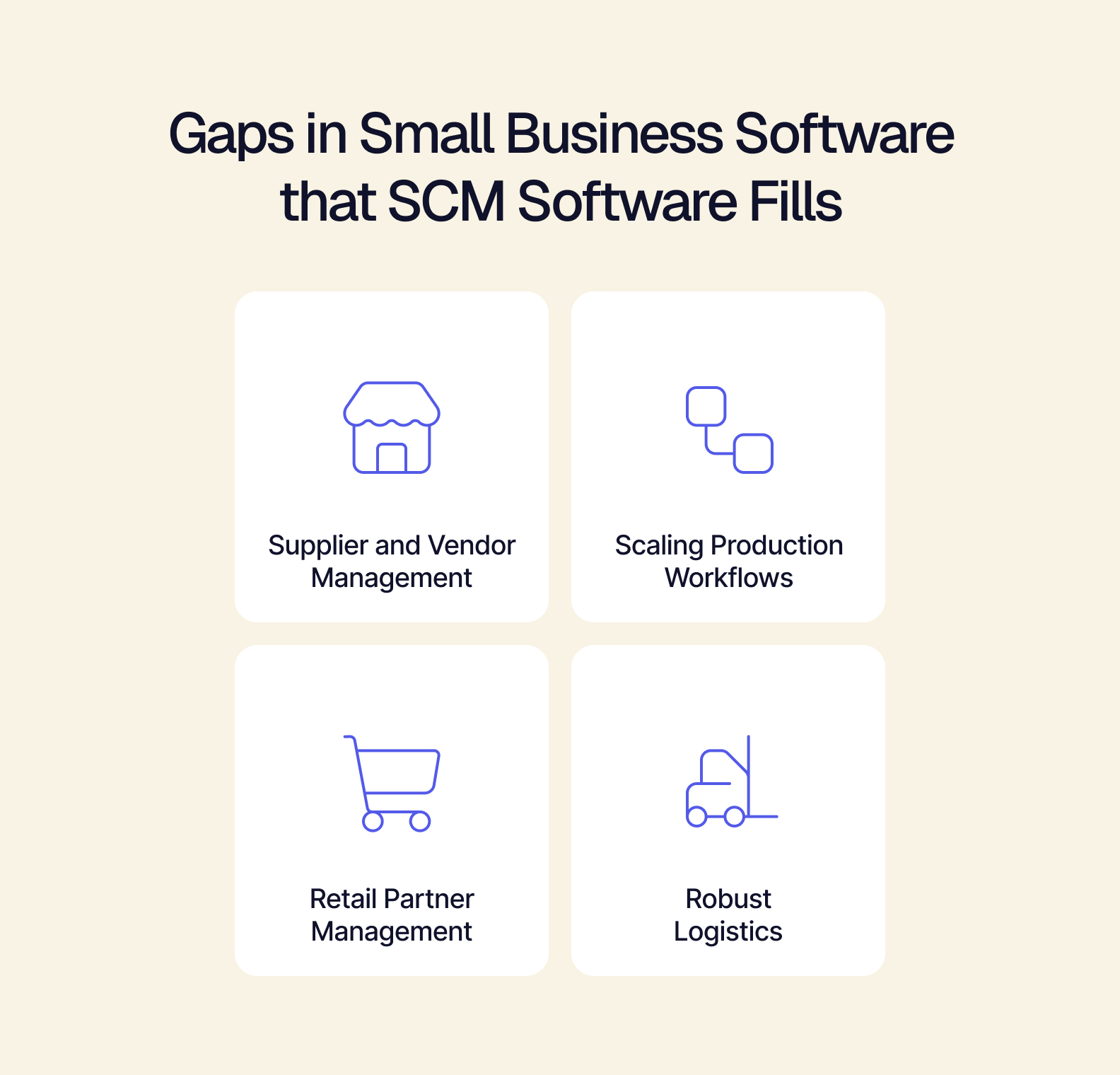
Supplier and Vendor Management Locks Up Productivity
When you grow into a mid-market business, the need for better supplier and vendor management can become almost immediate. You need more products, better purchase order workflows, and a way to manage your costs in real time. Unfortunately, it’s often easier for businesses to lean on spreadsheets and manually tracking of all this information, leading to mistakes and lower agility.
SCM software can meet these needs by helping you find the vendors and suppliers who offer what you need, at a cost you can afford. It can also help you track reliability, availability status, and shipping times — avoiding unnecessary slow downs.
Production Workflows Are Cobbled Together
Small business engagement with production is likely to be fairly limited, but scaling to mid-market often requires an expansion of production (if it fits your business model). Especially when balancing production, logistics, and vendors, these workflows can become rather complicated; something that small businesses-scaled software solutions may struggle to support. The right SCM software will be able to properly track and automate your shop floor, without those workflows becoming a brewing problem for your operations or disrupting your strategy.
Partner Management Scales Poorly
As you grow into a mid-market operation, the reality of managing retail partners can become a significant hurdle. Some retailers require EDI software integrations to do business with, but you also need powerful SCM software that can connect with a partner’s system to enable accurate tracking of inventory not directly in your control. Many small business tools aren’t built to interface with other brands’ software, and are instead focused on your brand only.
Logistics Support Is Too Limited
A similar theme arises in small business to mid-market logistics support. Small businesses have plenty to attend to with their smaller supply chains, but the jump into mid-market might mean the inclusion of third-party warehouses, bigger shipments, and keeping an increasing number of support partners paid. And all that data needs to make it to your Ops team on-time. SCM software can make this happen, by providing the connections, real-time data management, and automations necessary to keep your operations steady.
Choosing the Right SCM Software Integration
Mid-market retailers are put in the uncomfortable position of being “between sizes.” Many SCM software offerings are built for enterprise-scale retail giants, originally designed for monolithic, legacy operations. These solutions are too specialized, rigid, and often expensive for a mid-market retailer.
But the tools meant for small businesses aren’t robust enough to meet your current demands, either.
Obvious “right fit” options are rare, which can be frustrating and confusing, especially when problems need to be solved now. The importance of your supply chain management software shouldn’t be underestimated, so here’s what you should be looking for:
-
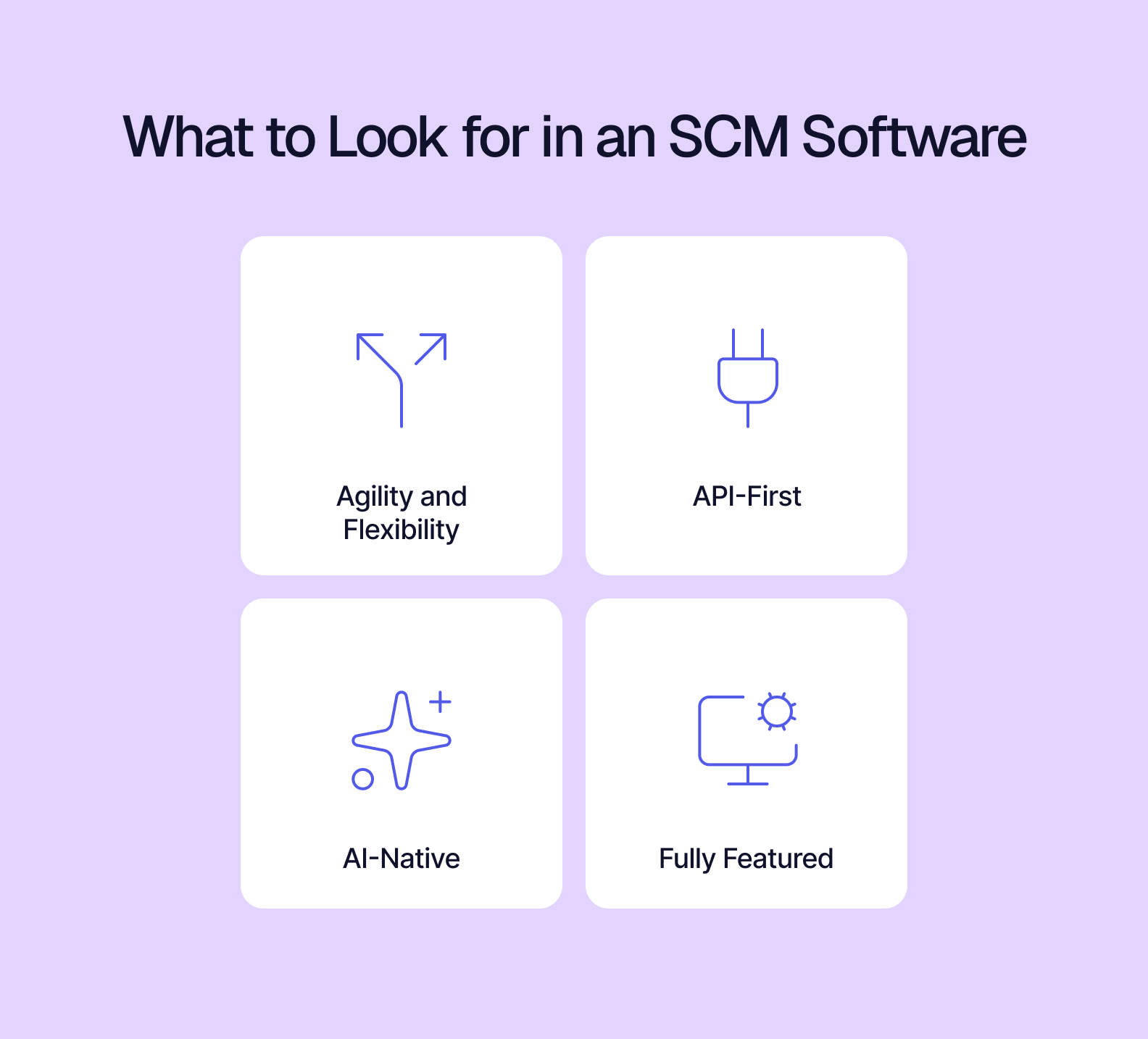
Flexibility and agility. Your business needs to be able to quickly adapt to unpredictable market changes — whether bracing for downturns or taking advantage of new opportunities. You also need to be able to add new tools without having to rip-and-replace old ones or develop custom workarounds to get them operational.
-
API-first. Easier, faster connections mean less operational complexity, which translates into reduced budgetary overhead and processes throughput. API connections give you more control over the tools you integrate into your SCM solution, which directly impacts your adaptability as you grow.
-
AI-native. By integrating a future-forward software, you make it possible to stay ahead of the curve with market trends. Bolted on AI solutions can result in less-than-stellar compatibility with the ever-changing AI landscape and subpar AI automation. An AI-native SCM software integration would feature powerful human-in-the-loop automation and be able to connect with many of the AI platforms you’re already using.
-
Fully featured (for your needs). Not every SCM software will have the features you need to support your business. Some are built for niche use cases, while others are outdated, legacy options. Choosing a modern solution that won’t force you into a bundled ecosystem or ask you to make feature compromises is a good start. The best choice for your needs will focus on the differentiators from this list, while also having room to expand as you grow.
Why Composable Architecture Is Important for Supply Chain Management Software
Your system architecture is the foundation for your entire business, and what it’s built from (and how you build on top of it) matters more than you think. Many businesses tolerate frequent firefighting, expensive rip-and-replace cycles, and constant manual data reconciliation because they think that’s what happens when a business scales — but this doesn’t have to be your reality too.
A composable foundation, one where you can effortlessly add or remove features, is designed to be modular — helping you avoid an ever-complicating string of workarounds for disconnected tools.
Why Modularity Works
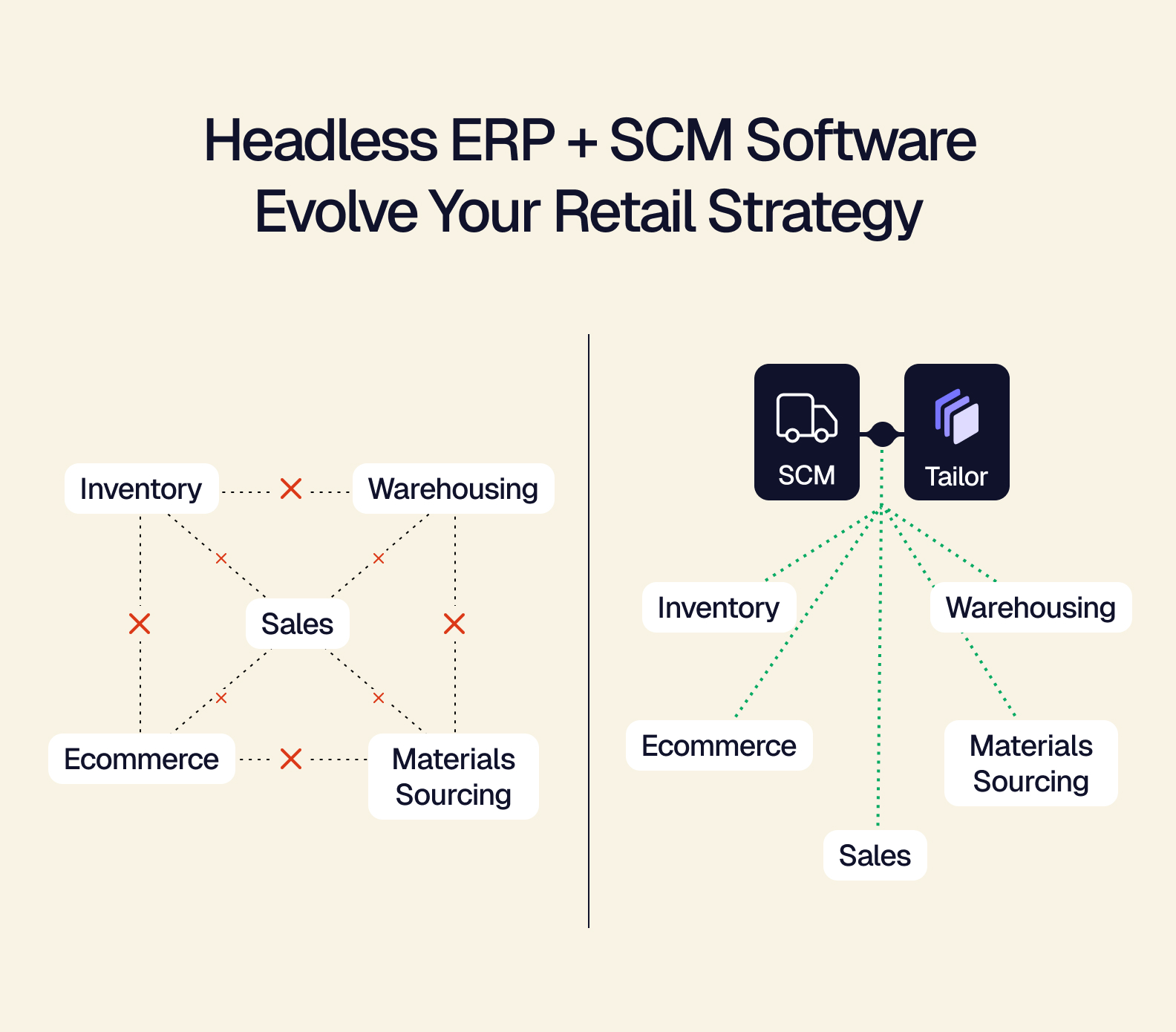
Think of a composable system architecture as being constructed with interchangeable building blocks. You can easily add, remove, or change out new tools, because the connection points are all standardized. With a headless, composable ERP like Tailor, all your business’s most important information is delivered to a single screen — made possible by these modular connections.
But why does this work for mid-market retailers?
Headless system architecture decouples your backend and frontend to make developing your codebase and UI separately possible — which keeps both sides of your business clean while making integrations and UI flexible. This goes in tandem with composability: when your system is modular, your SCM software’s capabilities can be maximized, which empowers your Ops team to do what they do best.
Using ERP and SCM Software to Evolve Your Brand
Before you can implement strong retail strategies as a mid-market retailer, you need to have your system fully supported. If your internal data and processes are a mess, evolving your brand can be a challenge — which limits your available market strategies.
When your strategic playbook is limited, you end up exposed to greater risk from unpredictable market conditions. Inflexible strategies are easily defeated and can prevent you from shifting your focus to new opportunities. In order to mitigate these risks, it’s important for your SCM software to seamlessly integrate with an existing (or future) ERP integration.
However, your ERP of choice matters. Some ERP are built for enterprise operations, with rigid structures and bundled software suites. This mismatch in size and functionality can cause a cascade of new problems that can sink your productivity. So like we recommended for your SCM software, look for a flexible, AI-native, and API-first ERP integration — like Tailor.
Once your ERP and SCM software are fully integrated, you unlock several capabilities that will evolve your mid-market retail strategy:
-
Real-time sync for your systems. When your ERP and SCM software are connected, you’re able to use real-time sync to help you reconcile and manage the large amounts of internal and external data flowing into your business. This helps you identify opportunities and mistakes, while monitoring risk more easily.
-
Human-in-the-loop automation. To keep up with market innovations, your business needs to factor AI automation into its strategy. Retail is unpredictable and fully-autonomous workflows are easily thwarted by rapid changes. Human-in-the-loop automation instead runs easily automated processes, makes suggestions for human operators, and clears bigger tasks with decision-makers before completion.
-
Future-proof scaling for your supply chain. Having both of these systems online — especially if you’ve integrated a headless, composable solution like Tailor — helps you future-proof your supply chain. Building your retail brand on top of flexible, agile, and adaptable software helps you grow the way you need to. This keeps your future open and doesn’t force you to grow to meet the demands of a rigid, monolithic software suite.
When your strategy is built around these powerful unlocks, the modularity of your system architecture, and the scalability you achieve through connecting your ERP and SCM, you can take your market head-on while your competitors fall behind.
Improve Your SCM Software Integration
Tailor understands what makes modern retail brands thrive, and our composable software offerings are designed to keep growing retail brands focused on what they do best — without the headaches, costs, and long integration times of other software products.
If you’re struggling to get the most out of an existing ERP or SCM integration, or you’re being held back by rigid software and convoluted workflows, talk with our experts today.