Scaling any business in this economy is tough, but securing conversions in a jewelry business can be especially hard. Yet, according to the 2026 McKinsey State of Fashion, jewelry is poised to be the fastest-growing fashion category by unit sales. Despite the difficulties facing jewelry brands, you can set your business up to thrive by improving the data you work with and properly scaling your operations.
Choosing ERP software that’s built for jewelry businesses can help you integrate your tools to improve visibility across your sales floors and understand what your customers actually want.
What you will learn:
-
Why the complexity of jewelry strains traditional inventory management systems and processes.
-
The real cost of leveraging patchwork tools and stop-gap solutions when scaling your jewelry brand.
-
How traditional and modern ERP systems handle retail jewelry operations.
-
How Tailor can work with your existing storefront to support your growth.
Why Physical Storefronts Matter for Growing Jewelry Brands
As consumers face rising costs of living and dwindling disposable income, they can become even more hesitant to commit to luxury and specialty purchases, especially online.
The Knot released its “Real Weddings Study” earlier this year, which surveyed over 10,000 couples married in 2025; 64 percent bought their engagement ring in-store, and more than half said shopping in person is important. Although this is just a small snapshot of a much larger industry, it still highlights shoppers’ concerns about fit and the finished product.
It also means that scaling retail brands need to consider two points:
-
Physical locations matter for some niches. Showrooms, pop-ups, and partner locations deserve consideration in your scaling strategy.
-
Good data management must not be ignored. More physical locations, POS systems, and logistics management demand an ERP system that can reconcile data accurately, in real time. Pieces selling at multiple storefronts should trigger production, reordering, or manufacturing processes before your stock runs out and customers are left frustrated.
What Jewelers Really Need from ERP Software
Buyer behavior indicates increased demand for self-gifted jewelry (up 58 percent since 2021). An area where retail brands can struggle to support this growth is in customizable, one-of-a-kind (OOAK), and made-to-order (MTO) pieces. Especially for wedding jewelry, Knot’s survey showed 88% of participants purchased custom-designed rings or added customizations to their purchase.
This is where ecommerce jewelry businesses have a unique advantage: they aren't bound by a physical store's limitations.
Online jewelry brands can offer unlimited SKUs, and paired with advances in AI, creating an online experience that lets shoppers fully immerse themselves in a piece's look and feel is easier than ever. However, with each additional offering and attribute (metal, stone, engraving, chain length, etc.), the systems behind the scenes have to track more.
Rigid traditional ERPs and spreadsheets tend to break under the complexity, leaving teams to reconcile stock and costs manually while orders pile up. Growth stalls, and it becomes clear that what separates a $2M jewelry business from a $20M jewelry operation is whether their backend can keep pace. If your goal is to scale your jewelry business in 2026, operational excellence is what moves the needle, and a headless, composable ERP is the gold standard.
Granted, when every piece is one-of-a-kind, you can’t manage inventory in the same way you would a standard catalog. Each personalized order requires its own unique combination of attributes, and a rigid ERP or patchwork tool forces those details to go unaccounted for — or rely on manual workarounds that can’t scale at high volume. Tailor’s headless, composable ERP is built to fit your business and handle orders from fabrication to purchase.
Here are a few ways Tailor can make a difference for your jewelry business today:
-
Solutions customized for your business, not the other way around. Tailor’s low-code platform lets you customize your workflows, making it easy to adapt as your offerings grow.
-
Backend tracking with real-time accuracy. Tailor tracks stock in real time with batch, lot, and serial details, and sets the stage for audit-ready reports by logging stock movements as they occur.
-
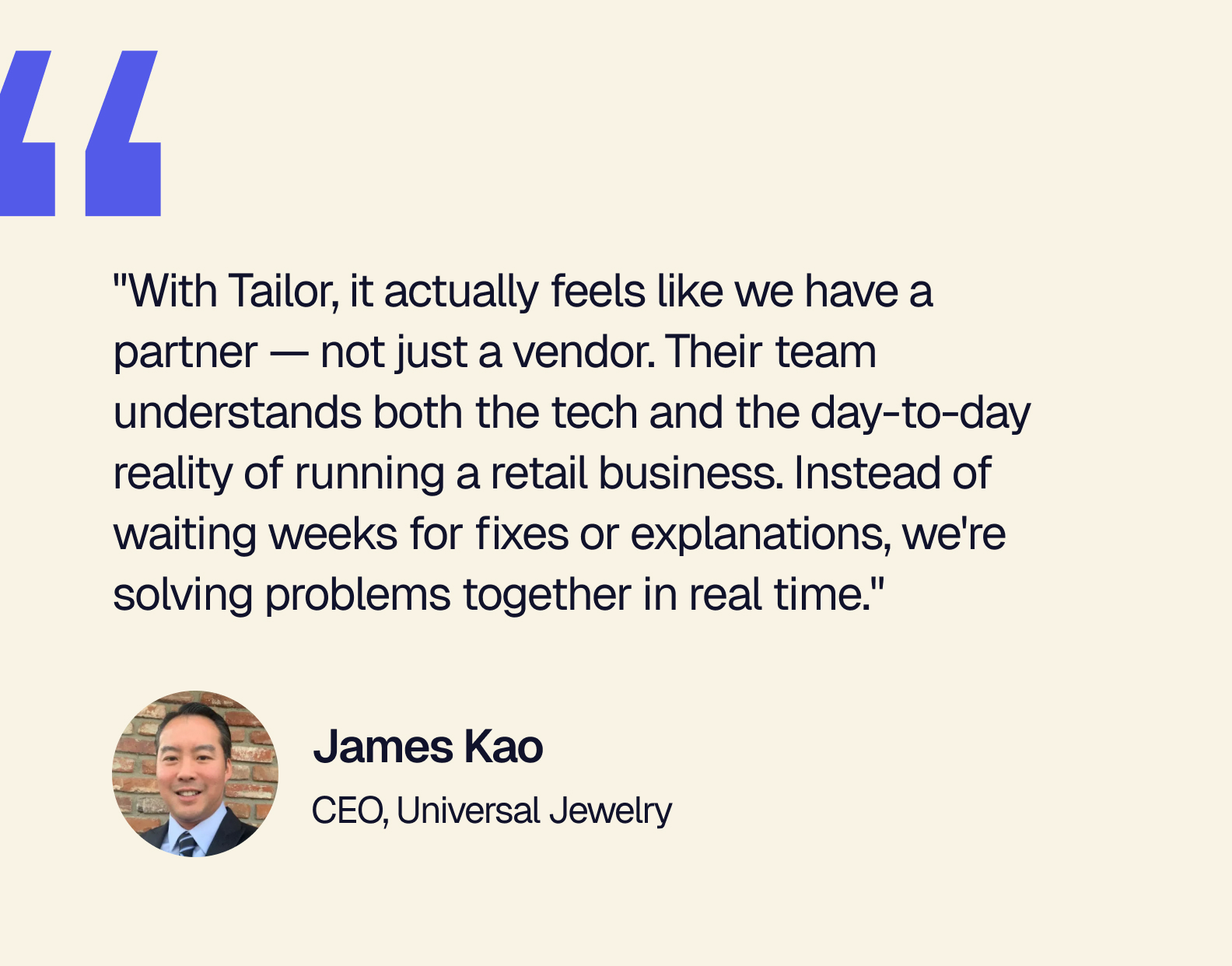
Keep operations in sync across every channel. For brands like Universal Jewelry — a made-to-order jeweler — Tailor provides a custom connector to manage order flows. In less than eight weeks, the team reported greater operational stability and continued seamless sales across channels, including Shopify and social media (like TikTok Shop).
Ecommerce Platforms and Rigid ERP Software Can Limit Your Jewelry Business
Like Universal Jewelry, many successful jewelry brands start on traditional ecommerce platforms like Shopify, but often quickly outgrow them.
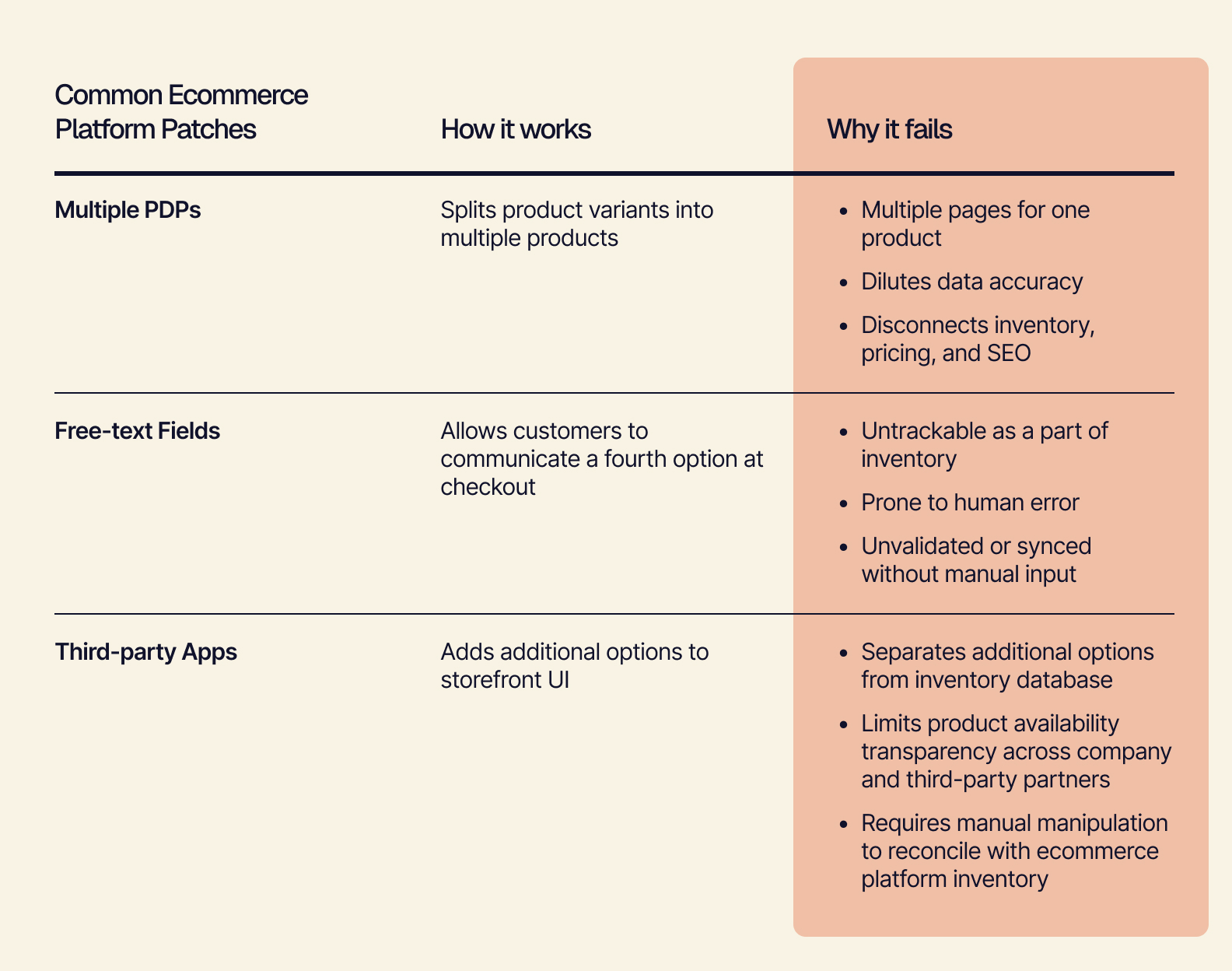
Most digital storefronts aren’t built for the complexity of a jewelry business, and one focused on personalization is even more challenging. These platforms are built for basic order and inventory management. Every attribute multiplies the potential for failure on the backend, and every “fix” requires you to integrate a new solution that may cause incompatibilities later.
Solving problems in your tech stack this way can result in data that doesn’t flow properly. In turn, this makes it so that teams have to manually cobble together disparate information, creating a bottleneck and burnout.
The Right Tools Can Help Jewelry Businesses Thrive
The answer isn’t always a new or “better” storefront; that can be a large (and costly) undertaking for a growing business. Often, stop-gap solutions for jewelry order management are unavoidable due to budget and timeline constraints. In those instances, decision-makers look for third-party apps to help bridge the gap.
Prior to working with Tailor, Universal Jewelry relied on a different tool to help sync Shopify and Odoo, but the updates often resulted in slow turnarounds and errors.
According to Matthew Laskowski, Order Processing Representative and Engraver at Universal Jewelry, at one point the team was “...constantly putting out fires — manual fixes, mismatched data and sync failures no one could fully trace back to the source.”
To eliminate this pain point, Tailor built a native Shopify and Odoo connector that enabled real-time data synchronization without rebuilding their Shopify storefront and mapping multiple Shopify options to one Odoo product.
Most ecommerce platforms alone aren’t built for the level of complexity that comes with running a jewelry brand, but with the right tools, like Tailor, your business can grow confidently beyond your storefront’s limitations.
Headless, Composable ERP Can Make a Rock-Solid Difference
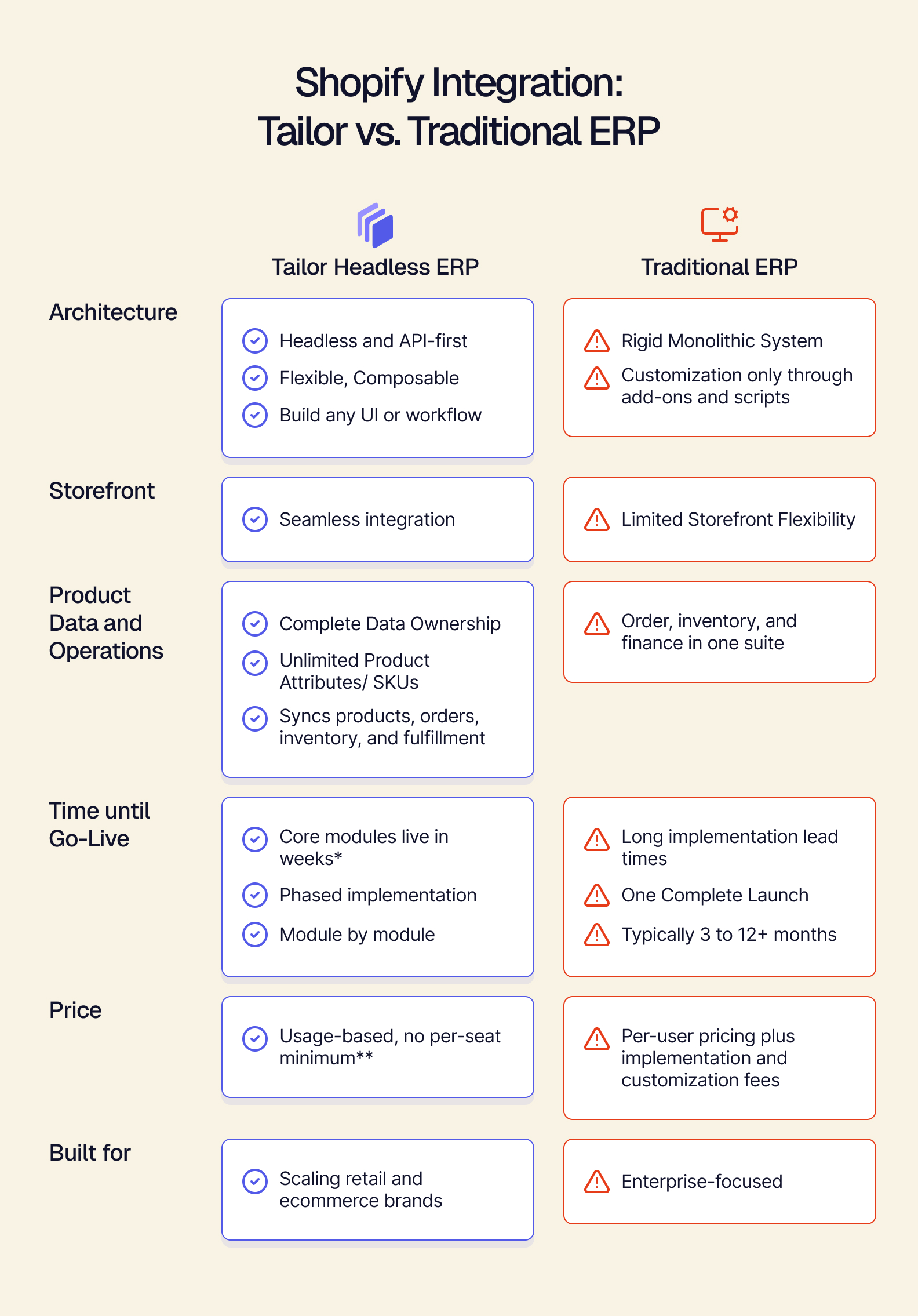
When it comes to choosing the right operational workflow for your business, it’s important to consider how different ERP solutions can affect your agility. While traditional ERPs can work well for enterprise jewelers, they often don’t suit businesses in the midst of scaling. Agile SMBs often find rigid ERP systems require long implementation timelines and offer little flexibility. Their one-size-fits-all solutions often require costly customizations and user minimums, while still being unable to quickly and easily handle your complex jewelry business’s backend needs.
Headless, composable ERP systems like Tailor take a different approach.
Tailor provides real-time, high-SKU inventory management and synchronization across your entire jewelry business, streamlining operations and reducing errors. With Tailor as the single source of truth for your critical data, you no longer risk inventory mismanagement errors that can delay orders and lead to customer dissatisfaction. But how does it work?
-
Tailor’s headless architecture decouples your stack’s backend codebase from your frontend UI, enabling you to develop your backend functionality without breaking the workflows your team relies on — and vice versa.
-
Tailor also uses composable design to make adding, removing, and upgrading the software in your tech stack easy. You can use all available modules (like inventory management, cost accounting, and purchase management, to name a few), or pick and choose what you need.
With a headless, composable ERP, you get the best of both worlds: you can add new features to support growth while keeping the tools you already use.
Scaling Faster Doesn’t Have to Make Operations Stall
Tailor gives jewelry brands the necessary support behind the scenes to create an adaptable single source of truth for all their business needs. With our API-first, developer-friendly, modular system, you can have a right-sized solution for your business that provides a predictable and flexible foundation to build your business upon.
Before you overhaul your storefront or commit to rigid legacy, book a demo with Tailor today. Our team will show you how our headless, composable ERP can support your jewelry business, without asking you to give up the tools you use every day.