For some scaling retail brands, expanding their supply chains feels like a looming (and expensive) endeavor without a guidebook. Integrating the right software and building up the proper infrastructure can take a lot of time, and it’s far too easy to grow different segments unevenly — resulting in technical hiccups and stressed budgets.
But what if your brand could start with a leg up?
We’ve prepared this quick-start guide for retail brands that may be ready to scale their supply chain, but aren’t sure where to start. We’ll take a look at many of the key areas that supply chain management (SCM) software interfaces with your business, while exploring how SCM connects and partners with ERP software to properly manage your operations.
You will also learn:
-
What supply chain management software does for retail brands
-
Which features SCM software need to support growing retailers
-
How SCM software interfaces with supply chains
-
Why retailers should pair SCM software with headless, composable ERP
What Supply Chain Management Software Does for Retailers
Supply chain management software is a key piece of connective tissue for growing retailers. Perhaps your business has grown to the point that it benefits from robust inventory management, forecasting, and production workflows. Each of these requires its own systems and solutions to be properly integrated into your day-to-day operations.
While your ERP manages the internal functions of your business and helps data flow where it needs to go, your SCM software is responsible for external functions — managing data from sales, distribution, vendors, outsourced production, and warehouses. These software solutions go hand-in-hand and are extremely important for enabling a smooth, organized operations environment.
Solutions like Oracle Fusion Cloud SCM, SAP Integrated Business Planning (IBP), or Kinaxis Maestro all provide robust support to the businesses that use them — but they may not be appropriate for a smaller retail brand due to higher total cost of ownership (TCO) and rigid, enterprise-scaled toolsets.
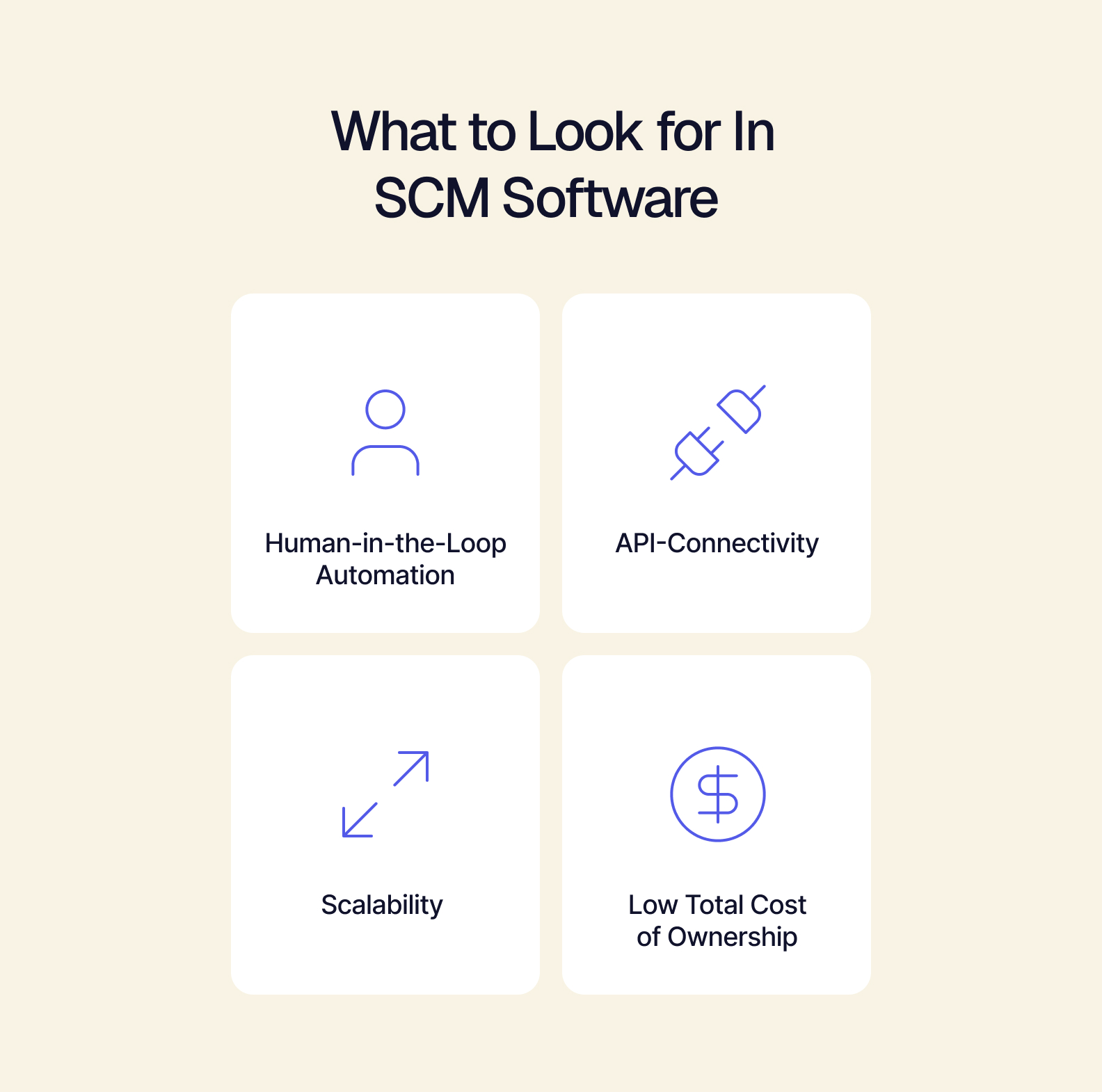
Thankfully, there are SCM solutions designed for non-enterprise businesses. Here’s what you’ll want to look for in an SCM software integration:
-
Human-in-the-loop AI automation. SCM software is designed to automate many of the processes your business needs to compete in the modern marketplace. However, typical machine-learning automation may not be enough to keep up. SCM software that’s AI-native and provides suggestions to decision-makers (to keep humans in the loop) could shape up to be more powerful than non-AI automation in the right hands.
-
API-connectivity. When you’re shopping for SCM software, your ultimate goal should be compatibility with the rest of your system — especially something that would integrate with a flexible ERP system (headless and composable is a plus). To achieve a high level of compatibility with modern software, an SCM that’s API-native will enable you to use the software as you scale, for much longer than an SCM solution that requires specific additional feature bundles or suites to function.
-
Scalability. For any growing retail brand, software needs to scale. Paying for rip-and-replace cycles every year or two is a slow-moving disaster that eats up technical bandwidth, operating budgets, and often creates more problems as time goes on. By choosing a scalable SCM that can be relied on for several years at a time, you can increase your agility and easily expand when you need to.
-
Low total cost of ownership. Enterprise-scaled SCM solutions are often prohibitively expensive for smaller retail operations and come with a hefty TCO. The right SCM for your business will have a low TCO, with features that are meant to scale with you — rather than force you to scale a certain way.
Understanding What SCM Software Impacts in a Business
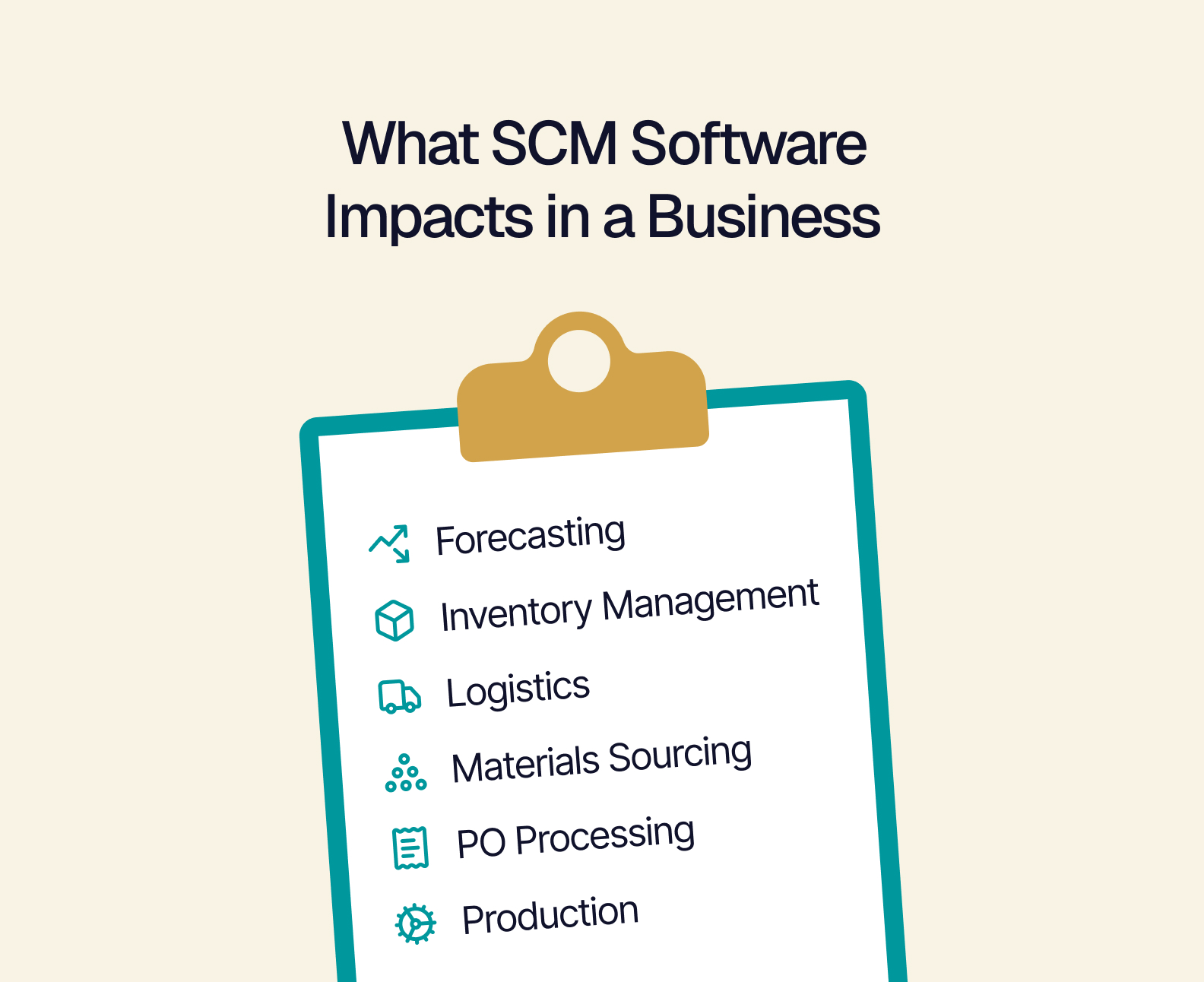
The next part of understanding what an SCM does is to identify what parts of the business it’s tied into and how it impacts them.
Forecasting
One of the most powerful tools any retail business can manage is forecasting. Accurate forecasting requires accurate past and present data to be successful, which is where SCM software comes in. Because SCM solutions manage your external data, they’re able to combine that flow with your internal data to map out predictions. Forecasting can’t tell the future, but it can help eliminate certain possibilities and guide you in the right direction by:
Forecasting can be dramatically improved when combined with a headless, composable ERP — something we’ll explore soon.
Inventory Management
Linked to SCM software forecasting is its ability to manage your inventory. SCM solutions are built to interface with your vendors or other third parties, giving you automated tools to reorder popular items at regular intervals, further avoiding stockouts. Additionally, with better managed external connections and data flow, the right SCM software integration can lower the holding cost of your inventory — translating into greater operating budget overhead to better react to customer demands or new opportunities.
Click here to learn more about how software integrations can improve your inventory management.
Logistics
When it comes to logistics, SCM software is able to help optimize your transportation times and costs associated with moving your products — from receipt of materials to customer fulfillment. These optimizations indirectly affect how expensive your materials sourcing and warehousing can be, which can result in a more refined budget for those areas.
Materials Sourcing
When you’re building your own production environment, you need vendors and suppliers you can rely on. The right SCM software integration will enable you to track vendor performance and reduce friction in your procurement process. This data and overall improvement to your process will help you choose the best partners for your production needs and lower your overall risk exposure as a result.
PO Processing
Between a headless, composable ERP and SCM software integration, you can substantially improve your PO processing times — especially with human-in-the-loop automation workflows and real-time sync. With these two advancements, your POs benefit from increased data accuracy, along with increased flexibility for your supplier communications and payments. Together, these tools will help you achieve a fully integrated retail operations system that’s ready to scale with your business.
Learn about how you can improve your PO processing.
Production
A strong production environment relies on timely data delivery, a tightly orchestrated shop floor, intelligent resource planning, and automations that generate manufacturing and sales orders. And those are just the internal needs, which the right ERP integration handles. But those internal processes also need external data to work properly; the right SCM software integration will synchronize your production schedule with your available inventory by reconciling vendor availability with your demand forecasts.
Power up your production management with a composable Production Module that will connect with your SCM software integrations.
How SCM Software Integration and Headless, Composable ERP Transform Your Retail Ops
With your ERP managing your internal operations and data, and your SCM managing your external operations and data, it’s easy to imagine that these two types of software thrive on synergizing with each other — and in well-structured business environments, that’s exactly what they’re supposed to do. However, it’s possible to end up with these systems clashing, and it’s necessary to understand why that is, what you can do about it, and how to build a system where they sync up.
The Problem
SCM and ERP can clash when both software are monolithic and rigid. Imagine a situation where you’ve integrated a rigid ERP suite — like NetSuite or SAP — and ended up saddled with a software suite with very specific third-party software compatibility. The higher TCO of the rigid ERP has been difficult, but you’ve adapted. In an effort to shrink your operating budget, you want to integrate an SCM software that isn’t built explicitly to work with your ERP.
After beginning the integration process, it becomes clear your ERP and SCM aren’t fully compatible, and you have to invest in creating a custom bridge to make these two solutions work together.
The Solution
Rather than trying to force two rigid solutions to work together, you can replace rigid software with a composable option. Tailor’s headless, composable ERP features a flexible and decoupled system that allows you to develop your backend infrastructure and frontend displays separately — but you don’t have to build a custom UI unless you want to; Tailor features an out-of-the-box UI that’s ready to use. All tech stack connections are managed through APIs, making it easy to integrate nearly any modern software you purchase.
Now, when you purchase an SCM solution, you won’t have to spend the resources building a custom bridge, and your integration can be live in just a few weeks.
Building a System that Synchronizes
The key to building a cohesive, synchronized system that’s working toward your growth is to start with a composable foundation. Where headless software features a decoupled backend and frontend, a composable system is modular — like interchangeable building blocks. This helps you add, remove, and upgrade features without lengthy integration times, while enabling you to choose the tools and solutions your business actually needs to keep up with the current market.
When it comes to your supply chain management, a composable system enables you to interface with more vendors, make important software decisions like EDI integration (which large retailers often require when putting deals together), and use warehousing solutions. Then, because your ERP is composable, your SCM software is able to connect directly to a single source of truth that reconciles your internal and external data without the need for manual work and spreadsheets.
Manage Your Supply Chain with a Composable System
Scaling brands need powerful supply chain management software to keep up with the competition, and it’s far too easy to end up with a system that’s fighting itself and slowing processes down. If this is the case for your business, you can change the status quo.
By choosing Tailor’s headless, composable ERP — or integrating our composable modules and connectors — you can break the cycle of manual reconciliation, slowdowns, and supply chain strain. Book a demo, and our experts will show you how composable software empowers your supply chain management software to do exactly what it should be doing.