With today’s often unpredictable market environment, retail brands can’t afford to take unwarranted risks — but they also can’t afford to be held back by software integrations. System architecture is the foundation that retail operations depend on, and when it’s not quite right, the consequences can be difficult to overcome.
If a business cannot scale fast enough to keep up with market demands, it risks being left behind. Building a business with the wrong system architecture doesn’t have to be a catastrophic error; switching to a composable architecture can get retail brands on a growth trajectory for rapid scaling.
What you’ll learn:
-
What composable architecture is and how it supports retailers
-
Four problems composable architecture can solve
-
Why headless, composable ERP might be the right choice
What Is Composable Architecture
Composable architecture is the backbone (or design philosophy) behind composable software. When we think about the word “composable” in other contexts, it means that something can be arranged, stacked, or built up to create a new design or rearrange what was there before. Bringing that concept into software results in a system that’s designed to be modular — like interchangeable building blocks.
What would it look like to make a retail brand’s system architecture composable? The short answer is a lean system that is highly customizable and easily modified. But what does this actually look like in application?
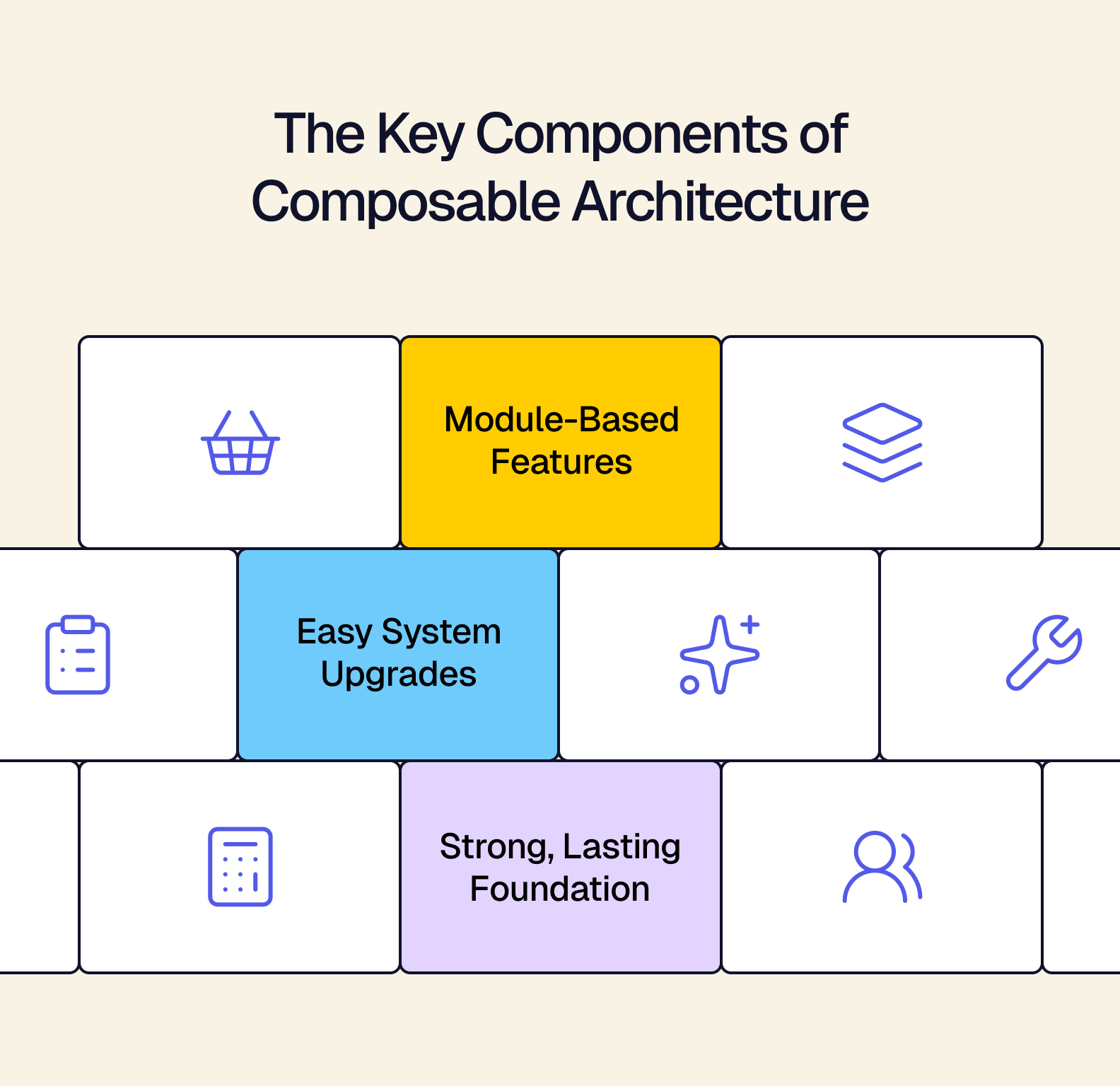
Features are Organized by Modules
Rigid systems often force adopters to integrate software bundles that cover a wide range of different functions. While suites and bundles are commonplace, the reality is that these bundles come with a lot of baggage that growing retail brands shouldn’t have to pay for. This is where composable architecture can flip this idea on its head:
Tailor offers different modules built with specific features for different workflows — based on popular retail use cases. An inventory management module integrates all the necessary features a retailer might need to keep their inventory workflows operational and accurate.
So rather than demanding the integration of a software bundle, Tailor provides a curated module that has all the necessary features to meet a variety of needs, including inventory, production, purchasing, cost accounting, and omnichannel.
Systems are Easy to Upgrade
When a system is designed to function like interchangeable building blocks, it’s substantially easier to upgrade. Rather than spending endless months tying different workflows together to support a new tech stack addition, a system built on composable architecture can plug in new software and tools with shorter timelines, less complexity, and fewer compatibility concerns than in a rigid system.
Additionally, if a business needed to replace part of its stack with a more powerful upgrade, it could avoid lengthy rip-and-replace cycles. This is possible because the stack is managed by API connections — rather than complicated, messy, and deeply intertwined installations hosted on physical hardware.
Building on a Foundation That Lasts
Rigid systems are built with legacy businesses in mind — they lack flexibility and require retail brands to operate in certain ways to make the most of what they’re paying for. This leads to a foundation that can get increasingly brittle over time. “The shoe” (or system architecture) simply doesn’t fit the business, which results in degraded performance over time.
Composable system architecture scales dynamically with the growth of a business, allowing them to keep their options open. This leads to a foundation that keeps pace with the needs of the business, resulting in “the shoe” being the right size. It won’t become brittle and break, making it the best foundation for a growing retail brand to build on top of.
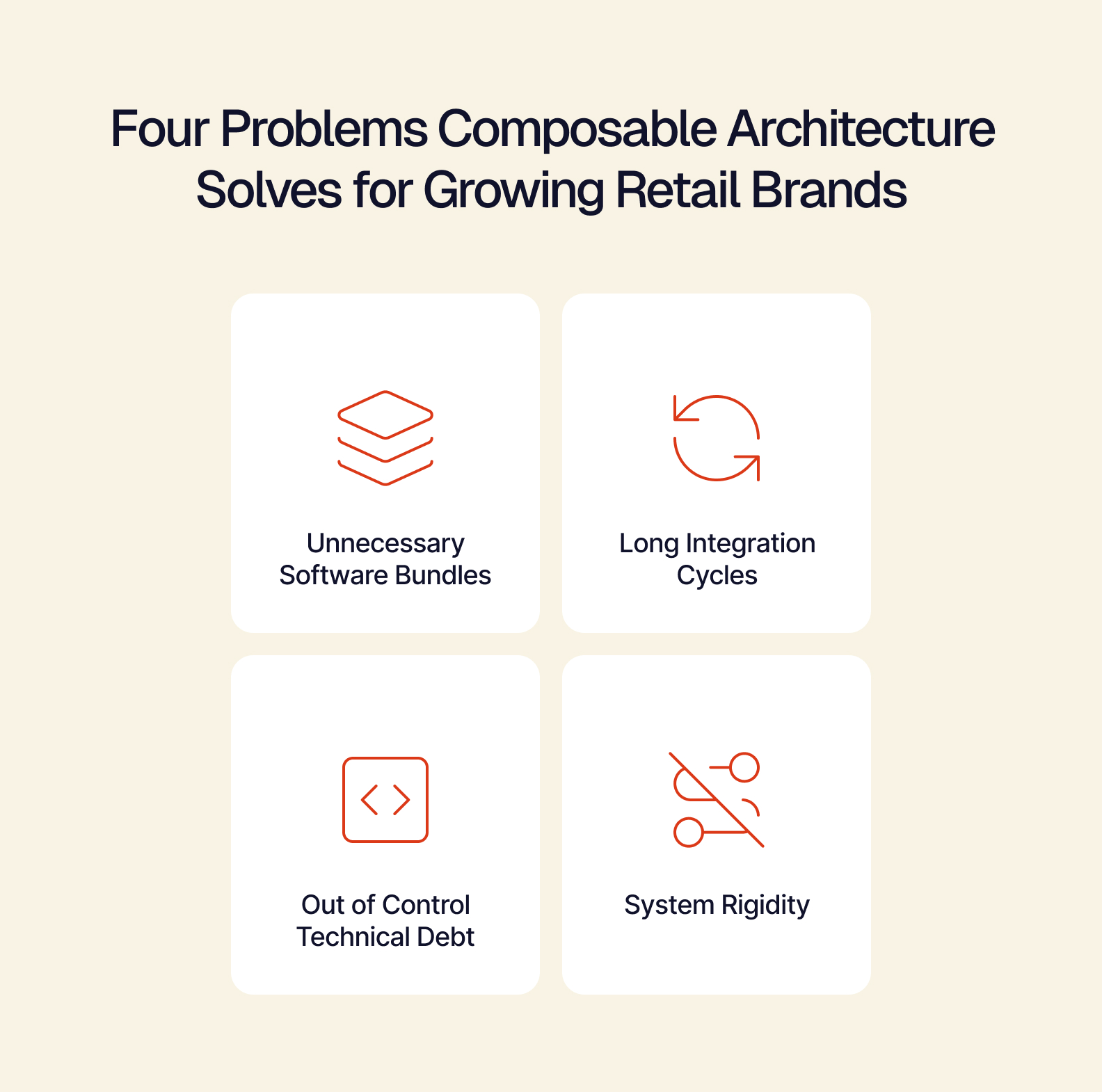
4 Problems Composable Architecture Solves
Problem 1: Unnecessary Software Bundles
Monolithic ERP systems often force bundled software packages to be integrated into a retailer's tech stack. This can create a situation where tools that were working for that retailer have to be ripped out and replaced by a tool in the bundle — causing teams to have to learn new workflows and retrain on a system that isn’t designed to fit their existing processes. The friction (and cost) of these rip-and-replace cycles puts significant strain on teams and systems alike, often causing more problems than they solve.
Composable architecture (and by extension, a headless, composable ERP like Tailor) ensures that bundling doesn’t have to happen. Instead, composable architecture enables businesses to keep the tools their workflows depend on, while making it easy to integrate new software later.
Problem 2: Long Integration Cycles
Long integration cycles are a result of a few different factors:
-
Scope creep. During integration cycles, the scope can expand as new, reactive needs arise. This complicates things and can add weeks, or even months, to even the most well-planned integrations.
-
Legacy system architecture. Some software integrations are slowed by the tools developed with old, complicated system architecture meant an earlier decade. This type of software can result in custom bridges needing to be developed to properly integrate into a business, or require technical experts for that tool to get involved — lengthening integration time and ballooning costs.
-
Strict software compatibility. Sometimes long integrations are caused by strict software compatibility lists. A legacy tool may not be compatible with an existing tool, resulting in needing to remove that tool, then integrating another tool that is compatible with the initial software integration.
Problem 3: Out of Control Technical Debt
Over time, businesses that have complicated tech stacks full of hacked-together workflows and workarounds build up technical debt. This technical debt makes it increasingly difficult to add new tools to a stack without headaches and broken processes. Composable architecture solves this problem by removing the need for those workarounds and hacked-together workflows.
Problem 4: System Rigidity
Growing retail brands can't afford to be slowed down by an inflexible system that saddles them with unnecessary baggage. Retailers that can’t pivot on a moment’s notice or pursue new markets because of funds tied up in operating overhead get left behind over time. By rebuilding their tech stack on composable architecture, brands can escape the operational dangers that come with system rigidity. The system flexibility offered by composable architecture ensures that retailers looking to scale aren’t held back by the tools they use every day.
Q&A: Why Tailor's Modules and Headless, Composable ERP Might Be Right for You
Q: Is Tailor an enterprise-grade ERP like NetSuite or SAP?
A: No. Tailor offers retail brands the system flexibility to scale the way they want, without the baggage that comes with integrating a rigid, monolithic ERP system. Where NetSuite or SAP might demand that one of their customers purchase and integrate bundles of tools (and rip out existing integrations), Tailor enables retailers to keep what was working. This means that a retailer that integrates Tailor gets to continue operating how they want, with a strong foundation that supports their entire operation.
Q: How does Tailor save me time and money while helping my business scale?
A: With no user minimums or per-seat pricing, Tailor provides a powerful ERP solution based around usage — with modules that provide only the features a retailer might need. This ensures that you’re not paying for bundles you won’t use. Tailor also reduces system bloat, which has a three-pronged benefit:
-
Shorter integration runway. Integrations can happen faster, lowering the overall total cost of ownership (TCO) of newly purchased software. Your technical experts spend less time fixing problems and can roll out new features over time, rather than all at once.
-
More efficient workflows. When you only integrate the tools you need, and use the software that actually works for your operations, your workflows can stay simple — increasing efficiency and preventing unnecessary complication when you add to your tech stack.
-
Lower TCO, bigger operating budgets. Usage-based pricing, shorter integrations, efficient workflows, and a fully composable system mean that Tailor’s TCO is lower than monolithic and other cloud-based ERP options. This frees up your operating budgets to focus on what matters most: taking on new markets, meeting your customers’ needs, and scaling without being held back.
Q: Will integrating a headless, composable ERP take as long as other retail ERP solutions?
A: No. Tailor’s integration timeline is 3 to 6 months total, with a phased rollout schedule of about six weeks per module — compared to monolithic ERP integrations which can take 9–24 months. This helps to get features online faster, without the problems that can come with a single go-live that monolithic ERP solutions may push for. Unlike other ERP vendors, Tailor’s experts directly collaborate with your team to perform the integration, which helps keep the timeline on track.
Q: My system is already lean. Do I really need composable architecture?
A: For most brands, the answer is yes. Integrating composable architecture early in your scaling process is insurance that your business will avoid some of the pitfalls your competitors may be rushing headlong into. It only takes one large retail partner to demand a rushed software integration — like an EDI — that your system might not be ready for.
If that integration doesn’t go well, it can kick off cascading problems within your retail operations. With a composable system architecture, your processes are far less likely to get tripped up by a sudden integration. Plus, integrating Tailor’s composable ERP ensures your system can remain lean as your business grows — meaning your operations can more easily maintain peak performance during your most hectic seasons.
Start Building on a Composable Foundation
Even if you’ve been building on the wrong foundation for your business, rebuilding on a composable foundation can strip away existing problems and speed up the rate at which you can scale. Composable architecture helps modernize your retail operations and keep your tech stack on the cutting edge; you can keep up with market pressures instead of dragging behind.
That’s why integrating a headless, composable ERP like Tailor is so important for growing retail brands: its curated, out-of-the-box UI and preconfigured modules meet the current moment — while being fully customizable to change as your business develops. If you’re ready to start building on a stronger, more flexible foundation, book a demo with Tailor today.