Your typical ERP purchasing decision often comes down to how well the chosen ERP will support daily operations and streamline workflows across your business. Most businesses search for potential ERP integrations based on feature checklists, but sometimes it makes more sense to start your search on an architectural level.
At this level, there are two choices: cloud ERP and on-premise ERP. Both ERP types have different risks to manage, so it’s important to be clear on the two core risks that need to be managed in the cloud ERP vs. on-premise ERP discussion: security and scalability.
This guide will help you shift the way you think about both cloud ERP and on-premise ERP solutions by:
-
Distilling the impacts each type of ERP can have on your business.
-
Analyzing how both types of ERP can deliver security and scalability wins.
-
Providing an objective dealmaker/deal-breaker cheat sheet to make shopping for ERPs easier.
Evaluating Cloud ERPs on an Architectural Level
The Advantage of Flexible Cloud ERP Integrations
Not all cloud ERP solutions are created equal. While many cloud ERP solutions are designed to solve immediate problems and set your business up to succeed in the short term, shockingly few are positioned to support your future. This is where headless and composable ERP solutions come into play.
First, a brief primer on “headless” and “composable” solutions:
-
Headless defined: a decoupled frontend (user interface or UI) and backend (the code that allows the software to function). This creates an opportunity for customized UI and adaptable, team-based workflows.
-
Composable defined: modular design that enables software to be added to, stripped down, or modified — without losing access to all the software’s features.
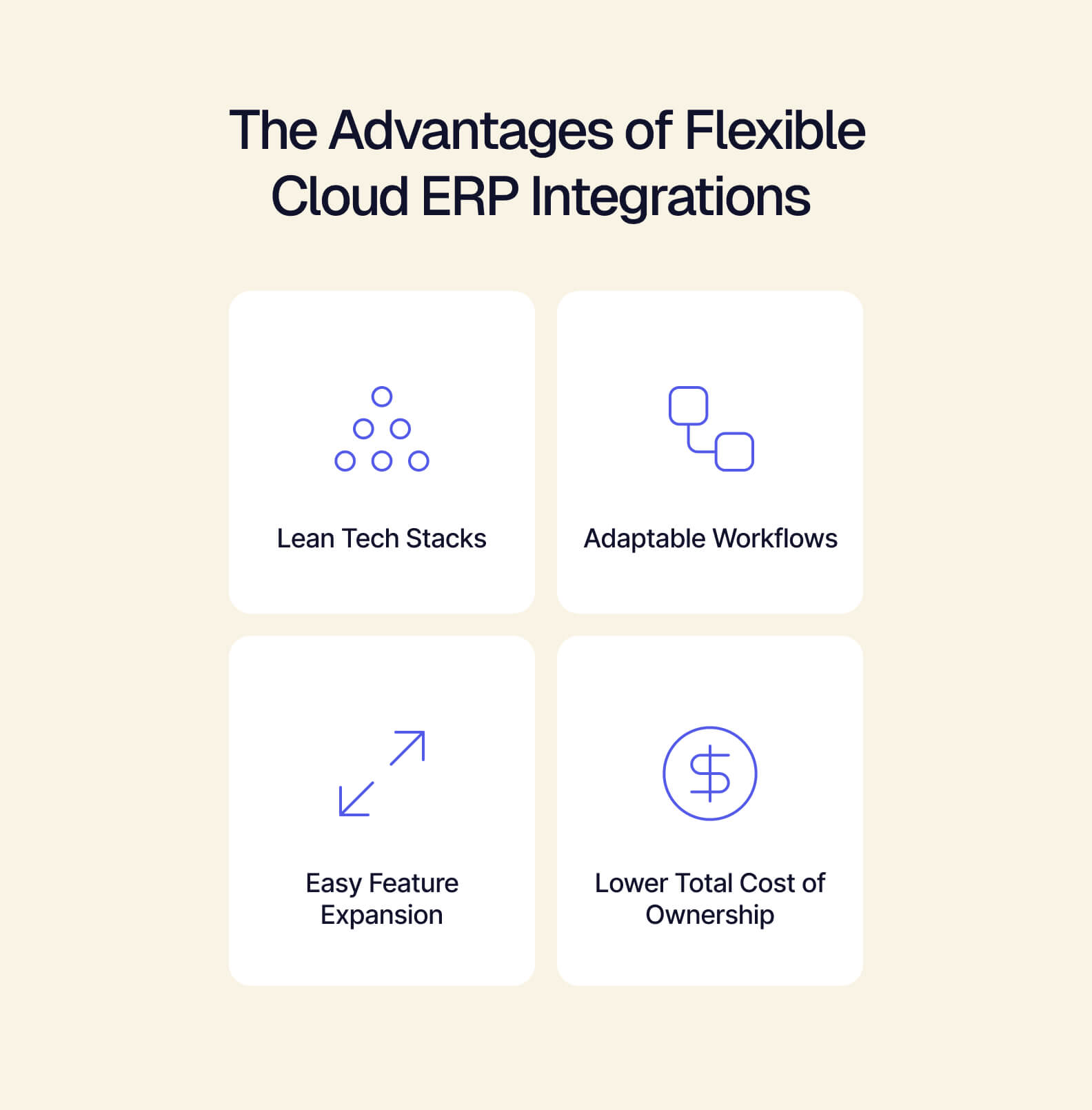
Now that we understand what headless and composable mean in relation to ERP solutions, we can dig into the clear advantages of flexible cloud ERP integrations (both headless and composable). Let’s start with the architectural benefits:
Benefit 1: Lean tech stacks.
- Flexible cloud ERPs tend to lean on API-native connections to keep tech stacks leaner, creating fewer incompatibility risks when you need to overhaul your business systems.
Benefit 2: Adaptable workflows.
- Some ERPs come with hardcoded workflows that can run counter to how your business operates on a daily basis. Flexible cloud ERPs enable you to adjust standard workflows to work better for your day-to-day operations.
Benefit 3: Easy feature expansion.
- Because a flexible cloud ERP is built on a composable backend, it enables you to easily add new features (either through API connections or through custom tool development) that meet the moment — or set you up to be ready for future growth.
Benefit 4: Lower total cost of ownership (TCO).
- TCO is an often overlooked aspect of software ownership. Cloud ERPs can provide lower financial footprints by taking away some of the standard costs involved with hosting an on-premise ERP: hardware, maintenance, security upgrades, etc.
How Cloud ERPs Make Keeping Up with Security Standards a Breeze
Utilizing strong security standards within your business can be the difference between notifying customers of a security breach (plus paying for damages) and carrying on with business as usual. A well-defended and security-compliant cloud ERP greatly fortifies your business from security threats. This is accomplished through:
-
Vendor-managed cybersecurity. Maintaining your own security systems for your business is a hallmark of achieving long-term business success. The downside is that the infrastructure it demands can be expensive and requires retaining specialized IT staff. Cloud ERP software security, instead, is managed by the software’s vendor, who is usually far better equipped for managing security needs.
-
Higher access hurdles. Many cloud ERP vendors encourage their users to use multi-factor authentication (MFA), role-based access control (RBAC), single sign-on systems (SSO), and other methods to reduce attack angles from bad actors.
Why Cloud ERPs Create Greater Scaling Potential for Retail Businesses
Sustainable scaling can only happen when you’ve got two key ingredients: expandable infrastructure and adaptable workflows. If you were to integrate a rigid ERP that features a full suite of tools you can’t use properly with cumbersome pre-determined workflows, you’ll find that you can only scale the ways the ERP software asks you to. Instead, a flexible cloud ERP — like Tailor — can help you put huge shots up without being held back by your own systems.
But how do expandable infrastructure and adaptable workflows help you scale a retail business?
Benefit 1: You can accommodate larger inventory, multiple warehouses, and global ecommerce.
- Why this is important for your business: Part of scaling is being able to stay ahead of your competitors — which is directly impacted by your ability to add warehouses, support more SKUs, and take orders from around the world. A flexible cloud ERP will enable you to do this with minimal friction on a timeline that works for you.
Benefit 2: You can adopt new industry-standard tools without worrying about compatibility issues.
- Why this is important for your business: When you need to add a new tool, or a big-box retailer has certain tech stack requirements, you can’t be worrying about whether or not the integration will actually work. A flexible cloud ERP enables you to integrate new tools without having to worry if your expanded processes will break under pressure.
Making Sense of On-Premise ERP in a Cloud-Dominant Retail Environment
The Infrastructural Needs of On-Premise ERP
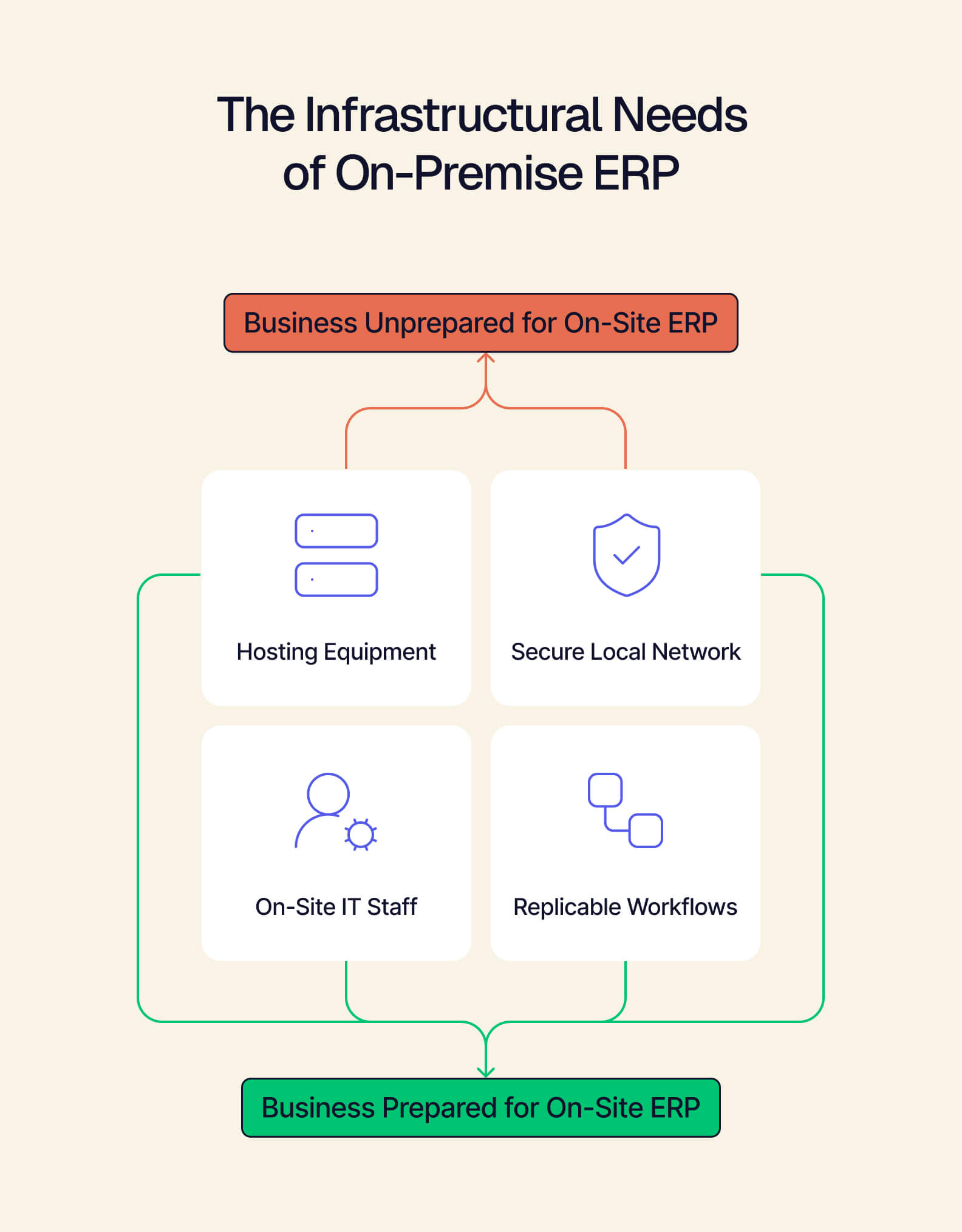
On-premise ERP integrations require far more prep work than a cloud ERP does, but the upside of on-premise can be a game-changer for the right business. Before we unpack the nuts and bolts of security and stability with on-premise ERP integrations, let's take a look at what a retail business needs to get one set up:
Requirement 1: Hosting equipment. The first major component of an on-premise ERP is having the physical equipment necessary to host the ERP. This largely means server equipment and dedicated space to house the servers (this usually requires a semi-permanent office for your business).
Requirement 2: Secure local network. Where cloud ERPs require an active internet connection and run on API infrastructure, an on-premise ERP requires a locally accessible network (connected via WI-FI or wired connections). This means that your business is directly connected to your on-premise servers, and your ERP is only accessible through local connections.
Requirement 3: On-site IT staff. Because you own your on-premise equipment, it’s up to you to service it when something goes wrong. Having IT staff capable of maintenance, system upgrades, and new feature development is a top priority with on-premise ERP integration.
Requirement 4: Replicable workflows. On-premise systems require more stability and decisiveness in the way your business operates. If you’re ready to shift to this type of ERP, ensure you’ve streamlined your workflows appropriately and that your processes aren’t governed by time-wasting workarounds or hacked-together fixes that encourage technical debt.
Why On-Premise ERP Might Be the Security Powerhouse of Your Dreams
With on-premise ERP, control is everything. This enables greater security across your business, and also protects you from typical cloud-based vendor pitfalls. If you’ve got the space, budgets, and personnel necessary, on-premise ERP enables you to control:
-
Who can access your network. On-premise ERP enables you to deploy RBAC, which greatly limits which of your team members can access what information. This can help thwart the efficacy of bad actors compromising employee machines or using token-based credential exploits against you.
-
When your IT team pushes system updates. A fairly common problem with cloud-based software is that patches or updates get pushed without proper testing. On-premise ERP enables you to thoroughly test your patches before pushing them live to your teams’ hardware — greatly minimizing the odds of things going wrong and being left out to dry while a vendor scrambles to fix their mistake.
How Scalability Shifts with On-Premise ERP Integrations
Scalability is determined directly by how much physical hardware you are able to contain and how much you’re willing to spend to expand. Businesses sometimes run into problems where their tools railroad them into making bad choices for logical reasons. However, on-premise ERP helps you take control of the scaling process and avoid being forced into bad decisions by:
-
Allowing you to set the pace you scale. If you’re not ready to hit the gas pedal, you can hold off adding the necessary hardware to support your expansion. Likewise, if you plan for a big scaling push, you won’t be held back by vendor-related issues or poorly timed upgrades.
-
Offering a path to create custom tools. Commissioning custom tools from vendors is costly and time-consuming, leading to long-term support issues and complicated business relationships. With an on-premise ERP, your IT team is able to create custom tools to fit your needs, shortcutting the costs and headaches.
Dealmakers and Deal-Breakers: A Cheat Sheet for Cloud ERP vs. On-Premise ERP Decision-Making
When shopping for cloud ERP and on-premise ERP, use this cheat sheet to help narrow down viable options. Dealmakers are features that should prompt you to research the software more deeply, whereas deal-breakers are red lines that you should look out for.
Cloud ERP Dealmakers
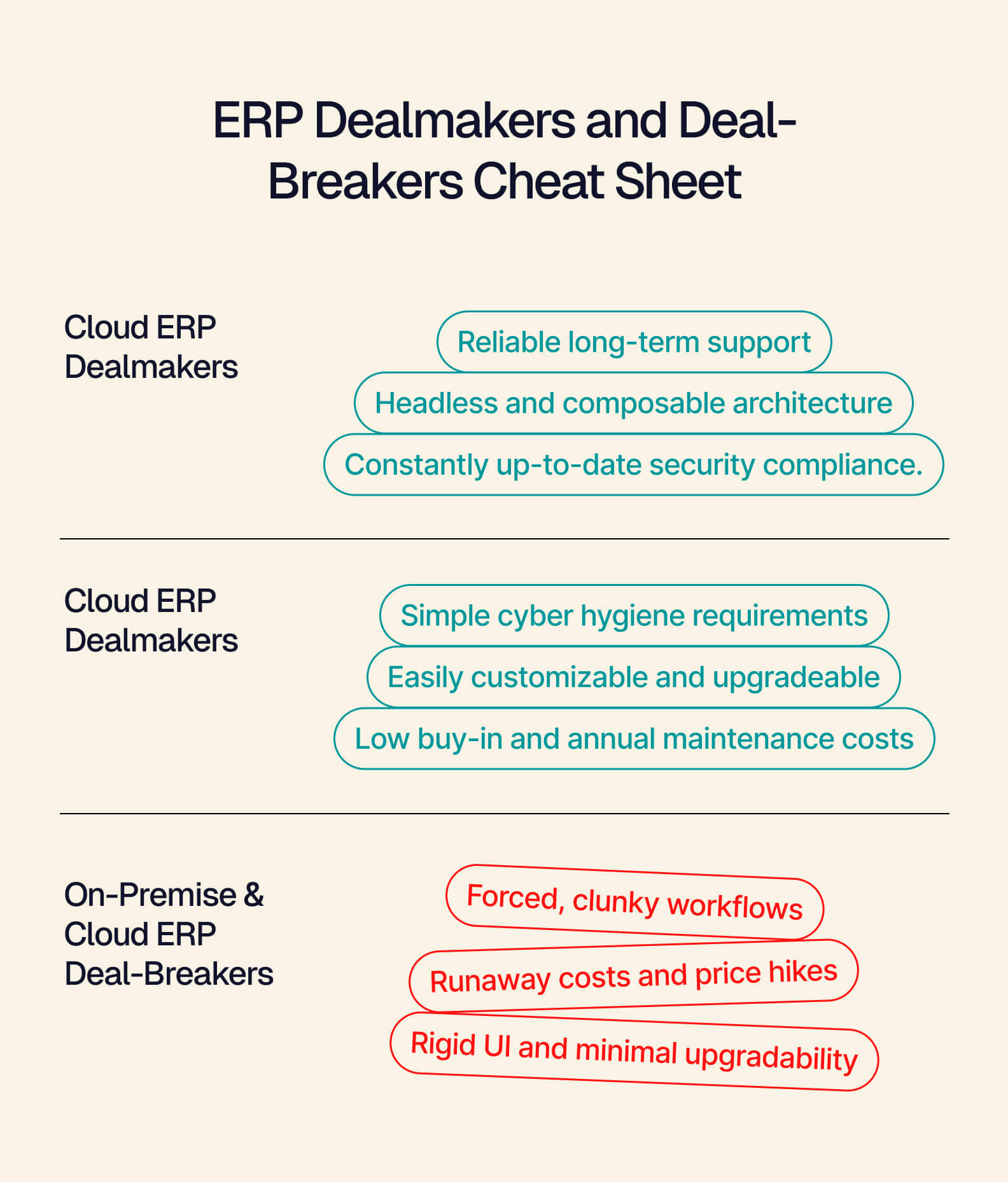
- Reliable long-term support.
- Constantly up-to-date security compliance.
- Headless and composable architecture.
Why these matter for your business: Some cloud ERP solutions want to control the way your business grows. Other, flexible cloud ERP solutions, like Tailor’s flagship cloud ERP, are designed so that you get to control how your business grows. We strive to eliminate the risks of scaling by prioritizing customization and exceptional security standards.
On-Premise ERP Dealmakers
- Low buy-in and annual maintenance costs.
- Easily customizable and upgradeable.
- Simple cyber hygiene requirements.
Why these matter for your business: On-premise ERPs specialize in enabling you to set the pace of your business, define the rules of how it operates, and create a predictably sustainable system for it to run on. While harder to pull off, the right on-premise integration can become the best engine for driving your business forward.
On-Premise & Cloud ERP Deal-Breakers
- Forced, clunky workflows.
- Runaway costs and price hikes.
- Rigid UI and minimal upgradability.
Why these matter for your business: Your software purchases should force you into working in ways that frustrate your teams, and they certainly shouldn’t threaten your financial stability. Thankfully, we have a SaaS software vendor questionnaire you can use to ensure you know both the product you're purchasing and everything about the vendor that supports it.
Get the Right ERP Integration for Your Business
Choosing the right ERP for your retail business doesn’t have to be hard. All it takes is a little learning and leveraging powerful tools like this SaaS Software Evaluation Scorecard. Now that you understand how to parse the conversation between cloud ERP vs. on-premise ERP, it’s time to start your search.
If you’re in the market for a flexible cloud ERP solution, Tailor can help:
Book a demo with us today to learn about our flagship headless ERP and other composable tool offerings designed for retail businesses ready to scale — but aren’t quite sure how to make the push.