Did you know that your inventory is the key for unlocking growth for your retail brand? Most SMBs see inventory as little more than a ledger for their SKUs, and while that’s technically true, it oversimplifies its impact on your bottom line and couches its potential.
For retailers looking to add wholesale to their business strategy, the gap between the wholesale and DTC is less about what is in stock and more about how you manage it. While wholesale can drive massive revenue growth for scaling businesses, managing bulk inventory (B2B) and direct purchases (B2C) can be complicated when it comes to ecommerce.
In this post, we’ll cover:
-
What wholesale inventory management is and how it works
-
How wholesale inventory management differs from DTC
-
Best practices for brands looking to transition into wholesale
-
Frequently asked questions about how an ERP can support wholesale inventory management
Why Wholesale Breaks DTC
Wholesale inventory management is the process of tracking, allocating, and replenishing stock sold in bulk. To manage your wholesale inventory effectively, you have to balance distributors' and retailers' demand with your business’s working capital. Most wholesale orders can strain a scaling brand's resources, from operations to finance. Typically, because of their sheer size, wholesale orders significantly impact stock availability and the business overall, requiring more capital to fulfill orders with longer purchasing cycles and lead times.
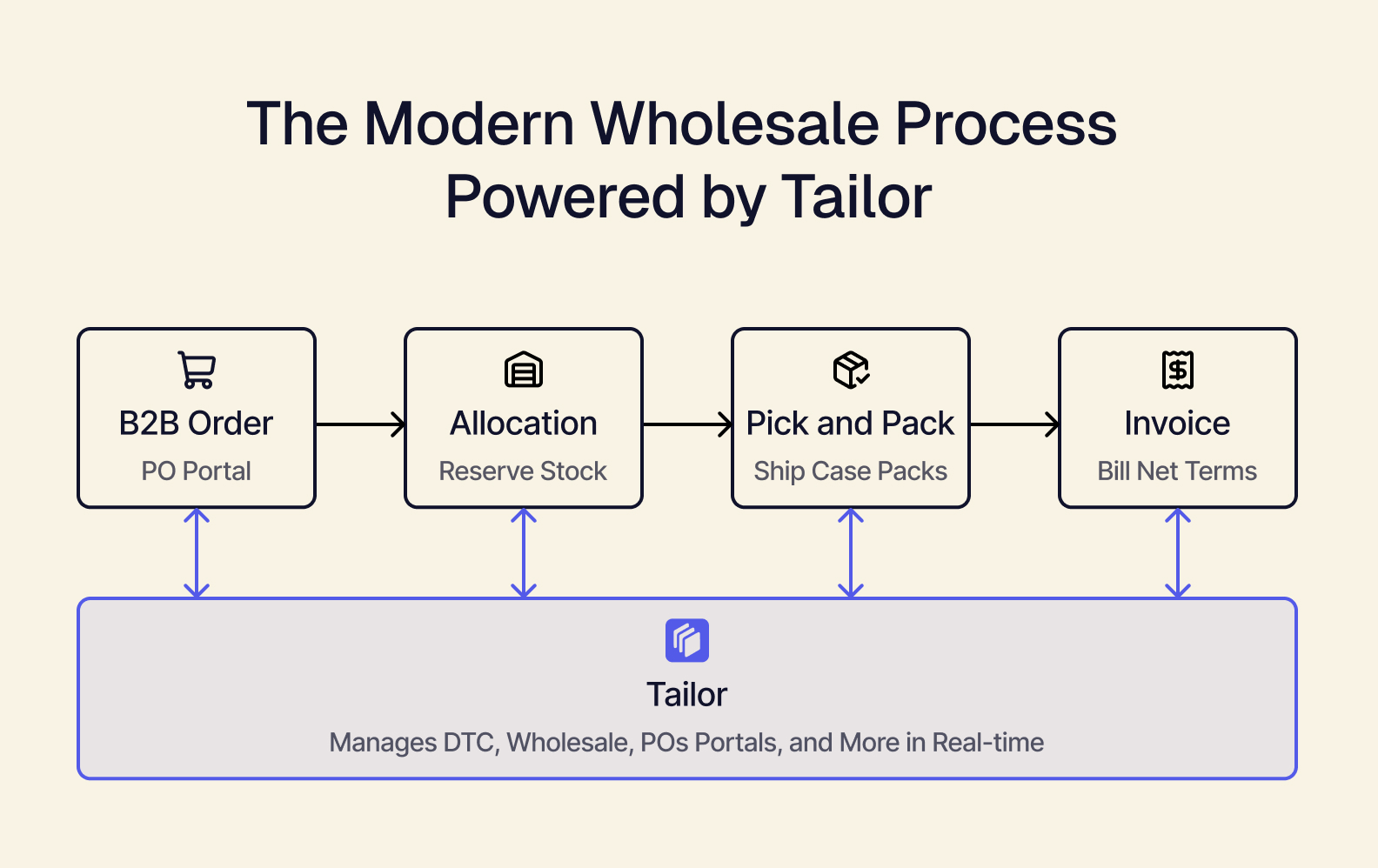
DTC businesses are more streamlined. B2C ecommerce relies on single-unit orders and instant payments directly from customers. Whether a customer buys one item or several, you receive payment right away at checkout, making it easy to manage stock and accounting. However, wholesale orders are more operationally and financially complex, with purchase orders (POs) using net terms (payment typically within 30 days of invoice receipt), case packs (fixed-quantity bundles), and minimum order quantities (MOQs) before fulfillment.
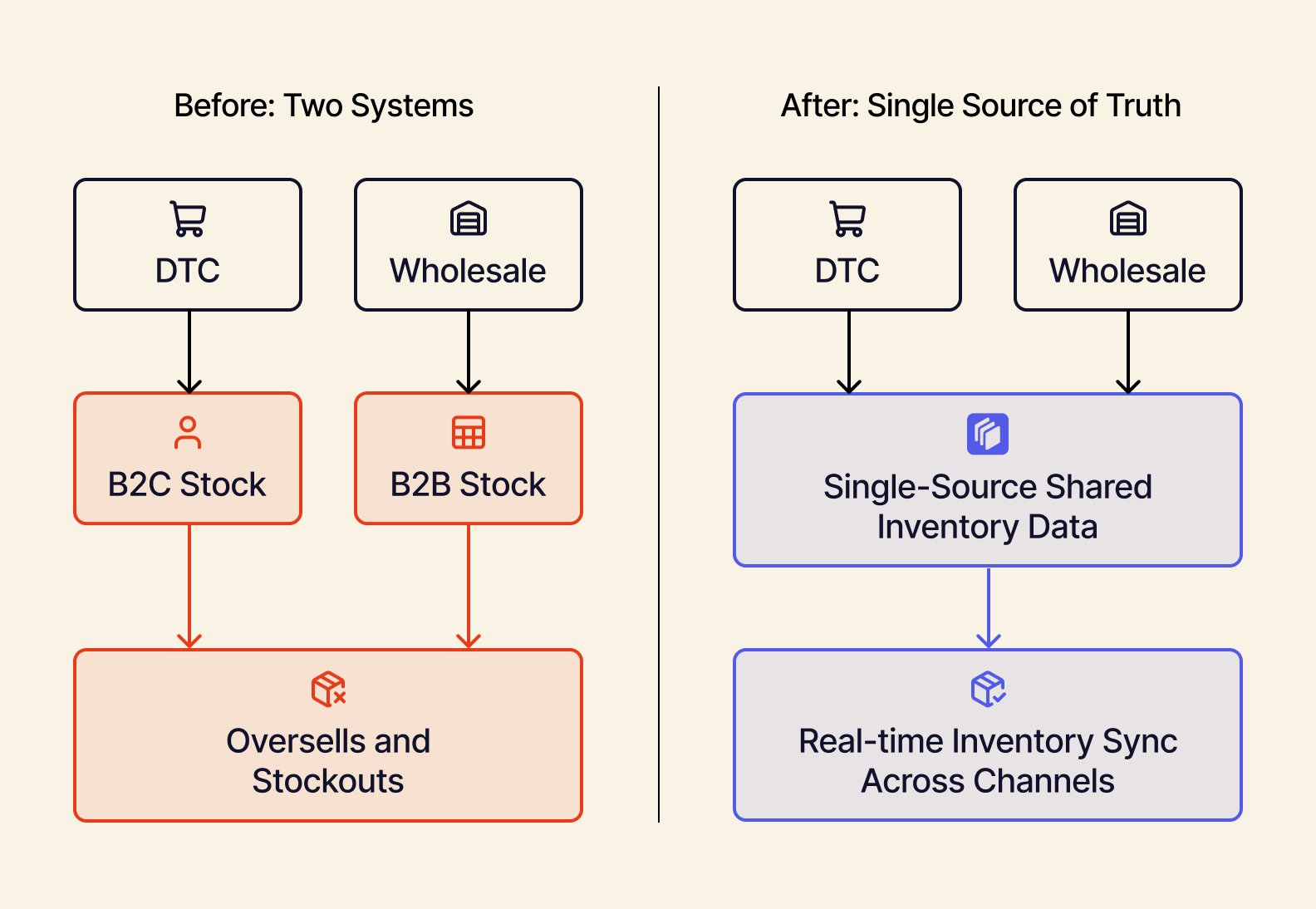
Unlike B2C orders, B2B ecommerce can leverage partial shipments to meet demand and offset financial risk. Often, this leads growing businesses to rely on stop-gap solutions. Some rely on spreadsheets that require a lot of manual labor to maintain on the backend. Others set up a completely separate system to manage their wholesale business. Either way, stock and accounting inaccuracies become inevitable as burnout and workloads increase. The result is brands overselling and risking stockouts for B2C and B2B customers.
So, what should a growing business do? Create a single source of truth for both DTC and wholesale inventory management.
How Wholesale Inventory Management Works
Today, platforms like Shopify and Amazon have opened DTC channels up to long-time wholesalers, and vice versa. Backed by a unified inventory system (i.e., headless ERPs like Tailor), modern wholesale inventory management leverages automated purchasing and real-time stock allocation to enable on-demand forecasting, making it easier to replenish stock, protect margins, and keep customers happier across B2B and B2C channels. Tailor’s headless, composable, and AI-native ERP lets you update inventory management systems in real time.
When wholesale inventory management isn't supported by a single system where orders flow smoothly from one tracked stage to the next, even a small error in allocation or picking can have crippling effects across the business and upend workflows — leaving teams constantly putting out fires. If that sounds like your business, here are a few tips on how to best integrate wholesale into your growing DTC business.
6 Wholesale Inventory Management Best Practices
Establish a Single Source of Truth for Your Inventory
Deploying a headless, composable ERP like Tailor can make wholesale integration significantly easier. Unlike stop-gap solutions and disjointed inventory ledgers that prevent cross-channel synchronization, create a shared source with channel-specific stock allocation that gives you a buffer so you don’t deplete stock needed elsewhere.
Use Available-to-Promise (ATP) Tracking for Wholesale Orders
Establishing ATP protocols lets operations earmark inventory for future bulk shipments, preventing DTC shoppers from purchasing those same units. This allows you to sell confidently to both channels without fear of stockouts.
Set Minimum Order Quantities (MOQs) and Case Pack Rules
Setting strict minimum order quantities and case-pack restrictions helps your fulfillment team pull units for wholesale orders without disrupting DTC stock availability. These simple rules also give your teams the bandwidth to plan for current and future orders, improving forecast accuracy.
Build a Tiered Pricing Model
Creating pricing tiers based on volume, channel, or customer within a centralized system helps protect margins across segments. It eliminates manual sales quotes by accurately tracking per-unit expenses (such as landed costs) and adjusting for credit limits and partial shipments, simplifying cost accounting.
Refine Your B2B Order Management
Minimizing manual touchpoints in the B2B order process is key to wholesale success. Also, consider integrating AI customer support to answer frequently asked questions or connect buyers with a sales representative in real time. Paired with an API-first ERP, you can then automate vendor POs to prevent stockouts and reduce lead-times.
Manage Purchase Orders (POs) and Replenishment
Integrating with an AI-native ERP allows you to automate purchase orders based on real-time sales and supplier lead times. Additionally, systems can flag unusual stock movements to help you plan against sales spikes without overextending your capital.
How Universal Jewelry Runs Wholesale and DTC Orders with Tailor
When Universal Jewelry, a multi-channel hybrid DTC and wholesale jeweler, wanted to eliminate their siloed backend by aligning their Shopify storefront with Odoo-supported workflows, Tailor stepped in.
According to Matthew Laskowski, Order Processing Representative and Engraver at Universal Jewelry, “From day one with Tailor, the number of manual fixes dropped significantly.” Previously, the team relied on a third-party app that couldn't handle the complexity and nuances of a made-to-order jewelry business, leaving them to reconcile their system manually each day and deal with impossible workflows. In less than eight weeks, Tailor built and implemented a native Odoo connector that enabled real-time synchronization for order processing and refunds, marking the first step in the company’s transition away from a patchwork of tools.
Today, Universal Jewelry is exploring how to incorporate Tailor’s API-first inventory management system for lot-level tracking across third-party logistics partners and warehouses.
What to Look for in Wholesale Management Software
Now that you have a good idea of how to integrate wholesale into your DTC business, let’s explore how to choose the right wholesale inventory management software for you.
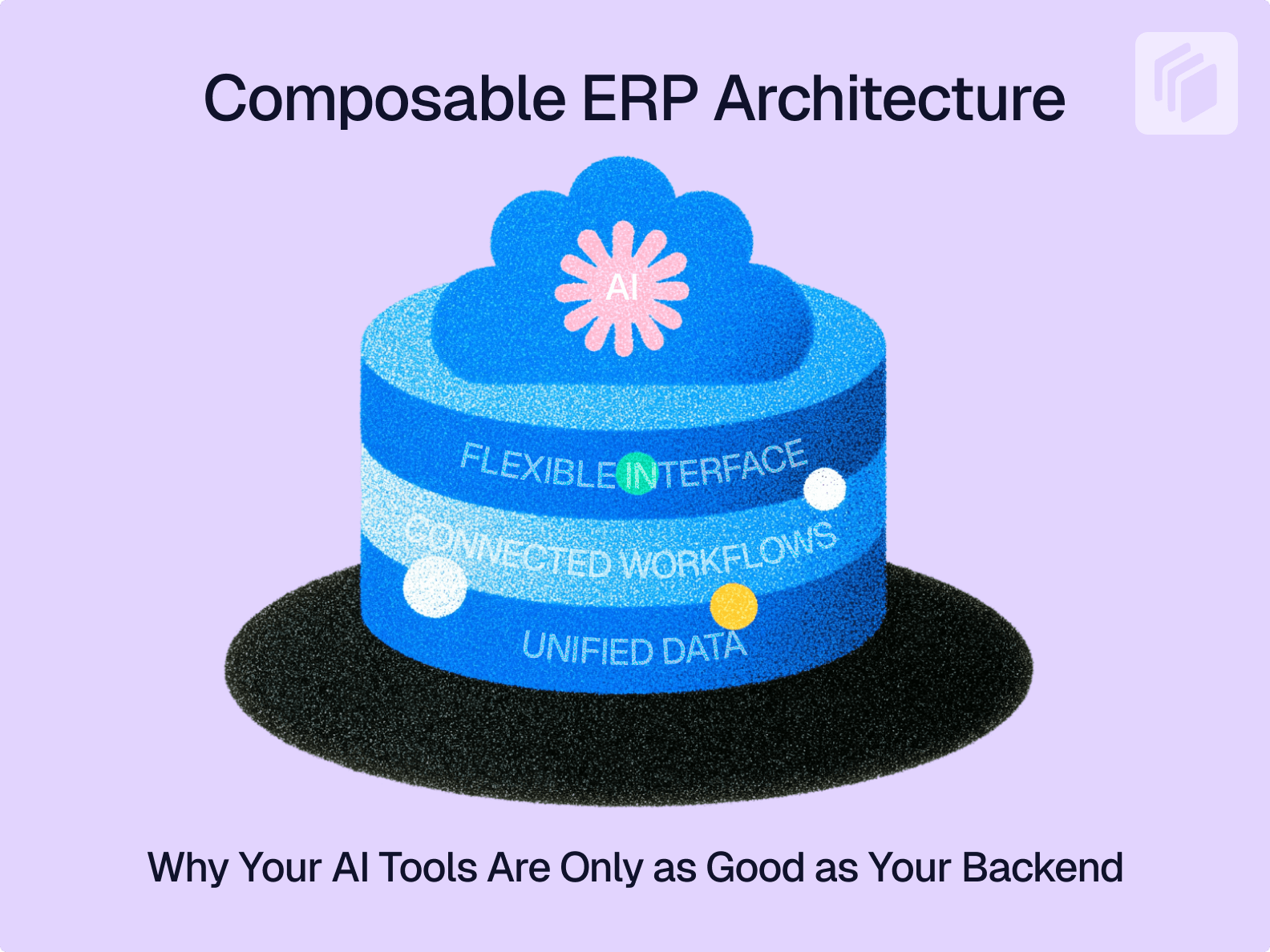
To properly assess a software solution, look beyond static feature lists and convoluted landing pages. When evaluating inventory management software, examine your business's underlying structure. You need to select a data system that can fit your business, not the other way around. That’s why composable ERPs, like Tailor, are the right fit for brands looking to scale. Tailor’s modular structure allows you to turn features on and off as your business needs shift.
You should also assess whether a particular system is built or can be customized to fit your needs. First, examine the system's API connectivity capabilities, especially if you plan to scale. API-first ERPs, like Tailor, let your business seamlessly integrate existing tools and technologies without overhauling your entire backend.
Tailor’s ERP easily integrates with more than 80 different tools, from accounting software like QuickBooks to CRMs like Salesforce. In fact, Tailor can connect with your existing storefront and host a POs portal. By decoupling your backend code from its frontend UI, Tailor lets you right-size your operations and feed channel data seamlessly into a single shared system — providing a single source of truth that syncs in real time.
Next, ensure the system lets you implement the best practices mentioned in this post:
-
Can it track ATP logic?
-
Will it enforce MOQ and case pack rules?
-
How does it handle tiered pricing models?
-
Will it coordinate B2B orders, including net term payments, partial shipments, and backorders?
-
Can it automatically trigger supplier POs and restocks based on sales and inventory data?
For more help evaluating ERPs, check out our in-depth retail software guide.
Frequently Asked Questions From Scaling DTC Retail Leaders
When Should a DTC Brand Add Wholesale?
There’s no hard-and-fast rule for when a B2C brand should add wholesale. A general rule of thumb is to wait until you have operational success and enough capital to cover large-scale orders. If your business cannot currently handle separate pricing structures, payment terms, or shared stock, that’s a good indicator you need to update your backend before going all in.
How Do I Manage Inventory and Fulfillment for Wholesale and DTC?
After you've set up the necessary backend components (i.e., a single source of truth for your data), reach out to your fulfillment team or 3PL to confirm they can handle cases or pallets in addition to single parcels. Note that some retailers have specific packaging and label requirements that will need to be confirmed before accepting any wholesale orders.
Do I Need an ERP to Sell Wholesale?
It depends on where you are in your business’s growth journey. If you're considering entering the wholesale market, it's safe to assume you understand the backend lift required to handle orders at scale, from multi-channel tiered pricing to net terms. It is also possible that up to this point your team has been managing them manually across spreadsheets or disconnected tools. However, to maintain operational excellence at scale, an ERP is the only tool that can do that. Better yet, a headless, composable, AI-native ERP is best because it accurately tracks inventory across channels, syncs accounting in real time, and triggers restocks and supplier purchase orders.
Ready to scale your DTC business into wholesale? Book a demo with Tailor today and see our headless, composable inventory management software in action.