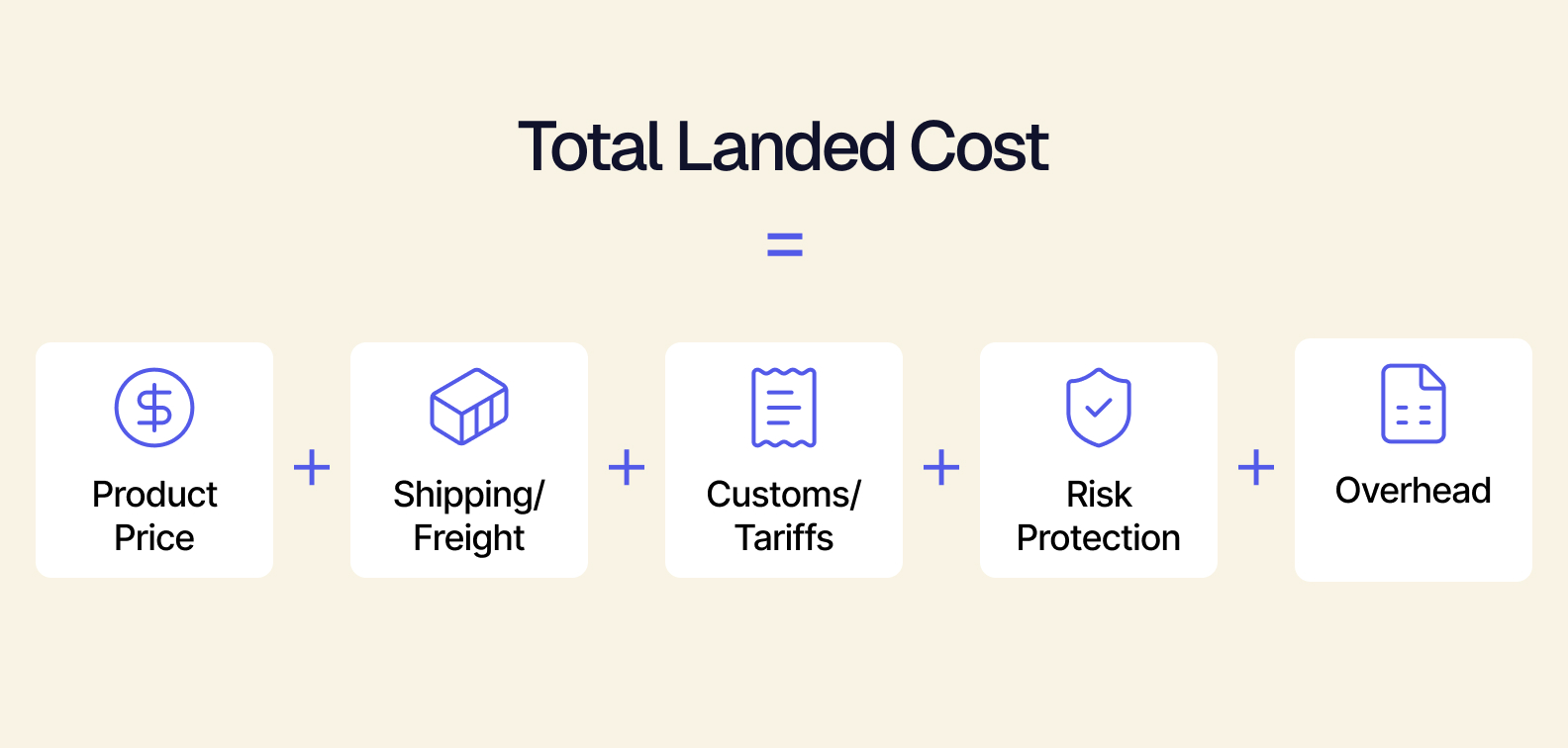
Landed costs are the total costs of bringing a product from the supplier/manufacturer to your warehouse or customer’s front door. By combining the base unit cost with administrative overhead, risk insurance, customs duties, and international freight, you get the most accurate per-unit price.
Understanding tariff and shipping volatility can make the difference between a retailer growing at scale and one that stagnates. Mastering landed-cost complexity becomes a key indicator of sustainable profitability, helping you forecast more accurately and improve profit margins. However, most traditional ERPs struggle to handle these calculations because of delayed batch processing and siloed supply chain data, ultimately leading your team to react to price inaccuracies and plan against thin margins.
In this guide, we’ll take a look at how inaccurate landed cost calculations affect scaling retailers' bottom line and why accurately capturing them can mean big business for retailers.
What you’ll learn:
-
How inaccurate price data can impact your profit margins
-
How traditional ERPs tend to fail while calculating landed costs
-
How mastering landed costs helps your business win with agentic commerce
-
How headless ERPs can help you manage costs in real time
What Are Landed Costs?
Before we start crunching numbers, there are a few types of “hidden” expenses that can affect total landed costs. Each of these fees can fluctuate with every new product you try to ship internationally; that’s why it’s important to fully understand what they are and how they impact your bottom line:
Customs: Every country operates with specific regulations and associated fees when it comes to the import and export of goods. The shipment’s recipients pay this cost, and you should account for it when calculating a product's total cost.
Port Charges: Mandatory fees from governments, terminal operators, or port authorities for shipping and cargo owners, covering operations such as security, maintenance, and facility usage.
Demurrage fees: A financial penalty that’s levied when shipping containers or vessels are at a port longer than scheduled. The longer the delay, the higher the cost.
Insurance: International shipping can come with a lot of risk. That’s why it is always a great idea to have insurance to help you mitigate that risk and protect you against lost, stolen, or damaged products. However, this cost fluctuates depending on the value of the shipped goods and its destination.
Free On Board (FOB): This legal term indicates who is responsible for the shipment during transit and who is liable if damage occurs. Depending on the terms set out in the contract, this can fall to retailers vs. their manufacturers and can impact insurance rates and other associated shipping fees.
Exchange Rates: Similarly, understanding how exchange rates between your manufacturing country of origin and your own country vary is key to SMB retailers' growth because rates often vary with global economic trends.
Now that you understand landed costs and the expenses that can affect them, let’s dig into how you can start estimating them more accurately.
Calculating Landed Costs
When calculating landed costs, you have to look at each product and element in its production individually.
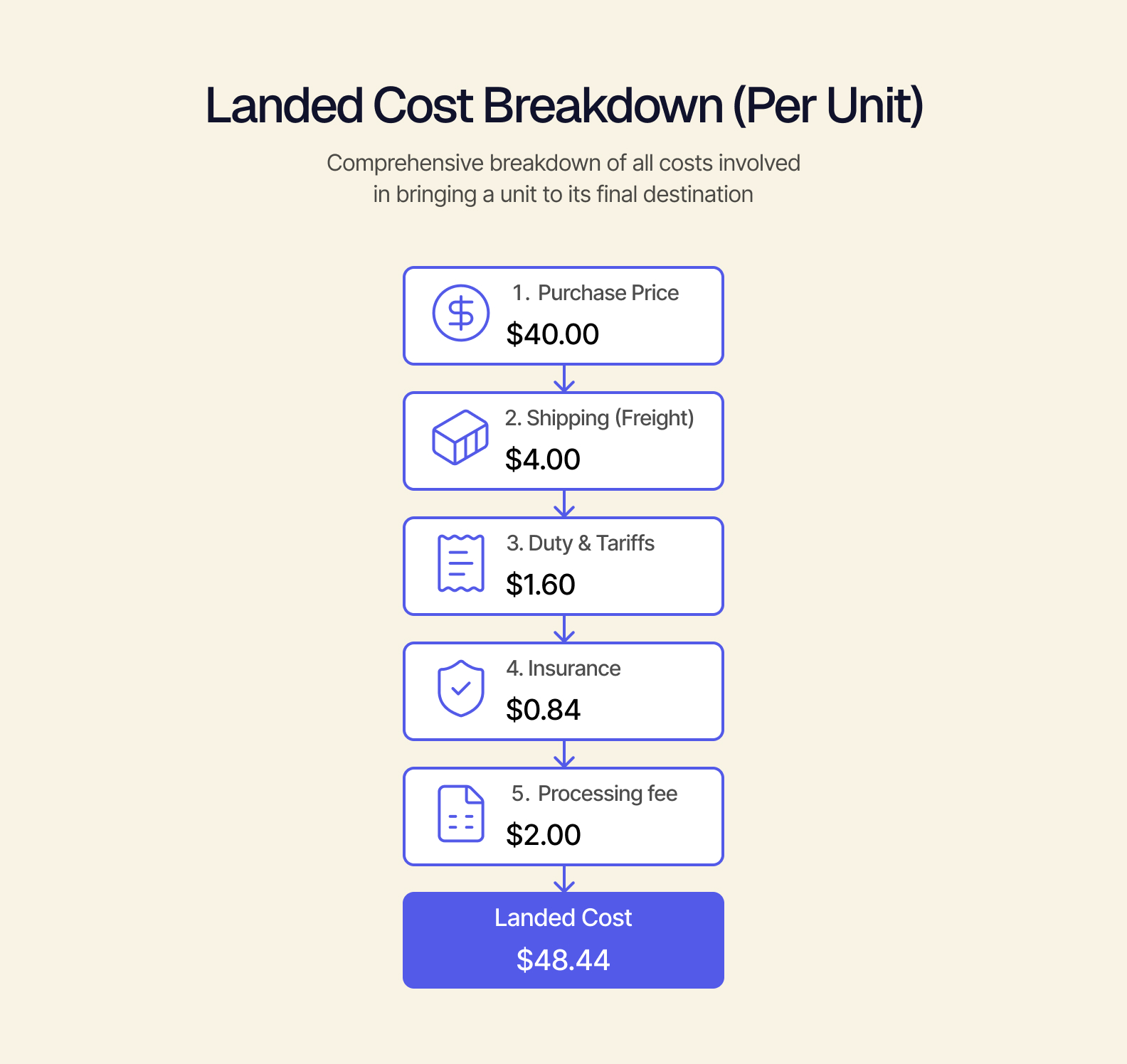
Imagine you have purchased 500 units from an international supplier at $40 per unit. Shipping is $2,000 total, or $4 per item. Duty rates vary widely by product and country of origin. For this example, we’ll use 4% to simplify.
To calculate the duty per unit, multiply the unit price by .04. That’s $1.60 per item.
Let’s say insurance is $400 total. However, there’s an additional fee of $20 per custom order, which means your insurance cost per unit is $0.84 ($400/500 units + $20/500).
Add the $2 per-unit processing fee, and you get a total of $48.44.
That’s more than a 20 percent difference in calculated costs per unit! Now, imagine doing this for thousands of SKUs. No matter how simple this calculation looks on paper, scaling it while accounting for variable shipments and volatile freight costs can be challenging for growing retail brands.
The High Price of Landed Costs: Why International Shipping Matters
While outsourcing production to international partners can help retailers scale faster, it also exposes them to hidden costs and added liabilities. With shifting freight costs, tariffs, and port fees, maintaining margins on SKUs that rely on overseas manufacturing can be hard.
Without clear context on how landed costs affect pricing strategies, retail leaders operate at a deficit. This can lead to incorrect product pricing that disrupts cash flow because the business has to absorb unexpected fees. It also threatens profit preservation and margins, setting businesses up to fail, especially if they are leveraging slow-moving enterprise ERPs.
Traditional ERPs Handle Landed Costs Differently
Enterprise ERPs were designed to accommodate more predictable cost structures than today’s market environment provides. As today’s retailers look to international manufacturers to scale by offsetting production costs, those savings largely depend on unpredictable international shipping conditions and volatile geopolitical factors that affect the individual expenses that equate to landed costs.
Unfortunately, most rigid ERP systems struggle to accurately capture multi-layered expenses without creating operational bottlenecks.
Batch & Delayed Cost of Goods Sold (COGS) Processing
Unlike API-first ERPs like Tailor, these rigid programs don't update data in real time. Typically, traditional systems use batch reporting and scheduled nightly syncs or period-end closing to update inventory and financial valuations cyclically. This leaves finance teams operating on outdated COGS or scrambling to manually reconcile data records daily.
These processing delays create what’s called “phantom margins.” Phantom margins are predicted gross profits based on expected daily sales, offset by unaccounted duty rates or freight charges that must be reconciled after data processing.
Manual Record Reconciliation
Tracking landed costs with traditional enterprise ERPs often forces retailers to stitch together a patchwork of tools to keep the business running, which significantly impacts finance and operations teams. When landed cost calculations are inaccurate, teams experience burnout manually reconciling supplier invoices, customs statements, and carrier documentation with purchase orders and receipts.
This increased workload invites error and adds operational overhead across the company, ultimately causing inventory inaccuracy, customer dissatisfaction, and financial strain as margins shrink.
Scaling in Modern Retail: Preparing for Agentic Commerce
Inaccurate data creates major problems for growing retailers, but it also affects customers trying to connect with your brand. With the rise of agentic commerce, it is more important than ever that your backend matches what’s on your storefront.
Agentic commerce is driven by customers using autonomous AI agents that research, recommend, and purchase based on their chat queries. To fulfill those requests accurately, agents rely on APIs and emergent protocols to pull product data across channels. Often, agents assess data accuracy to verify pricing, delivery dates, and product availability, and favor the most reliable sources. If your data is out of sync with what’s actually available, agents may pass over your products or give shoppers incorrect information.
Often, most ecommerce platforms aren’t built to handle complex expense tracking. Tailor’s headless, composable ERP lets you separate them seamlessly without retiring or overhauling your storefront, while serving as a single source of truth your team, agents, and logistics partners can reference in real time. In fact, Tailor's composable structure easily combines modular solutions to right-size a precision landed cost strategy for your retail operation:
Cost Accounting
Tailor’s cost accounting module employs a double-entry ledger approach that continuously tracks tariff, freight, and duty costs in real time. This lets you simplify supplier payments while maintaining a full picture of product margins through COGS tracking and inventory costs.
Production Management
Whether you operate on a make-to-stock (MTS) or make-to-order (MTO) model, Tailor lets you track landed costs back to specific suppliers and vendors for the most accurate cost visibility. This helps you make accurate business decisions and cost allocations.
Inventory Management
Inventory Management
Tailor’s ability to track stock in real time across sales channels and partners helps you get the most accurate inventory costs and trigger automated replenishment through intelligent forecasting. This helps you prevent stockouts and maintain customer satisfaction.
That is why landed costs are so important to retailers.
Manage Your Landed Costs in a Unified System
When retail leaders do not have through-the-line visibility into how each expense, like tariffs on raw materials or shipping price hikes, impacts finished-good valuation, they put themselves at a disadvantage and risk. Any workaround adds operational stress and is doomed to break retailers' backends because traditional systems rely on multiple autonomous data sets instead of a single source of truth that updates backend data in real time.
That’s why we recommend:
-
Auditing your existing landed cost workflow and assess how much lead time and overhead cost it currently requires.
-
Looking for opportunities to create synchronization on the backend between data systems.
-
Consolidating your landed costs expense data in a centralized system.
A headless, composable ERP designed for scaling retail brands can make these recommendations possible. Book a demo with Tailor to see how our API-first cost accounting, inventory and production management modules help improve workflows from supplier to sale, while creating a single source of truth for your business data.