A retail brand placing a handful of purchase orders (PO) a month can easily check every invoice by hand. Someone pulls the PO, confirms the delivery with the warehouse, and approves the bill. Nice and easy.
But once you’re managing hundreds of POs across multiple suppliers, warehouses, and 3PLs (third-party logistics), that manual check starts to break down, which allows overpayments and other errors to sneak in.
Three-way matching is how accounts payable (AP) teams catch those errors before the money leaves the bank account. Understanding it is the easy part. Keeping the match reliable as you scale is where it can fall apart — or at least become a struggle.
Here’s what breaks the match, what to do when it fails, and how an ERP keeps all three documents in one easy-to-see location.
What you will learn:
-
How three-way matching works
-
How 3-way matching compares with 2-way and 4-way matching
-
The PO process issues that can cause matches to fail
-
How to handle partial shipments, price variances, and tolerances with 3-way matching
-
How a headless, composable ERP automates the match to prevent overpayments
How Three-Way Matching Works
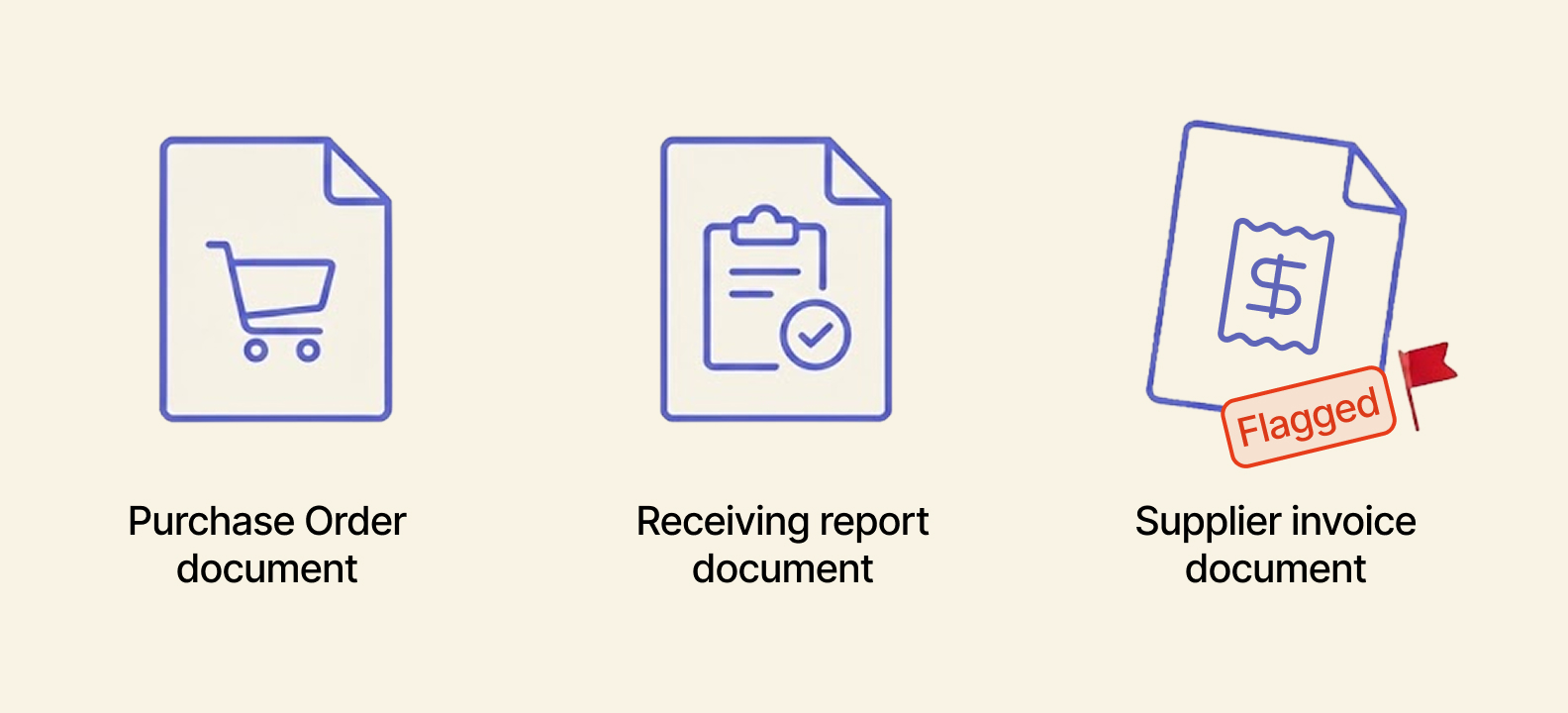
Three-way matching connects three key documents to prevent payment errors. Those include:
-
The purchase order, which sets the item, quantity, price, and vendor.
-
The receiving report (aka goods receipt) to confirm what actually arrived.
-
The supplier invoice showing what you’ve been asked to pay.
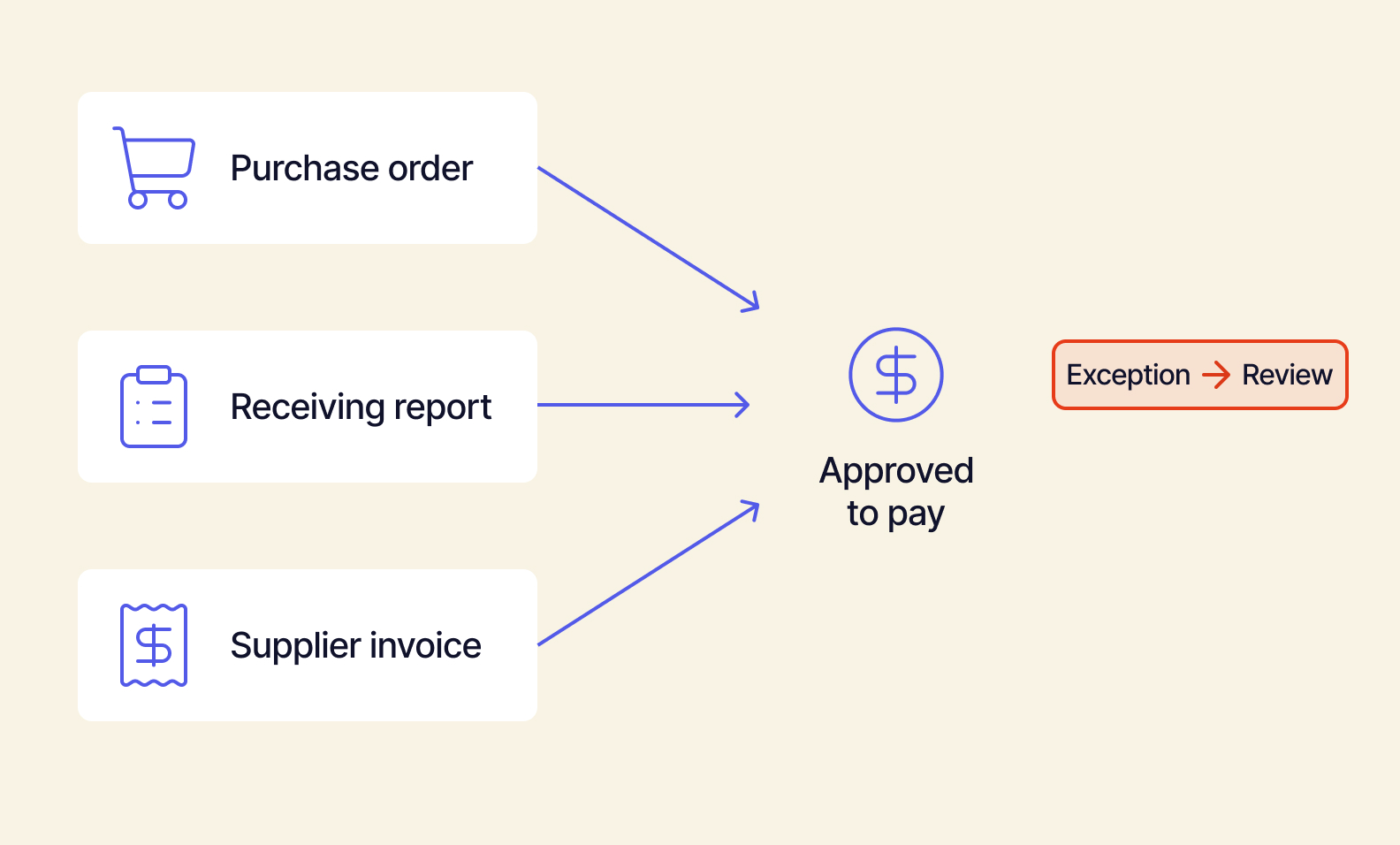
Once an invoice arrives, the AP team compares five details across all three documents:
-
PO number
-
Vendor
-
Products(s)
-
Quantity
-
Unit price
When everything lines up, the invoice is approved for payment. But if anything’s off, the invoice is held as an exception until someone can resolve it.
The catch, unfortunately, is that each document typically comes from a different team or person. Purchasing issues the PO, the warehouse or 3PL logs the receipt, and AP handles the invoice. So, the three often end up in three different places, and matching them can take more work and coordination than expected.
2-Way vs. 3-Way vs. 4-Way Match
Of course, three-way matching isn’t the only option. Some purchases simply don’t need this level of verification. Others need more if they’re, for instance, more highly regulated.
Here’s how the three most common processes compare:
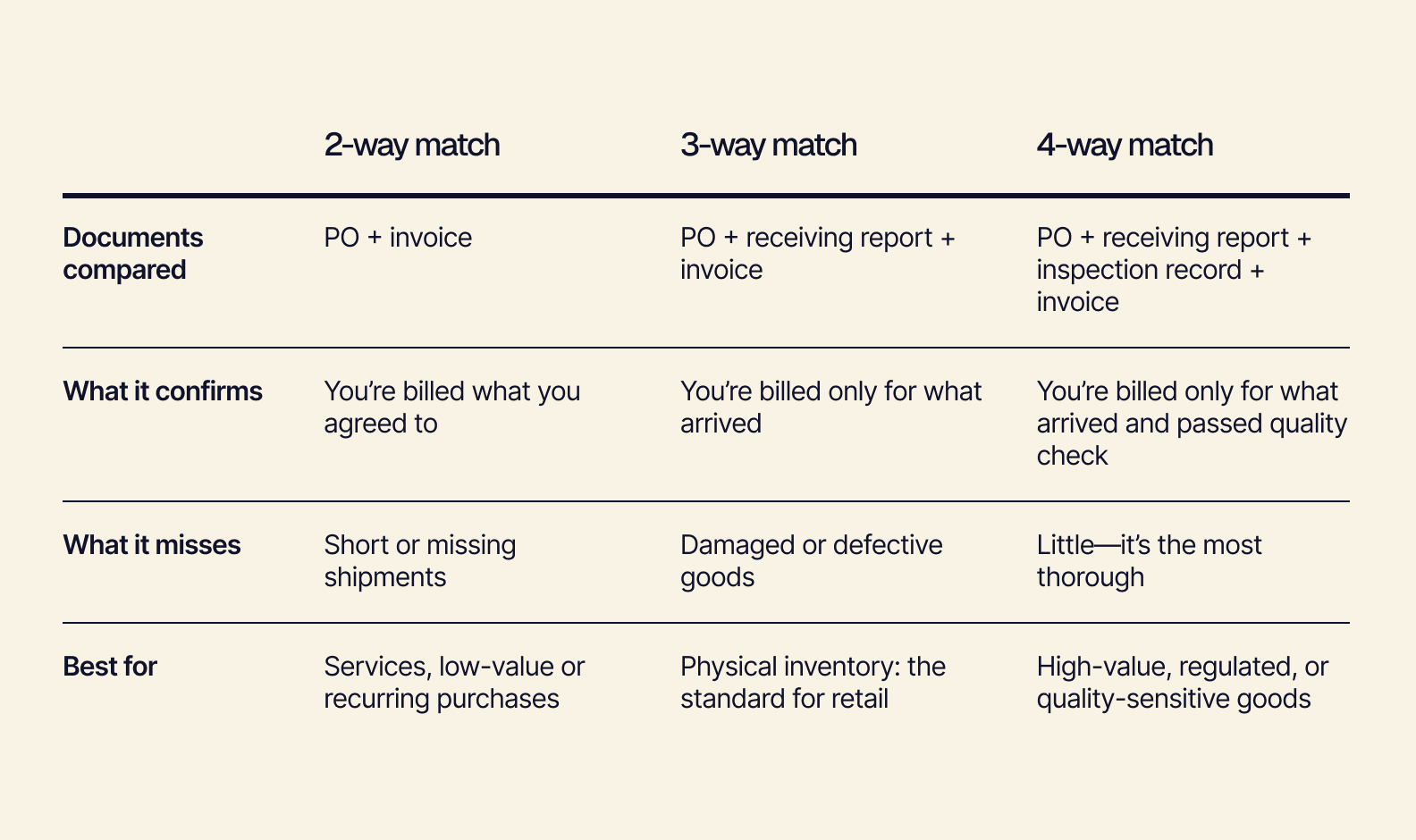
A two-way match works when there’s nothing physical to count — such as a software subscription or consulting retainer. But when you’re buying inventory, confirming that the goods arrived is the whole point. That’s what makes 3-way matching the smart, practical baseline for retail brands.
If, on the other hand, you’re in a more highly regulated industry or have quality-sensitive goods, it may be worth moving up to 4-way matching, since quality failures can be costly.
Problems with the PO Process that Break the Match
Three-way matching sounds so simple on paper. And for smaller businesses, it’s not unusual to manually compare the documents before payments are made. It’s just a cost of doing business.
Yet as the business grows, clean matches become harder and more time-consuming.
Two-way Matching Stops Working as You Scale
A 2-way match will approve an invoice for 10,000 units even if only 9,000 arrived. At low volume, someone catches it (at least most of the time) or can quickly correct it. At scale, though, overpayments and short shipments slip through and turn into inventory headaches when counts don’t add up.
The Three Documents Live in Three Different Tools
The PO sits in a spreadsheet or email thread. The receipt is logged in a 3PL portal or warehouse management system (WMS). The invoice is in an AP inbox. Every match starts with someone pulling data from each place and copying or re-keying it. Not only does that take precious time away from other important tasks, but it’s also error-prone. It’s the same disconnect that makes it hard to link sales orders and purchase orders for better inventory decisions.
Receiving Holdups Invoicing
Suppliers often invoice on the ship date. That means the invoice comes in before the warehouse has had a chance to count the delivery — and sometimes before it’s even been received.
AP is left with two bad options: either hold off on payment and risk a late fee, or pay blind, without proof of receipt.
Supplier Invoices Arrive in Every Format
PDFs, emails, and portal downloads all have different layouts. Pulling the right numbers from each one by hand is tedious, and the more invoices you process, the more likely errors are to add up.
See how Tailor connects POs, receiving, and invoices in one workflow here: Purchase Management.
3-Way Match in Action
A real-life example demonstrates how three-way matching works with real numbers.
A growing outdoor gear brand orders 10,000 insulated water bottles from its supplier at $4.50 per unit for a total of $45,000.
The PO: 10,000 units at $4.50, totaling $45,000.
Receiving: The warehouse logs 9,000 units. The last 1,000 are delayed and will be shipped later.
The invoice: Because of an outdated price list, the supplier bills for all 10,000 units at $4.75 each for a total of $47,500.
The match catches and flags the two variances:
-
Quantity: The brand is billed for 1,000 units it hasn’t yet received.
-
Price: The invoice is $0.25 per unit over the agreed PO price.
What the brand actually owes right now: 9,000 units at $4.50, or $40,500 total. Paying the invoice as-is would overpay by $7,000.
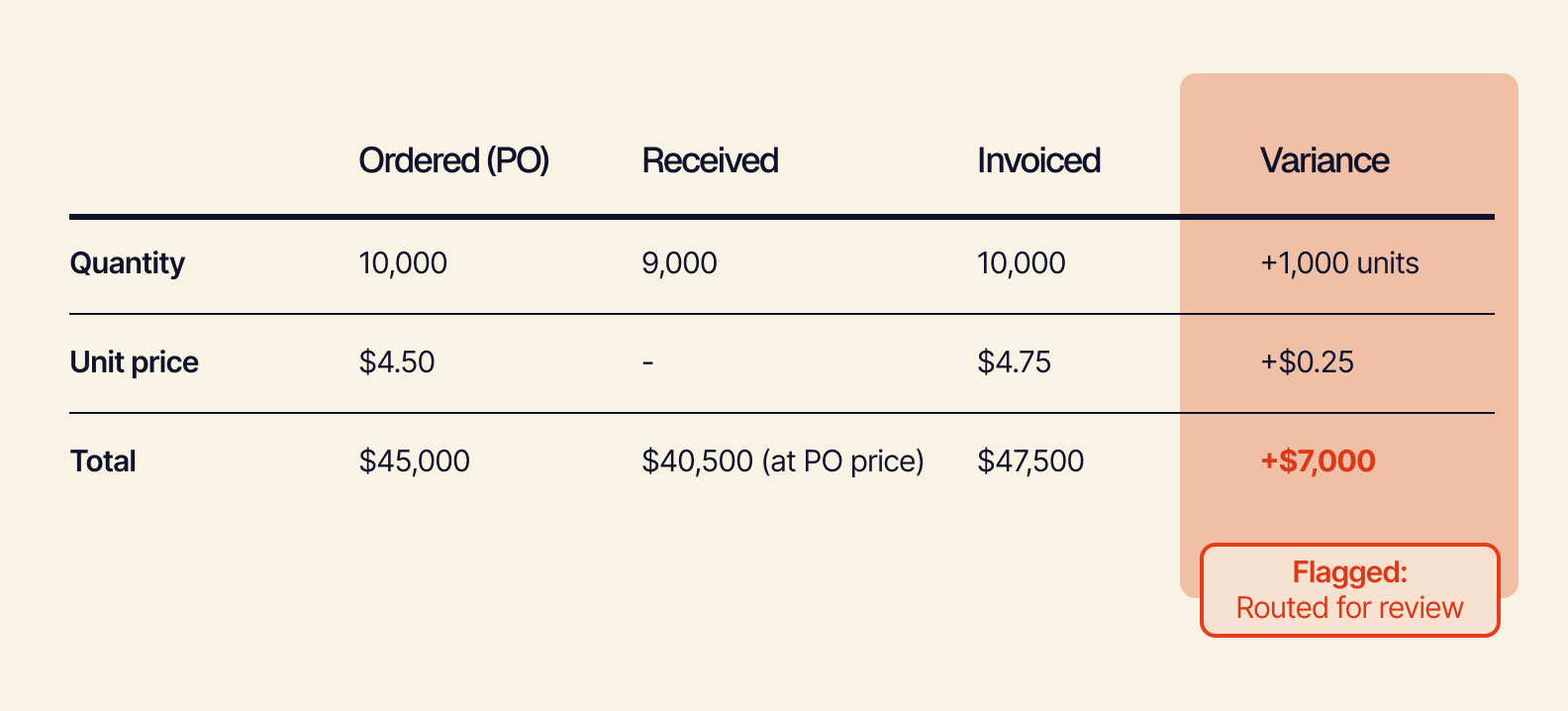
Instead of automatically paying the invoice, it’s flagged and routed for review. AP can then ask the supplier for a corrected invoice (at the agreed-upon price) and pay only for the units received. The PO stays open until the remaining units arrive.
A 2-way match would have caught the price difference, but it would have missed the short shipment completely.
What Happens When a 3-Way Match Fails
A failed match doesn’t always mean something is wrong with the supplier. Most exceptions come from everyday purchasing realities, such as:
-
Partial shipments: Part of the order arrives now, and the rest comes later. The fix is simple: pay for what arrived and keep the PO open for the remainder.
-
Price variances: Tariff surcharges, outdated price lists, or currency changes can shift the invoice price above what was originally agreed to.
-
Other mismatches: Duplicate invoices, a vendor name that doesn’t quite match the PO, a missing PO number, etc.
To keep minor differences from overtaking the review process, many AP teams set tolerance thresholds for an acceptable variance. This can be set as a small percentage or dollar amount. So a few cents of rounding can clear automatically, but anything larger gets a second look.
In the water bottle example above, a 25-cent increase on a $4.50 unit is more than 5%. That’s well outside of any typical tolerance. Because Tailor’s workflows are customizable, teams can build their own approval rules around these thresholds.
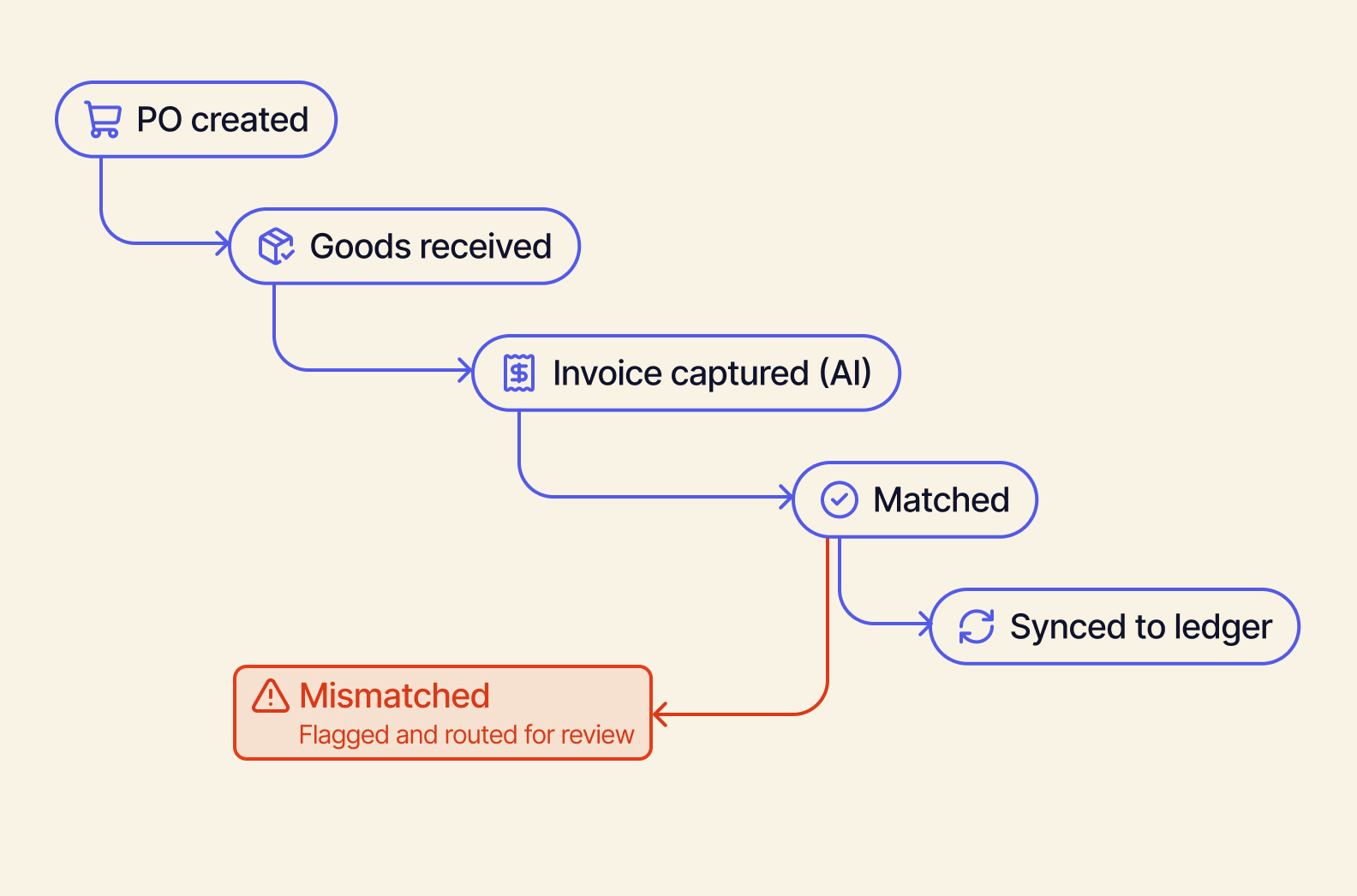
When the PO, receiving record, and bill don’t match within Tailor, the bill is flagged and routed for review. A person can then make the call with all three documents right in front of them. No need to chase them down across different tools. They can then request a corrected invoice or credit memo, pay the matched portion, or approve after adjusting the document.
In short, automation clears the routine matches, and people make the judgment calls on the exceptions that need them.
How an ERP Automates Three-Way Matching
Automating a three-way match only works if the system can see all three documents. That’s where the right ERP makes the difference.
All Three Documents Are In One Place
With Tailor, the PO is still created in purchase management, receiving is logged in the inventory module, and once the supplier invoice comes in, it’s matched against both. So, there’s no need to cross-check between dashboards or re-key entries from one tool to another since your team has the full picture in one view.
AI Reads the Invoice for You
Tailor is AI-native, so it’s built for AI agents to work alongside your team. Agents can read the supplier PDFs, pull the line items, compare them with the PO and receiving record, and route mismatched bills for review. AI in inventory management goes beyond basic OCR invoice capture, which only turns a document into text. Ultimately, your team stays in control of decisions, while agents handle the repetitive checks that slow AP down.
Headless and Composable
Tailor is the connector, rather than the ledger. Matched records go seamlessly into QuickBooks, Xero, or your chosen accounting software. Your 3PL or WMS plugs in through Tailor’s API. The match runs on live data instead of yesterday’s sync. Because there are fewer sync points, there are fewer mismatches to catch. Continuous reconciliation is built into the system, not bolted on after the fact.
Stop Manually Matching
Three-way matching keeps your books in line while you pay only for what you’ve received at the price you agreed to. A small business can easily check each invoice against the PO and receiving log. But as your business grows, that task takes more time and becomes more error-prone.
By keeping POs, receiving records, and invoices in one place, routine matches can clear on their own, leaving your team to focus only on the exceptions that need their judgment.
See how Tailor brings the PO, receipt, and invoice together: Request a demo.