Peak season hits, order volume spikes, and everyone starts getting busy — too busy to notice that inventory counts and financial records have started to disagree. There’s no time to check, and the numbers looked fine last week. By the time someone finally notices (weeks later), the discrepancy has compounded and takes a multi-day investigation to fix.
This sort of scenario happens when a business treats reconciliation as something to do periodically instead of continuously. Continuous reconciliation eliminates that timing problem, keeping pace with the volume. But it’s only as strong as data it’s reconciling.
Learn why continuous reconciliation is worth adopting, where it hits a ceiling on its own, and what makes it hold up for good.
What You’ll Learn
-
When manual reconciliation turns into an emergency
-
Why continuous reconciliation is a real fix
-
Where continuous reconciliation hits the ceiling
-
Built in, not bolted on: How real-time sync makes reconciliation structural
-
Three questions to diagnose your reconciliation gap
When Manual Reconciliation Turns Into an Emergency
Many businesses don’t think far enough ahead when it comes to reconciliation. Instead of implementing proactive reconciliation policies, they wait until the worst kind of moments remind them — like peak season transactions spiking above the team’s capacity for manual review.
This isn’t the only scenario where manual reconciliation can hit a wall, causing major delays or turning into a fire drill at a moment’s notice. Take a look at these other examples:
What happens: Two systems disagree and there isn’t a single, defined source of truth. Somebody has to make a decision: Which number are you going to trust? Often, that person doesn’t have much to go on except gut feel.
The outcome: Reconciliation becomes more and more inconsistent from one disagreement to the next because there isn’t a documented, standardized process showing how to resolve these incidents.
What happens: Manual reconciliation doesn’t happen unless somebody remembers to do it. And if there’s a problem that needs to be traced back to the source, you’re just hoping that person also remembers everything they did.
The outcome: If an auditor or a team member needs a trail, there may or may not be one. You’re at the mercy of institutional memory. That doesn’t hold up under an audit or official inspection. It also doesn’t transfer when an employee leaves.
What happens: When a company relies on manual reconciliation, it’s usually just one or two people taking charge of that process as one of their many responsibilities.
The outcome: The reconciliation process depends on how much time those employees have. This places a constraint on business growth. At some point, reconciliation is going to become the bottleneck.
These examples all have one important element in common: timing. The timing gap is where continuous reconciliation comes in.
Why Continuous Reconciliation Is a Real Fix
Continuous reconciliation closes the gap between when something breaks, and when someone notices.
You don’t have to wait for the next scheduled review on the calendar. Continuous reconciliation matches records as transactions happen.
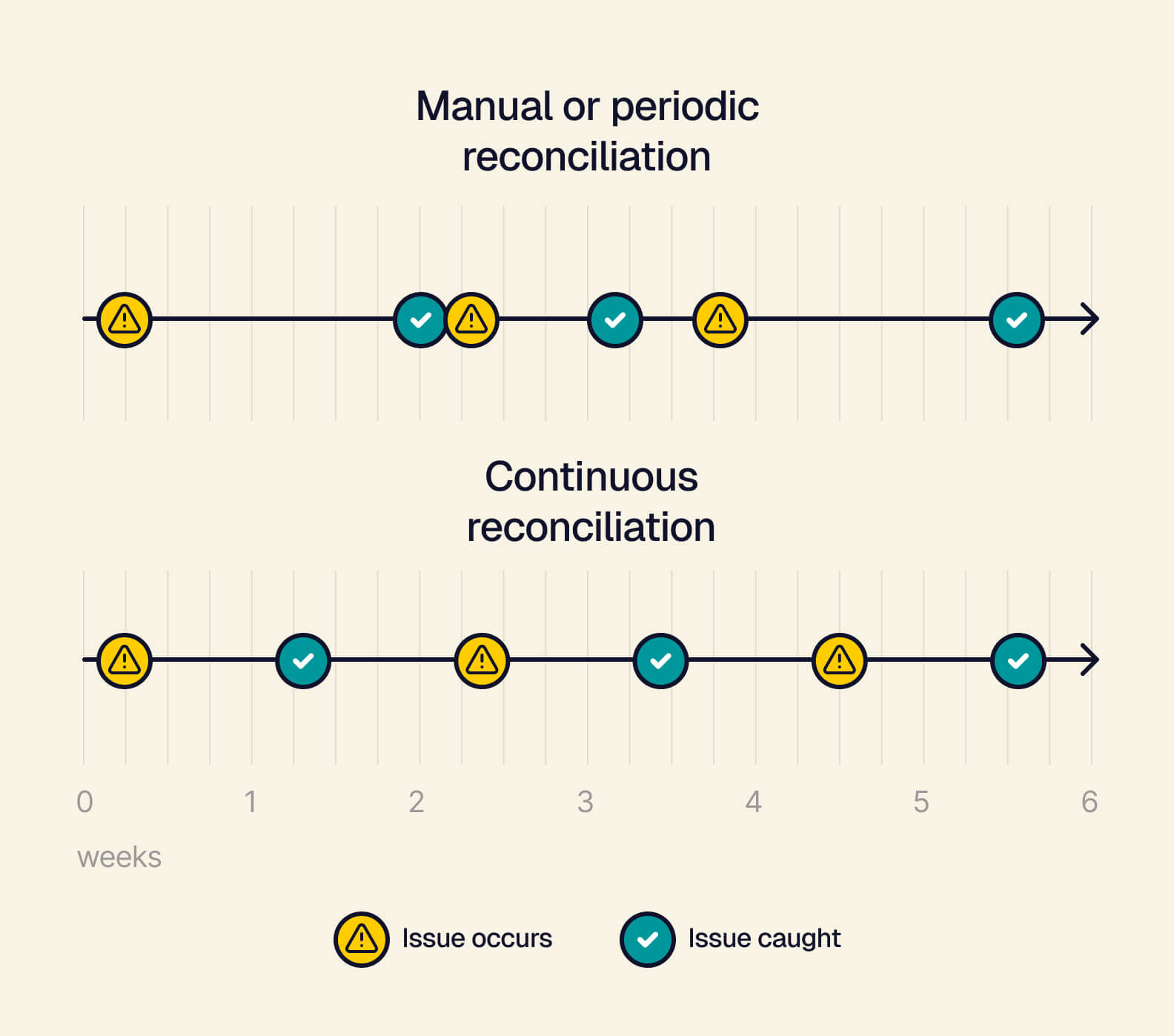
For example, during peak season, brands won’t experience that same backlog because reconciliation happens as transactions come in rather than whenever the team has time or in a scheduled batch. The system can keep pace with volume.
What else does continuous reconciliation get right?
-
Shrinks the size of each discrepancy by catching them early
-
Reduces the number of emergencies thanks to ongoing visibility
-
Frees up employees who were formerly tied to manual reconciliation
-
Records a system-generated trail
Good automation has a part to play in enabling the continuous reconciliation process. It routes exceptions to the right person, applies matching rules to clear transactions where possible, and calls on human judgment for the cases that need it.
Where Continuous Reconciliation Hits the Ceiling
Eventually, continuous reconciliation does hit a ceiling. Continuous reconciliation is only as good as the data it’s reconciling. If inventory, orders, and accounting are still separate systems that are each recording their own version of events, then faster matching just means you’re catching the same conflict, but sooner.
-
Continuous reconciliation is downstream of the ERP. Typically, reconciliation tools read data after it’s already been written in two or more places. No matter how fast the matching cycle is, even a same-day catch is still a catch, not a prevention.
-
Look for telltale recurrences. Consider the categories of mismatches that are emerging with each cycle. If the same ones are showing up again and again, this suggests the underlying systems don’t agree. Continuous reconciliation is managing a live, ongoing condition, not a one-off.
-
This is an area where automation can help. Good automation points out that telltale pattern. The pattern isn’t just something to auto-resolve. It’s pointing at a structural issue upstream.
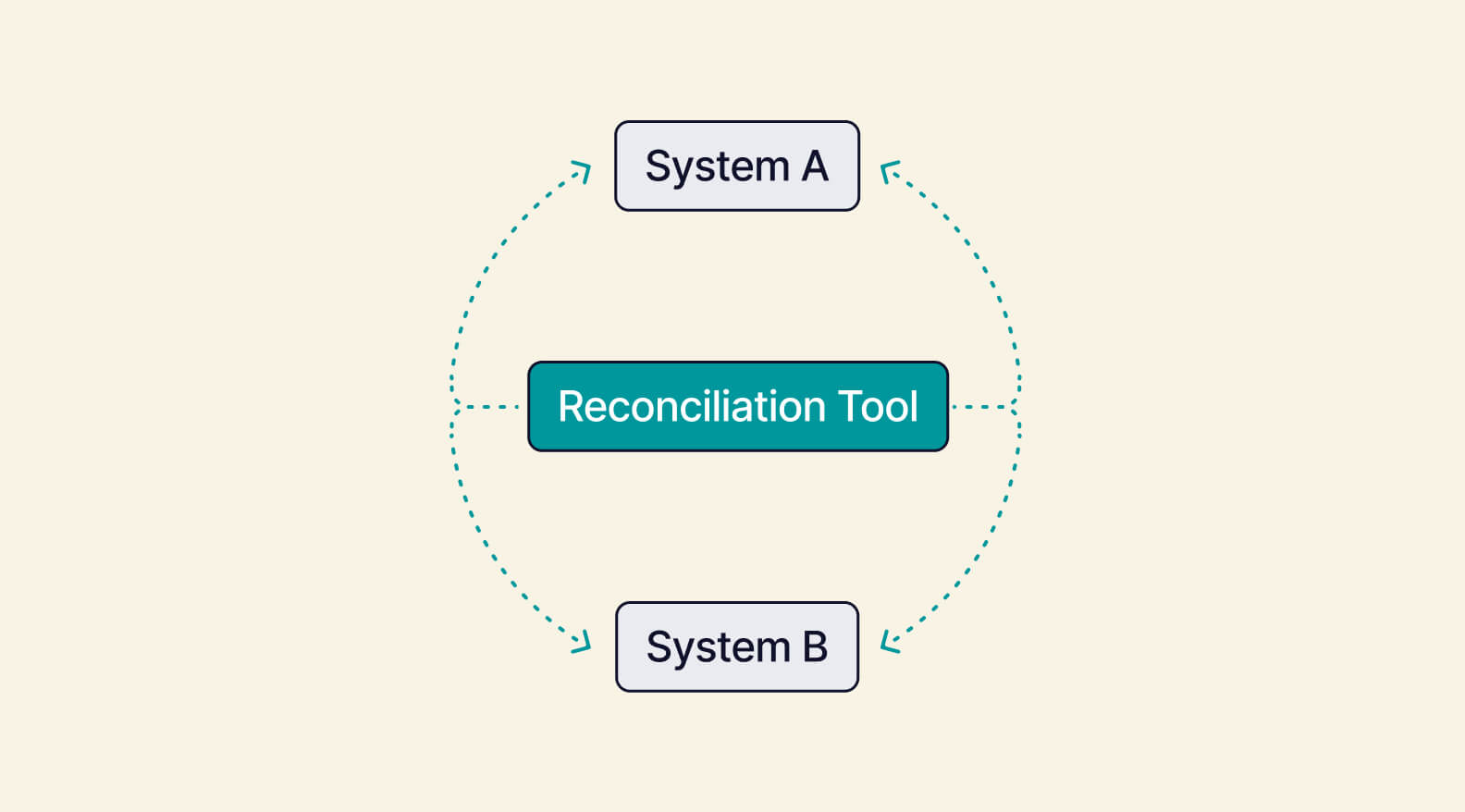
The job of continuous reconciliation is to shorten the length of time between when something breaks and when someone notices. But what would it take to close the gap between the systems themselves, so there’s less for continuous reconciliation to catch in the first place?
Built In, Not Bolted On: How Real-Time Sync Makes Reconciliation Structural
Tailor reduces the need for reconciliation by aligning operational systems through one shared source. Since inventory, orders, and financial records all reference the same truth, there’s much less for a reconciliation layer to catch in the first place. The underlying systems all agree and there’s naturally a smaller amount of reconciliation to do.
The following components of how Tailor is built are helpful to understand:
-
A source of truth upstream of everything. Inventory, orders, and financial records all read from the same underlying data layer instead of existing in separate systems that attempt to sync with each other. A sale is a single event with a single version — no reconciling required.
-
Decouple accounting from operations. Tailor separates accounting and operations so they update in tandem. Accounting reflects operational reality in real time.
-
Best-in-breed, not all-in-one. With Tailor’s composable architecture, the system’s individual capabilities (like inventory, fulfillment, and storefront) all connect to the same shared source of truth. Before, integrating another tool likely added another new sync point that needed its own reconciliation. When everything plugs into the same underlying layer, it’s much simpler.
-
The screen is one manifestation of the API. Tailor is headless. Every interface (accounting, inventory, storefront) is a display of the same underlying record, not a separate copy of it. So whichever team is viewing whichever screen, they’re all looking at the same live data, not the version that was last synced yesterday.
-
Keep what works and replace the duct tape. You’re not removing existing tools. You’re removing the sync layer between them. What changes is what they’re all reading from underneath.
When the systems that are being reconciled finally agree with each other, the job of continuous reconciliation becomes smaller and its results become permanent.
Three Questions to Diagnose Your Reconciliation Gap
These three questions will help guide you through this spectrum, discerning whether continuous reconciliation alone will solve your problem or if the gap goes deeper.
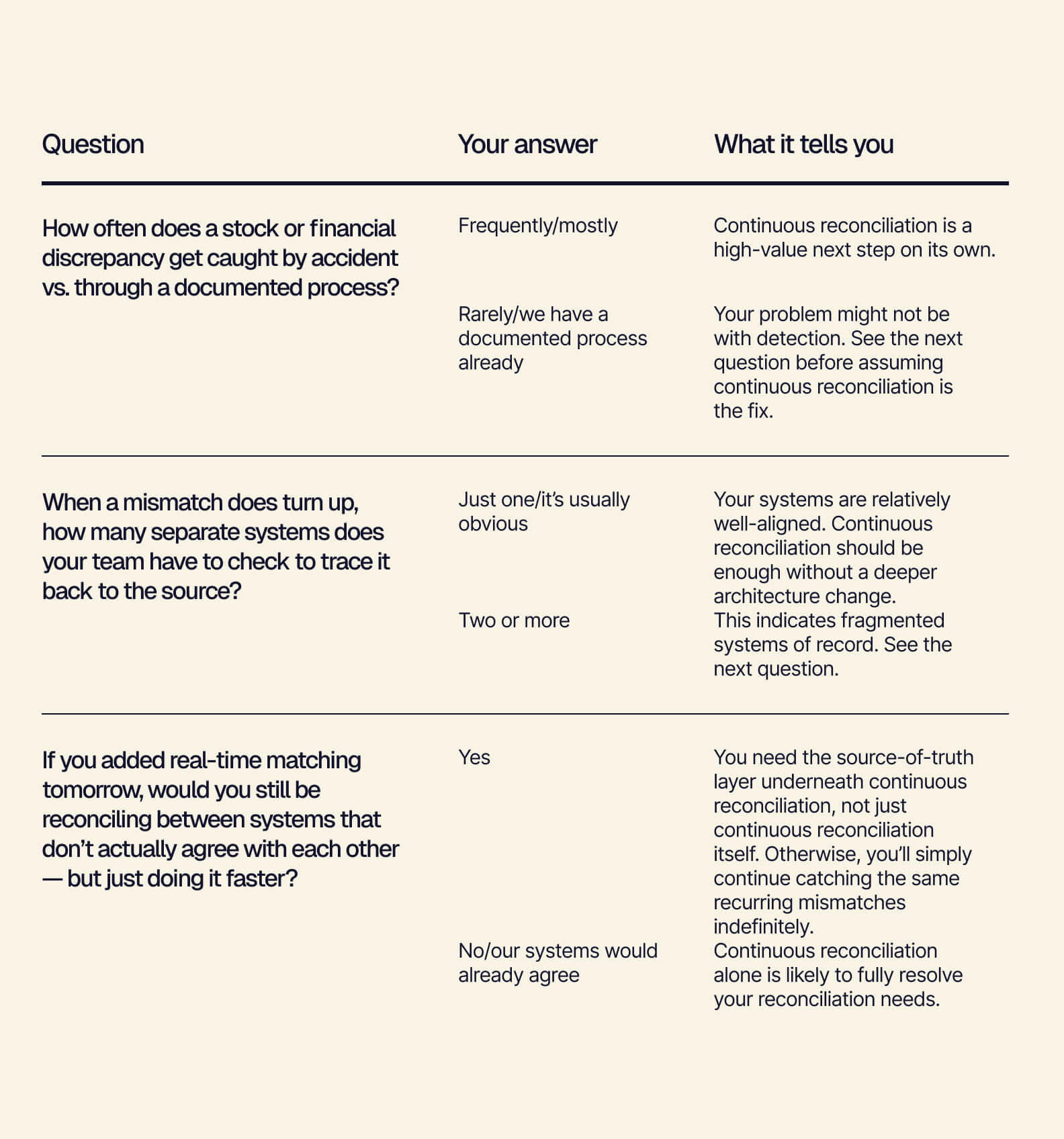
If your answers indicate an issue with detection, look into adopting continuous reconciliation.
If they point to disagreement between systems that persists no matter how fast you catch it, that’s the signal that you need the architecture underneath the reconciliation to change, not just the tool sitting on top of it.
Continuous Reconciliation, Done Right
Continuous reconciliation catches problems in hours instead of weeks, turning reconciliation from a fire drill into routine visibility. When combined with a headless, composable, AI-native ERP, all systems share one source of truth. You have less to reconcile and real-time sync that’s part of the architecture.
See what continuous reconciliation looks like when it’s built into the system by booking a demo with Tailor.