Fast-growing retail and ecommerce brands rarely pick one ERP integration method and move on. Instead, they accumulate methods — a connector, a middleware layer, a developer patching an API gap before a big sale — until integration maintenance becomes its own full-time job and nobody really understands your stack anymore.
This guide breaks down the standard ERP integration methods, why the pile-up happens in the first place, and what you can do to stop it.
What You’ll Learn
-
Standard ERP integration methods (and where they break)
-
What happens when you stack integration methods
-
The alternative to stacking ERP integration methods
-
What API-first integration looks like in practice
-
Where the stacking stops
Standard ERP Integration Methods (and Where They Break)
Most retailers are familiar with five primary ERP integration methods. Those methods — plus the failure points specific to retail operations — are listed below. As you read through the “where it breaks” column, keep an eye out for a hidden pattern:
Each breakdown is really just describing the same root issue from a different angle.
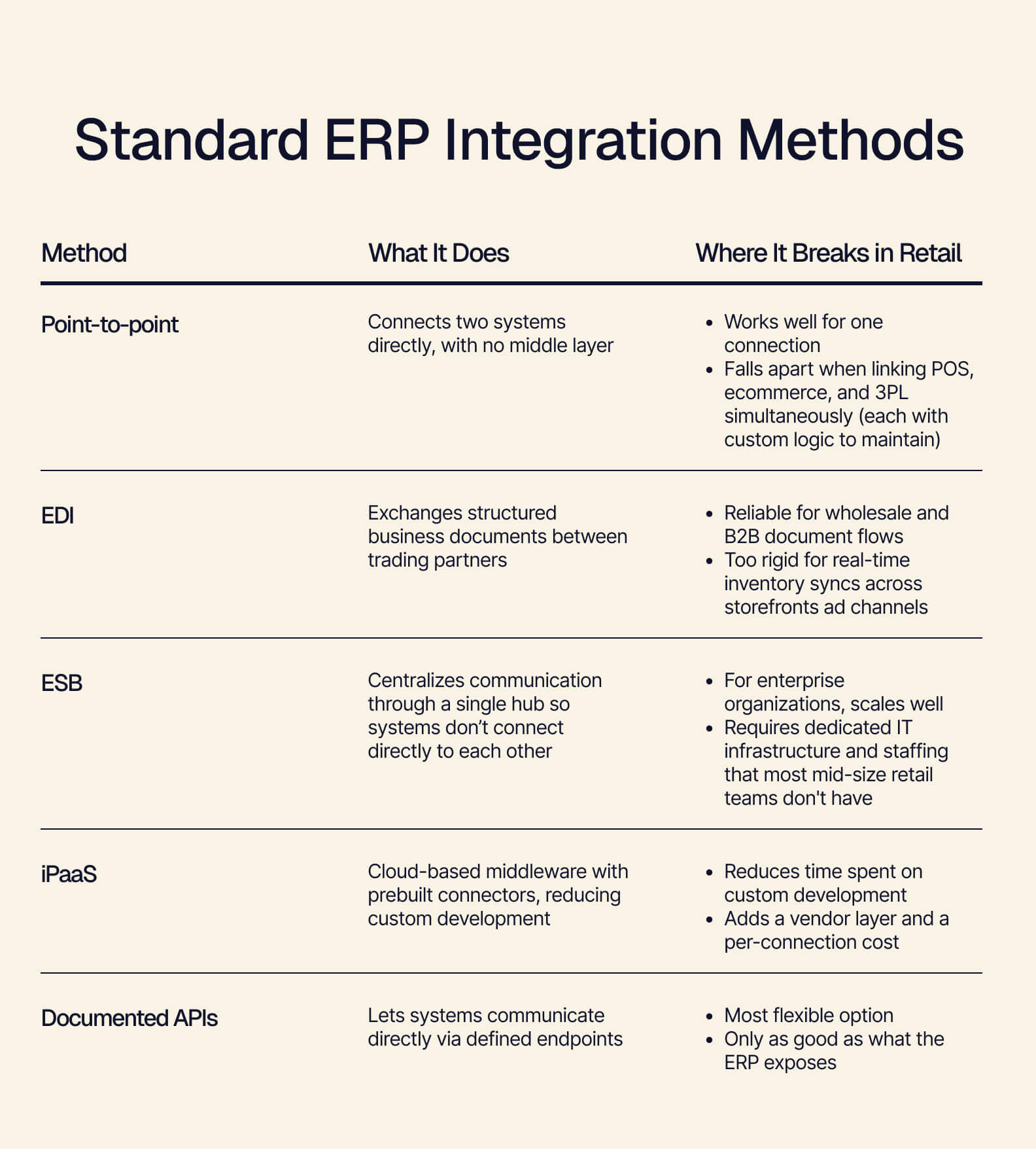
You also might notice that four of these five methods exist to work around the limits of the one before it.
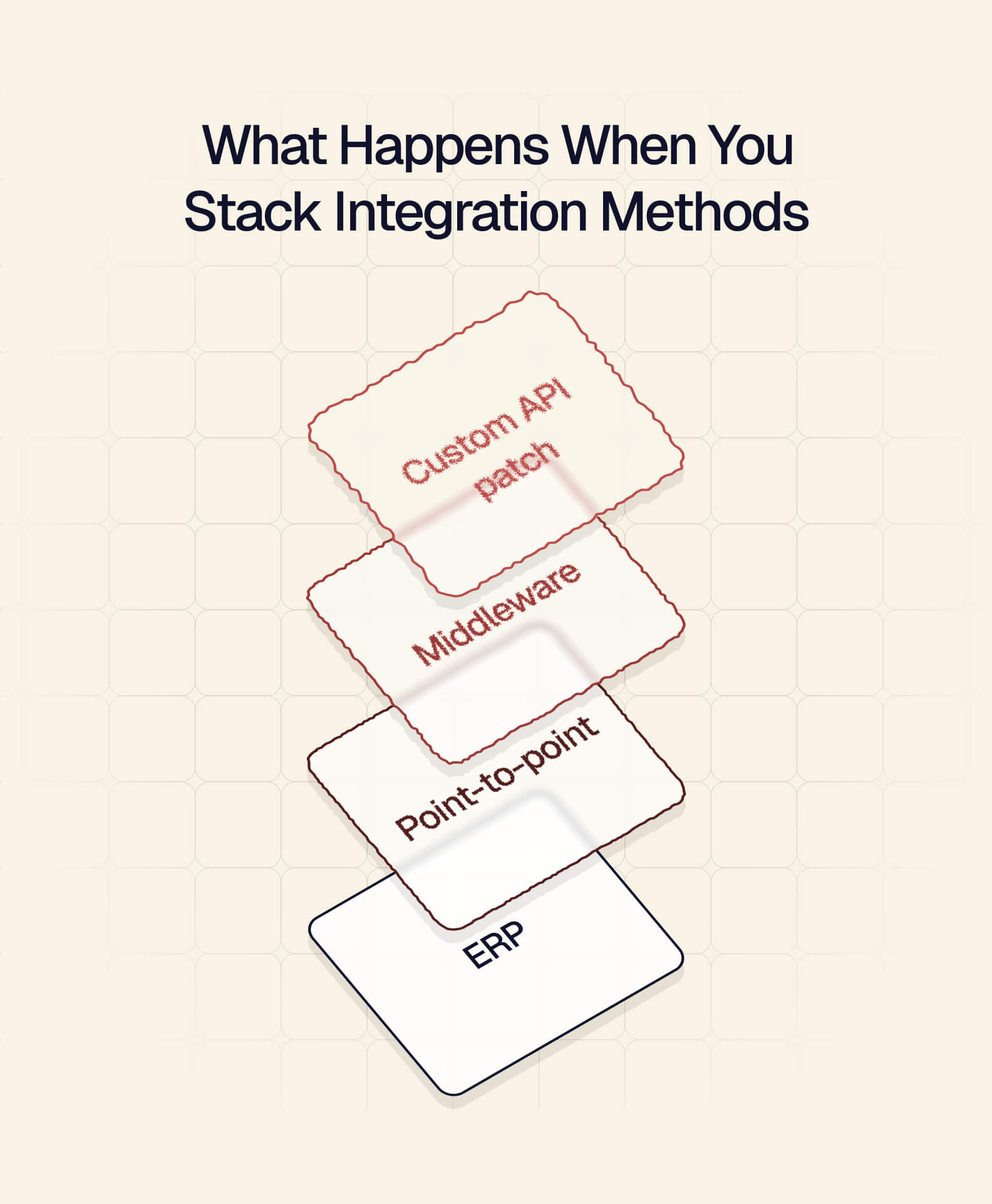
What Happens When You Stack Integration Methods
Imagine a retail group acquires a second brand that runs on different systems. Instead of replacing either ERP, they add middleware as a bridge between the two.
Now the iPaaS layer is doing double duty — connecting each ERP to its new channels, and connecting the two ERPs to each other. That’s one of many reasons stacking happens: organizational growth.
Rather than being the result of poor planning, this is a consequence of integrating your tech stack with a rigid system.
One Connection Becomes Five
The first big problem retail brands tend to run into: The core ERP wasn’t built API-first, so every new connection needs custom work.
As a consequence, point-to-point connections multiply with each new channel (POS, storefront, marketplace, 3PL) until nobody has a clean map of what talks to what. You’ll end up dealing with integration diagrams that turn outdated the same week they’re drawn, or only having one person who knows how the storefront-to-ERP connection actually works.
Middleware Solves One Problem, Creates Another
As point-to-point becomes increasingly unmanageable, brands add middleware (iPaaS or ESB) to centralize it.
iPaaS/ESB is often the correct response, but it also comes with a tradeoff. You’re trading a lot of small failure points for a big one. And that big failure point is now situated right between your ERP and everything downstream.
At the end of the day, iPaas is still a workaround for a structural issue.
The Data Model Was Never Retail-Ready
The next major problem? The ERP’s underlying data model wasn’t built for retail complexity. Every layer downstream inherits the same structural mismatch, so regardless of integration method, you’re going to see breakage in areas like:
-
Bundle/kit SKUs that don’t map cleanly
-
Variant data (size/color) that doesn't carry through to a marketplace listing
-
Personalization data that has nowhere to live in a rigid schema
More integration layers don’t fix a bad data model and add more places for the mismatch to show up.
IT Becomes the Bottleneck
Every new integration request, like a new marketplace or new fulfillment partner, has to be routed through IT or a vendor regardless of which method is in place.
This causes IT to become the bottleneck for business growth instead of the enabler. A holiday fulfillment partner that could add capacity for peak season — or a marketplace opportunity that a competitor has already pushed live — is waiting on integration capacity.
The Alternative to Stacking ERP Integration Methods
Eventually, every retail brand is going to have to make a choice: Add yet another integration layer to manage the sprawl, or address why the sprawl exists.
Instead of seeking a different integration method that might be a better fit, you’re setting a new starting point, asking whether the core system needs to be integrated this heavily in the first place.
That’s where composable, headless architecture comes in.
The API Is the System
With a headless ERP, the UI itself isn’t the system. It’s one view into functions that are already exposed via API. When every function is already built to be accessed via API, you no longer have to have your technical team create custom connections to your existing tools. Instead, their data and functions will be brought into a single screen, with minimal integration time.
A Single Source of Truth
Before, each system may have had its own partial version of the data. Inventory was in one place, order status in another, and product variants somewhere else. Integration methods tried to reconcile those partial truths after the fact.
But now, everything reads from a single upstream source. This is especially key for retail because bundles, kits, and variant data don’t have to be translated between systems when there’s one accurate version instead of several approximate ones.
Best-in-Breed
A composable ERP is best-in-breed, not all-in-one. You’re not routing every connection through one centralized layer — that would become its own point of failure. Instead, capabilities can connect to each other directly. Integration layers won’t necessarily disappear completely. But you no longer have a monolithic setup, so the architecture doesn’t need centralization to compensate for a rigid core.
No Rip-and-Replace
With composable ERP, you keep what works and replace the duct tape. You don’t rip out your stack — you simply stop needing workarounds for it.This makes it easier to retire the complicated workarounds you once needed to facilitate communication between those tools and your old rigid system.
Even better, when you have less workarounds to build and maintain, your IT team is free to focus more energy on actual commercial requests instead of integration maintenance.
What API-First Integration Looks Like in Practice
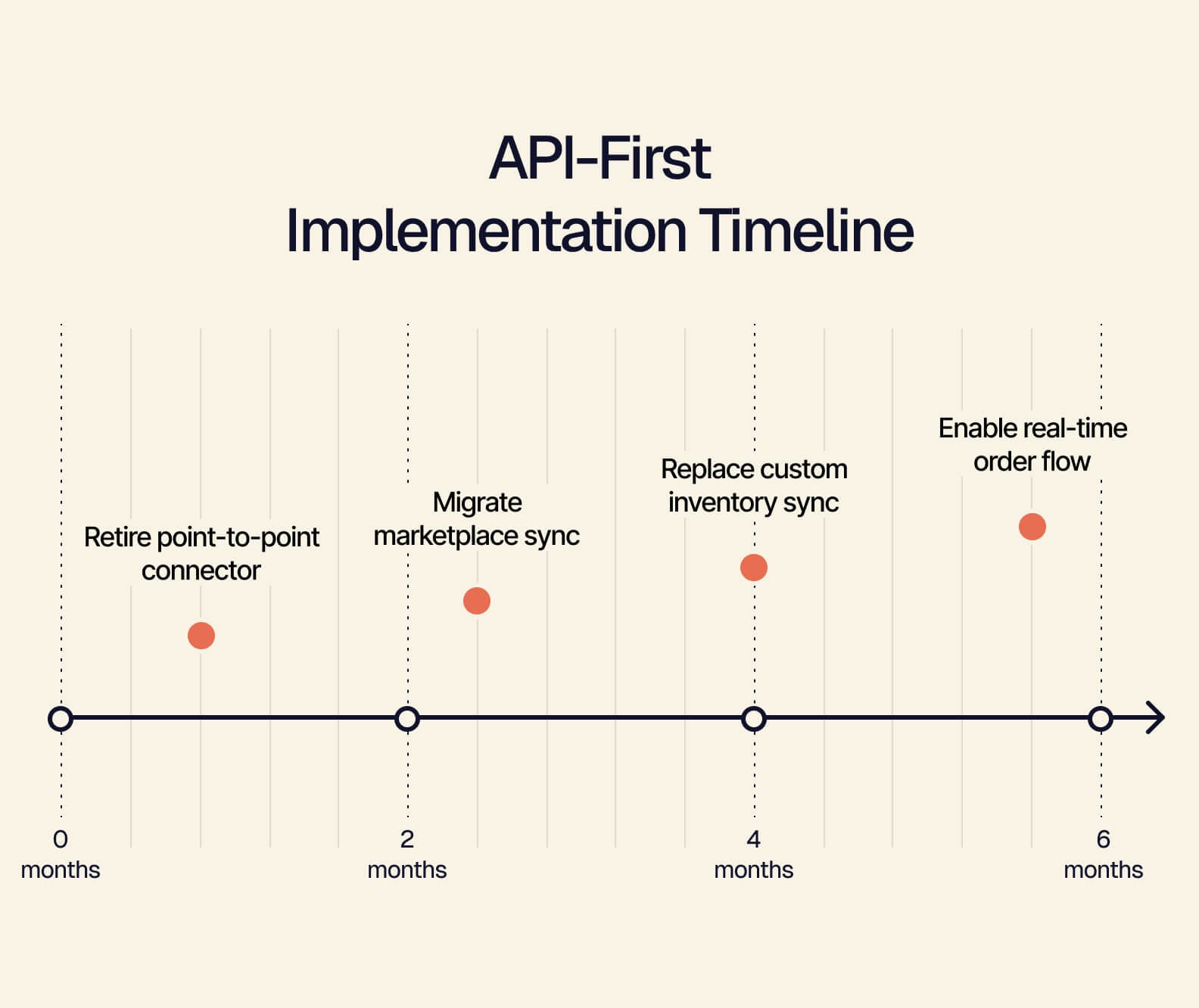
Once the ERP itself is API-first, choosing from ERP integration methods becomes much simpler. Most connections become direct, documented API integrations. Heavier layers (ESB, multiple iPaaS subscriptions) shift to unnecessary overhead rather than a requirement. This is what everything in the section above looks like in practice:
-
Ask vendors what their API covers. Any ERP can claim to have an API. Whether that API is worth building on is a different story. Before committing, see if your team can test it. You want to know whether every core function is exposed, or only a subset, and whether the documentation is current.
-
Headless changes what your team is building. A headless ERP affects more than looks. Instead of custom work to expose a connection point, the connection point already exists. With Tailor, a new channel or marketplace connects to functions that were already built to be accessed via API.
-
Fast integration makes the transition realistic. Tailor’s implementation can go live in weeks, and let you pilot features before pushing them live. This helps you carefully retire integration workarounds and ensures your system isn’t shocked by the change.
-
Bundles and variants are the proof point. If bundle/kit handling and variant data were the first things to break in the old stack, they’re the clearest test of whether a new one actually fixed anything. Tailor’s data model is built for retail variants and personalization from the start, so this part of your integration stops breaking during every peak season.
Where the Stacking Stops
You don’t need a sixth integration method. Instead, you need a system that doesn’t require them at all. See what that looks like with Tailor — book a demo with our team today.