Scaling your business in the midst of ever-changing market conditions can expose your retail brand to more risk than you planned for. Even with this risk, you need to scale to keep up with your competitors.
But how can you scale when market conditions continually reveal problems with your inventory management, system flexibility, and customer satisfaction?
Retail brands that can scale in these conditions are doing something different: they’re embracing composable commerce operations — which provide predictability, sustainability, and the flexibility necessary to weather market chaos.
What you will learn:
-
How composability solves common scaling difficulties
-
Why sustainability matters for composable commerce operations
-
How headless, composable ERP helps you build faster
Common Scaling Difficulties That Disrupt Retailers
Scaling your retail brand in the midst of market chaos can be harrowing. Your day-to-day operations can be constantly disrupted by broken processes, supply-chain stress, and fluctuating customer demand. Your brand is either fully prepared to stand up to these disruptions or primed to be blindsided.
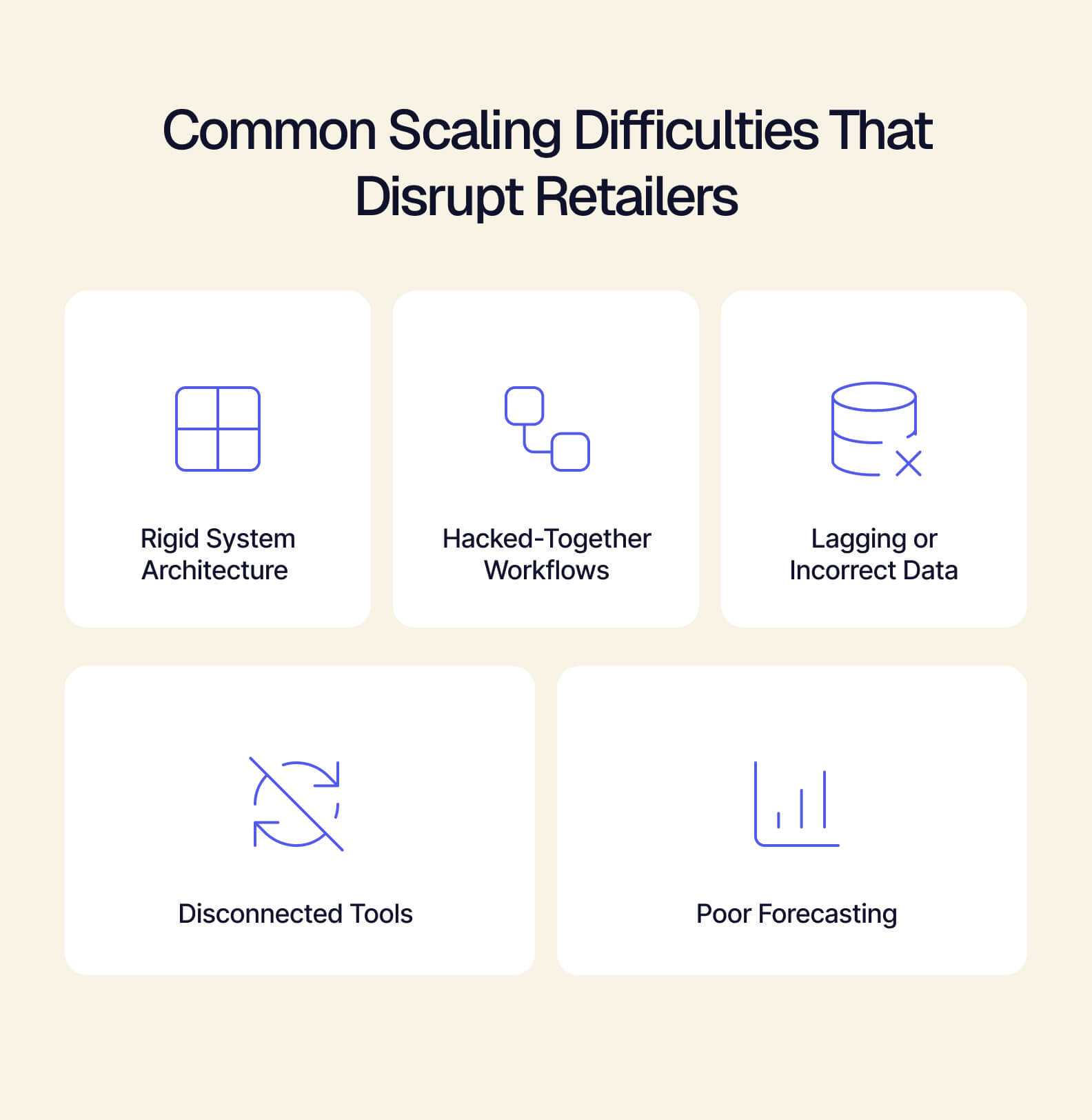
Fortunately, the path to overcoming these disruptions can be traveled by using composable commerce operations to address these five common scaling difficulties.
1. Rigid System Architecture
The first difficulty is trying to scale with a rigid system architecture. A rigid system is often caused by:
-
Monolithic ERP (or an all-in-one, closed-ecosystem ERP) integration
-
Outdated or custom software solutions that are difficult to service
-
Disconnected tools that require translation layers or spreadsheets to “talk” to each other
But how do these factors actually make scaling more difficult?
-
Monolithic ERP limits the way you can grow your business. Because workflows are set in stone, you’ll have to rely on third-party connectors to integrate new tools into the ERP. This means you’ll be stuck running your business exactly how the ERP expects you to, and when you don’t, you have to build convoluted workarounds that can easily break your processes.
-
Outdated software creates compatibility nightmares. Retail brands often end up with a system that is necessarily structured around deprecated software. Without a suitable replacement, it’s dangerous to move away from this software without causing a lengthy and expensive rip-and-replace cycle.
-
You only get a fraction of what you pay for with disconnected tools. When your system is composed of disconnected tools tied together by spreadsheets and translation layers, you’re likely spending a large portion of your operating budget on tools you can only half-way use.
How composable commerce operations can help. With a headless, composable ERP, you can decouple your back-end system from your front-end design, allowing you to easily replace deprecated software with a composable system that won’t ask you to disconnect and change every piece of software connected to it, while also being easily upgradable on the architectural side.
2. Hacked-Together Workflows
A consequence of rigid system architecture is hacked-together workflows and complicated workarounds. When your system is designed to only work one way, for one type of business, it’s inevitable that your teams will have to create workarounds to “make things work.”
When it’s just a single tool that requires the workaround, the operational hit is almost non-existent. But over time, new tools demand new workarounds, and suddenly your operations are infested by a network of increasingly difficult to navigate workflows (that will eventually break).
How composable commerce operations can help. Adopting composable commerce operations can help you untangle these manual workarounds by providing the infrastructure necessary to use your existing tools as intended.
3. Lagging or Incorrect Data
An issue for scaling retail brands is that after a certain point, your data is no longer available the moment you need it. When you were smaller, with fewer SKUs and less exposure to market chaos, daily inventory reports from your POS systems were totally acceptable. But now that you have multiple storefronts — or you’re preparing for omnichannel, multi-warehouse operations — daily reports, late reporting, and incorrect inventory data are risks you can’t tolerate.
As your business grows in complexity, the integrity of your data collection must as well. And if it doesn’t, you’ll be caught off-guard by cascading inventory issues you should have been able to avoid.
How composable commerce operations can help. One of the biggest benefits of a composable system is real-time data sync. When you’ve scaled your business sufficiently, your data needs a highway to traverse — which brings all the data you need into a single, easily-accessible window.
4. Disconnected Tools
A mirror issue caused by rigid system architecture is having a system full of tools that simply cannot interface with each other, or are specifically designed to only work in limited, interconnected ecosystems. This problem often arises from short-term solutions seeking to help put out fires during your initial scaling.
The outworking of this difficulty looks like:
-
Managing your day-to-day workflows from a series of spreadsheets
-
Constant miscommunication between your teams
-
Siloed data that doesn’t make it to where you need it
How composable commerce operations can help. By building your retail brand around composability, you give your system a way to help your disconnected tools “talk” to each other.
5. Poor Forecasting
With greater complexity comes a need for quality forecasting. This difficulty goes hand-in-hand with incorrect or lagging data — when your data is missing, incorrect, or outdated, forecasting is going to give you subpar results, leaving you exposed to greater risk and operating with unreasonable uncertainty. The consequences of poor forecasting can result in:
-
Overstock tying up your operating budgets with low demand for affected SKUs
-
Stockouts during peak demand, frustrating customers
-
Ill-timed market pushes when you could have waited and had more success later
How composable commerce operations can help. Composability enables more than accurate forecasting, it also gives you the system flexibility necessary to support AI-native forecasting solutions — which can ingest your past and real-time business data while factoring in external market data.
More Than Scaling: Composability Encourages Sustainability
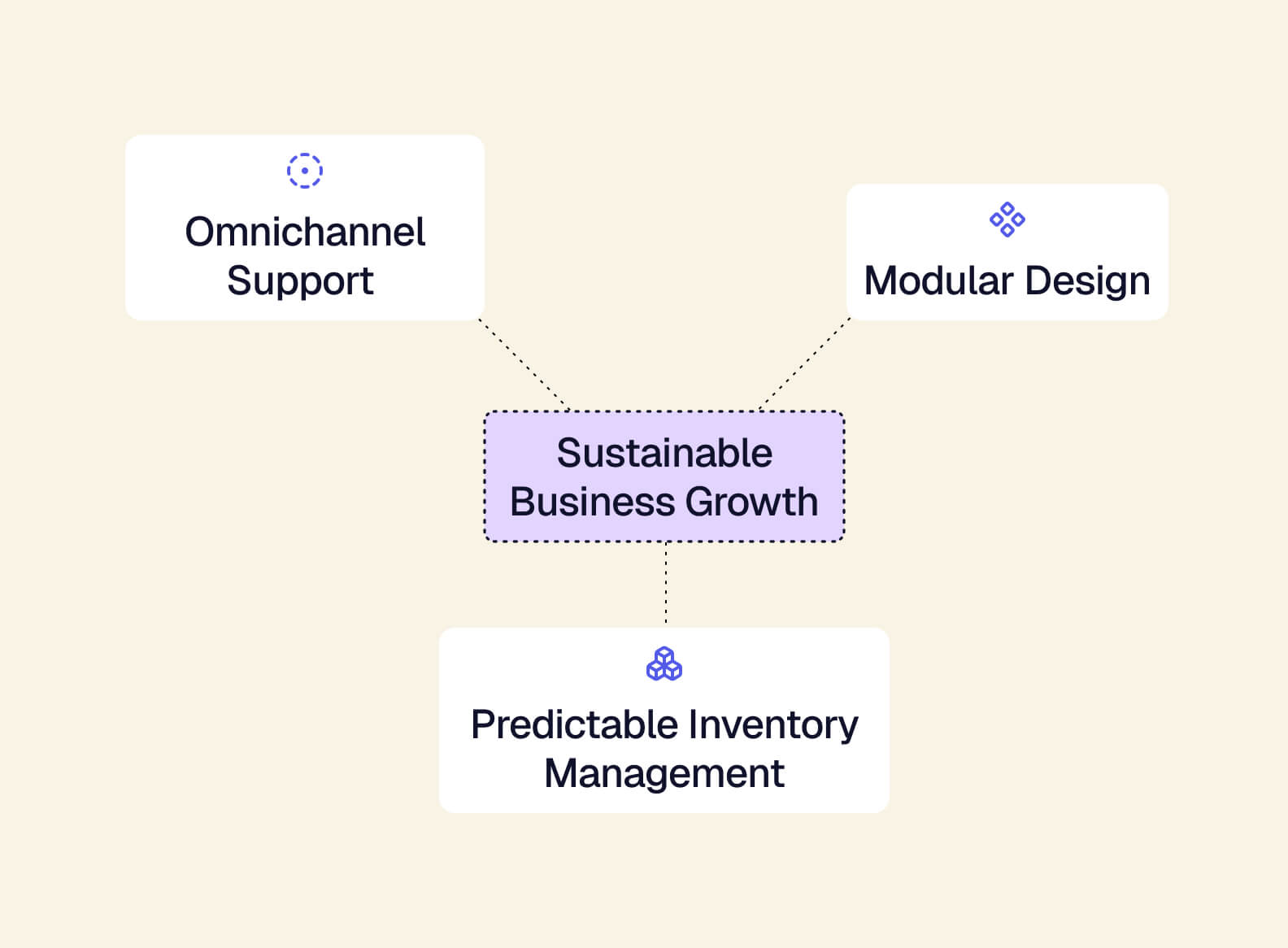
When scaling your retail business, it’s not just about speed (which composable commerce operations enable), it’s about your operational sustainability. To better understand the impact of composable commerce operations in your retail brand, let’s look at three outcomes this operational stability can achieve in your business.
Predictable Inventory Management
One of the most notable impacts on your business’s ability to sustainably scale is achieving predictable inventory management. When smaller retail brands begin scaling, they often get caught up in increasingly complicated workflows that result in frequent manual inventory recounts, frustration with returns logic, and stockouts hitting at the worst time.
The outcome: When you pivot to composable commerce operations — by integrating a headless, composable ERP or composable modules — you can restructure your inventory management system to ensure that manual recounts are a thing of the past; with more robust returns logic for your storefronts and a significant reduction in stockouts.
Why it matters: Predictable inventory management provides your brand with the stability it needs to offer new products and ensure that your customers stay happy. If your inventory management is unpredictable and chaotic, you’ll be forced to play it safe and manage customer dissatisfaction, which limits your scaling potential.
Omnichannel Support
Under the hood, composable commerce operations enable seamless omnichannel support for your entire operation, connecting every storefront, warehouse, and tool you use. With a composable ERP, or a composable omnichannel module, you can start dismantling silos and unintuitive user experiences that could be preventing pleasant shopping experiences for your customers (and causing headaches for your Ops team).
The outcome: When you have proper omnichannel support, you get greater end-to-end insight into how your business runs. In turn, this helps you optimize your day-to-day operations, providing process stability as you continue to grow.
Why it matters: By supporting your business with composable omnichannel solutions, you fight back against the spread of bad data and the double-edged sword of workarounds for necessary tasking.
Modular Design
A persistent issue for retail brands that integrate rigid ERP systems is that the system’s UI and UX aren’t designed to fit their workflows. This causes a large amount of friction in daily tasks, and closes off the brand’s ability to add new software and tools that could help solve that friction — leaving them with two options: spend more to fix a problem they shouldn’t have to fix, or undergo a disruptive rip-and-replace cycle.
The outcome: A headless, composable ERP like Tailor offers retail brands a flexible system that’s designed to minimize UI and UX friction, while enabling brands to keep the tools that work for them. When you have composable, modular design underpinning your business, your operations are primed to run without problem — and if problems do occur, you’re spared the headache of trying to fix an inaccessible, inflexible system.
Why it matters: When your system design is built to work for composable commerce operations, the heart of your business is able to stay healthy and handle whatever you throw at it. This is the key to long-term sustainability in your scaling: because you can trust your system to be flexible and work how you need it to, you can move forward with confidence.
The Advantages of Building with a Headless, Composable ERP
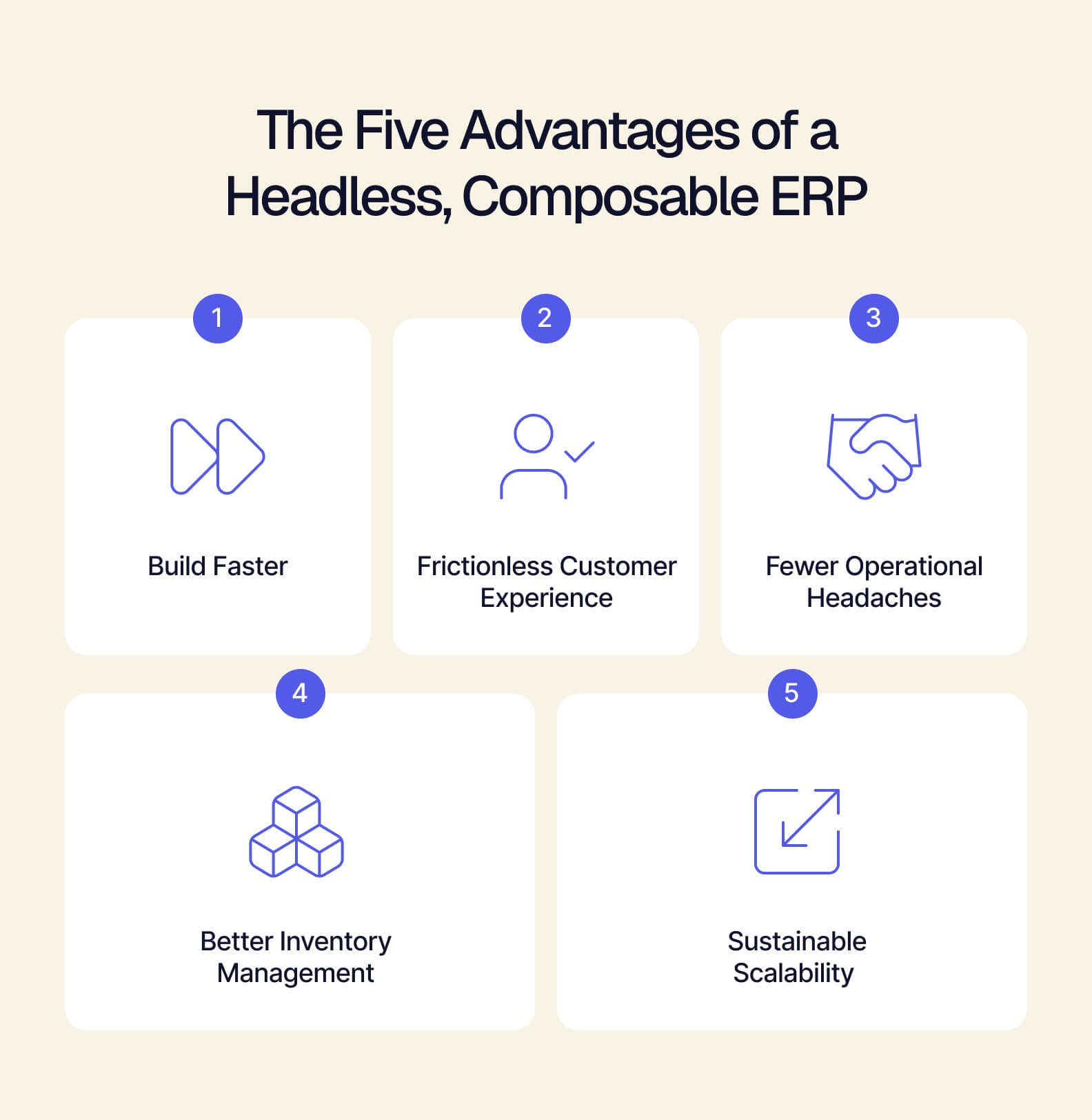
Now that you understand the scaling difficulties that challenge many retail brands and how composability provides more stability for scaling businesses, let’s distill the advantages of switching to composable commerce operations:
-
Build faster. A composable, headless ERP enables you to cut down integration times, add tools quickly, and jump into new market opportunities.
-
Frictionless customer experience. Your customers will be able to shop without being hit with order cancellations due to stockouts, and won’t have to puzzle their way through confusing return experiences.
-
Fewer operational headaches. Integrating a headless, composable ERP helps your teams work faster, communicate better, and catch problems early — meaning they spend far less time putting out fires, and spend far more time doing what they do best.
-
Better inventory management. A headless, composable ERP system brings all your inventory data into a single screen, so you don’t have to parse your inventory status from data silos and spreadsheets.
-
Sustainable scalability. The bottom line is that when your business is built on a composable foundation, you can scale sustainably. This means you can control the pace at which you scale and will be able to do so without slamming into unexpected roadblocks.
Achieve Composable Scaling with Tailor
Composable commerce operations don't have to be “just a possibility” for your retail brand. It can be your reality in just a few weeks. In this era of market chaos and uncertain long-term conditions, you need a path to sustainable scaling that will help you weather any unexpected changes that could negatively impact your business.
This is where Tailor can help: our composable, pre-built modules and headless, composable ERP are easy to integrate with your existing software, while providing you the support you need to become a key player in your existing markets. Our tools come with an out-of-the-box UI that easily and quickly integrates with your existing software.
Book a demo with us to experience how composability could transform the way your business operates — without forcing you to abandon your existing tools.