You’re preparing for your summer sales event. You’ve set up multiple bundles online and have a decent amount of stock available (based on last year’s summer sale data) in-store for your most popular items. At the start of this sale, you’re hit with an unexpectedly large rush of new customers, and before you know it, your warehouse inventory is out of sync with your ecommerce platforms, and your physical storefront sales reports aren’t reconciling with the rest of your sales data in real-time.
Suddenly, you’re overselling products you didn’t realize you were out of and unable to restock at your physical storefronts — disappointing customers and throwing a wrench into your POS inventory system’s ability to support the growth of your brand.
What if there was a way to ensure this never happened again?
What you’ll learn:
-
Why your POS inventory system is failing under pressure
-
How headless, composable ERP gives your POS the support it needs
-
What the future of your POS system could look like
Common Problems with the Most Popular POS Inventory Systems for Growing Retailers
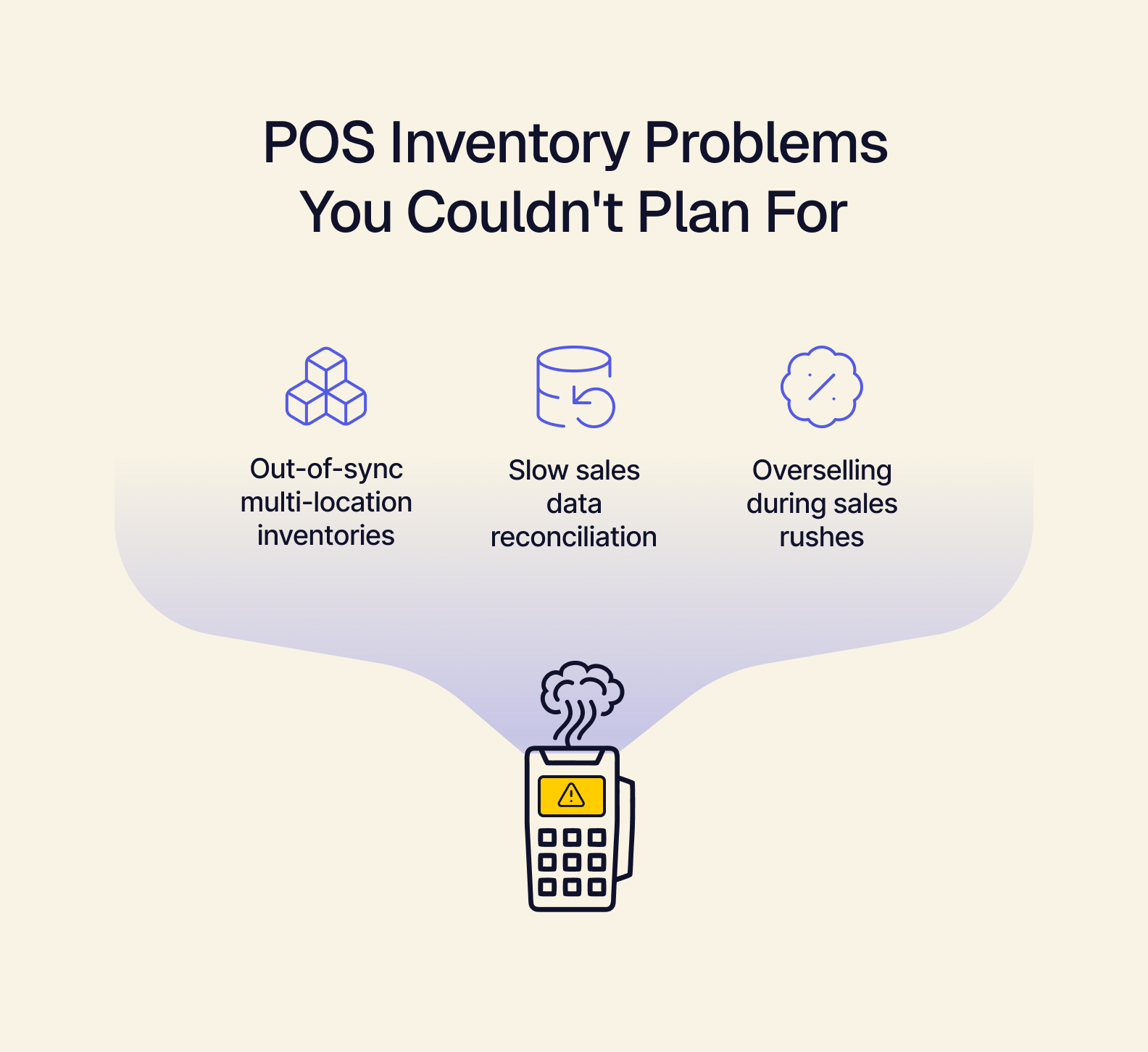
Scaling retail brands can eventually hit a wall with their POS inventory management, no matter the solution. Shopify, Lightspeed, and Square — despite being industry leaders and fantastic tools — can all falter at the same points without the right infrastructural support. There are three prominent root causes that undermine your POS systems:
-
Multi-location inventory tracking. Keeping up with the data in your business and inventory changes was easy when you had a single storefront and warehouse. But now you’re using multiple storefronts and warehouses with different tracking methods — causing confusion and enabling different, conflicting inventory counts to interfere with your retail operations.
-
Syncing high-volume online and storefront sales data. Another area where your POS inventory system can go wrong is reconciling sales data between your online and physical storefronts. High sales volume from both places, at the same time, can result in mismatched inventory numbers because both systems may not sync with each other and your warehousing in real time.
-
Overselling, understocking, and manual recounting. Together, both of the above issues can lead to overselling (selling products you don’t have available due to inventory sync issues), understocking (caused by not having the right forecasting systems set up to anticipate stockouts and reordering in time), and lengthy manual recounts — all of which contribute to degrading your POS inventory system efficiency over time.
Before we uncover why these roadblocks are happening, it’s important to understand why some of the most popular POS tools work so well for growing retail brands (even with these problems in mind).
Why Shopify, Lightspeed, and Square Work for Retailers
The capabilities afforded by a POS system like Shopify, Lightspeed, or Square are responsible for the first few stages of significant growth for small retailers. Going from manually tracking all your data and selling a few units every week, to thousands of dollars of revenue a month and automatic inventory updates can feel like a whirlwind — and make the why behind these systems hard to pin down.
So, if you’re a small retailer hoping to scale up and get the most out of these popular POS inventory systems, here’s why they work:
-
Enable greater sales volume. The only way you can grow is if you can sell more of your products, which is exactly what these POS systems can help you do. By plugging directly into some of the most popular online marketplaces, you can gain access to new customers and host a larger catalog of SKUs to sell.
-
Provide omnichannel support. When you’ve grown large enough, they also offer you a means to access omnichannel workflows — which gives your customers an overall better journey with your brand. This enables customers to have more ways to interact with your brand and further propels your growth.
-
Scale your business. While you're transitioning from an early-days retail brand to a scaling retailer, these POS systems provide you with the tools you need to expand your inventory offerings and connect to larger marketplaces — giving you the runway you need to grow. They take standard increases of operational complexity in stride and automate enough of the process to keep you from getting bogged down by sales, fulfillment, and inventory management.
When They Stop Working and Why
The why and when behind low POS inventory system performance has nothing to do with the quality of these solutions. These performance failures have much more to do with your growing operational complexity and those tools needing more support to keep up.
This is why you might see your POS inventory system failing:
-
Your sales volume hits critical mass at multiple points. Critical mass throughput stresses your systems and can trigger cracks in your processes, break workflows, and cause inventory hiccups you’re not prepared for — costing you time, money, and reputational hits.
-
Your SKUs have multiplied, and you’re utilizing a large number of bundles to keep products moving. Keeping track of the individual items within a bundle after they’ve sold can be tricky with existing POS systems. If each individual item isn’t updated after a bundle sells, you can create the perfect environment for overselling products that aren't available.
-
Your warehousing infrastructure is falling behind. As your core operation has developed in complexity, it’s likely that your warehousing infrastructure may have fallen behind. This often results in lags between your POS and warehouse inventory management software, leading to frequent frustrations and inventory opportunities falling through the cracks.
How Headless, Composable ERP Gives Your POS Inventory System a Power-Up
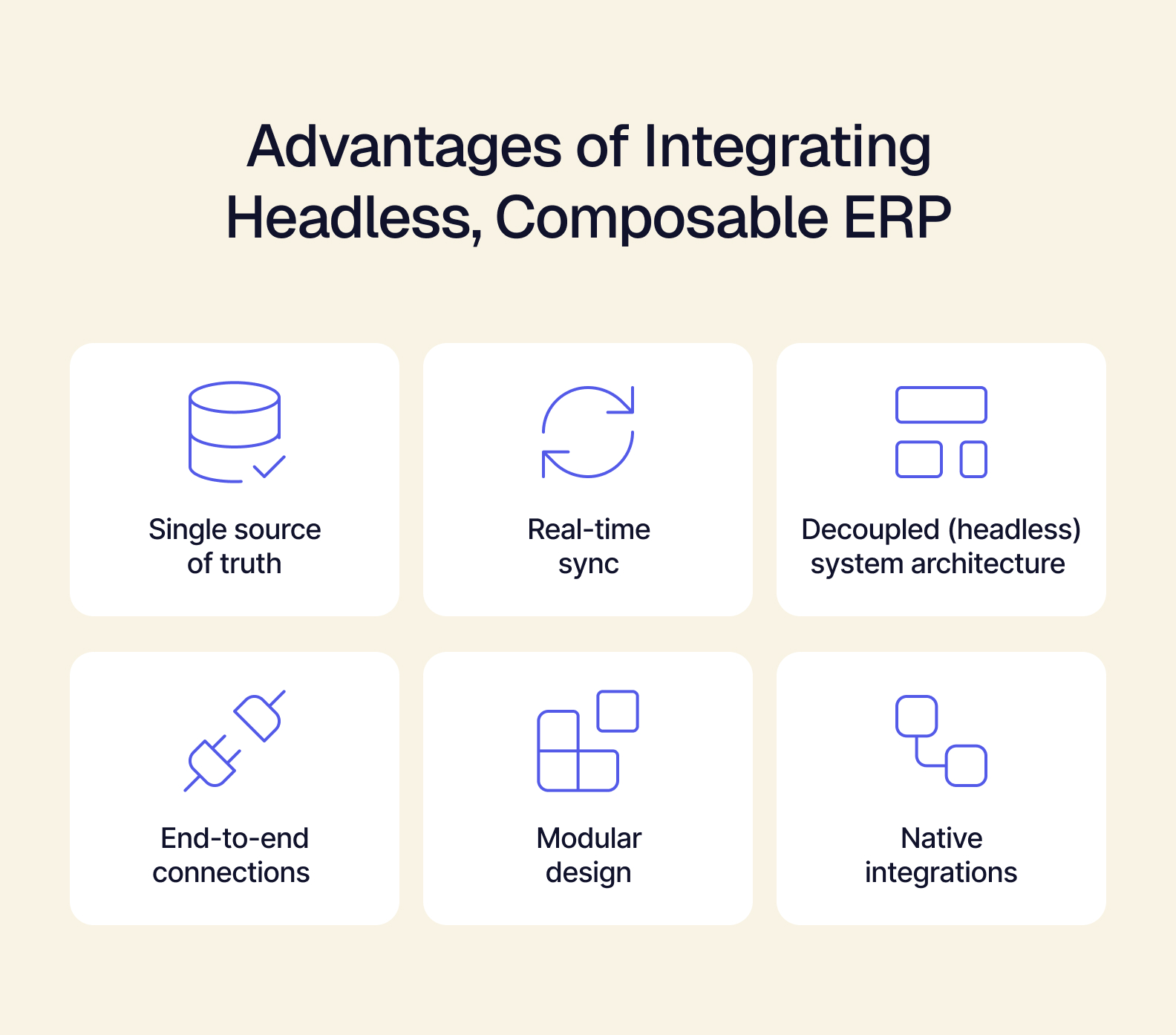
The key to giving your POS inventory system the support it needs to keep up with your increased complexity is integrating a headless, composable ERP. By integrating a solution like Tailor, you’re unlocking several key benefits that directly support the places your POS system might be failing:
-
A single source of truth to simplify inventory management, which prevents understocking, overselling, and unnecessary manual recounts.
-
Real-time sync across your business to better manage higher sales volumes and rapidly changing inventory counts.
-
Effortlessly reconcile data by connecting multiple storefronts and warehouses to your core system for accurate reporting across your business.
These benefits sound great on paper, but it’s important to understand how a headless, composable ERP actually helps, why it works, and the unique advantages it offers over other legacy and cloud ERP options.
How It Helps
Decoupled System Architecture
Tailor’s system architecture is built on the principles of headless design. Headless means that your system is decoupled between the backend and frontend — allowing for the code that powers Tailor’s ERP to be modified without forcing the frontend (the UI and UX) to change. Additionally, changes in the UI and UX don’t need to be directly tied to backend systems.
This means that you can add new features to the system, and only change the UI for certain teams who actually use those features. With your frontend and backend being separate layers, you can grow and change without your workflows suddenly breaking down.
End-to-End Connections
One of the biggest challenges for a POS inventory system is low visibility across your business and disconnected tools (aka siloed tools). When data cannot flow quickly from its source to where it’s supposed to go, disconnected tools are getting in the way, and complicated workflows muddy the delivery process, your inventory management can quickly devolve into a headache-inducing flurry of emergency changes.
Tailor enables you to remove silos and increase your system visibility by providing end-to-end connections for nearly every tool and software you rely on. It utilizes API connections with your existing tools to bring them into a single screen, removing the barriers between your POS inventory system and your Ops team.
Why It Works
Modular Design
The other side of Tailor’s system architecture is its composable foundation. Rather than hard coding new features into the backend, you can connect modules that add new functionality — like interchangeable building blocks. For businesses that want to keep their systems simple and highly functional, modules offer an opportunity to add only what they need, and remove the features and software they don’t.
With modular design, you can fight against technical debt, complexity caused by siloed tools, and hacked-together workflows that don’t scale.
Native Integrations
API and AI-native connectivity are at the heart of Tailor’s headless, composable platform. Tailor can quickly integrate software and tools that feature API access, allowing it to bring powerful features into a single screen for easy access. And when it comes to preparing your system to be future-forward, Tailor’s architecture is AI-native, allowing you to deeply integrate AI-powered tools without them feeling bolted on.
The Tailor Advantage
While other ERP solutions force you to build inside their curated ecosystems, with a predetermined growth trajectory, Tailor’s headless, composable ERP is designed to work for your business. You choose your modules, keep your existing tools, and retain the workflows that have helped you scale.
Tailor achieves this through its headless architecture, modular design, and API connectivity. Rather than demanding you grow to fit the solution, Tailor grows to fit your needs.
Considering the Future of Your POS Inventory System: Your Questions Answered
Q: What happens if I outgrow my current POS inventory system?
A: If you outgrow your current POS system and have Tailor integrated into your tech stack, you can easily shift to a new one. However, Tailor offers several functionalities that will help you get the most out of your existing POS inventory system — so you will only have to upgrade when your existing POS is no longer meeting your needs.
Q: Do I really need a headless, composable ERP if my POS inventory system problems are manageable right now?
A: A headless, composable ERP like Tailor prepares you for what comes next. Scaling can get messy, tools can suddenly hit their limit, and your data can suddenly go bad. Tailor helps you get ahead of these common problems and sets you on a path to control how you grow — while making it possible for you to integrate better tools.
Q: Why shouldn’t I choose a legacy ERP system like NetSuite?
A: Tailor is a lightweight and customizable ERP solution that’s designed to work for your business, with native Shopify, QuickBooks, ShipStation, and 3PL integration — all of which can be deployed in weeks. NetSuite is an extremely powerful ERP system, but it features a system designed for a closed ecosystem, with bundled features meant for enterprise operations and an implementation timeline that can take more than 12 months. Learn more about the differences between Tailor and NetSuite.
Prepare Your POS Inventory System for Rapid Scaling
Your POS inventory system doesn’t have to be the tool holding you back from rapidly scaling your retail brand. While the problems you might be experiencing today cause chaos for your inventory management, integrating a headless, composable ERP like Tailor can help.
Book a demo with us today to see how our out-of-the-box modules and user interface can help you get a handle on your inventory, accounting, and omnichannel needs — without forcing you to give up what’s working.