Whether you’re transmitting purchase orders, invoices, or inventory updates, electronic data interchange (EDI) software is the bridge that links your brand with the other companies you do business with.
However, with the way systems interact, it’s rarely quite as simple as hitting a button and transmitting error-free data back and forth. Instead, software incompatibility, convoluted workflows, and system architecture can all create problems that prevent EDI ERP integrations from performing as expected.
What you will learn:
-
Why retail brands benefit from having EDI software
-
How EDI workflows can fail
-
The ways your system architecture impacts EDI performance
-
How composable ERP solves EDI integration challenges
Why Scaling Retailers Need EDI
Despite being necessary for doing business with potential retail partners, EDI software is necessary for scaling retailers for a few different reasons:
-
Manual data reconciliation leads to errors. With the speed at which modern retail businesses move, manual data reconciliation is a liability as much as it is a high-friction task. Comparing your data with the information that your partners are sending back to you can lead to confidently working off your own keying errors, or accepting incorrect partner data — resulting in costly mistakes that are hard to undo.
-
Workflows are slow and difficult to maintain. Without EDI software to handle incoming (and outgoing) document transfers and other external data, you may end up with many of your internal processes slowing down or becoming increasingly difficult to keep up with. This is partly caused by manually reconciling data, but is further complicated by communication delays.
-
Overhead costs substantially increase. Because your processes are focused on manual labor, they require more specialized labor — resulting in increased overhead. While it’s advantageous to have a team of professionals who can handle these tasks, their energy is best spent on higher ROI workflows. When they’re not working on those revenue-generating tasks, you’re losing out on opportunities just to process documents.
-
Automated workflows aren't a viable option. The types of process efficiency that EDI provides for your brand come from automating many of the tasks you would otherwise perform manually. To best keep up with the modern retail environment, you need to be able to automate both your internal and external (often supply chain-related) processes. And when you can only automate your internal processes, the flow of external data can often leave you in a lurch.
If the above is a potential reality for your business without EDI software (and a subsequent EDI ERP integration), let’s take a snapshot of the benefits EDI software could provide:
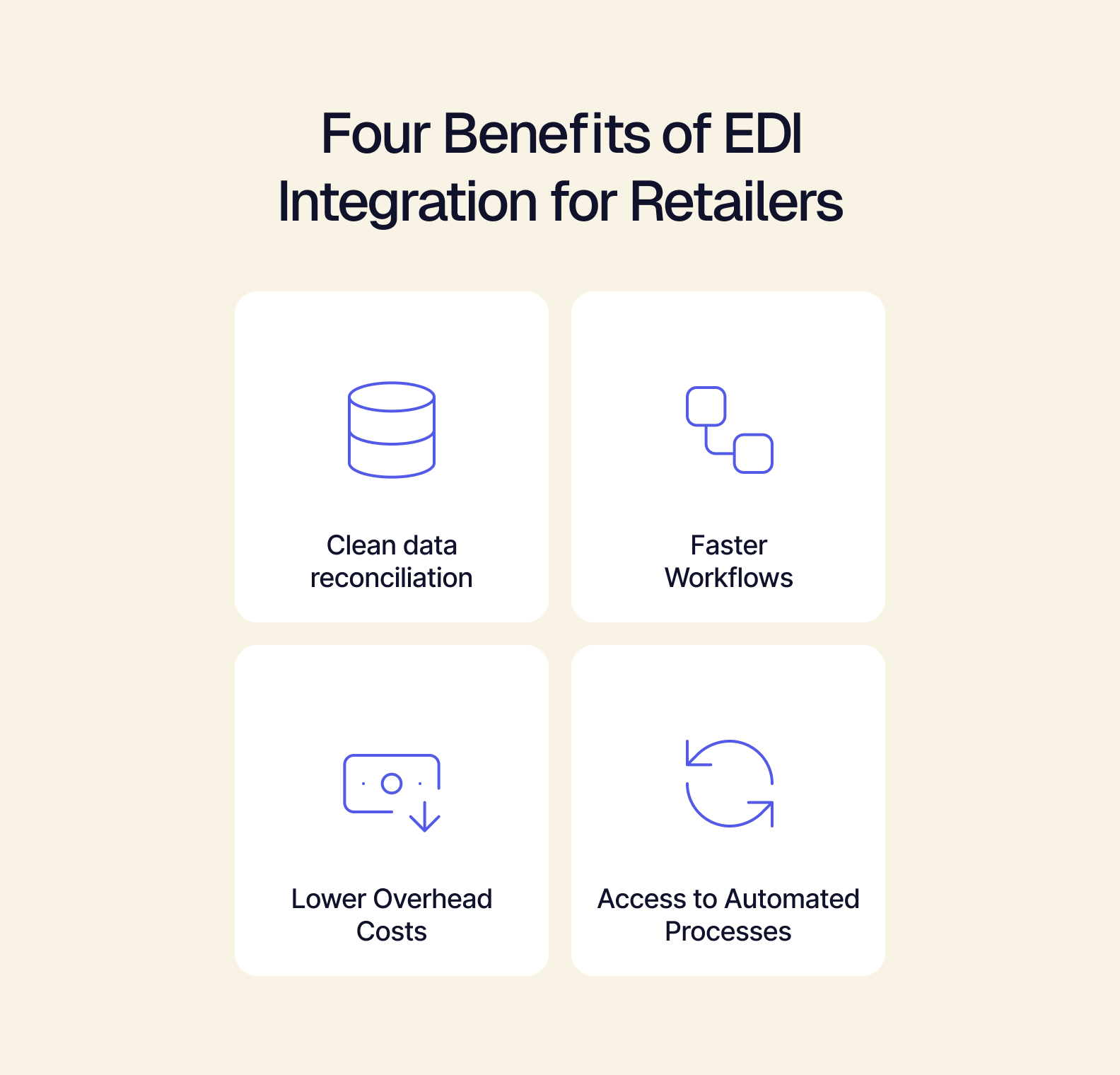
Automated data reconciliation. Your documents and external data can be processed automatically, with manual data reconciliation being necessary in rare instances.
Faster, simpler workflows. With EDI software, your supply chain workflows aren’t held back by your teams’ availability.
Reduced overhead. When your specialized team members are able to focus on their revenue-producing tasks, meaning your operating budget isn’t wasted on low-level tasking.
More opportunities for system-wide automation. Because your document processes are automated, you can connect them to your internal automation and keep that data flowing predictably — which is necessary for automations to thrive.
What Strains EDI ERP Integration the Most
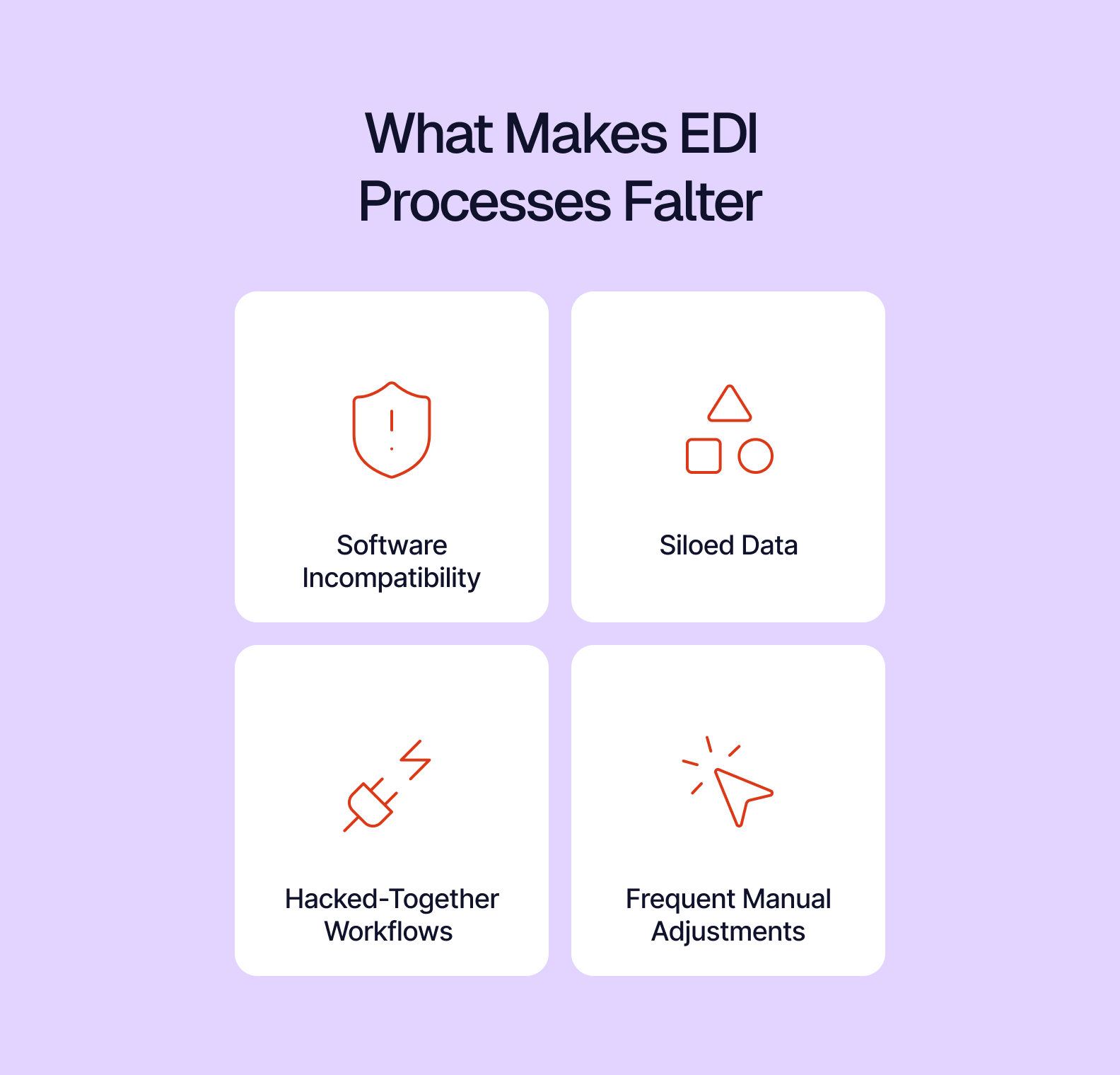
While EDI software tees you up to better manage your supply chain and partner relationships, the rubber really meets the road when you integrate EDI and ERP software. Unfortunately, it’s rarely as simple as plugging them into each other and calling it a day. Some ERP solutions are rigid (or monolithic) and can create new problems that cause performance issues across your stack. But, before we dig into the ERP side of this integration, let’s take a look at what makes the EDI half of the integration strain:
-
Software incompatibility. When your tech stack isn’t built around compatibility and predictable data flows, you can run into an issue where the tools you rely on aren’t actually able to work with each other. This is an immediate blocker for productivity and can generate error-prone environments — which can make process hiccups caused by incompatibility spread across your business. If this incompatibility is related to your EDI processes, then you’re going to have to lean on workarounds to try and force these software to work together.
-
Siloed data. Another way that EDIs easily falter is when your business has pockets of siloed data: disconnected software within your stack that holds back key data or documentation that EDI requires to function at its maximum potential. This can also happen in external environments where your supply chain management solutions are too disconnected from your EDI, causing important data to be missed.
-
Hacked-together workflows. Running your business with hacked-together workflows makes upgrading software, adding tools, and replacing integrations exceptionally difficult. And when these processes break, it can put undue stress on your entire business. This negatively impacts your ability to use your EDI and interface with your supply chain and retail partners.
-
Frequent manual adjustments. Finally, if your internal data is prone to errors, it can put a heavy burden on your EDI software. Because data errors must be fixed manually, it’s easy to disrupt your automated workflows, which can cause problems for you and your business partners. That’s why it’s important to have a single source of truth for your operational data, which prevents most manual adjustments.
How Rigid System Architecture Contributes to EDI ERP Integration Difficulties
On the other side of this integration sits your ERP software. Let’s imagine that the EDI side is properly implemented and the data it directly manages is accurate and flowing correctly. But let’s also picture an ERP implementation that creates a poor internal data environment built on rigid system architecture. What does this system architecture do for your EDI ERP integration?
More Difficult Upgrades
One of the main problems that comes with having rigid system architecture is that you get stuck in the state you deploy; changing your system, whether you need to upgrade or replace software, increases friction that may prevent these actions. And even if you succeed in making those necessary changes, it’s likely that a process, workflow, or tool breaks — creating a period of disruption for your operations.
Working Against Bundled Tools
If you have rigid system architecture, it’s often caused by using a rigid, monolithic, or legacy ERP software in your tech stack. These types of ERP often come bundled with mandatory features or additional software integrations that you may not be able to use properly. This can directly cause trouble with your EDI software or other supply chain management tools you need to use.
What Composable ERP Can Do to Help
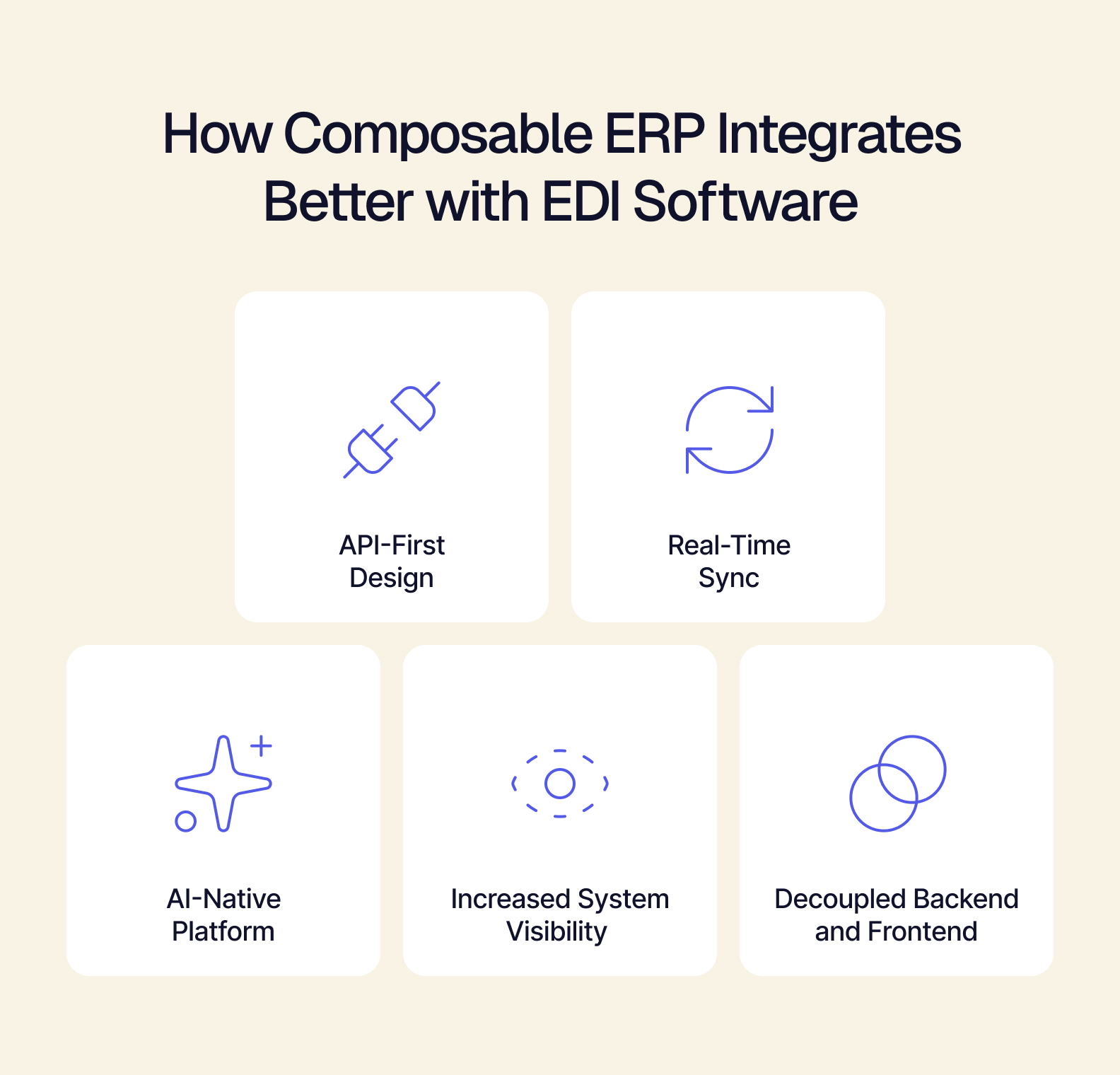
The best way to take charge of your EDI ERP integration is to focus on choosing flexible, API-first software. This can be found in a composable ERP solution like Tailor. How does Tailor solve these common (and fairly significant) EDI ERP integration problems? It all comes back to the unique advantages of headless architecture and composability:
API-first design. Tailor’s first advantage is being designed to maximize API-connectivity. This increases its software compatibility by directly connecting with other tools that have APIs to call. Having this capability allows you to keep your tech stack clean and helps avoid hacked-together workflows.
Real-time sync. One of the key ingredients for strong automated workflows (and a powerful EDI ERP integration) is real-time sync. Tailor uses real-time sync to reconcile the data moving through your business, ensuring that it’s as accurate as possible — directly empowering automations from your inventory management all the way to your external supply chain workflows.
AI-native platform. Part of keeping a platform healthy is being able to embrace cutting-edge technology as you scale your business. Tailor enables your business to be AI-native, easily adding AI tools to your stack without the implementations feeling bolted on.
Increased system visibility. System visibility is the best way to identify problems before they grow out of control and cause disruptions. Because Tailor removes data silos and connects your entire stack, your Ops team is able to keep a close eye on the most important movements in your day-to-day workflows.
Decoupled backend and frontend. One of the biggest benefits of using Tailor in your EDI ERP integration is that it allows your business to build with headless system architecture. Headless architecture enables you to develop your system backend and UI separately, meaning that changes to your codebase and UI won’t disrupt each other. Tailor also offers a curated UI that can be used out-of-the-box, but can also be customized to meet the needs of different teams within your business.
Solve your EDI ERP Integration Problems for Good
Despite EDI ERP integrations being magnets for recurring problems that disrupt your operations, there is a way to solve them for good. That solution is Tailor, a headless, composable ERP built for scaling retail brands. In just a few weeks, you can have Tailor’s powerful modules and connectors up and running, without the long integration times of legacy ERP systems.
Book a demo with Tailor today to talk with our experts about which modules you need to solve your EDI ERP integration pain points.