As a growing retail brand, managing your supply chain is not a simple task. With constant data tracking on top of vendor and retail partner relationships to manage, it’s easy to lose sight of the best way to manage it all. That’s where supply chain management software integration comes in.
However, integrating supply chain management software isn’t a simple plug-and-play process — you need to understand what it does, why its features matter, and what makes it so important for the future of your business. That’s why we’ve compiled this guide to highlight everything you need to know about supply chain management software (and provide you with additional reading if you’d like to learn more).
What’s in this guide:
-
A brief overview of what SCM software is
-
A list of features you should look for in SCM software
-
Considerations of what makes SCM software important for retail brands
-
An introduction to the relationship between ERP and SCM software
A Supply Chain Management Software Primer
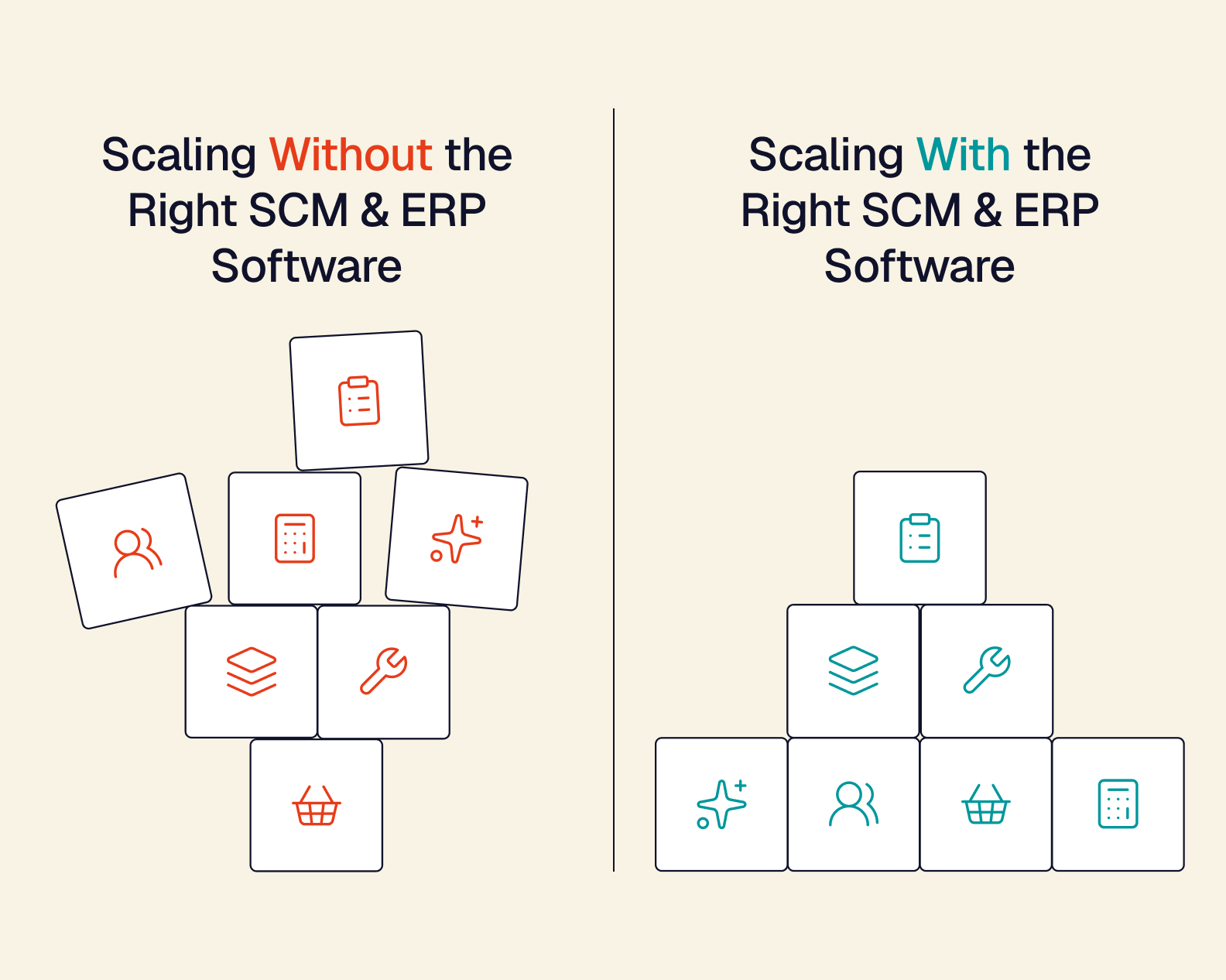
Your growing retail brand needs stronger architectural support as it scales. While it’s easy to focus solely on the internal supports, leaving your external supply chain weak and brittle only invites chaos into your operations. The most likely time when this imbalance of internal and external support shows up is during the transition from a small business to a mid-market retailer.
Complexity grows, and internal systems need to be upgraded so that your workflows can scale. But what often catches retailers off guard is the sudden need for more supply chain infrastructure than they expected. Integrating powerful supply chain management (SCM) software will help you better manage your vendors, logistics, production, and warehousing — but it’s important to find the right solution that’s built to meet your needs.
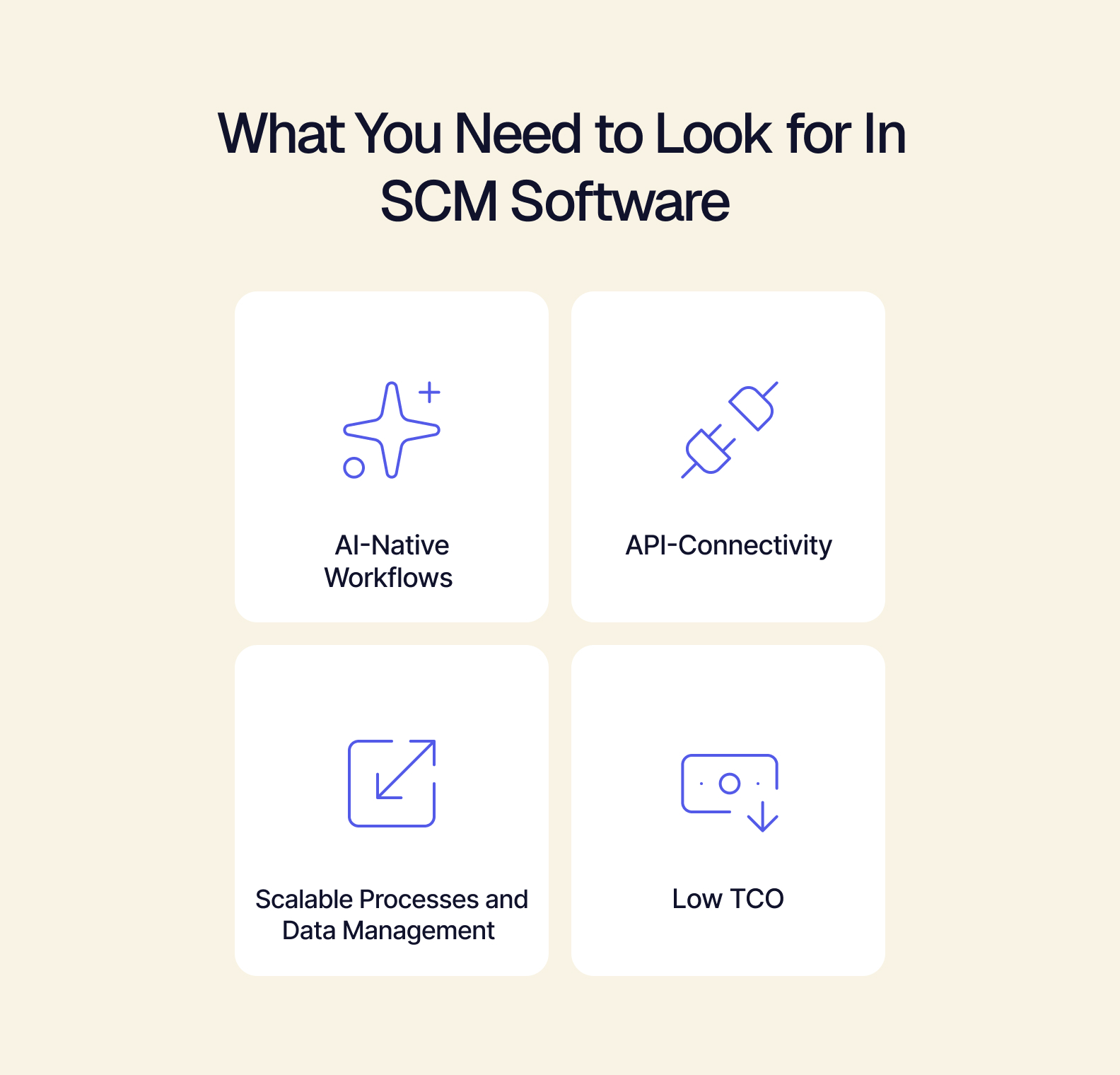
What you need to know: The type of SCM software you should look for benefits from being built with these traits in mind:
-
AI-native. Having access to AI tools and human-in-the-loop automations can result in increased productivity.
-
API-connectivity. Being able to easily connect to other tools enables faster integration and easy upgrading.
-
Scalability. Choosing a tool that isn’t bundled with other unnecessary software — and designed to be built on top of — will help you avoid expensive software replacement cycles before you’re ready.
-
Low total cost of ownership. SCM software that doesn’t come with unexpected fees, long-term mounting costs, and expensive, frequent maintenance is necessary to keep up in the current market environment.
Why you should learn more: Understanding what SCM software does for your business and how it can improve your external data management, workflows, and operational speeds will set you up to choose the right integration.
Read our SCM software quick-start guide.
SCM Software Features That Help You Grow
As a retail brand trying to get ahead of market conditions, you need to know which SCM software features will get you where you want to go. However, getting a better understanding of these features is just the first step — you also need to know how these features impact the rest of your business.
One overlooked factor that impacts the performance of your SCM software is whether or not your system is flexible enough to keep up. Your system’s flexibility is largely determined by its ERP integration and whether or not it’s built on composable or rigid architecture.
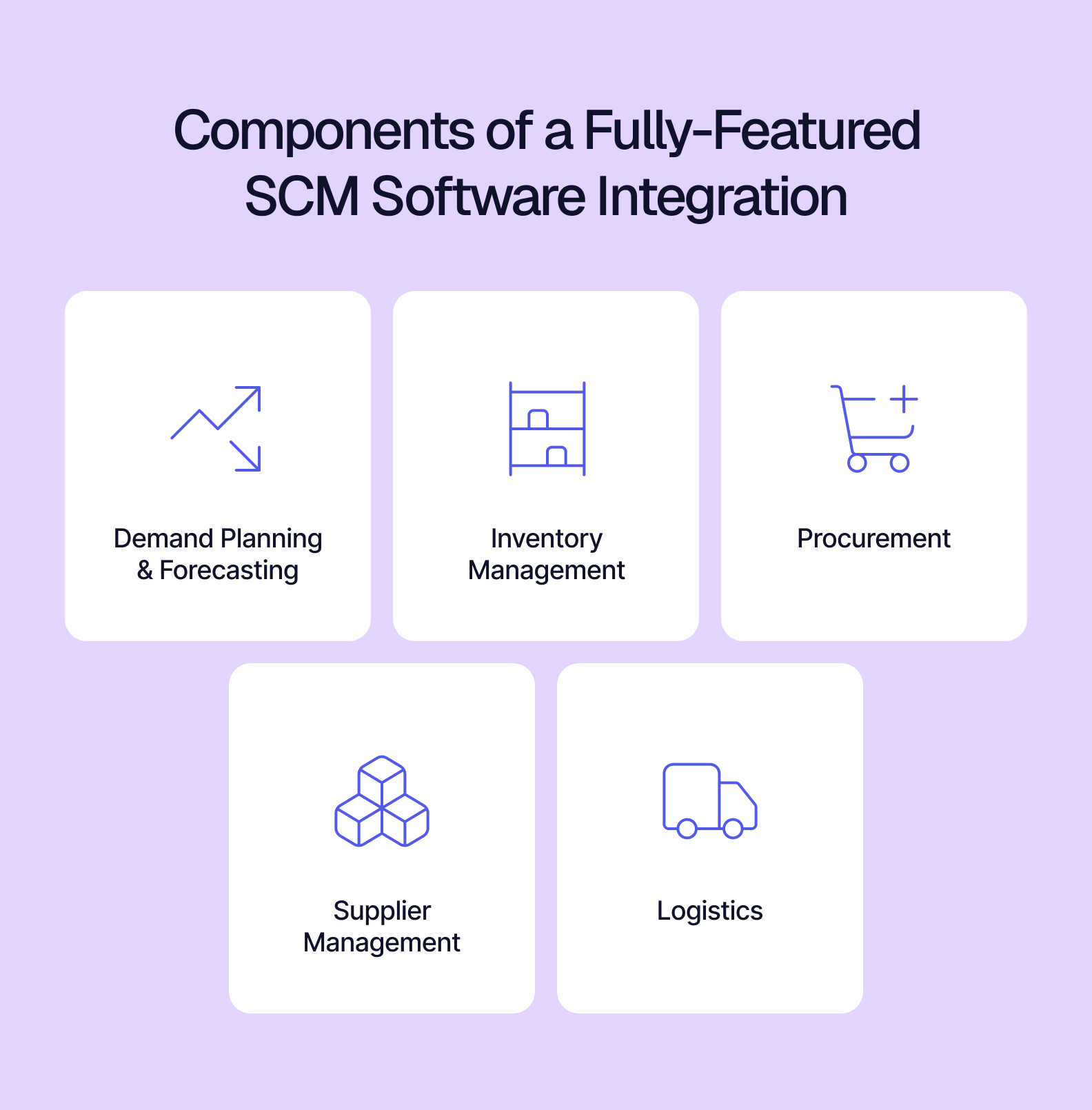
What you need to know: When you have SCM and ERP software properly integrated with each other, you’re able to dramatically improve the accuracy and flow of your data. This helps you achieve real-time visibility across your business and level up the performance of the following features:
Why you should learn more: If your Ops team starts building out your supply chain infrastructure on a rigid foundation — often caused by complicated software connections or monolithic ERP integrations — you may come to find that your SCM software won’t perform as well as you’d hoped. However, if you take the time to integrate a headless, composable ERP into your business, you’re far more likely to meet your supply chain management goals.
Dig into the impact of SCM software features.
Why SCM Software is Important as You Scale
The importance of SCM software is threefold: it manages your external data and processes, provides the infrastructure you need to grow your business, and enables you to interface with and manage third-party retail partners, vendors, and suppliers. However, this is just one facet of why SCM software is important (once you’ve already scaled into a mid-market retailer).
There are several other ways it’s important for your scaling brand. SCM software:
-
Fills the gaps between your existing software and new, future integrations.
-
Guides you out of small business operations and into the new, more demanding operations of a larger retailer.
-
Provides you with the additional data you need to get control over otherwise complex processes and strategies.
What you need to know: The overall importance of SCM software really shows up once you’ve established your growth in the market. Once you’ve advanced out of small business operations, complexity forces itself into everything you do. Tracking your products as they move between warehouses, reconciling retail partner data with your own, and keeping your production schedules tight can become sources of frustration without the right system architecture.
Why you should learn more: Going beyond coming to grips with why SCM software is important in general, it’s necessary for a growing retail brand to also understand why it’s important for their unique business needs. This includes uncovering the relationship between composable architecture and a thriving supply chain, along with how to choose the right SCM software integration.
Find out how SCM software could transform your supply chain management.
Get the Most Out of Your SCM Software with Headless, Composable ERP
It doesn’t matter how well your supply chain can run or how accurate your external data is if your tech stack is a convoluted mess of siloed processes and hacked-together workarounds.
With a rigid system architecture, these problems only compound over time — resulting in operations that slow down and frequently stall. This is why you need composable architecture at the heart of your business. But before we dig into the benefits, let’s review what headless and composable mean.
Headless software solutions feature decoupled backend and frontend operations, allowing for greater flexibility in architecture choices and UI design. Composable software is built to be modular, like interchangeable building blocks. This enables you to standardize your connections and makes it easier to build out your tech stack.
Let’s highlight the largest benefits of integrating a headless, composable ERP into your business:
Stack-Wide TCO Reduction
With a headless, composable ERP at the center of your business, you can achieve lower TCO for many tools and software integrated into your tech stack. This is because a headless, composable ERP — like Tailor — enables you to have access to better software choices because of its API-first design. When you have more choices available to you when shopping for software, you can avoid software bundles that force you to rip-and-replace the tools you rely on. This means you can choose solutions that actually fit your needs and use cases, which reduces overhead pressures on your yearly software costs.
High System Visibility
Without a headless, composable architecture orchestrating your business, you’re at the mercy of your current tech stack layout. Often this comes with tools that are either disconnected from the rest of your system, or feature data delivery methods that require processing before it’s accessible by other tools you rely on. In either case, this creates a silo that hides data and reduces the overall visibility of how your business is actually performing. Headless, composable architecture tears down those silos and enables data to flow easily — giving you a high-visibility view of everything happening in your day-to-day operations.
Real-Time Sync
This goes hand-in-hand with high system visibility. Once you have the correct system architecture in place and all your data is flowing to a single source of truth, you can achieve real-time sync across your business (keeping in mind that some integrations may have limitations that prevent instantly synced data). With real-time sync, you can trust that your inventory fluctuations are properly reconciled, warehouse SKU counts and shipping details are accurate, and supply chain logistics decisions aren't based on outdated data.
Flexible Processes and Platform
The outworking of all this is that your business ends up built on a flexible platform with processes that can be reshaped to fit your needs. This stands in stark contrast to rigid, monolithic ERP solutions providing an architecture that demands you work the way it wants you to, with processes that aren’t optimized for how your unique business operates. If you integrate new software, you should be able to readily adjust your workflows in a way that helps your teams get to work — rather than forcing them to relearn how to fulfill their roles.
Upgrade Your Supply Chain Management with Tailor
Your supply chain management doesn’t have to be a series of headaches and slow-moving accidents you can’t avoid.
Supply chain management is key for any growing retail brand to master, and it’s not enough to choose the best SCM software for your needs — you also need a system architecture that can put it to work and maximize its potential. By choosing a headless, composable ERP like Tailor, you can unify your system with an out-of-the-box UI that’s ready to use, and a modular system that’s responsive to both your frontend and backend needs.
So if you’re ready to upgrade your supply chain management and squeeze the most power out of your SCM software integration, book a demo with Tailor today.