When people think about automation, they might imagine a factory full of assembly lines manufacturing different equipment. So when industry leaders talk about automation and autonomous tools (in the AI sense), it’s likely that retailers might be thinking of these tools as a means to achieve factory-like automation within their day-to-day workflows.
However, this is not how these tools are designed to be used — especially in a fast-moving, ever-changing retail environment. Manufacturing automation requires predictable, repeatable, and ironclad workflows that rarely deviate.
You know as well as anyone that operating a retail brand is anything but predictable — especially in this era of market chaos. Despite retail’s inherent incompatibility with factory-like workflows, you can make great use of AI-powered tools, like autonomous planning, if your system and teams are prepared to handle them.
In this article:
-
Three advantages of adopting a human-in-the-loop approach to automation workflows
-
How a headless, composable ERP supports and enables better autonomous planning
-
Why AI-native retail ops matter for the future of your business
The Human-in-the-Loop Approach to Autonomous Planning Workflows
First, what is autonomous planning? Autonomous planning is an AI-powered system that is designed to support the planners on your Operations team.
In the right hands, autonomous planning can be quite powerful, but it’s important to keep a human-in-the-loop approach when integrating autonomous tools into your tech stack. Try looking at autonomous planning adoption as building a new equation that utilizes your people.
Your Ops’ teams planner (X) uses an autonomous planning system (Y) to achieve large productivity gains (Z), creating this equation: (X * Y = Z).
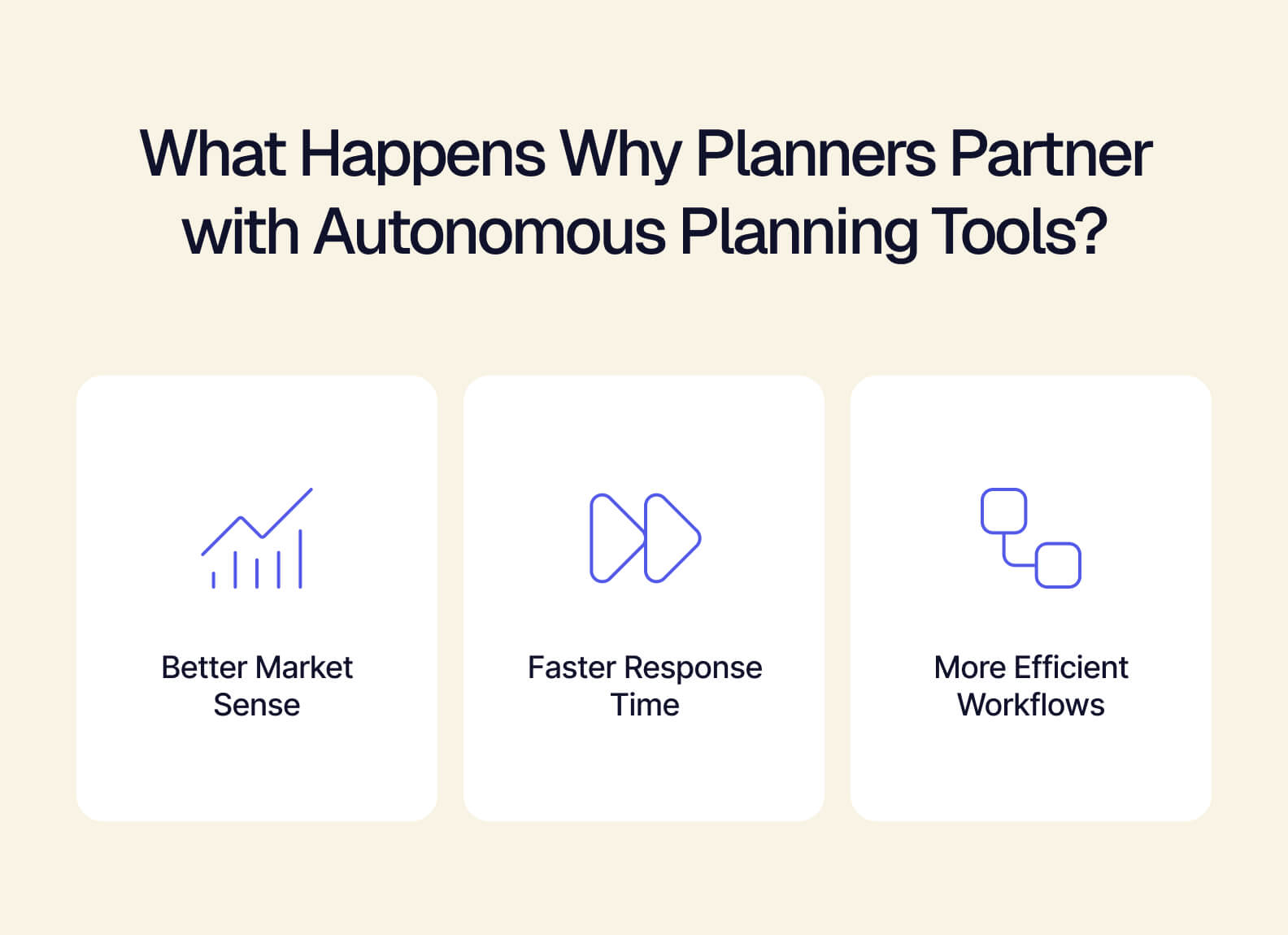
When you give your planners access to an autonomous planning system to support their existing workflows, they gain three advantages that can put your brand at the top of your niche:
-
Better market sense. Autonomous planning systems take in information from outside your business, giving your planners more data to chart out your upcoming resource demands and workflow adjustments. This can help your brand get out of reactivity loops and start taking advantage of anticipated changes to the market.
-
Faster response time. Autonomous planning systems enable your planners to work faster because they don’t have to spend as much time manually crunching information and plans — instead, they can process unexpected changes in real-time and pivot fast.
-
More efficient workflows. Autonomous planning systems do some of the heavy lifting and easily repeatable tasks so that your planners are able to spend more time on big picture projects. Because of this capability, your planning workflows can be shifted and revised to work for automation, resulting in greater efficiency.
Adding Headless, Composable ERP to the Autonomous Planning Equation
When you integrate autonomous planning systems to support the tasking of planners on your Ops team, the equation looks like (X * Y = Z). But what happens if you add a headless, composable ERP to that equation?
With a system like Tailor, you’re not just improving your planning infrastructure. The impact that a headless, composable ERP can have is that it touches every part of your business, from Ops to Inventory Management, Sales, Production, HR, Accounting, and more. It can also connect with your existing tools to dramatically improve your efficiency, while driving exponential scaling for your brand.
-
Adding a new variable. Tailor’s headless, composable ERP provides the infrastructure to scale rapidly. How? By increasing the speed at which you can build your system, Tailor’s headless ERP drastically improves the output from your team members and their AI-powered tools.
-
The headless, composable advantage. Give your retail business a strong system to build on, with smooth workflows for your teams, while maximizing your scalability by making your business more agile, flexible, and resilient; particularly when unpredictable markets require you to pivot at a moment’s notice.
How Tailor Supports Autonomous Planning and AI-Powered Tools
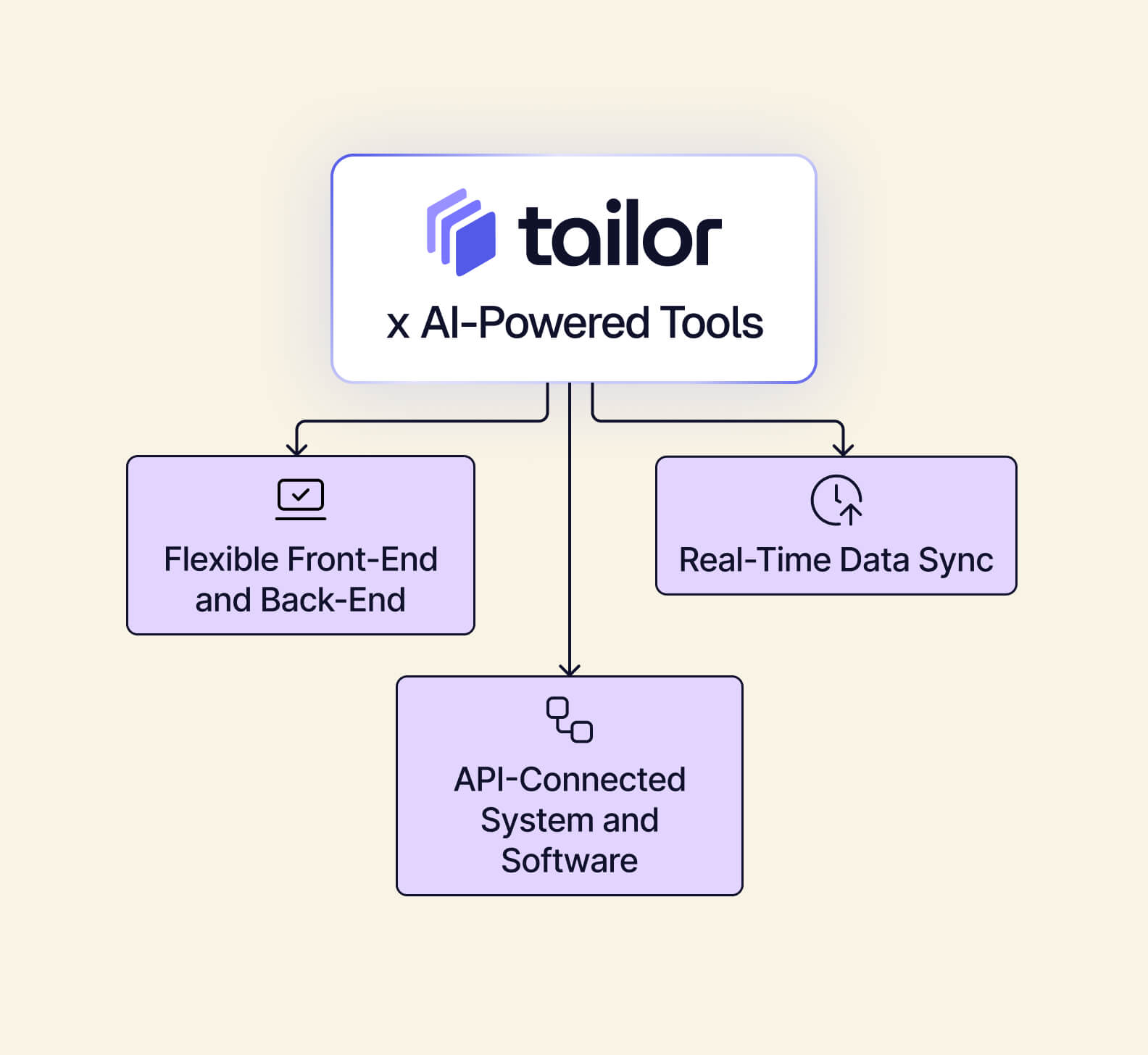
Tailor’s headless architecture, composable design, and AI-native functionality lay the foundation necessary for autonomous planning and many different types of AI-powered tools to succeed when integrated into your tech stack. This is made possible through:
-
A focus on flexibility. Headless architecture splits the back-end system from the front-end design, enabling you to add new features and quickly adjust the UI to accommodate them. Composable design — which goes hand-in-hand with headless architecture — encourages a modular approach to software design, like interlocking bricks. This creates an environment where you can quickly add, remove, or improve functionality. The result is a boost to your tech stack’s flexibility, which gives your AI-powered tools more room to develop and positively impact your productivity.
-
API-enabled interconnectivity. Typically, unless software and tools are in the same product family or specifically built to work with one another — it’s extremely difficult to get them to communicate, making transferring data between them a chore. With Tailor as your ERP, your tech stack is connected by APIs, which have two very important effects: the removal of siloed data and reduced reliance on spreadsheets. This results in your autonomous planning system having the ability to see what’s happening across your business without important information being inaccessible.
-
Real-time sync of important data. Getting sales data from your POS can be gated by daily (or weekly) reports that come long after you need to make decisions. Tailor’s headless, composable ERP allows you to pull that data without waiting for reports, so you can easily reconcile your existing inventory, SKUs sold today, upcoming orders, AI-powered forecast data, and autonomous planning recommendations all in one place — without having to wait around.
Why Composability is Best for AI-Native Workflows and Autonomous Planning
AI-powered tools are designed around a flexibility-first mindset: they can learn, adapt, and change their behaviors based on the requests of whoever is using them. This inherent adaptability can completely change the game for retailers who also have a composable system at the heart of their tech stack.
But not every retailer has a composable ERP. Some have no ERP and others have rigid (or monolithic) ERP systems that force AI-powered software to function as bolted-on additions, rather than being thoroughly integrated.
With this in mind, let’s explore the differences between composable ERP and rigid ERP when it comes to autonomous planning and AI-native workflows.
Evolving Your Retail Strategy for Agentic Commerce
What this all adds up to is an evolution of your retail strategy. Agentic commerce is here and foregoing AI-native upgrades to your system could leave you lagging behind your competitors. With an increasing number of shoppers using AI chat recommendations and AI agents to shop on their behalf, it’s important to understand three things: what agentic commerce is, how you can be ready, and how autonomous planning factors in.
Q: What is agentic commerce?
Agentic commerce is a shift in the ecommerce environment where more shopping and web navigation is done by agents rather than directly by your customers. This is often accomplished through AI chat interfaces, which can fundamentally change your intended shopping experience. However, this doesn’t have to be a problem — especially if you shift your business to become AI-native.
Q: How do I know if my business is ready?
Some businesses, for example, use ChatGPT’s built-in tools to translate their website shopping experience into an app that ChatGPT can open if it recommends your products to a customer. Otherwise, there are a series of adjustments you can make to the website to reduce friction for AI agents, which can increase the likelihood of your products being recommended to new customers while still getting all the data you need from those customers.
Q: Why is autonomous planning important for agentic commerce?
Agentic commerce is moving fast and shifting rapidly. You need a planning system that can take in these changes in real time and give you high-context, actionable steps that help you succeed in this increasingly unfamiliar retail environment.
Unlock Your Retail Strategy Upgrade
Preparing your business for the future of agentic commerce and autonomous planning integration doesn’t need to be a time-consuming headache. With the right AI-native, headless, and composable ERP like Tailor, you can transition your business toward AI compatibility, so you can make use of today’s most powerful tools, while being prepared for what comes next.
Book a demo with us today to see how Tailor can help you unlock your next retail strategy upgrade.