If you’re evaluating ERPs, you’ve probably noticed that many vendors use the same phrases: modern, cloud-native, AI-powered. It’s hard to take these terms seriously when you see them over and over again.
These vendors aren’t being dishonest. Next-generation ERPs simply cover a lot of ground, describing everything from a refurbished UI to a complete architectural rebuild. And from your end, it’s hard to tell what you’re looking at.
To make the evaluation process easier, you can use this framework to spot real modernization while you’re shopping for a next-generation ERP.
What you’ll learn:
-
What “next-generation ERP” actually means
-
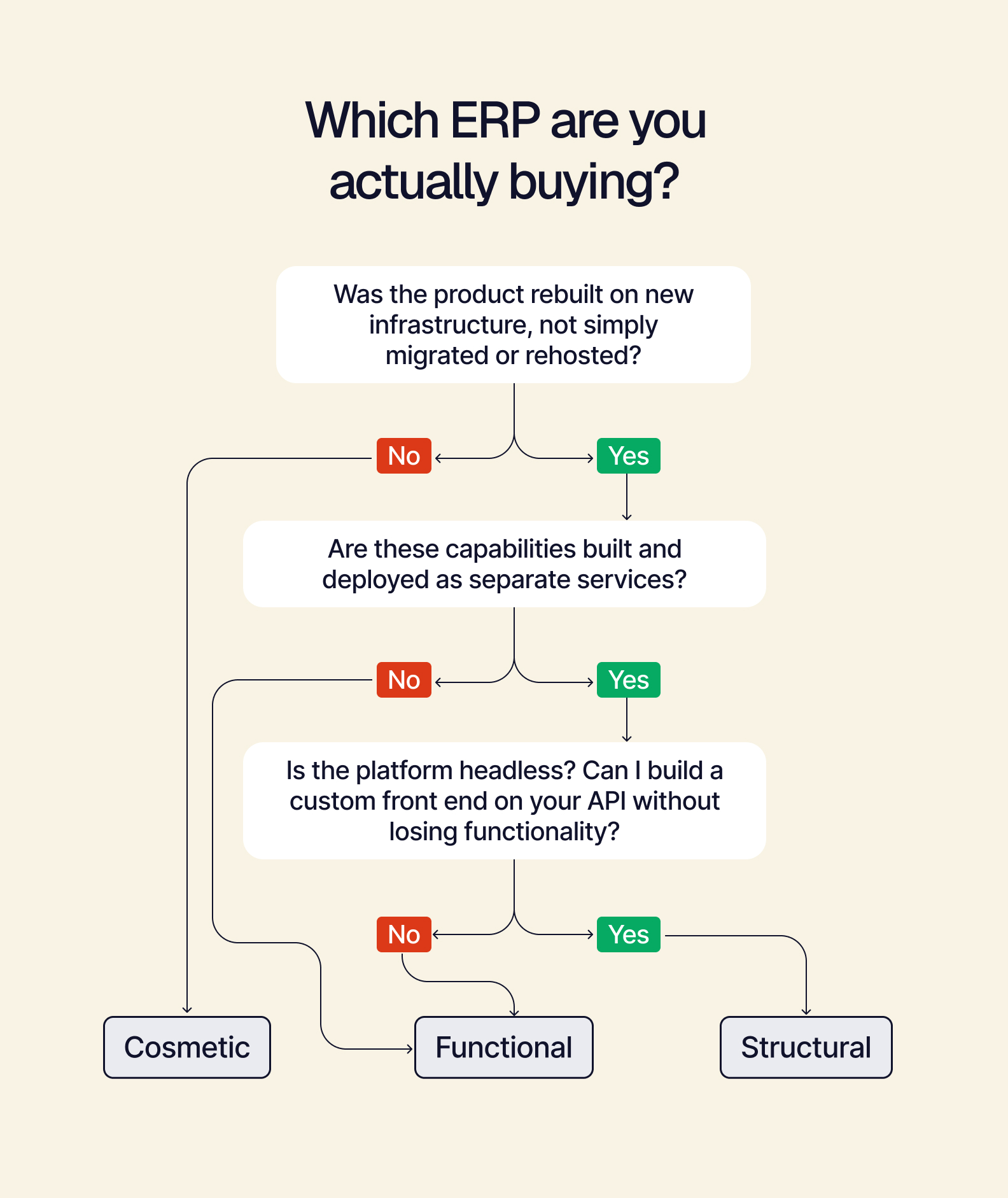
The three tiers of next-generation ERP: cosmetic, functional, structural
-
Why many next-generation ERPs eventually become legacy systems
-
The next-generation ERP architecture that doesn’t age out
-
How to evaluate next-generation ERP vendors on your shortlist
What “Next-Generation ERP” Actually Means
Telling a genuine claim from sales language starts with knowing the right vocabulary.
-
Cloud-native: Built for the cloud from the ground up, not a legacy system that’s just hosted there.
-
AI-native: Architecture that’s built around AI from the beginning, not AI features bolted onto old workflows. It doesn’t replace human judgment — it’s designed for AI to assist people.
-
Real-time: Data reflects the current state as it changes, not batch-updated on a set schedule.
-
Modular/composable: Capabilities can be added, removed, or swapped independently of one another.
Composability is the trait that determines whether an ERP can keep up as new capabilities and AI advancements emerge. Here’s how all of these traits typically play out against a traditional ERP:
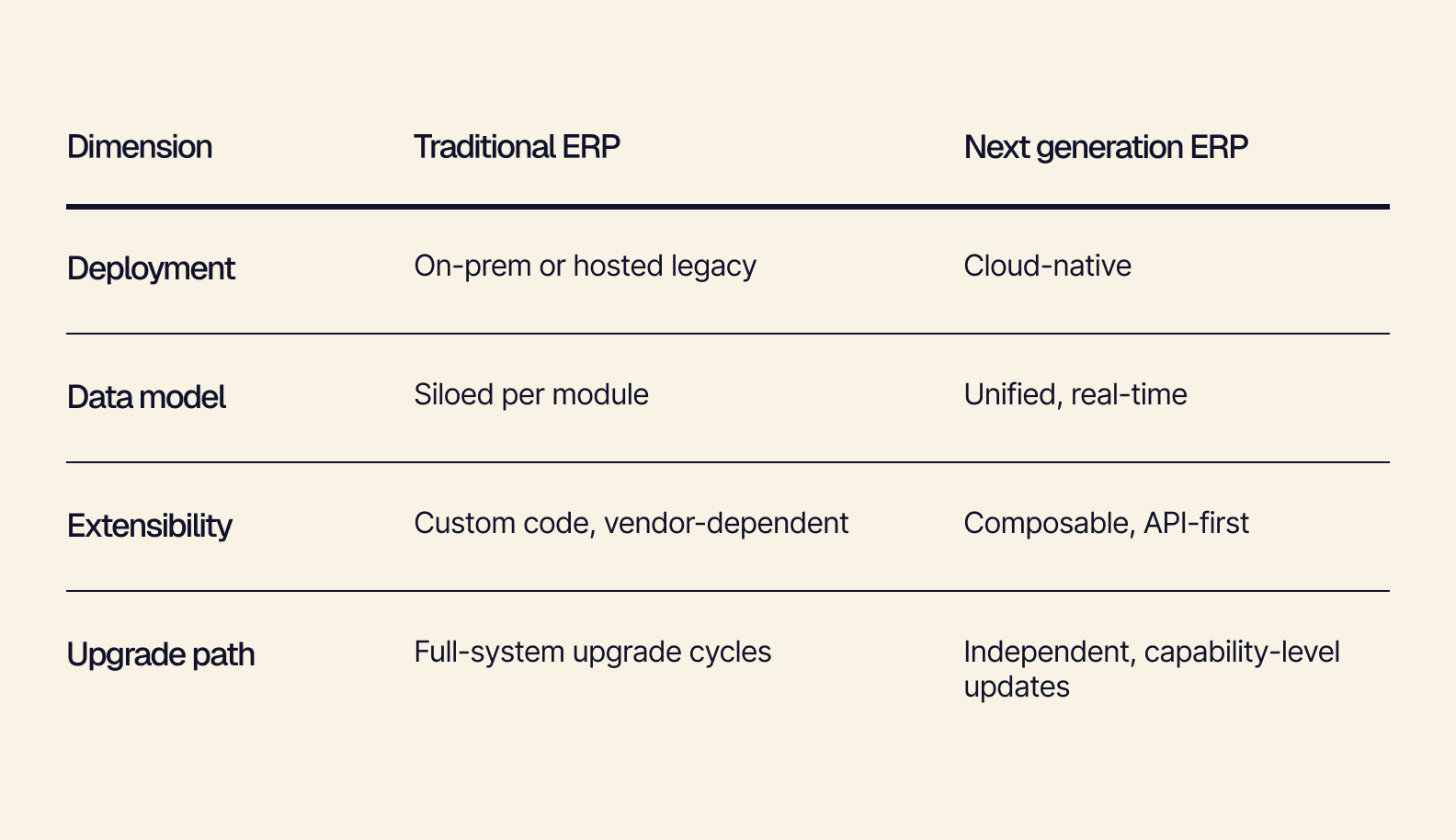
These four traits are necessary, but they aren’t enough. A vendor can check every box on the surface — cloud-hosted, AI features, a modern dashboard — and still be built the same way underneath as the system you’re replacing.
That’s where the following three-tier framework is meant to help.
The Three Tiers of Next-Generation ERP: Cosmetic, Functional, Structural
Two vendors can both legitimately claim to be cloud-native, AI-native, and modular, and yet still be completely different structurally. You can use the following three-tier framework to tell them apart.
Tier 1: Cosmetic
This first tier of next-generation ERPs has a new UI and is cloud-hosted. However, the underlying system hasn’t changed. You’re getting legacy architecture redone with a modern look on top.
What to ask vendors:
-
Has this product been rebuilt on new infrastructure, or migrated and rehosted to the cloud?
-
What actually changed in your last major release — the interface, or the system underneath it?
-
If I need a new capability, am I limited to what’s in your core suite, or can I add a third-party option?
Tier 2: Functional
In this tier, some genuinely new capabilities or domains have been added, but they’re still shipped and maintained as one bundled unit under the hood. This can be tricky to spot since the additional functionality is welcome, but the elements holding it back are structural.
What to ask vendors:
-
Are these capabilities built and deployed as separate services or as part of one core application?
-
If I want to update just one capability, does that require a release cycle for the whole platform?
-
Can I turn off or replace a single capability without affecting the others?
How often do you ship updates to individual capabilities vs. the system as a whole?
Tier 3: Structural
Tier 3 has capabilities that are independently built and swappable. This is most commonly found in an ERP that is built with composable and headless architecture. Tier 3 is also the only tier designed to keep up with new capabilities and AI advancements, without the need for a full replatforming.
What to ask vendors:
-
Is the platform headless? Can I build a custom frontend on your API without losing functionality?
-
Can accounting be decoupled from operations, or are they part of the same core system? (A follow-up question to ask is “Can I keep QuickBooks?” This will help determine how flexible their system is.)
-
If I swap one capability for a best-in-breed alternative, what else breaks?
Where does your source of truth live? Is it upstream of every capability, or downstream of the core application?
Why Every Next-Generation ERP Eventually Becomes Legacy
Now that you’re familiar with these three tiers, there’s another important question to answer: Why do many “next-generation” ERPs end up outdated so quickly?
The short answer is: The system was one unit, so upgrading it meant replacing everything, which makes it increasingly difficult to do maintenance.
History of “Next-Generation” ERPs
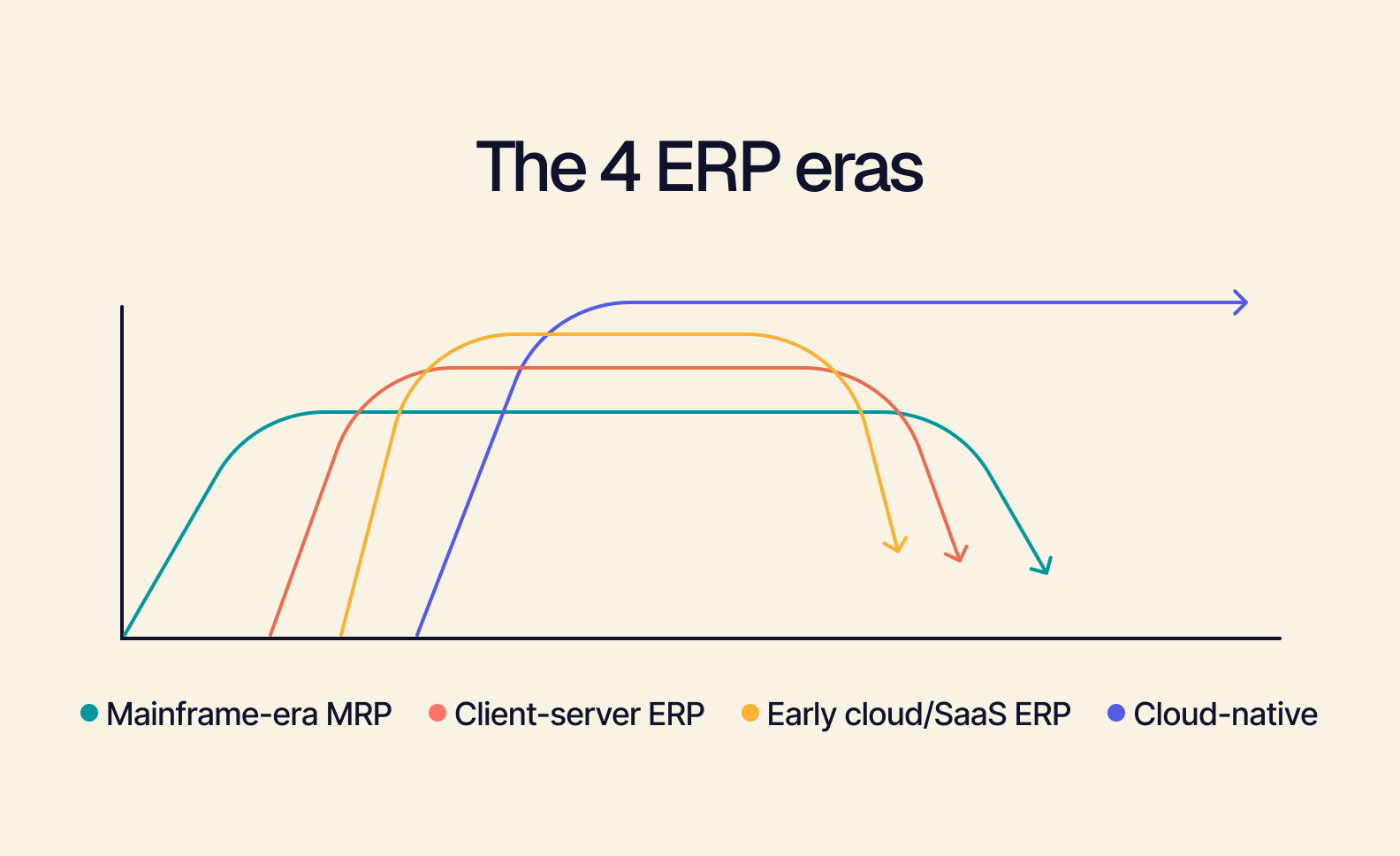
There have been four primary eras of ERPs:
-
Mainframe-era MRP: The earliest Material Requirements Planning (MRP) systems had centralized planning that replaced manual, paper-based inventory and production tracking.
-
Client-server ERP: Client-server ERPs brought that centralized system to desktops across the organization, increasing accessibility.
-
Early cloud/SaaS ERP: These systems moved off local servers altogether, removing hardware and maintenance overhead.
-
Today’s modern ERPs: Often labeled as cloud-native, AI-native, real-time, and modular — all powerful advances, but only a few are built to live up to these labels.
The Shared Structural Flaw
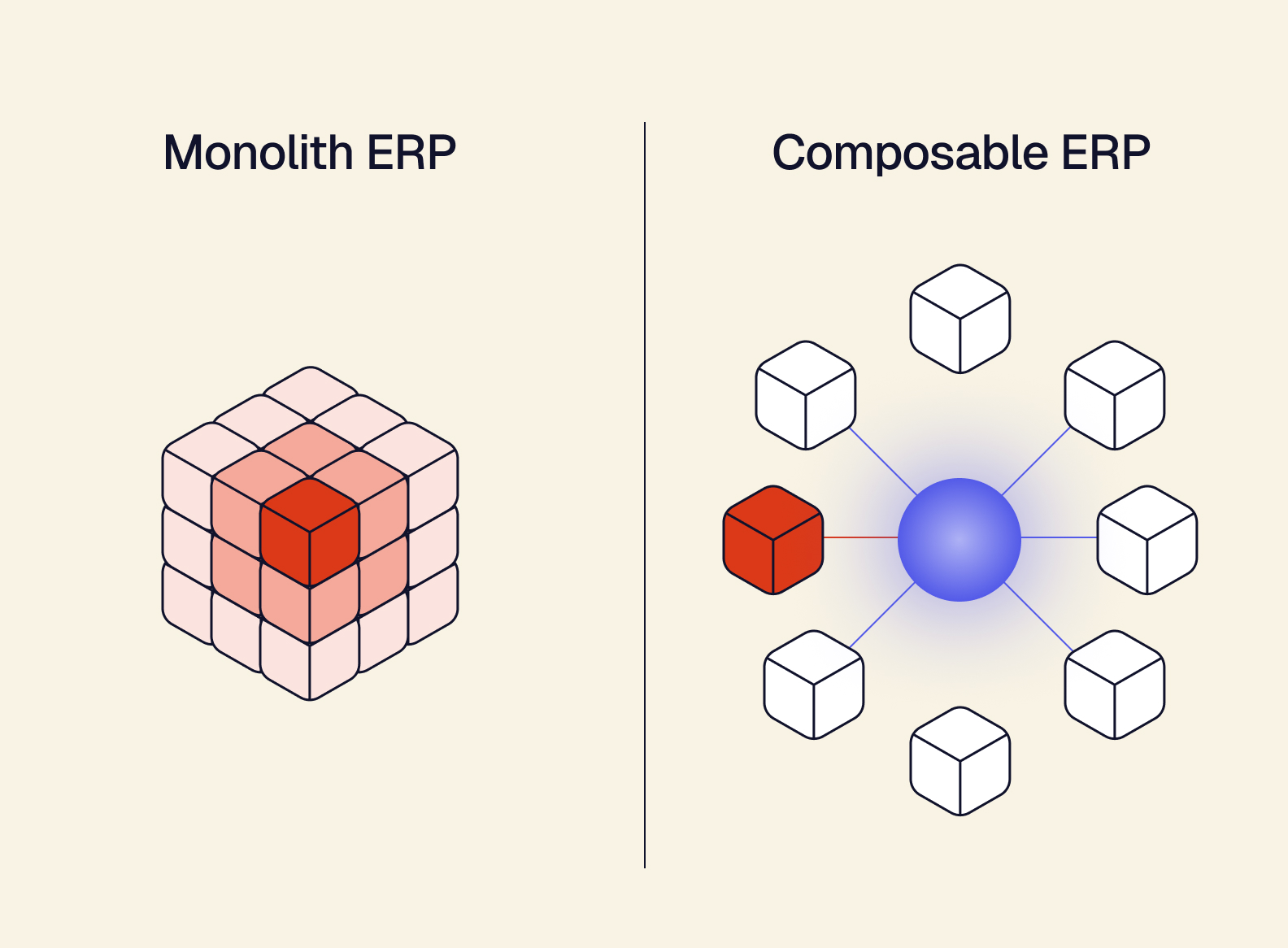
All four of these eras share a single structural flaw. Capabilities were bundled into one monolith, so a single upgrade cycle controlled the whole system. If you changed one part, you had to change everything. In practice, that costs:
-
Migration costs: Every upgrade meant re-implementing the entire system, not just the individual part that needed to change.
-
A single cutover at the end: With the whole organization going live at once, all of the risk was concentrated in that one moment.
-
The whole system is waiting on the slowest-moving domain: If one piece is lagging, it’s holding back every other capability from moving forward.
Rigid, monolithic architecture is what causes these consequences. Truly next-generation ERPs are built with a different architecture as their foundation.
The Next-Generation ERP Architecture That Doesn’t Age Out
Composable, headless architecture — what Tailor is built on — removes the need to upgrade the entire system by letting you replace only the part that’s outdated.
Headless: The Interface Isn’t the System
The screen is one manifestation of the API. The interface is just one way of interacting with the underlying system. Redesigning it, replacing it, or building a custom front end doesn’t touch what’s underneath. While Tailor itself is a headless, composable, and flexible system, it offers a curated out-of-the-box experience with pre-configured modules for retailers that need this functionality. And because of this, you can swap any one capability without a system-wide migration, meaning you’re not locked in to a vendor.
Composable: Best-in-Breed, Not All-in-One
Capabilities are independently built, not modules bolted onto a shared core. You can keep the parts of your stack that already work and only replace what’s outdated.
This composability is what truly lets an ERP keep pace over time. When something new comes out, it can be added or swapped in without a major migration. Tailor’s headless, composable ERP is designed to easily add new features and functionalities to help you stay on the cutting edge.
AI-Native, Human-in-the-Loop
Trustworthy AI implementations need a unified, real-time data layer underneath. An AI’s output is greatly improved by having access to the information flowing through your source of truth. Otherwise, its reasoning ends up based on incomplete or stale information.
How to Evaluate Next-Generation ERP Vendors on Your Shortlist
Use this condensed version of the tier framework to compare against whatever’s actually on your shortlist:
-
Cosmetic: New look, same system underneath.
-
Functional: Real new capabilities, still one bundled unit.
-
Structural: Independently built, swappable capabilities on a composable, headless architecture.
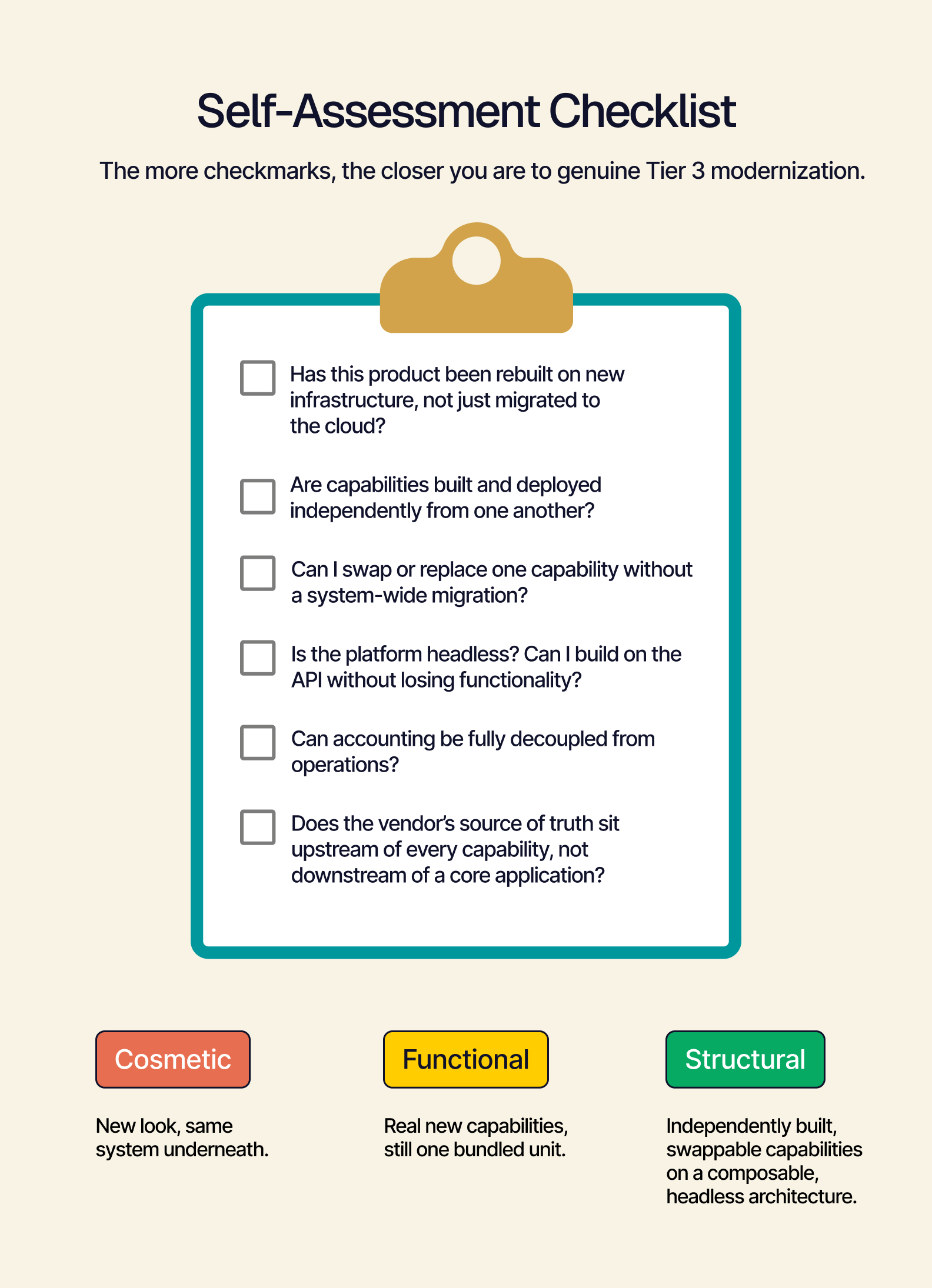
Self-Assessment Checklist
You can also run each vendor on your list through the assessment questions below. The more “yes” answers, the closer you are to genuine Tier 3 (or Structural) modernization.
-
Has this product been rebuilt on new infrastructure, not just migrated to the cloud?
-
Are capabilities built and deployed independently from one another?
-
Can I swap or replace one capability without a system-wide migration?
-
Is the platform headless? Can I build on the API without losing functionality?
-
Can accounting be fully decoupled from operations?
-
Does the vendor’s source of truth sit upstream of every capability, not downstream of a core application?
At the end of this checklist, you’ll get one of two outcomes: confirmation that you’ve found real, structural modernization, or the clarity to keep looking before signing on with a vendor. Either way, you can feel confident you’re not making this decision based on marketing language alone.
See what structural, Tier 3 architecture looks like in practice — schedule a Tailor demo.