For many companies, ERP integration feels like a permanent problem.
New channels need new connections, new markets need customization, and the integration backlog never really clears. But you planned your ERP integration strategy to the letter, so what gives? The issue probably isn’t your strategy itself. It’s the architecture your strategy is built around.
This post walks through what a solid ERP integration strategy covers, where it tends to break down at scale, and how a composable, API-first ERP changes the problem entirely.
What You’ll Learn
-
What a strong ERP integration strategy actually covers
-
Where the standard ERP integration strategy hits a ceiling
-
How composable ERP architecture changes the integration strategy conversation
-
Building a long-term ERP integration strategy
What a Strong ERP Integration Strategy Actually Covers
A solid ERP integration strategy should be more than just a project plan. It’s a set of intentional decisions about your organization’s data, architecture, and how you’ll manage them as you scale. These questions need to be settled before you start looking at vendors or tools.
Core elements of a strong ERP integration strategy include:
-
Integration architecture. Point-to-point integrations, middleware, and iPaaS all have pros and cons. Choose based on your current and future complexity.
-
Data ownership. Define which system is the source of truth for each data type and what happens when systems fall out of sync.
-
Integration mapping. Before building anything, document every touchpoint between your ERP and the rest of your stack.
-
Phased rollout. Taking a phased approach to implementation lets you test and validate integrations little by little, lowering risk.
-
Governance. Define who owns the integration layer on an ongoing basis — who’s responsible when a sync fails, and who maintains integrations over time.
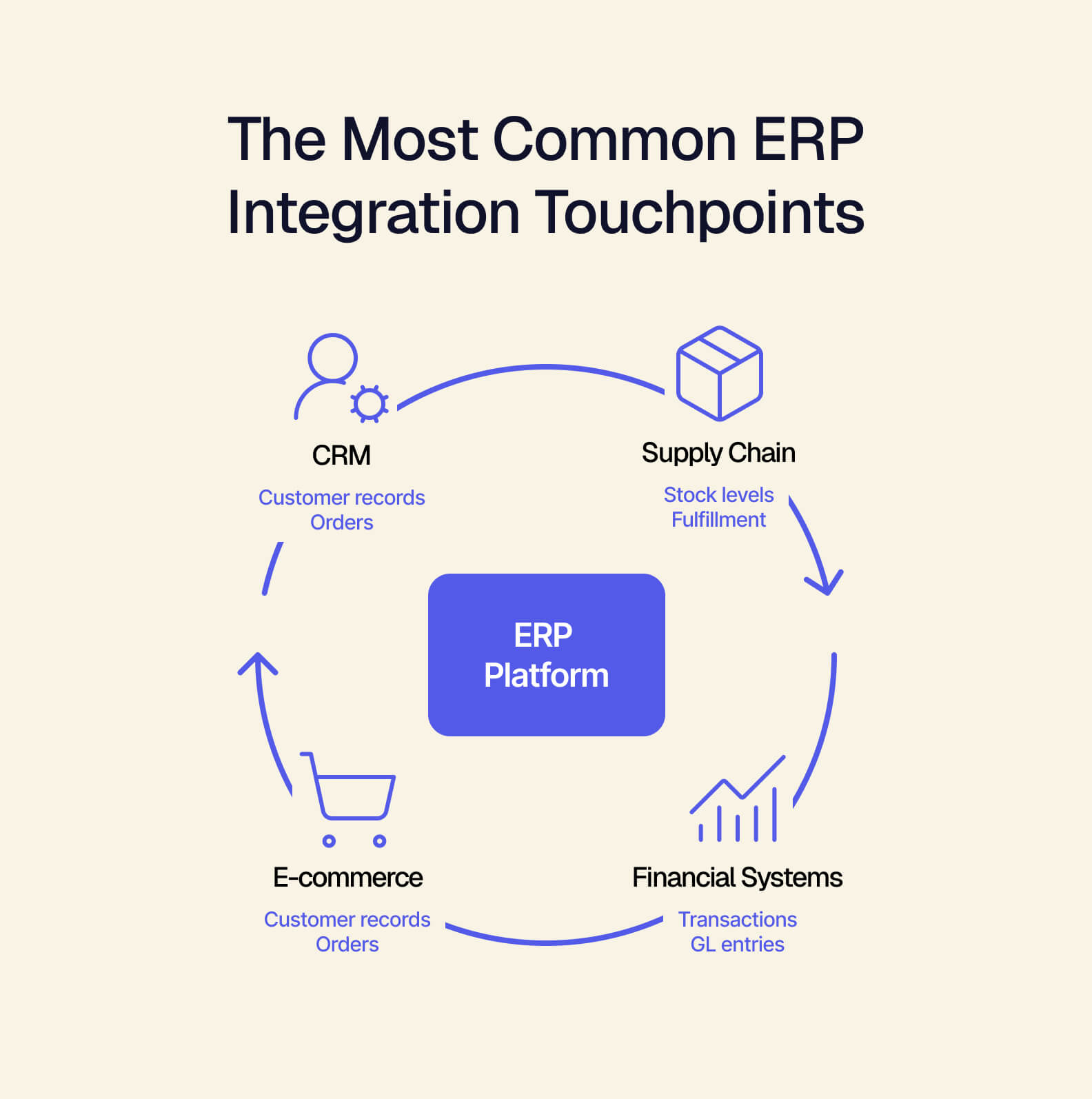
The Most Common ERP Integration Touchpoints
Most ERP integration strategies need to connect some combination of the same core systems. Since each system has its own way of organizing data, getting them to talk to each other can be a bigger job than it seems at first glance.
-
CRM integration. The customer and order data stored in your CRM and ERP need to stay in sync even though both systems structure it differently.
-
Ecommerce integration. Your storefront needs to reflect real-time inventory, automatically pass orders to your ERP, and stay aligned with your finances.
-
Supply chain and WMS integration. Procurement, warehousing, and fulfillment all generate data that needs to land correctly in your ERP.
-
Financial systems integration. Every transaction that touches any system in your stack eventually needs to be accurately reflected in your general ledger.
When your ERP’s underlying data model is clean and flexible, each of these connections is much more likely to run smoothly.
Where the Standard ERP Integration Strategy Hits a Ceiling
For companies with a stable ERP, a predictable tech stack, and a slow rate of change, the strategies above should work well. But if you’re actively scaling, you won’t stay in that position for long. Sooner rather than later, the normal “best practices” are going to stop being enough.
Standard ERP integration strategies break down when you:
-
Add a new sales channel. Each new channel (whether it’s a marketplace, a wholesale portal, or a physical retail location) requires a new set of integrations. Often, these touch data models that a monolithic ERP wasn’t built to handle.
-
Expand to new markets or geographic areas. Currency, tax logic, and fulfillment rules vary according to region. These variations generally don’t fit cleanly into a monolithic ERP’s standard data model and need expensive customization (plus ongoing maintenance) to work.
-
Introduce mergers, acquisitions, or new business units. When you bring a new entity into your tech stack, the integration layer has to absorb an entirely new system set, often with conflicting data structures. The integration layer has to reconcile different software and different ways of representing the same business operations.
-
See compounding middleware costs. Every new integration is another connection that has to be built, tested, and maintained. Maybe you started with just three integrations — but a short two years later, you’re managing 15. And each one is a potential point of failure.
The Hidden Cost of the “Middleware Tax”
With middleware costs, integration strategy can become an ongoing operational burden, not just a one-time investment.
Think of this as the “middleware tax.” It’s the accumulated cost of maintaining an integration layer that’s only there to compensate for a closed ERP. You pay this tax over time in licensing fees, engineering time, and organizational complexity.
The middleware tax is the result of building workarounds on top of a system that wasn’t designed to be open.
Headless, composable ERP architecture eliminates this tax by making the integration layer largely unnecessary. When your ERP is built on open APIs, modular components, and a flexible data model, systems can easily connect to it, making your integration strategy a whole lot easier.
How Composable ERP Architecture Changes the Integration Strategy Conversation
A composable, API-first ERP fundamentally changes what integration means. Instead of connecting other systems to a rigid core, you’re assembling a stack where each component communicates natively.
Composable ERP Definition
A composable ERP is built as a set of modular, independent components. Inventory, order management, financials, fulfillment — each one is connected using an API. You can swap out the individual components without having to replace the entire thing.
This is very different from a monolithic ERP, where business logic is locked inside the platform. To customize a monolithic system, you have to modify its core. And this creates upgrade risk and technical debt.
What changes when you build on composable architecture?
-
Data ownership becomes explicit by design. Since each module has a well-defined data model, it’s clear which system owns which data.
-
Integrations follow a consistent pattern. Thanks to open APIs, connecting a new system always works the same way.
-
Business logic lives inside the ERP. Pricing rules, inventory logic, and fulfillment configurations are contained in the ERP instead of being distributed across third-party tools.
-
Your integration strategy becomes about maintenance. Since you’re no longer putting out constant fires to keep your connections working, you can focus instead on growing your stack.
What a Composable ERP Looks Like in Practice
Consider a scaling retail brand that decides to add a wholesale channel. If the brand had a monolithic ERP, this would be a major integration project involving new order flows, inventory sync logic, financial reporting rules, and a new set of middleware connections.
But with a composable ERP, the wholesale channel connects using the same API layer as the rest of the stack. Orders come through the same order management module and inventory updates flow via the same data model. You don’t have to configure new middleware or complete a new data mapping project.
Of course, it will still take some elbow grease for the brand to launch the new channel. But the integration work is a fraction of what it would be on a monolithic ERP.
This is exactly what Tailor is built for. As a composable, headless ERP, Tailor treats integration as a native capability. With a flexible data model, open APIs, and modular architecture, Tailor provides an ERP foundation where the integration strategy evolves right along with your business.
Building a Long-Term ERP Integration Strategy
Whether you’re building an ERP integration from scratch or troubleshooting one that’s become unmanageable, the key is to build something that scales with your business. The best way to do that is by answering these strategic questions before you commit to an approach:
-
Does your ERP expose clean, documented APIs? Or are integrations dependent on vendor-specific connectors that break every time the vendor updates?
-
Do you have a clear data ownership map? If multiple systems are claiming to be the source of truth for the same data, you’re facing big reconciliation problems.
-
What does your integration complexity look like in two years? Say you add three more systems, two more channels, or expand to a new region. Can your current architecture handle the growth? Or will it need more custom integration work?
-
Are you paying a middleware tax? Add up the licensing costs, engineering hours, and maintenance overhead of your current integration layer. The final number may be higher than you expect.
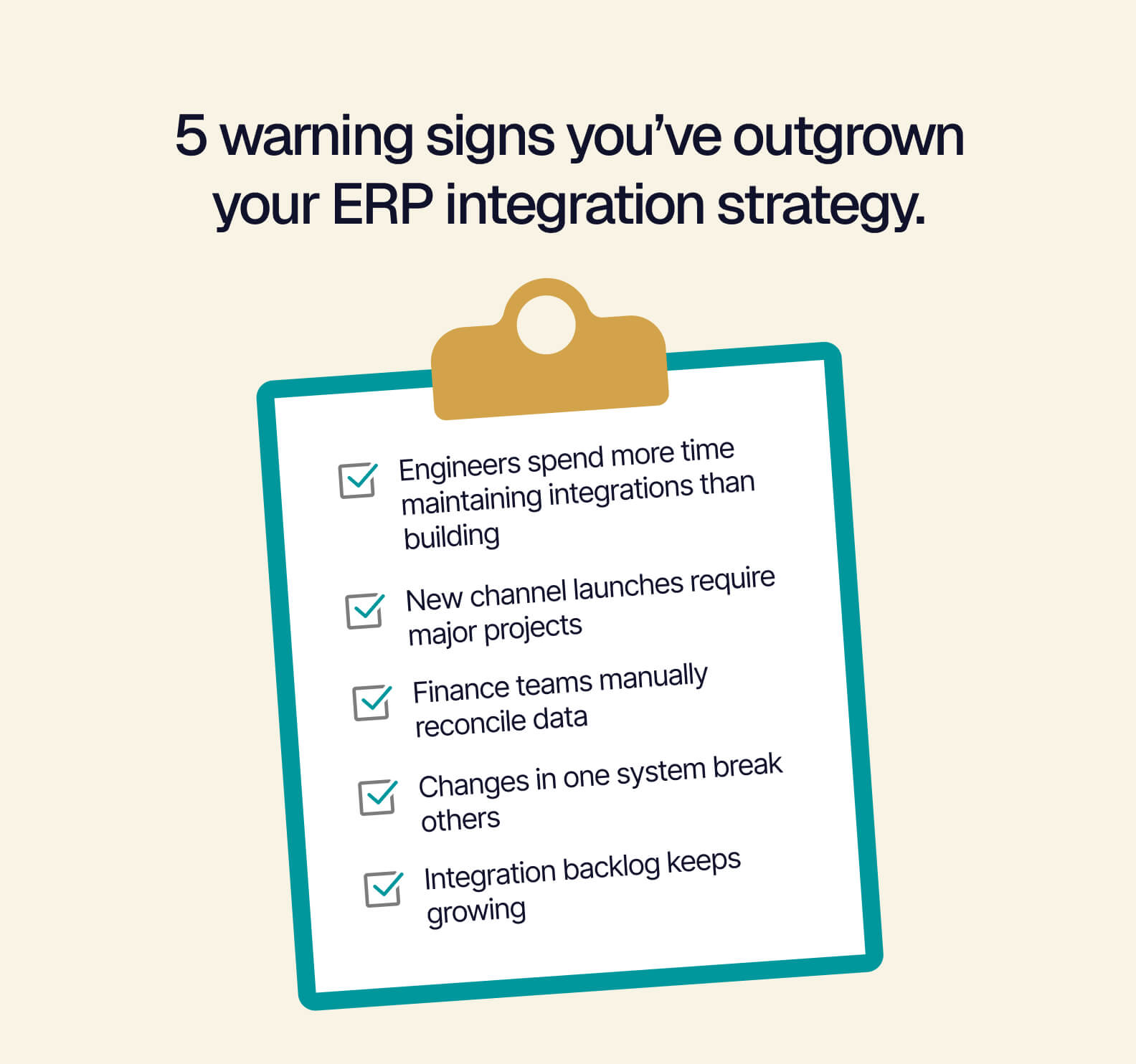
Signs You’ve Outgrown Your Current ERP Integration Strategy
Watch for telltale signs in your day-to-day operations, including:
-
Your engineering team spends significant time maintaining integrations rather than building new capabilities.
-
A new channel launch always requires a multi-month integration project.
-
Your finance team regularly has to manually reconcile data because the data coming out of different systems doesn’t agree.
-
A change in one system breaks something in two others.
-
Integration maintenance has a long backlog.
These are signals that your current ERP integration strategy is no longer working, and your integration layer is generating complexity faster than your team can resolve it.
Companies that move to a composable ERP foundation find that many of these signals go quiet because the architecture stopped generating the problem. Tailor gives your integration strategy a foundation that’s designed to scale.
Create a Smarter Strategy with Tailor
At the end of the day, ERP integration strategy is about architecture. And the best ERP integration strategy is built on an architecture that makes the integration layer as thin as possible. Composable, headless ERP means you’re spending strategic energy on growth, not maintenance.
Book a demo with Tailor to see how a composable ERP foundation can simplify your integration strategy from the ground up.