You’re looking for an ERP, but you’re struggling to find the right one — not because the systems you’ve seen aren’t impressive enough, but because they all look good. Every vendor demo is showing you seamless integrations, robust security, and an efficient implementation timeline. How are you meant to choose?
Vendors aren’t being dishonest. But they’re extremely well-prepared for the questions most buyers ask. When you inquire about features like integrations, security, and support, you’re essentially reading the next lines on a script that only they can see.
There’s a better way to run a vendor evaluation. It starts with asking different questions — organized around your business priorities, not theirs — and knowing what to listen for in the answers.
Here’s your guide to a new way of thinking about questions to ask ERP vendors.
What You’ll Learn
-
What questions should you actually be asking ERP vendors?
-
Why most ERP vendor question lists work against you
-
How to reframe ERP vendor questions around business priorities
-
ERP vendor questions that reveal how the system is actually built
-
What the right answers to your ERP vendor questions unlock
What Questions Should You Actually Be Asking ERP Vendors?
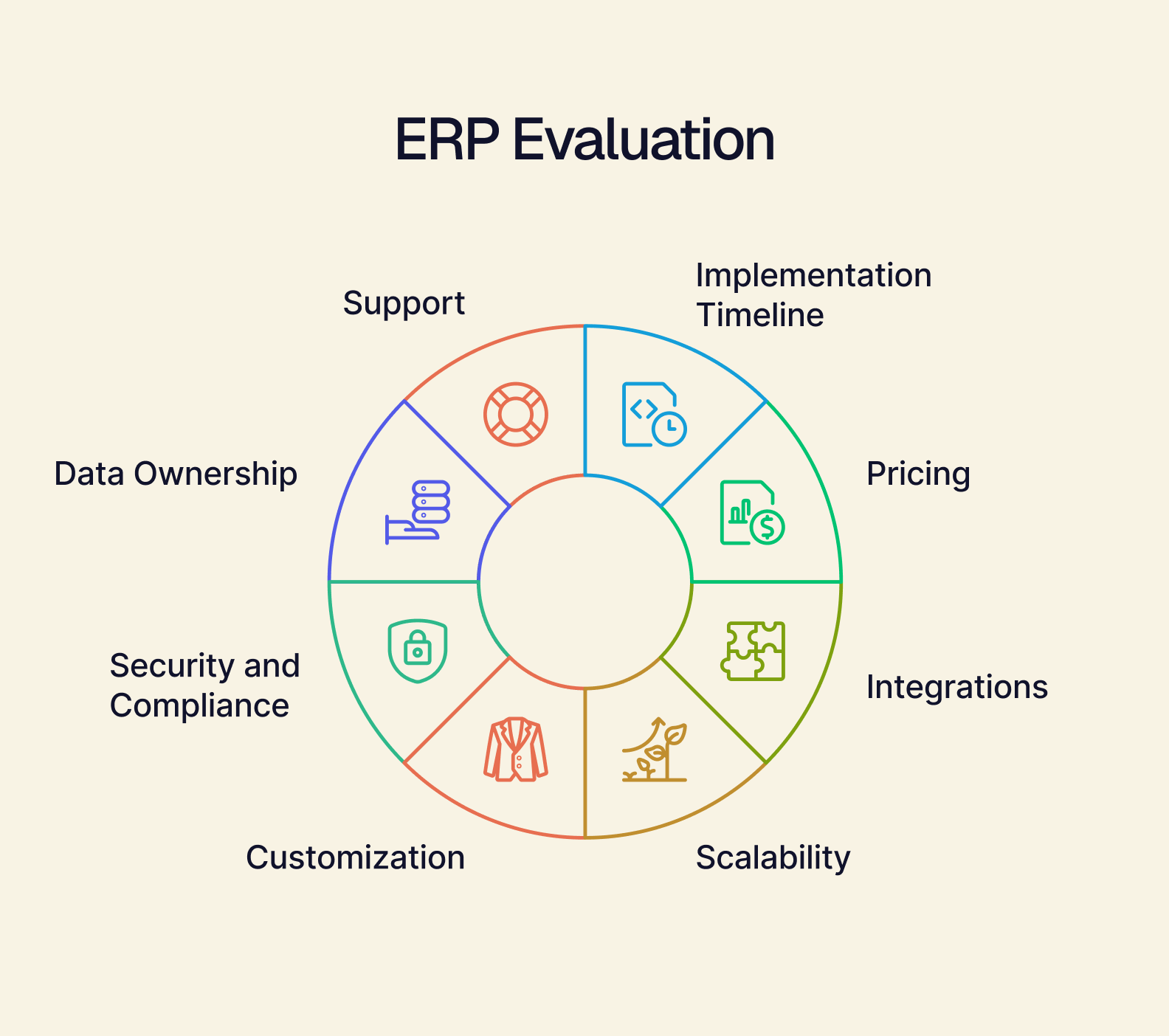
There’s a lot that goes into ERP evaluation. For you as the buyer to get a comprehensive picture of the product you’re considering, the vendor conversation needs to address the following eight areas:
-
Implementation timeline. This category is all about scope. You want to know how long it’s going to be until go-live, and why — because of training, data migration, custom development?
-
Pricing. Total Cost of Ownership (TCO) encompasses more than just the license or subscription fee. Customization costs, per-user fees, the cost of ongoing support, and more will all make an impact, too. Ask for a full first-year cost estimate.
-
Integrations. Pretty much every vendor will say they integrate with Shopify, QuickBooks, and Salesforce. What you really want to know is how those integrations work. Does the vendor connect to your existing tools (much easier to set up) or replace them with their own modules (more complex migration)?
-
Scalability. With scalability, the key concept to understand is what happens when you make a change. Some systems need a whole new implementation project when you add a new sales channel or new warehouse location. Others — the ones that actually scale — only need a configuration change.
-
Customization. ERPs that are capable of true customization can build something the system doesn’t natively do. You want to understand who does the customization, how long it takes, and what it costs.
-
Security and compliance. Vendors might be SOC 2 certified today. But what about the future? Make sure the vendor is equipped to handle potential future compliance needs as you grow.
-
Data ownership. In this area, there are two questions you need to ask: who owns your data while you’re a customer, and what happens to your data if you leave. If you have a complex data model, the ability to easily leave becomes even more crucial.
-
Support. Ask about what’s included and what costs extra; whether you’ll have an account manager or use a ticketing system; and how the vendor handles product updates and new features.
Why Most ERP Vendor Question Lists Work Against You
Most ERP vendors structure their pitches around the product’s category and features. They talk about implementation, pricing, security, integrations.
Standard buyer question lists are typically organized this way, too. So when you ask something like “how long does implementation take?”, you’re getting a pre-rehearsed answer to every question. The vendor knows exactly which numbers to reference to put a glossy sheen on their product.
They aren’t lying. They’re just doing their job. Naturally, vendors are going to highlight the best-case stories and steer away from mentioning product weaknesses.
But this doesn’t get you the information you truly need to compare ERPs. Every vendor conversation is going to sound the same. If they all seem to have a good set of features, how are you supposed to know which one is right for your business needs?
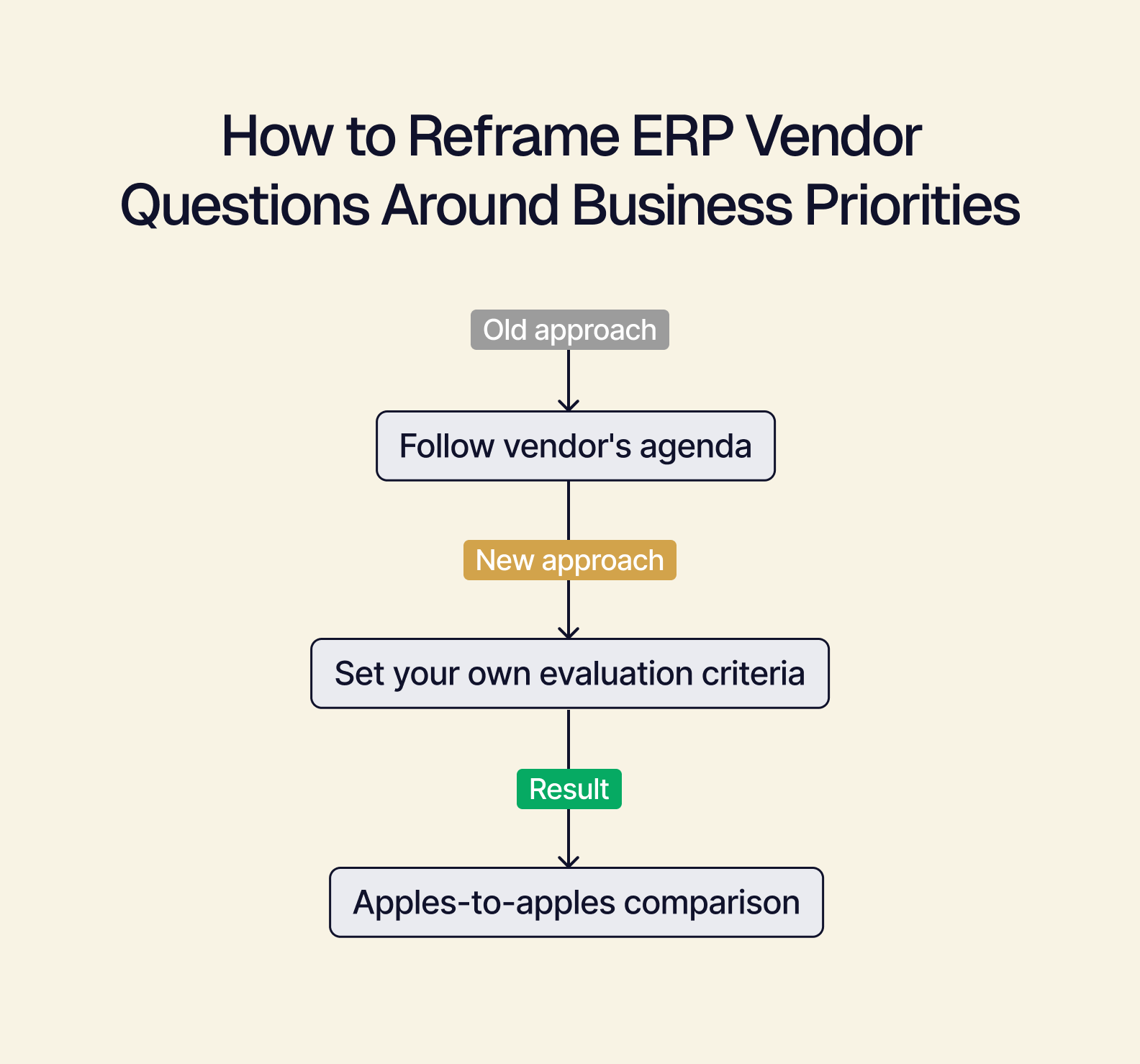
Organizing your questions around business priorities instead helps you learn what you need to know.
This way, you’re asking about outcomes, not features. It changes the conversation because vendors don’t have a polished script based around your priorities. You’re forcing them to get specific.
-
Old approach: “How does implementation work?” (vendor gives a standard answer about their product)
-
New approach: “What if a company of our size, with our tech stack, needed to add a new channel?” (vendor must give a specific answer tailored to your business)
By asking every vendor questions like these, you’ll wind up with notes that are much easier to evaluate and compare as you make a final purchase decision.
The key is walking into a demo not with questions organized by ERP category, but with questions organized around what your business actually needs.
How to Reframe ERP Vendor Questions Around Business Priorities
Your business priorities will determine whether this system succeeds or fails for you, specifically. Flip the demo script by identifying what your business needs and building your questions around those priorities.
Your business probably needs things like flexibility, scalability, and data integrity. Asking about flexibility, for example, exposes whether the system adapts to how you work, or whether you’re forced to adapt to how it works. This is an important architectural concern. What you’re looking for is composable architecture — where flexibility is truly built into the system, allowing you to swap out individual components without having to rip-and-replace it all.
Scalability is another essential priority. While every vendor will tell you they scale, they won’t tell you the time, money, and effort it will take. A composable ERP scales much more efficiently as you add new components.
Data integrity should be a priority because you need unified data — a single, authoritative number you can trust. Ask vendors about real-time accuracy (how quickly changes update across systems) and whether the system creates a single source of truth (no reconciliation required). With a platform like Tailor, all connected tools share the same backend, creating a unified data layer you can trust.
These aren’t the only business priorities to add to your list. You might also consider things like total cost, UX, or support. But these priorities lay the foundation as you shift to a new way of thinking and begin to set your own evaluation criteria.
ERP Vendor Questions That Reveal How the System Is Actually Built
The questions that truly help you distinguish vendors are about your business priorities and the system’s architecture, not just the product’s features.
Here are a few examples of the types of questions to ask ERP vendors — plus, guidance on where to spot red flags in their responses.
Do you connect to the tools we already use, or do you replace them?
-
Good answer: The vendor explains specifically which tools they connect to natively, how those connections work, and what the data model looks like when multiple tools are connected.
-
Bad answer: “We have an integration marketplace with 100+ connectors” without specifics about how those connections work, or “Our inventory module handles what ShipStation does.
If we decide to move away from one of your modules, what happens to our data?
-
Good answer: A clear, specific description of data portability that makes it clear your data lives in the unified backend, not inside the module, so moving away from a module doesn’t affect your data.
-
Bad answer: Anything vague — “We’d work with you on that”; “It depends on your contract.”
If we add a new sales channel or business unit 12 months from now, what changes about our setup?
-
Good answer: A step-by-step description that doesn’t involve professional services, scoping, or timeline estimates. “You’d add the new channel as a connected source. Your inventory, order, and fulfillment data stay unified. Nothing needs to be re-implemented.”
-
Bad answer: A vague response or anything that hints at a new project. “We’d need to scope that out based on complexity.”
Describe what a real implementation looks like (not best case, but typical case).
-
Good answer: An honest breakdown of timelines and who’s responsible for what. “Week one and two are connecting your existing tools and configuring the data model; weeks three and four are module setup and testing; and from there it’s user onboarding, which varies based on team size.”
-
Bad answer: A very wide timeline range without explanation (“anywhere from six weeks to 18 months”) or the inability to describe a typical implementation at all.
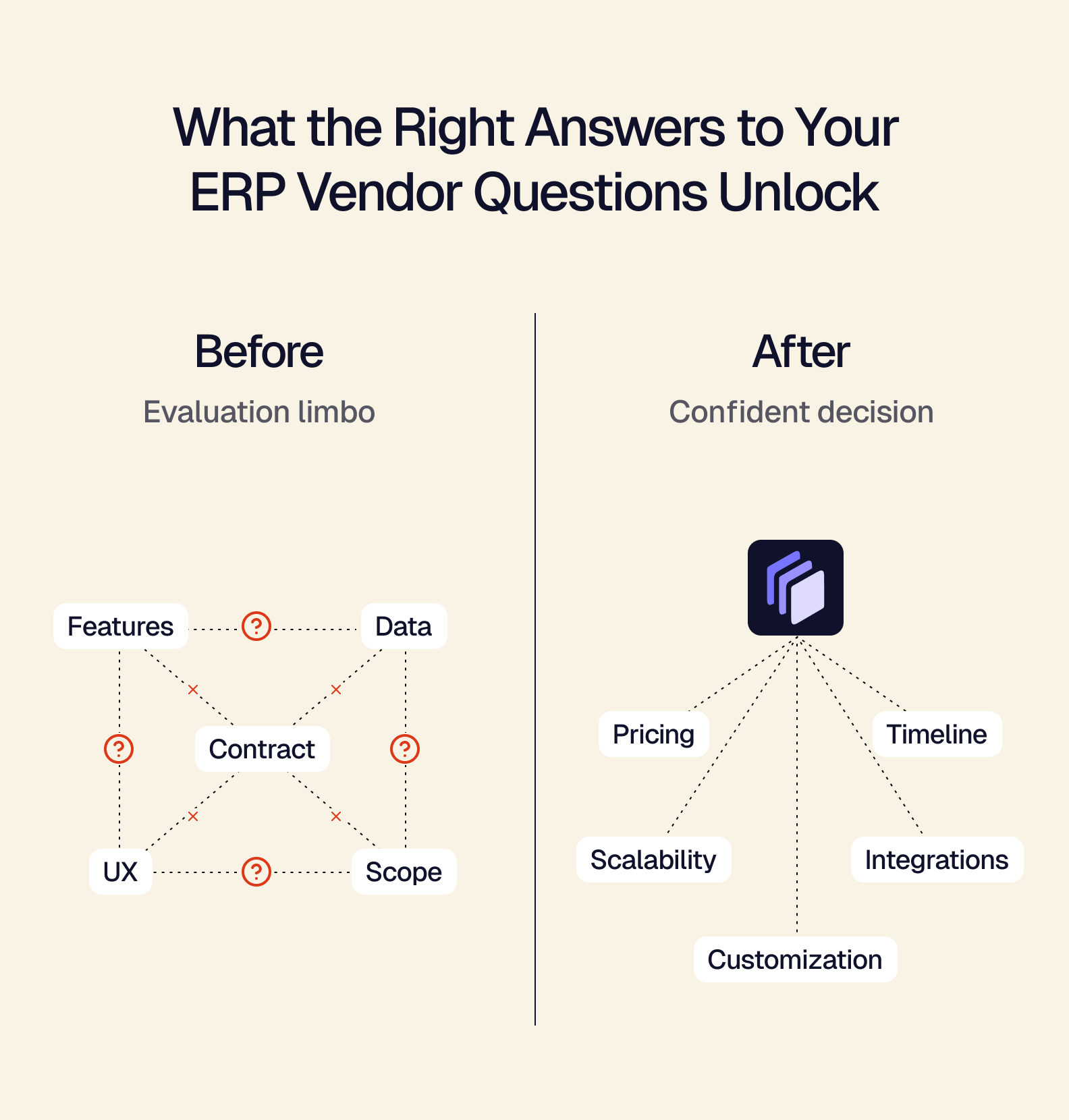
What the Right Answers to Your ERP Vendor Questions Unlock
Once you stop evaluating ERPs based on features and start evaluating based on architecture, you stop making a decision about software and start making a decision about infrastructure. And the right infrastructure is what makes the next level of growth possible.
Now, you can walk into every demo prepared with questions that reveal what sales decks hide. Make a confident ERP decision without second-guessing it three years later, and get the infrastructure in place that you need to actually grow.
See how Tailor’s composable architecture — ready to go live in just weeks — can help you scale by contacting us for a demo.
Or learn more about how to compare ERP solutions.