You probably know the standard ERP integration benefits: cleaner data, fewer duplicate entries, and faster reporting. But there are other benefits that determine whether people come to work happily, make good decisions under pressure, or waste half the day chasing information down.
While these human-centered benefits aren’t always part of the conversation, they’re just as important as software and processes are for supporting your retail business. Understanding how your ERP integration affects your systems and your people can be the difference between lagging behind your competitors or leaving them in the dust.
What you’ll learn:
-
Why most ERP integration benefits stop at the system level
-
The ERP integration benefits that change how your team works
-
Why you need flexible ERP architecture
-
The people-centered ROI of ERP integration
Why Most ERP Integration Benefits Stop at the System Level
Often, organizations get through a successful integration only to find that these “human” benefits are still missing. Companies tend to measure ERP integration success the same way they measure software performance: uptime, sync speed, and error rates. While these metrics are important, they’re missing where the true ROI lives.
This is what’s actually happening:
-
Traditional ERP integrations are built to connect systems, not reshape workflows. Integration focuses on data transfer. How your team gets work done day-to-day is a separate problem.
-
When the ERP is rigid, people adapt to the software, not the other way around. If your workflows don’t match the ERP’s fixed data models and preset screens, you either pay heavily to customize or learn to work around it. Data flows, but day-to-day work doesn’t really change.
-
Teams still maintain shadow spreadsheets or wait for reports. You end up with an integration that works as promised. But the system doesn’t fit how you actually work.
-
Human benefits like faster decisions, less friction, and more autonomy don’t come through. Even if it’s well-integrated, a rigid ERP still makes people adapt.
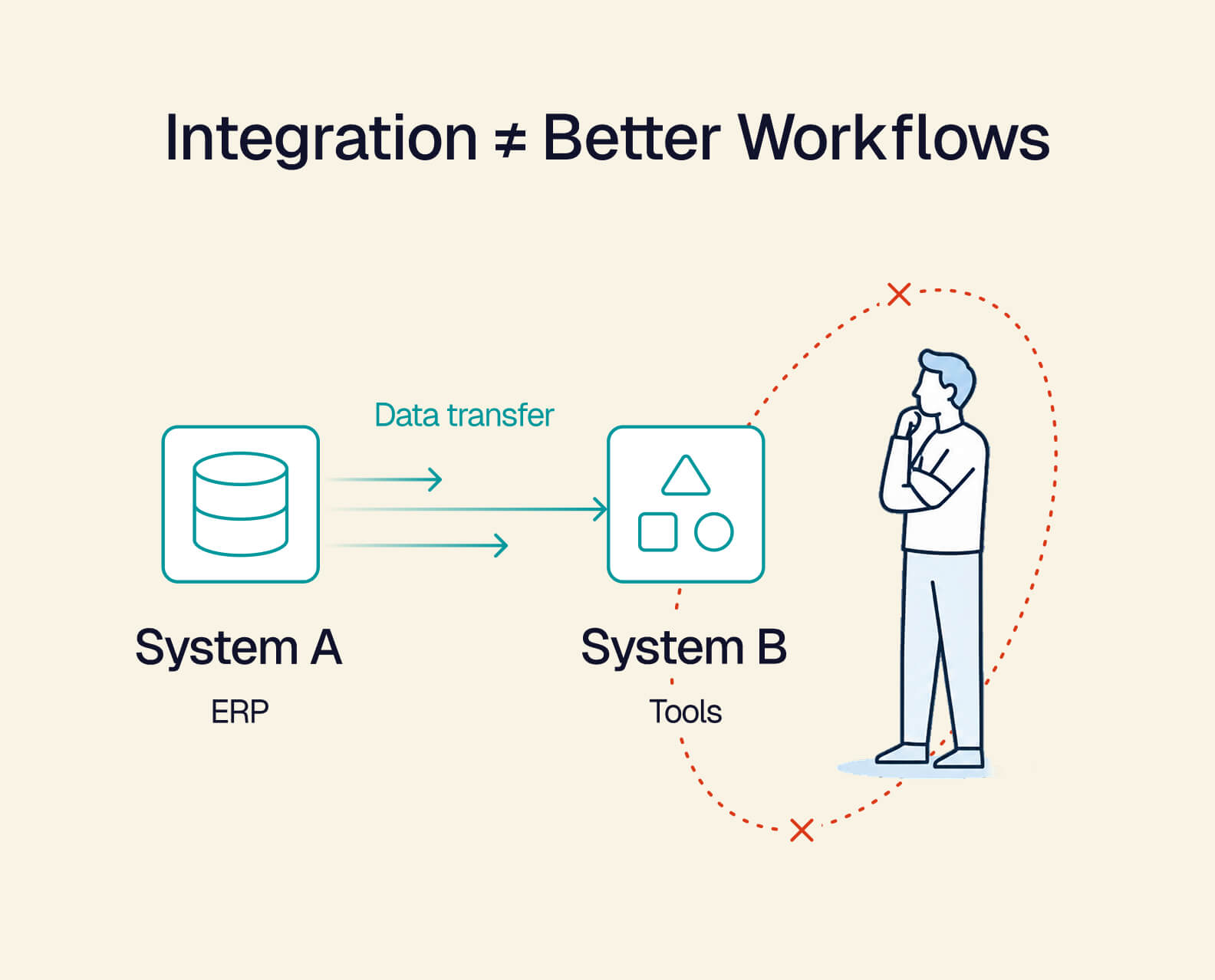
Integration itself isn’t the issue. Rigid, monolithic ERP architecture is the source of these problems. But if you have a composable, headless ERP, the system is designed to flex around how your team works. That’s what determines whether integration benefits actually show up in your people.
The Three ERP Integration Benefits That Change How Your Team Works
1. Faster Decisions and Fewer Bottlenecks
One of the biggest ERP integration benefits is how it accelerates decisions. This is true not only at the executive level, but on the warehouse floor, at the sales desk, and for every team that’s ever had to wait on data.
-
Without integration, decisions are stuck waiting on data. Someone has to pull a report, email a colleague, or cross-check systems. And often, by the time the answer finally arrives, it’s too late.
-
With real-time data flowing across systems, frontline teams stop asking and start acting. Everybody has access to what they need, exactly when they need it.
-
The delays that affect day-to-day operations no longer cause bottlenecks. Inventory shortages get caught earlier; purchasing doesn’t need to wait on finance to approve; ops doesn’t have to wait on sales to close out an order.
-
Decisions that used to require a manager now happen at the person closest to the problem. Frequent, low-stakes decisions can be handled by the team member who knows the context.
Here’s an example of what this looks like in practice: Imagine a wholesale order comes in, but the inventory count in the system doesn’t match what’s actually on the shelf. Without integration, solving the issue requires three people and two hours. With a connected system, the person managing fulfillment is able to see the mistake and act on it right away.
Tailor’s API-first, headless architecture makes this kind of real-time visibility possible across your entire tool stack. Whether you use Shopify, QuickBooks, or a custom workflow, each team member gets the data they need, where they’re already working.
2. More Time
Automation is another significant ERP integration benefit. With automation that’s overseen by humans — called human-in-the-loop automation —, you can give hours back to your staff, by automating tedious and repeatable tasks. And for bigger automated processes, like initiating purchase orders, your teams get final say before the workflow completes. Let’s examine an example workflow to see how ERP automation can support your business’s overall productivity.
Workflow Before Automation:
- Repetitive manual work drains your employees. Tasks like data entry, re-keying orders, and reconciling inventory counts sucks up the time of people who weren’t hired for those jobs.
Workflow After Automation:
-
ERP workflow automation eliminates busywork. With integrated systems, data moves automatically between platforms. There’s no need for repetitive tasking.
-
Employees’ newfound free time is redirected. Now, team members can use their recovered time on work that moves the business forward.
-
Statistics back this up. According to Salesforce via Harvard Business Review, 90% of employees say they feel more satisfied with their job since they began using automation. More than 90% say that automation solutions increase their productivity.
Think about a purchase order workflow:
Without automation, someone has to manually enter P.O. details, follow up with a supplier, update the inventory system, and notify the finance team. With an integrated, automated workflow, the majority of these steps happen on their own. A person only intervenes if something needs attention. Your team can build and automate complex, multi-step workflows using Tailor’s composable backend. Define the logic once, and the system handles the rest.
3. Cross-Team Collaboration
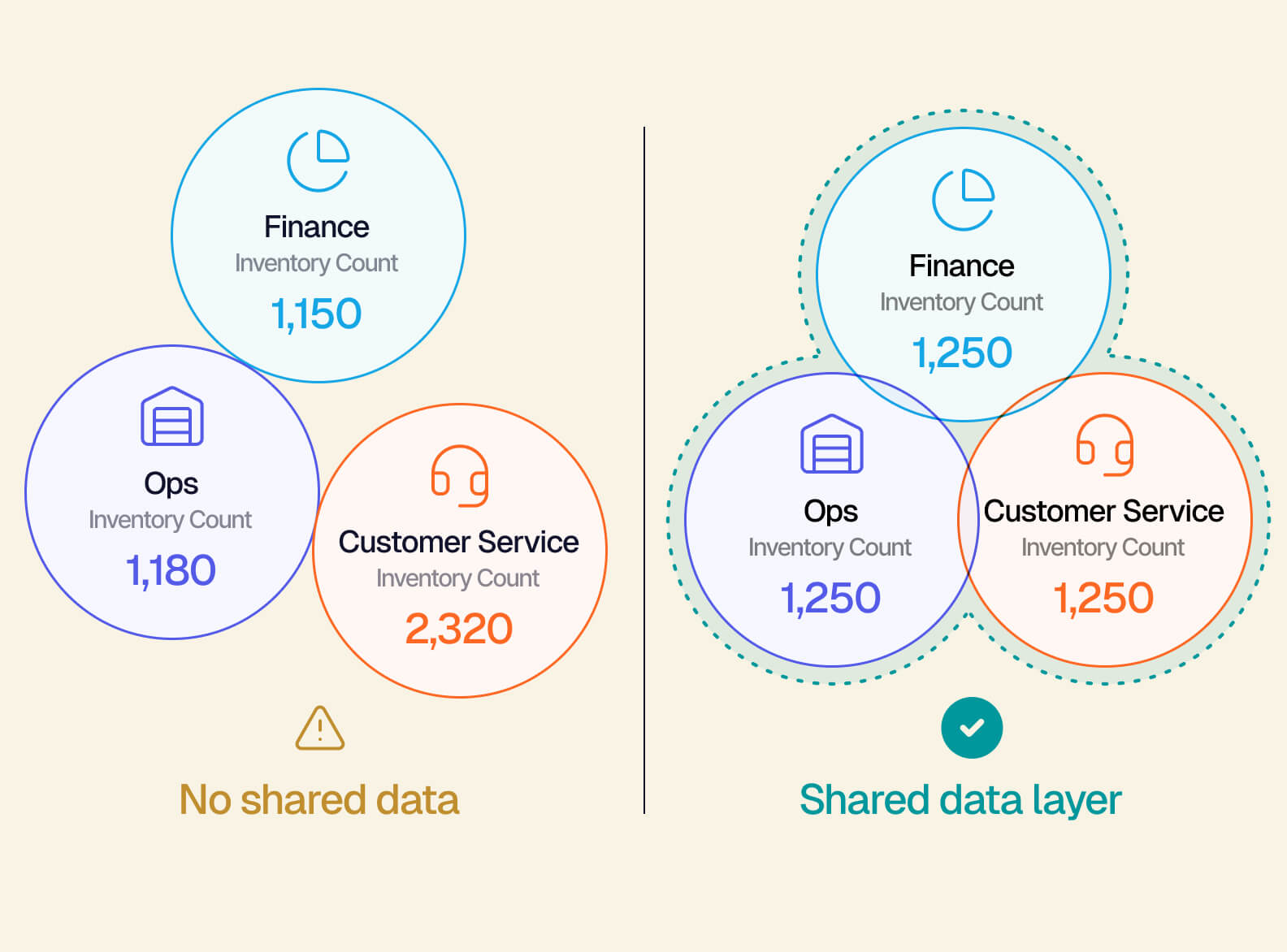
Many cases of system-wide data inaccuracy can be traced back to two teams looking at different versions of the same files and making changes independently of each other. How does this happen?
-
Finance and ops disagree on inventory value. They’re pulling numbers from systems that haven’t talked to each other. Which one do you trust?
-
Sales quotes a price that procurement can’t honor. If a customer gets a commitment the business can’t keep, that’s not a sales or procurement problem — it’s a visibility problem.
-
Fulfillment doesn’t know what customer service promised. The customer gets a different answer from every person they talk to. And with each one, they lose a little more trust in your business.
These are structural problems created by disconnected systems. They’re also expensive. Misaligned teams escalate more, move slower, and spend too much time making decisions that should have been straightforward. You can solve many of these recurring issues by integrating a headless ERP system. By establishing a single source of truth — where all data is reconciled — teams stop spending energy on manual reconciliation inside spreadsheets and start spending it on the work, resulting in greater alignment across projects.
Here’s how this plays out:
A customer calls to check on an order. The CRM, warehouse system, and ERP each show a different status. But with a properly integrated system, everyone is looking at the same record — producing one clear, accurate answer for the customer.
Why You Need Flexible ERP Architecture
These human benefits aren’t guaranteed by integration alone. They depend on whether the underlying system is built to flex around your business, or whether your business has to flex around it.
The issues with a rigid ERP include:
-
Traditional ERPs assume your workflows match their data model. When they don’t, you either have to customize (at a high cost) or compromise.
-
That rigidity is why people end up working around the system instead of through it.
-
It’s also the cause of ERP implementations “succeeding,” but not quite providing the operational benefits you wanted to see.
Composable, headless ERP enables:
-
A headless ERP separates the data/logic layer from the interface. Teams can interact with ERP data through the tools they already use.
-
A composable ERP lets you build and adjust workflows modularly. Add, change, or replace pieces without disrupting the whole.
-
An API-first design means the ERP fits into your stack, not the other way around.
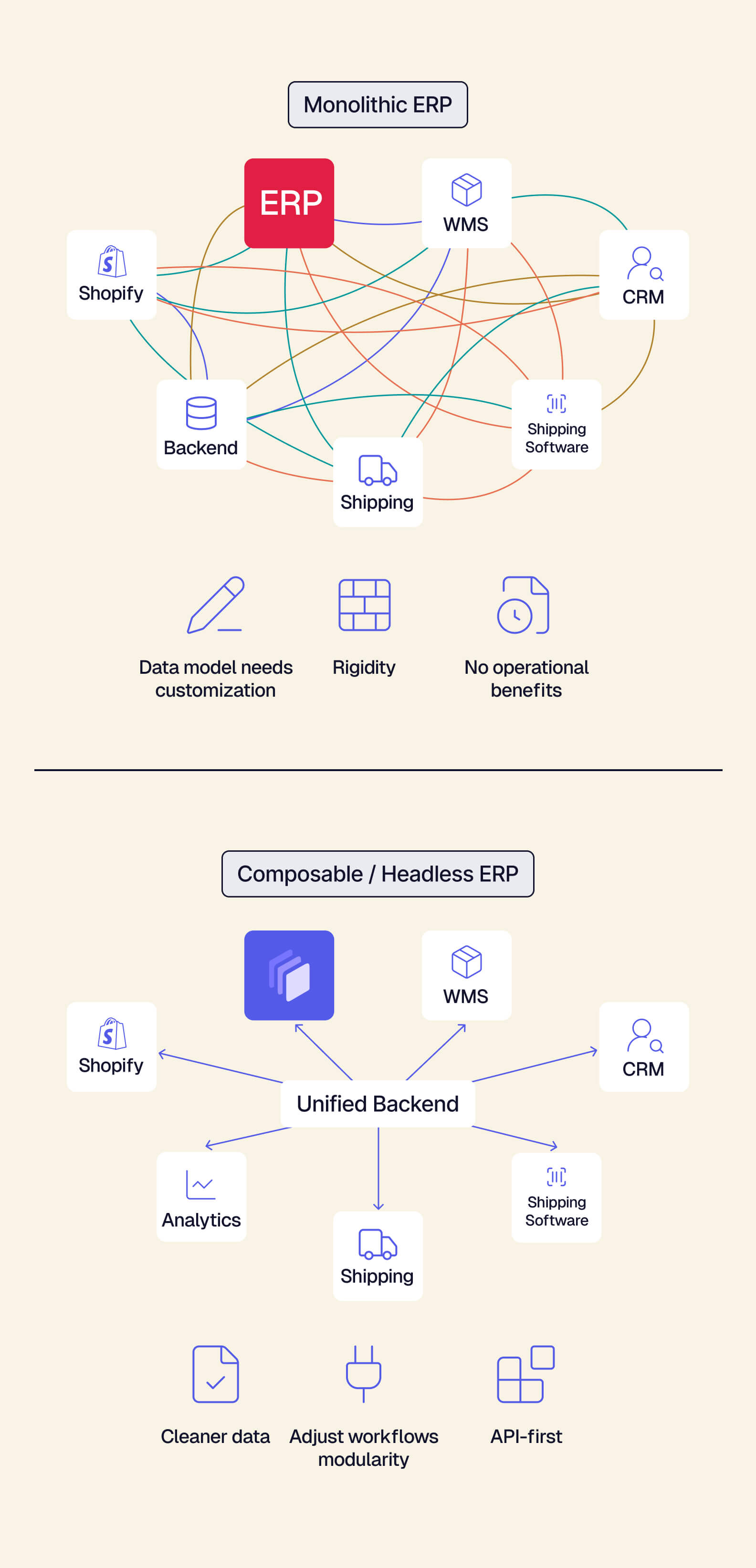
This is what Tailor is built on. Instead of forcing retail and ecommerce operations into a predetermined system, Tailor’s composable, headless platform adapts to how your team actually operates. The result is cleaner data, sure — but more than that, a team that actually uses the system, trusts it, and works better because of it.
The ROI of ERP Integration Is About Your People
There’s nothing wrong with the standard list of ERP integration benefits. They simply struggle to support the entire business. An ERP integration should give you faster data and fewer errors, while delivering high-impact changes for the people doing the work — like clearer decision-making, recovered time, and less friction between teams.
To get there, you need to choose a foundation that’s flexible enough to meet your team where they are and composable enough to scale along with your operations.
See how Tailor’s composable ERP fits your existing workflows without disruption: Book a demo to see how you can deliver the change that will help your teams thrive.