One of the biggest hurdles retail businesses face when considering whether or not they should integrate autonomous procurement workflows is creating an environment where automated tasking can successfully operate. Inefficient processes, convoluted workarounds, siloed data, and rigid ERP systems can all thwart the viability of autonomous procurement deployment.
While this hurdle can be significant for certain businesses to overcome, it’s not impossible — and the positive impact that autonomous procurement can have on your business is too big to pass up.
If you want to level up your procurement workflows to take advantage of autonomous procurement, this guide will help you target the three shifts you need to make to properly prepare your business for it. Along with these shifts you need to make, you will also learn:
-
Why customizable UI, UX, and workflows boost the potential of your autonomous procurement system
-
How headless ERP integrations pave the way for automation-friendly streamlining of your operations
-
Why human-in-the-loop automation gives you an edge over competitors in your niche
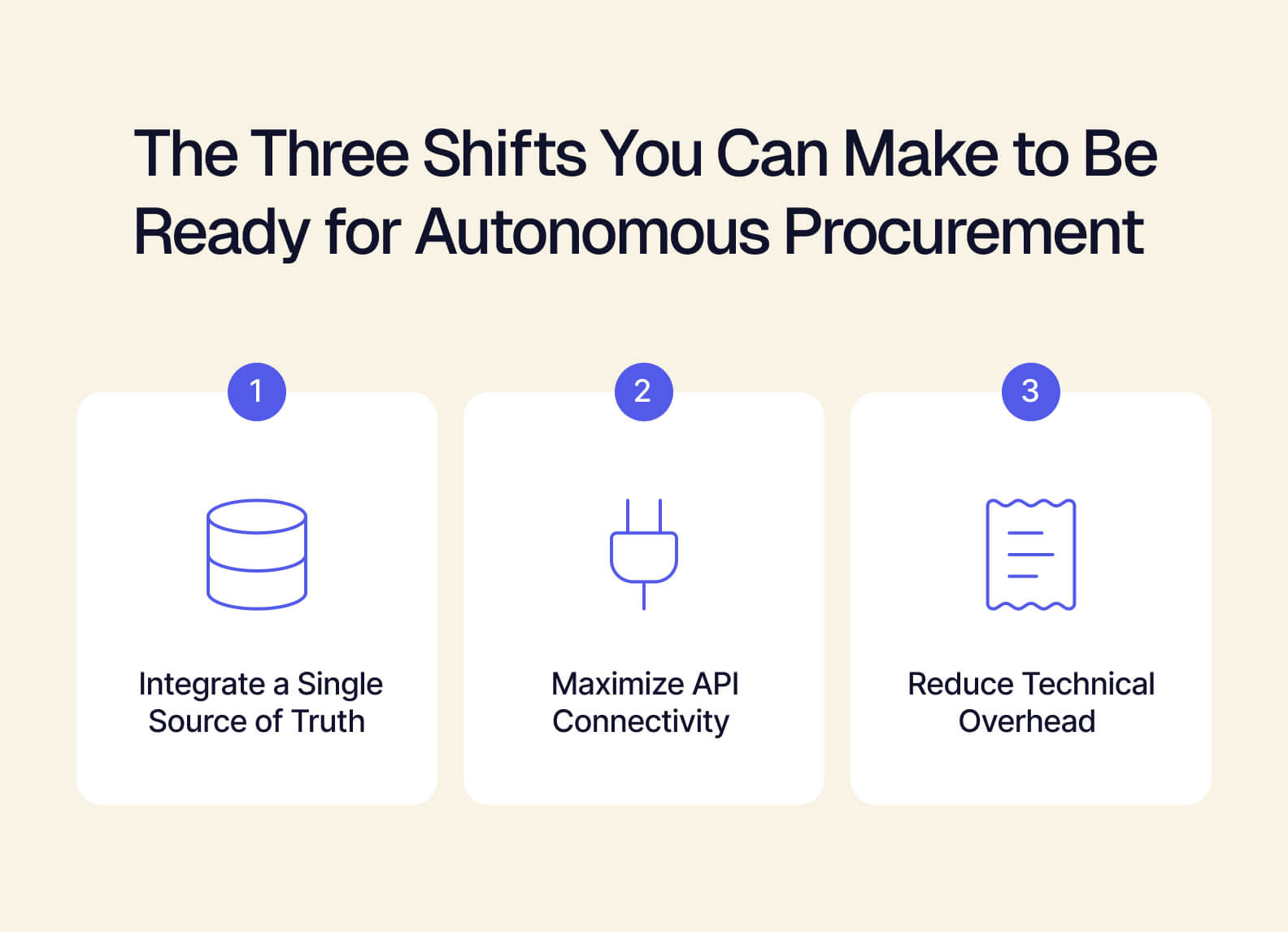
Shift 1: Integrate a Single Source of Truth
The ERP system you choose to integrate into your business dictates your ability to scale and operate. Some ERPs have user experiences (UX) and user interfaces (UI) that are set in stone — these are rigid ERPs —, limiting your future tech stack additions. Others are called headless ERP and feature:
The structure of headless software, ERP or otherwise, creates an ideal environment to deploy autonomous procurement workflows. It does this by becoming a single source of truth for your business; eliminating potentially dangerous data errors, complicated, unreplicable workflows, and tying together previously siloed parts of your business.
Headless Architecture Enables Autonomous Procurement
First, it’s important to understand that autonomous procurement is more than just a singular workflow.
It may be tempting to think it's an AI-powered tool that one-click runs your entire procurement process end-to-end. Instead, think of autonomous procurement as something we call human-in-the-loop automation. This is AI-powered automation that gives you final say over the most important parts of the procurement process (like initiating large purchase orders), while accurately performing predictable tasking. This ensures that you can react to sudden changes caused by vendor delays, demand fluctuations, or other unforeseen events.
The advantage of human-in-the-loop autonomous procurement is that you retain the ability to pace your business, while fully autonomous systems can become a runaway freight train that can cause more problems than they solve. Now that you know why this type of automation matters for your procurement pipeline, let’s explore the impact it can have on the broader business:
Streamline your daily operations. Because autonomous procurement systems thrive on easily replicated tasks that can be governed with rules-based logic, integrating this technology into your business enables your operations team to systematically refine your day-to-day tasking. This often results in a net productivity gain for teams that utilize these workflows.
Real-time data tracking. One of the largest unlocks that comes with autonomous procurement (when deployed alongside headless architecture) is the ability to track key inventory management data in real time across your business. This not only enables your AI-powered procurement system to generate higher-context purchase orders, but it also gives you better visibility across your entire operation.
Contextual demand forecasting. With real-time data and the right AI-powered tools, you can also benefit from demand forecasting based on in-the-moment information and historical data. Previously, ops teams would only be able to lean on historical data to project demand, but with autonomous procurement and AI-powered systems, it’s possible to have more accurate forecasting than ever before.
Shift 2: Maximize API Connectivity
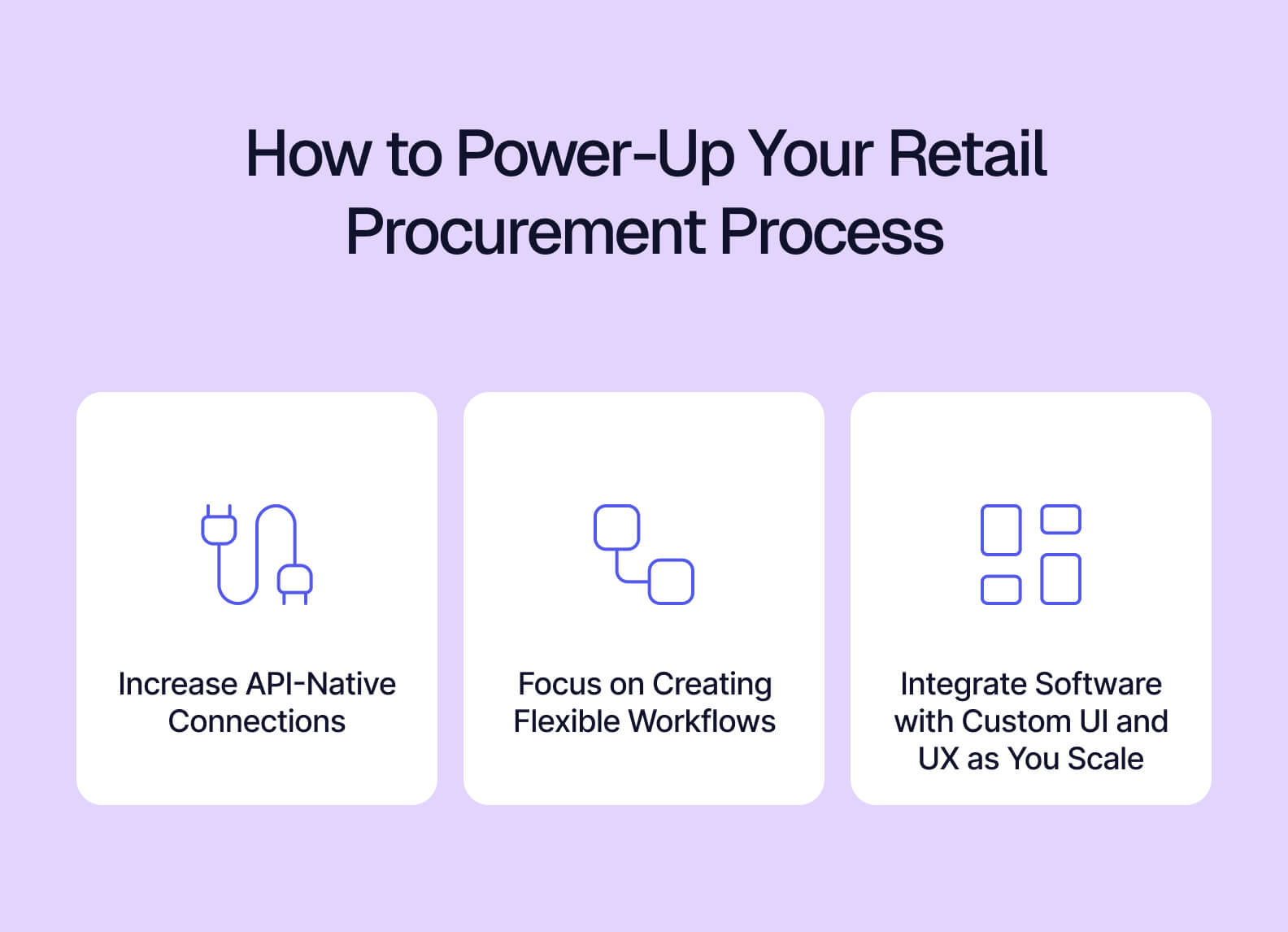
Increase API-Native Connections Across Your Business
API-native systems ensure that your business remains ready to scale, adapt, and explore new opportunities with little risk. You can add (and remove) tools with ease, giving you access to more options than you had before.
- How it impacts your bottom line: Building your tech stack with traditionally rigid software locks you into specific workflows and prevents quick pivots when market chaos affects your business. By shoring up your business with API-native software, you can avoid chaos and prepare for autonomous procurement.
Focus on Creating Flexible Workflows
Frustrating workflows and hacked-together workarounds create inefficiencies and recurring frustrations for your ops team (and anyone else in your business who has to fumble with subpar UX). This all adds up to slowdowns, errors, and cascading problems that could be avoided with better tools and flexibility.
- How it impacts your bottom line: Investing in headless software saves your teams the frustration and time from slogging through bad UX. This gives you more runway for innovating your internal processes and gives each team a workflow that meets their productivity needs.
Integrate Software with Custom UI and UX as You Scale
Without customizable UI and UX, any time you add a new tool to your tech stack, you’ll be stuck creating “go-between” processes — or integrating bridge add-ons — for your different software to force them to work together. This can introduce unintended vulnerabilities, inefficiencies, or even cause technical debt.
- How it impacts your bottom line: Prioritizing customizability in your UI and UX gives you unparalleled adaptability to weave API-powered software into different workflows for different teams. Because your UI and UX can be changed when necessary, you can branch out UI elements for team-specific tools without having to integrate a new dashboard for your entire business.
Shift 3: Reduce Technical Overhead
Autonomous procurement deployment demands that your business operate on a simpler foundation, and technical overhead makes your daily operations anything but simple. If you’ve got a number of rigid software integrations, old systems, or other technological limitations that make it difficult for you to scale your business, you probably need to downscale.
By stripping back software and systems that are working against your business's growth, you’re enabling newer, better tools to be integrated into the tech stack — which will prime your business to take on autonomous procurement. But how do you know if you actually need to downscale your technical overhead?
Let’s dig into the three signs you might need to.
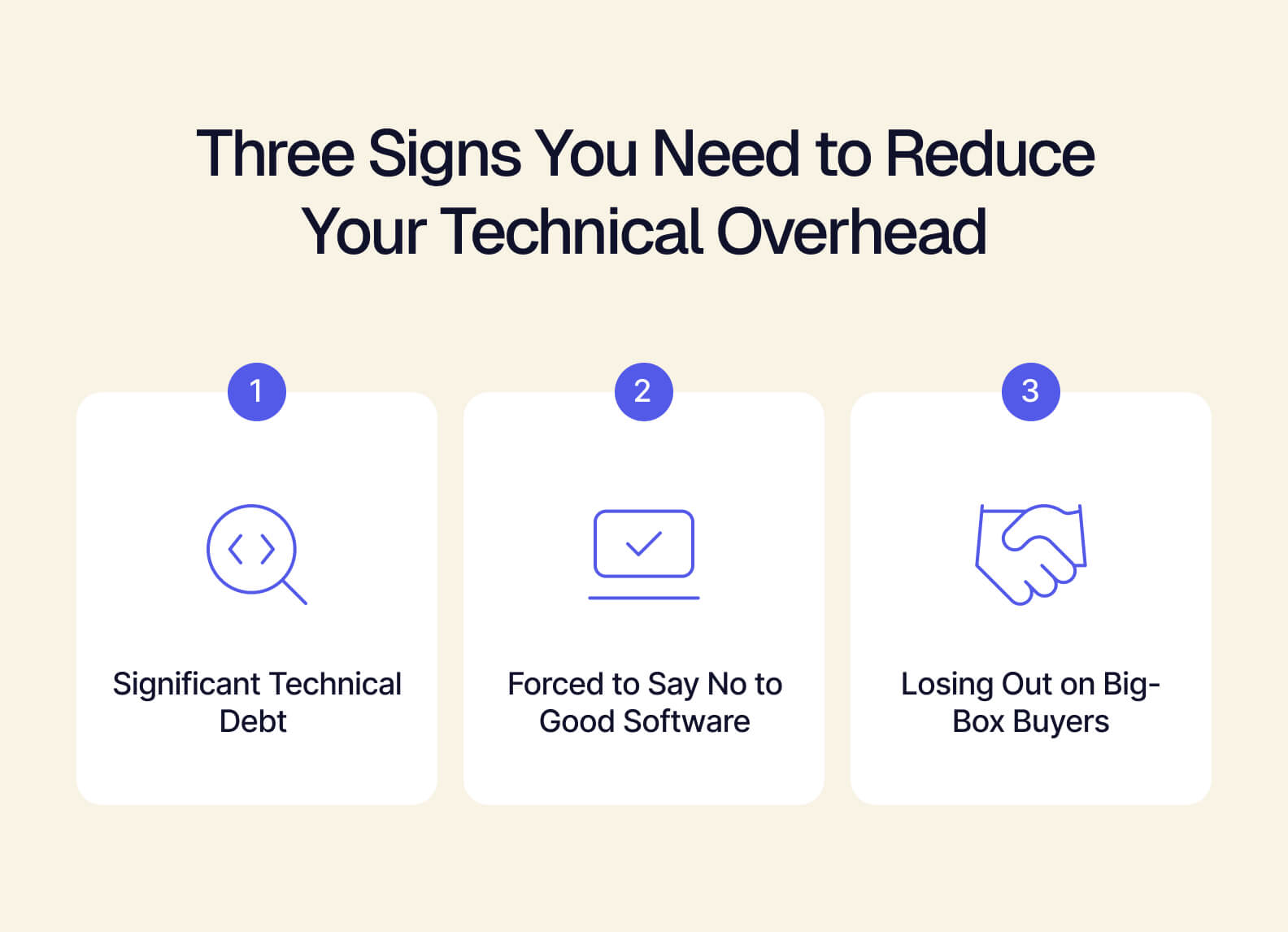
The First Sign: Significant Technical Debt
The problem: Technical debt often builds up from having too many software integrations that simply do not work well together. What results is a series of ever-complicating workarounds or customized micro-integrations meant to simulate the software working together. But over time, new tools put more strain on these otherwise limited solutions.
What you can do about it: Search for composable or API-native tools that have the same functionality as your current tools. This will give you the opportunity to disconnect your problem software — plus the workarounds they require — and replace them with tools that won’t produce technical debt. API-native tools will also enable you to integrate better software choices in the future, without testing your tech stack’s limits.
The Second Sign: Forced to Say No to Good Software
The problem: You might be in the market for new software, but when you get to the demoing or testing phases, you quickly realize that an otherwise good software can’t be used in your business. This often comes down to your tech stack demanding you only use certain types of software. Unfortunately, this type of exclusionary design ensures that scaling and updating your tech stack functionality is a pain.
What you can do about it: Integrating a headless ERP as the backbone of your tech stack will ensure that you have the flexibility required to take on newer and more powerful software. You won’t have to say no if the software backing up your business can say yes, without worry.
The Third Sign: Losing Out on Big-Box Buyers
The problem: Many big box stores require Electronic Data Interchange (EDI) capabilities to do business with them. Some smaller retail businesses may not have planned ahead, leaving them without an appropriate EDI, or worse, purchasing one that doesn’t work for their business. In both situations, retail businesses looking to scale may miss their best opportunity because they didn’t have the right software integration.
What you can do about it: Ensure that your system can handle a quick EDI integration in a pinch, but you should also prioritize researching the types of EDI that will enable you to partner with your ideal big-box stores. Scaling opportunities like these can only usually be anticipated, rather than counted on — making a flexible system mandatory in this unpredictable business environment.
The Result: Direct AI Agents and LLM Workflows with Human-in-the-Loop Automation
Why Human-in-the-Loop Autonomous Procurement Works
One of the largest concerns with AI-powered automation is the risk associated with bad data entering the system. This bad data can come from something as simple as a delayed inventory update due to an outage, or a manual data entry process being submitted with a rounding error. What results is an autonomous system charging forward with bad information — which can quickly cause cascading inventory problems.
This is the primary reason why Tailor advocates for human-in-the-loop automation integrations. Your teams know your business best, and can spot data errors before they enter your automation processes. Likewise, it enables you to trust your gut on purchase orders, take calculated risks on new products, and safely adjust parts of your procurement process if vendors change, materials become unavailable, or you need to scale up.
By ensuring you remain in control, you get to experience the power of autonomous procurement without risking stumbling over inevitable roadblocks.
Level-Up Your Retail Procurement Pipeline
Still not sure if your business is ready for autonomous procurement? If your business needs autonomous procurement to keep up with competitors, but you’re stuck figuring out how to make the shifts necessary, Tailor can help.
Our team of headless software experts can work with you to audit your tech stack and processes to guide your business toward a flexible future where you can scale with ease and embrace human-in-the-loop automation.