Unanticipated SaaS costs are blowing your annual budgets.
Purchasing a new SaaS product for your retail business isn’t as simple as choosing the product, inking a deal, then paying the box price. The bill you pay today may look very different three weeks, months, or years down the line. The actual cost of that SaaS software is informed by its Total Cost of Ownership (TCO) — or the set of factors that add up to an integration costing more than you planned for.
In this guide, you’ll learn about the different costs that increase your TCO and how to avoid them.
Usability Costs: Scaling Bottlenecks and Inefficient Workarounds
Your New Tools Scale Poorly
Many businesses forget to think about where they’ll be in three years and only focus on meeting sales numbers for the next few months. This often leads to purchasing an inadequate software solution that can only serve the immediate need, but once you’ve exhausted its capacity, it leaves you with a new set of problems.
Why it costs you. Purchasing and integrating new tools starts a series of knock-on effects that can either save or cost you more money. When you start that process with a tool that won’t scale with your retail business, you’re guaranteeing multiple cost cycles. These costs won’t stop once you’ve outgrown the tool, either.
What you can do about it. Shop for your tools with scalability in mind. Make sure that it meets the current need, but can also be useful in a few years — after your business has grown and changed. Adopting a problem-solving approach rather than operating with a “patch it now, fix it later” workflow will help you mitigate adopting low-scalability tools.
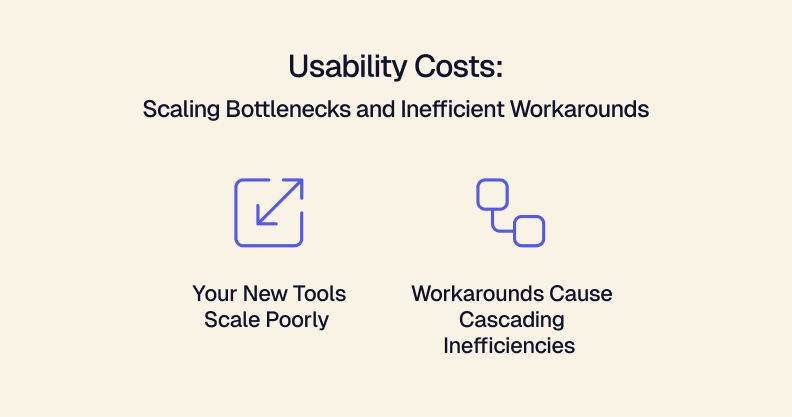
Workarounds Cause Cascading Inefficiency
Workarounds are a natural part of daily operations. Tools can’t always connect to each other, and sometimes they have unanticipated bugs or UX experiences that demand on-the-fly adjustments. However, many workarounds waste time or even cause technical debt when performed enough times. These effects often hit on a delay, catching your teams off guard when they strike.
Why it costs you. Workarounds inherently slow down workflows, and when they start piling up technical debt, your teams could see hours of reduced productivity. These slowdowns inevitably lower your ability to react to chaotic market conditions, inflating your susceptibility to risk.
What you can do about it. Choosing composable software solutions can enable your ops team to clarify and simplify existing workflows so that workarounds don’t have to be a necessity. This preserves your agility as a business and keeps your day-to-day operations moving along.
Serviceability Costs: Data Accessibility and Update Cycles
You Should Control Your SaaS Data
Having unhindered access to your data is extremely important — especially in this cloud-based software environment. Many SaaS products are built in closed-data environments, which means you’ve got to go through the vendor any time you need to access your business’s unique data. In emergencies, or when you have to execute a data migration, having your data gated off can create a number of headaches.
Learn more about open vs closed-data environments
-
Why it costs you. Coordinating with your vendor, receiving your data, and getting it reconciled with your system takes time and opens up opportunities for data entry errors to occur — triggering cascading issues that touch every part of your retail business.
-
What you can do about it. Choose a SaaS software that was built with open data in mind. Open-data vendors enable you to access your data at any time, so you don’t have to fight for what was yours to begin with.
Long Update Cycles Waste Time (and Budget)
Vendors will push updates to tools to add new features, fix bugs, and upgrade the security compliance of the software. Unfortunately, not every software is built with easy updating in mind (and not every update is thoroughly tested). This leads to painful update cycles where tools could be offline for hours, days, or even weeks; throwing your daily operations into chaos and negatively affecting your customers, sales targets, and project pipeline.
-
Why it costs you. Having a core part of your workflow offline for any amount of time can exponentially increase your cost to operate each day, and the longer it goes, the worse it gets. Broken tools can also open up avenues for missed opportunities or dipping sales caused by frustrated customers.
-
What you can do about it. Learn as much as you can about the vendor and the tool you’re buying. Ensure they have a predictable update cycle and on-demand, expert support available if something goes wrong.
Teardown Costs: Ripping, Replacing, and Data Migrations
Removing Tools is Harder than Adding Them
With modularity and composability being newer architectural philosophies in the software space, many tools are still designed to be plugged in and never removed. The reality is that businesses outgrow their tools and software vendors discontinue products, shut down operations, or become acquired by a competitor. Tools that need to be removed for any number of reasons can create IT emergencies, slow operations, or cause technical debt for users of that SaaS product.
-
Why it costs you. Ripping a tool out of a tech stack requires IT professionals to disconnect a tool, migrate (or store) its data, and then your Ops team needs to stitch together new workflows that don’t use the removed tool. The other shoe drops when you integrate a replacement tool and have to undergo a new TCO calculation.
-
What you can do about it. Choosing modular tools and composable integrations can help limit instances where you may have to begin a rip-and-replace process, while also lowering the chances of undergoing an exponential hike in your TCO.
Moving Your Data Reveals Infrastructural Pain
Data migrations quickly become nightmares for many retail ops teams because they don’t have the infrastructure to process their data (like a tool specifically designed to contain and move data). A typical migration flow may look like this:
- Remove [DATA] from X-Application
- Move [DATA] into a spreadsheet
- Convert [DATA] into a new format for Y-Application
The move from “X-Application” to spreadsheets can lead to errors, and the same can happen with managing the conversion from the spreadsheet to “Y-Application”. If all goes according to plan, this could lead to a busy few hours of work, but data migrations rarely go through without a hitch.
-
Why it costs you. Moving data around is a big lift that requires the time of your IT professionals (or hiring a contracting team if you don’t have any experts working for you). The secondary cost is the damage that comes from data becoming corrupted, or unintentionally altered, in the migration process — causing issues with your inventory or other core workflows.
-
What you can do about it. The short answer is to ensure you prepare for data migrations. Clean your data ahead of time, have the right personnel on hand to help, and try to cut spreadsheets out of the migration process by choosing a software solution that interfaces directly with the tool you’re migrating from.
Hidden Fees: Out-of-Control API Calls and Support Depreciation
Runaway API Calls Add Up
An overlooked consequence of scaling isn’t growing out of tools, but rather exceeding the limits you were paying for with those tools. When you seize an opportunity and suddenly scale, some of your tools may hit their “paid for” rate limits or API calls — suddenly exposing you to the fine print of your contract or service plan. This often looks like overage fees or per-call charging, which can dampen the benefit of a sales boom.
-
Why it costs you. The real cost here is when you’re unprepared to max out your usage limits, and you don’t know that the limit was reached. Receiving a massive bill from your vendor will negatively impact your ability to take on new markets later.
-
What you can do about it. Planning for the future is important, but utilizing accurate forecasting tools can help you mitigate unexpected momentum much better. AI-native forecasting tools can intake your past and present data to help you make the best decisions about which SaaS services to scale up (avoiding a deluge of fees if you meet the cap), and which to leave as-is.
When Software Reaches End-of-Life
When your SaaS software reaches end-of-life, you’ll be faced with a choice: use the tool as-is (if it’s a tool you can run on your own hardware) or find a new tool to replace it. The trouble comes when you’ve recently purchased a soon-to-be-dropped tool, or the vendor wasn’t expecting to cease operations. And as you know by now, ripping and replacing these types of tools leads to a whole new TCO cycle.
-
Why it costs you. End-of-life cycles are difficult and always lead to increased costs. They forcefully upend parts of your system that were working, making them obsolete — forcing you to change when you may not have wanted to, leaving your operations in a lurch.
-
What you can do about it. Choose SaaS products from vendors who have a proven track record or show the hallmarks of a strong business. Also, look for SaaS vendors who may be able to give you a standalone version of their tools in the event they cease service.
Let Tailor Help You Refactor Your SaaS TCOs
Growing a retail business with the latest SaaS tech doesn't have to drain your annual budgets and add risk to your business. You can reduce your TCO overhead by prioritizing:
If you’re ready to check all these boxes for your next retail software purchase, Tailor can help. Book a demo with us today to learn more about how our composable ERP modules and customizable user interface can help your business scale and speed up your daily operations — without exponentially increasing your TCO.