Growing your business means increased complexity. As you add products and storefronts, communication between internal systems becomes more important and more difficult. That’s where retail ERP integration comes in.
ERP integration connects all your departments and applications, serving as the central source of truth that receives and distributes information. Your point of sale, production, purchasing, inventory, accounting, CRM, and HR programs communicate in real time through the ERP that connects them.
You may be familiar with traditional, legacy ERPs and tempted to go with integrating an “industry standard.” But mid-size and growing retail businesses have distinct workflows and pain points that legacy systems were not designed to meet. For brands like yours, there’s a better way to integrate an ERP and your existing software.
What you’ll learn:
-
How to choose an ERP that’s the right fit for your business
-
What modern retail ERP integration can do to meet your brand’s needs
-
Why retail ERP integration is faster and easier with headless and composable system architecture
How Choosing the Right ERP Supports Your Retail Business
Legacy ERPs are typically designed for large, enterprise-level businesses that do high-volume, multinational sales. These ERP systems may include features that you don’t need and are typically not designed to handle the more nuanced complexities of smaller-scale retail sales.
An international pharmaceutical company, for example, has legal, manufacturing, distribution, and marketing processes that a retail business does not. They don’t have product lines that change with every season or want dynamic pricing based on customer demand. The ERP that this company would use in their business should reflect their overall stability and predictability.
Rather than investing in enterprise-grade ERP, choosing an ERP built for retail operations that easily integrates your existing tools and uses composable, headless architecture will better meet your needs. Here’s why:
-
Maintain your agility. Retail businesses need to be able to make decisions quickly, without their system architecture slowing them down, limiting their choices in the marketplace, or absorbing operating budgets. A modern ERP keeps your processes lean, maintains your performance, and keeps your data accurately synced between channels.
-
Improve your brand’s flexibility. An ERP that’s headless and composable decouples your frontend from your UI to create a more responsive tech stack that utilizes your existing tools, so you can pivot or take on new markets without disrupting your workflows.
-
Control your complexity. A right-sized ERP that’s deeply integrated with your tech stack helps you fine-tune the complexity you can handle, while enabling you to easily add more as you scale.
The Benefits of Integrating Your Retail Workflows into a Modern ERP
Retail moves fast, with continual product changes and endless variations. Legacy ERP systems weren’t built for that pace and volume, leaving retailers with out-of-sync stock counts, outdated sales data, and margins that are a guessing game. A modern headless, composable ERP connects retail workflows seamlessly, keeps pace with retail’s rapid changes and variety, and gives you real-time visibility into what’s happening throughout the entire process.
Manage Your SKU Complexity
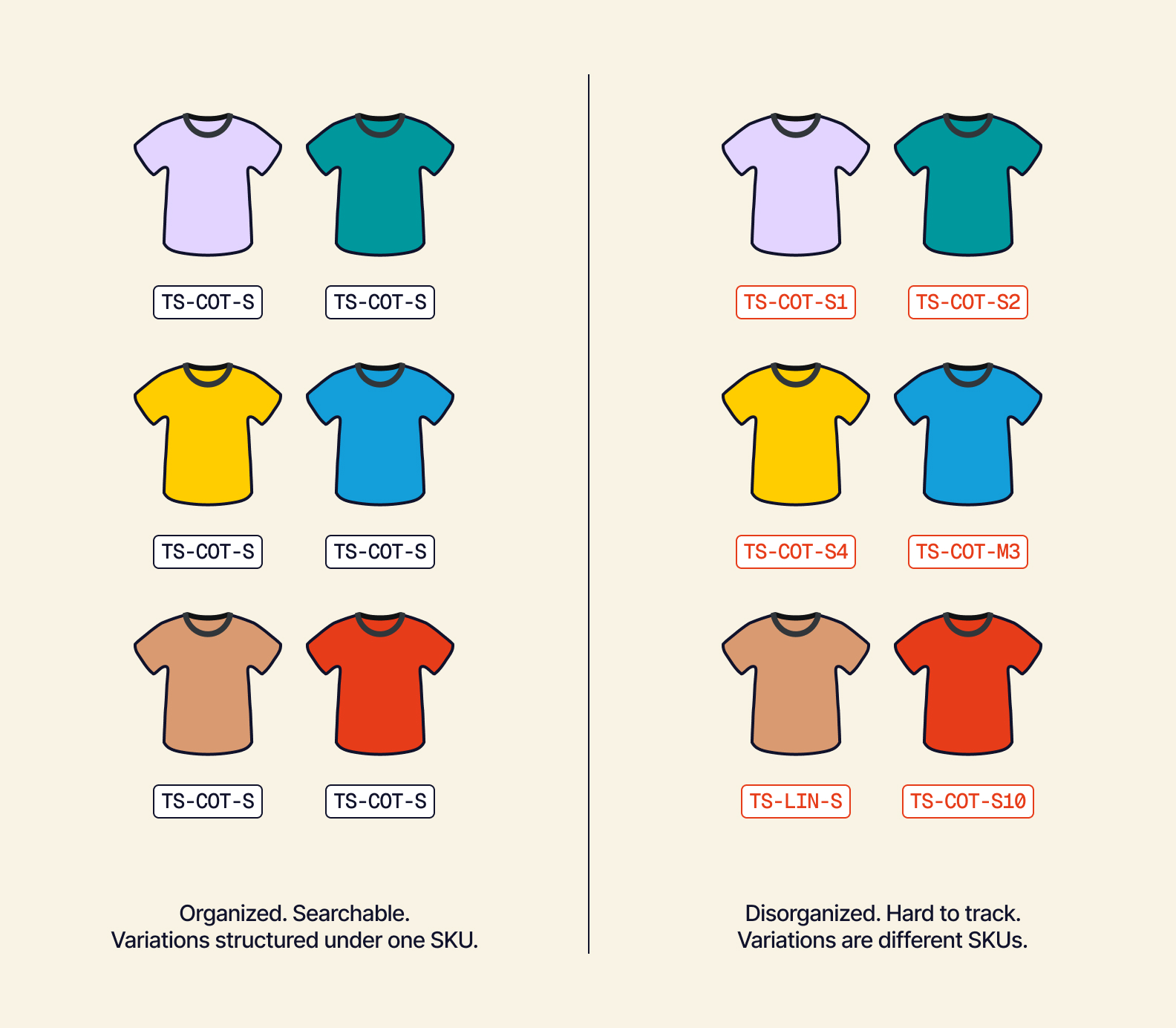
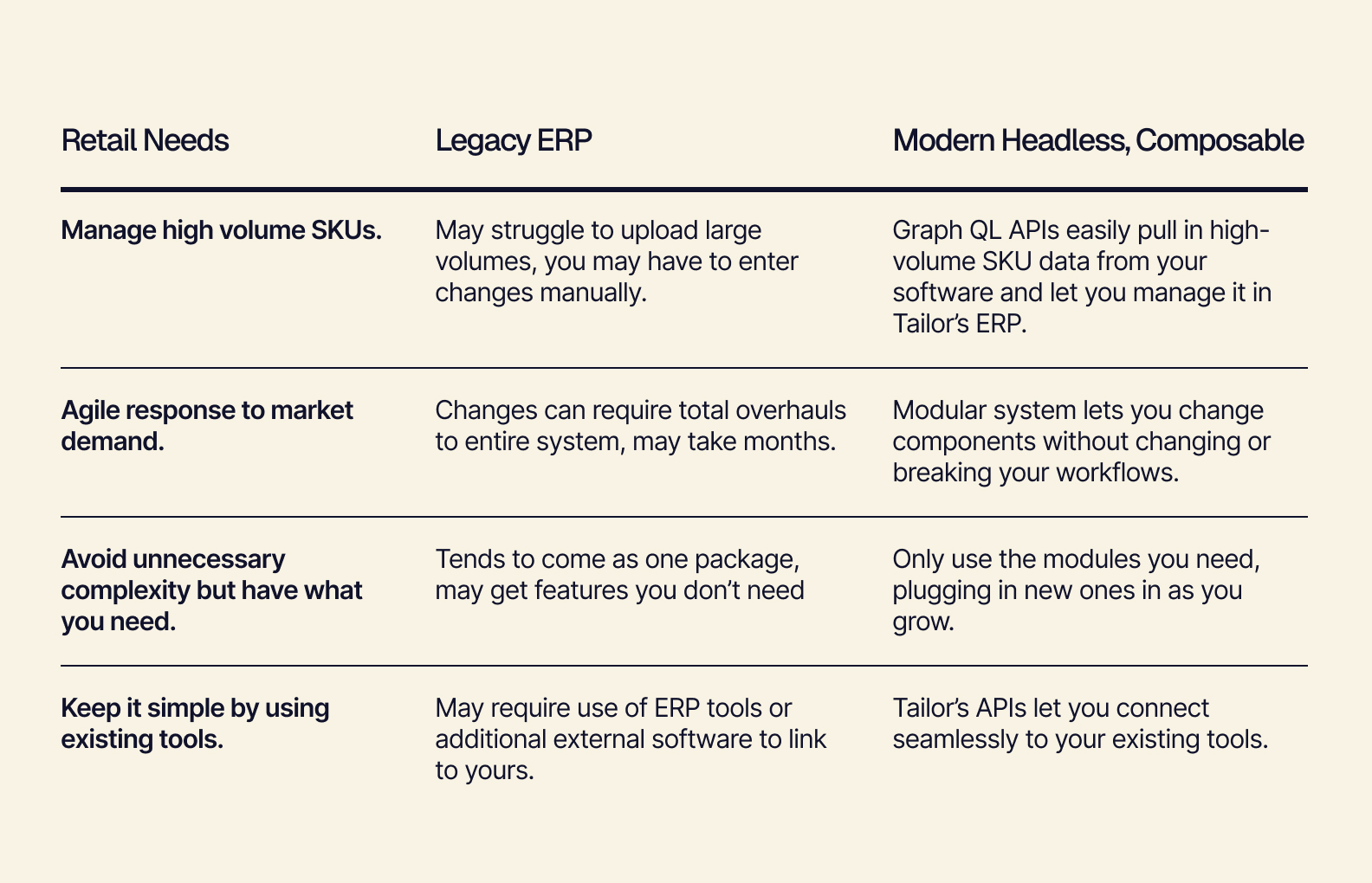
Legacy ERP programs were typically built for businesses with fewer variations and less frequent changes in products than in the retail world. They can struggle to scale large numbers of SKUs. Headless, composable retail ERP integration, on the other hand, was designed with a high volume of SKUs in mind.
Have hundreds of t-shirt designs in multiple colors and sizes? No problem. Modern retail ERP integration is here for it.
-
Tailor’s GraphQL APIs manage your SKU data as it flows into the ERP from your inventory software, whichever programs you are using. With the data in Tailor’s ERP, you can pull it in seamlessly and add, edit, or delete data right from Tailor’s dashboard.
-
GraphQL APIs can help you find, filter, and manage your inventory wherever it’s shelved.
Comprehensive Inventory Syncing
Nothing frustrates a customer more than trying to order a product or buy it in the store, only to learn it isn’t available because you’re out of stock on a product that showed as available on your digital inventory. Or, even worse, ordering and paying for a product that shows as purchased but never arrives. Sending that “we can’t fulfill your order” message is a great way to lose customer loyalty.
On your end, this is a lost sale that didn’t have to happen. With better inventory management, you may have restocked the item or at least directed the customer to a different product.
-
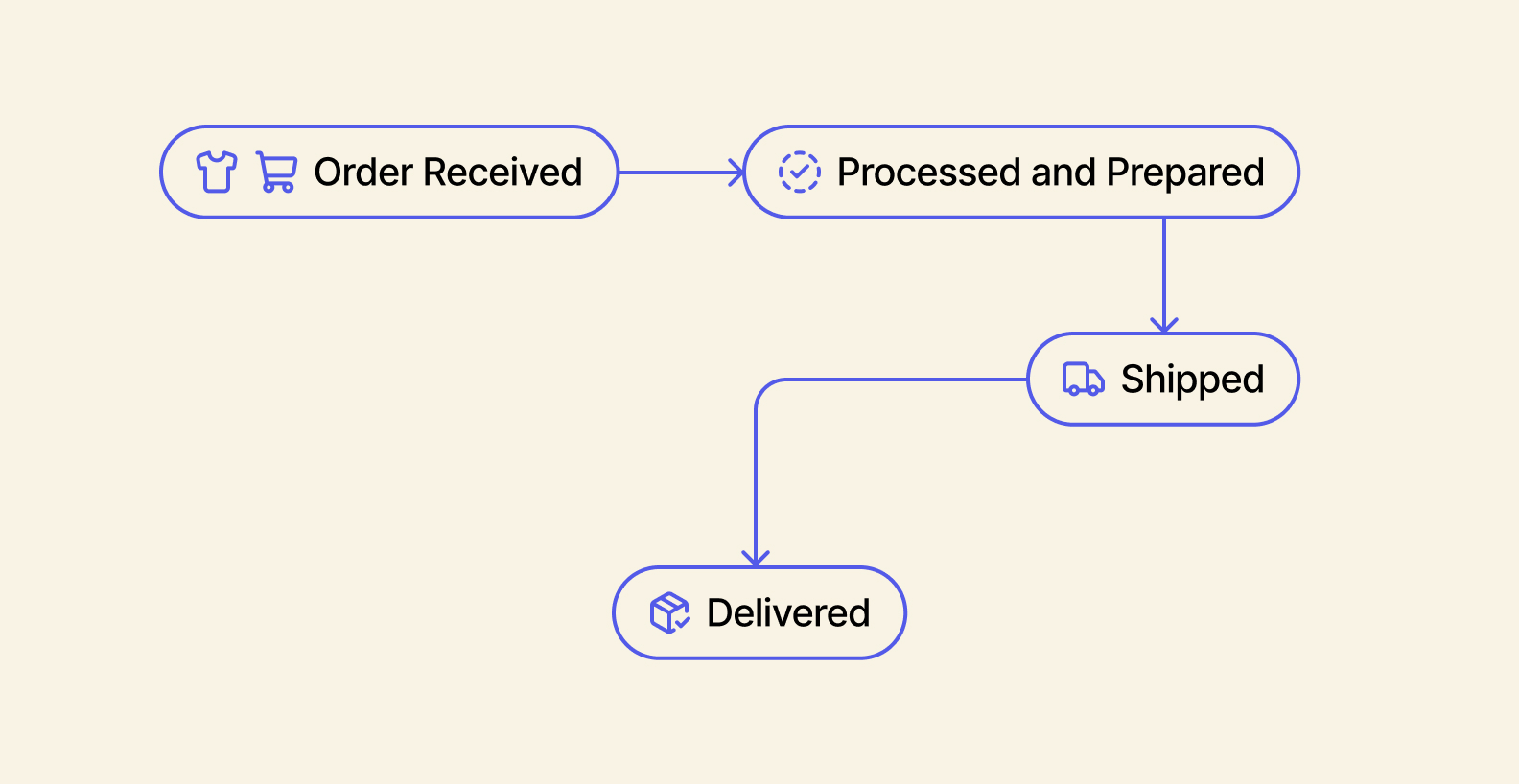
With Tailor’s inventory management module, all components that touch inventory talk to each other via ERP integration. If you sell a denim jacket on Shopify, your Amazon inventory is updated. You can easily see if a product is in production, in the warehouse, or en route to a customer. Order cancellations, returns, and store-to-warehouse transfers update in real time, too.
-
What makes headless, composable ERP systems different is that this inventory integration happens seamlessly even if you add storefronts, product facilities, or warehouses. Since the retail ERP system is modular, you can quickly plug in new locations and processes that get integrated quickly.
Accurate POS and CRM Data, Plus Improved Demand Forecasting
Along with your inventory, your sales data updates in real time with retail ERP integration. You can easily track trends, both among groups of buyers and individual customers, while moving quickly to adapt to what’s hot and what’s not.
-
Create better sales/stock forecasting based on current data, knowing it’s up to date everywhere and happening in real time. Capitalize on sudden shifts in demand and avoid both under- and overstocking.
-
Adjust pricing according to current demand, reducing items that need to be cleared out and tweaking margins for in-demand products.
-
Get better demand forecasting based on your historic sales data and external market conditions, such as material delays or vendor availability. This improves your ability to make educated choices on which specific SKUs or product lines to focus on the most.
-
Since your CRM data can be plugged in too, these point-of-sale updates let you drill down on specific customer behavior. This also helps keep any customer rewards programs you offer up to date.
-
With headless, composable retail ERP integration, the flow of data isn’t interrupted if your digital storefront uses a different POS system, or if you’re adding locations and CRM tools. Wherever you’re selling and whatever tools you’re using, you can integrate quickly and keep business flowing.
Accounting at a Glance
Retail businesses require near-continuous restocking. Tailor’s AI-native cost accounting and purchase order management modules do more than just provide data. They help you understand and manage your flow of money, supplies, and products.
-
ERP integration gives you real-time margin visibility, pulling both your sales revenue and your expenses into one dashboard. No more guessing what your margins are and hoping for profit. You’ll know where you stand financially and can make decisions accordingly.
-
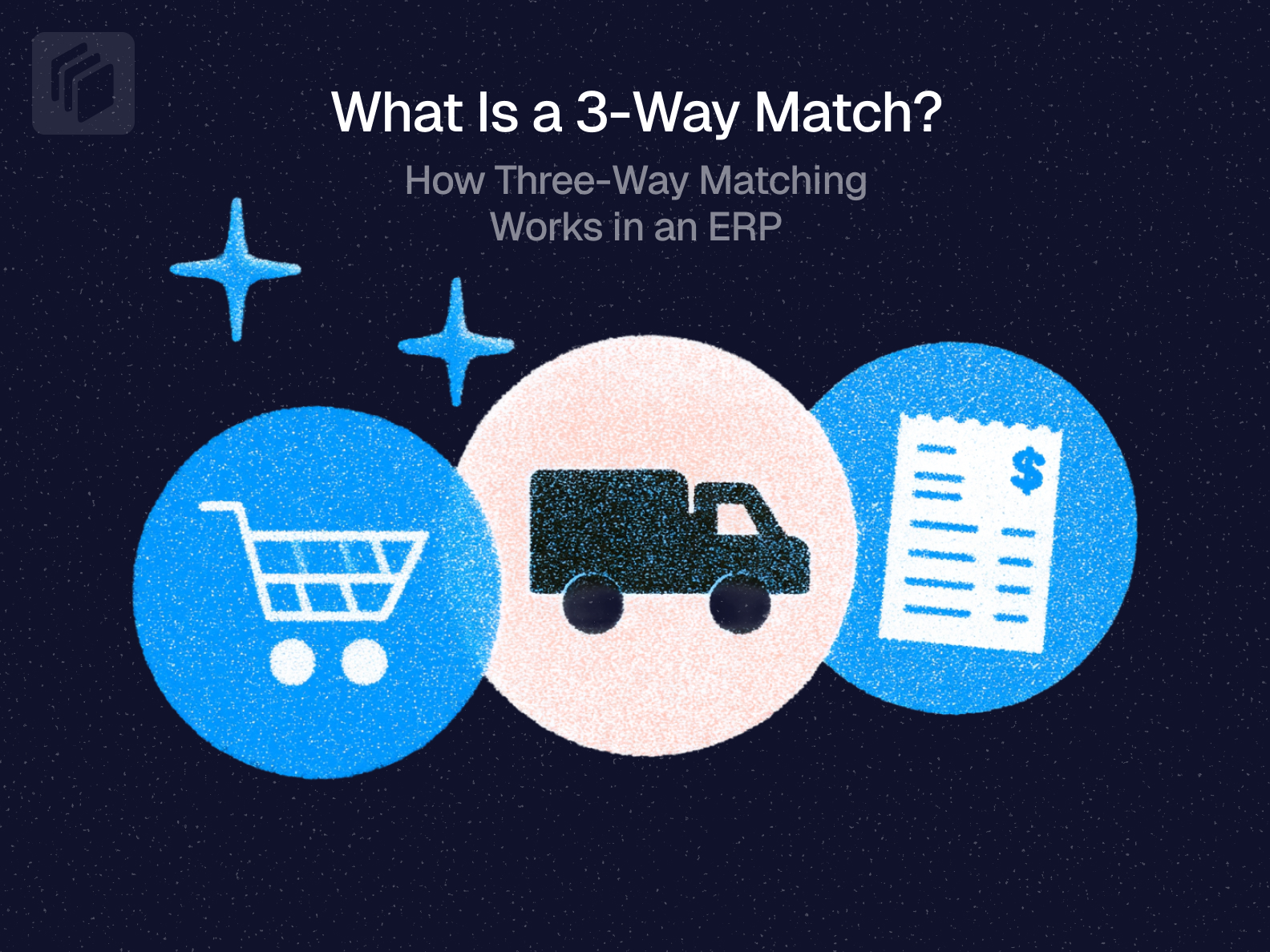
Three-way invoice matching compares purchase orders with the vendor invoices and the goods receipts at delivery, using AI-OCR (Artificial Intelligence Optical Character Recognition) to read documents with improved accuracy and context comprehension. This helps avoid overpayments while also allowing you to implement vendor tolerance variance rules that keep invoices from being bottlenecked for minor details, such as a $1.00 difference on a $10,000 order.
-
Purchase order-level rollups let you assign sub-POs to a parent PO, or roll items up into a specific department or budget. This lets you categorize spending, making it easier to analyze.
-
Use existing accounting tools. With Tailor’s integrated into your retail business, you don’t have to switch accounting tools to make all this happen. Thanks to Tailor’s modular and API-first design, you can integrate QuickBooks or any other API-enabled accounting systems you want to use.
Retail ERP Integration Results in a More Agile and Adaptable Business
Legacy ERP systems are implemented and launched all at once, which can take six months or more to implement. Changing one piece — such as adding or removing a storefront or switching CRM or accounting systems — can result in a total overhaul.
Retail moves too fast to be stuck waiting for changes. The ERP implementation process for headless and composable integration lets you get up and running quickly and adapt to changes fast.
-
With Tailor’s headless, composable retail ERP, your integration can be up and running in 3 to 6 weeks.
-
Open-source templates, low-code interface customization capability, AI-native and API-first configuration mean you don’t have to do heavy back-end engineering to get set up or make changes. More technical teams have the opportunity to fully customize the system for their needs.
-
Since Tailor is modular, you don’t have to implement everything at once. You can deploy features in phased rollouts based on your business’s priority needs.
-
As your business evolves, you can easily plug or unplug modules. Each one is developed independently and designed to connect and work with other parts of your stack — like interchangeable building blocks.
-
You can keep your existing tools. This means staff won’t have to relearn workflows and processes; another time-saver that helps keep your business agile.
Modernize Your Tech Stack
With a headless and composable ERP like Tailor, you can use current and accurate information to help you make the right business decisions, refine your strategies, and take on new markets. Your data automatically flows through your business, giving you full visibility of the most important processes, like manufacturing, inventory management, purchase orders, accounting, and more.
Discover exactly how modern retail ERP integration can help you get there with a demo from Tailor today..