Today’s vendors are full of promises about how their AI capabilities will transform your operations.
But your AI problem isn’t about finding the right tool. If you’ve invested in an automation tool but seen little improvement, the real issue was your architecture.
A fragmented backend blocks AI from seeing the full picture. And when AI can’t access comprehensive data, its decisions and recommendations will be incomplete.
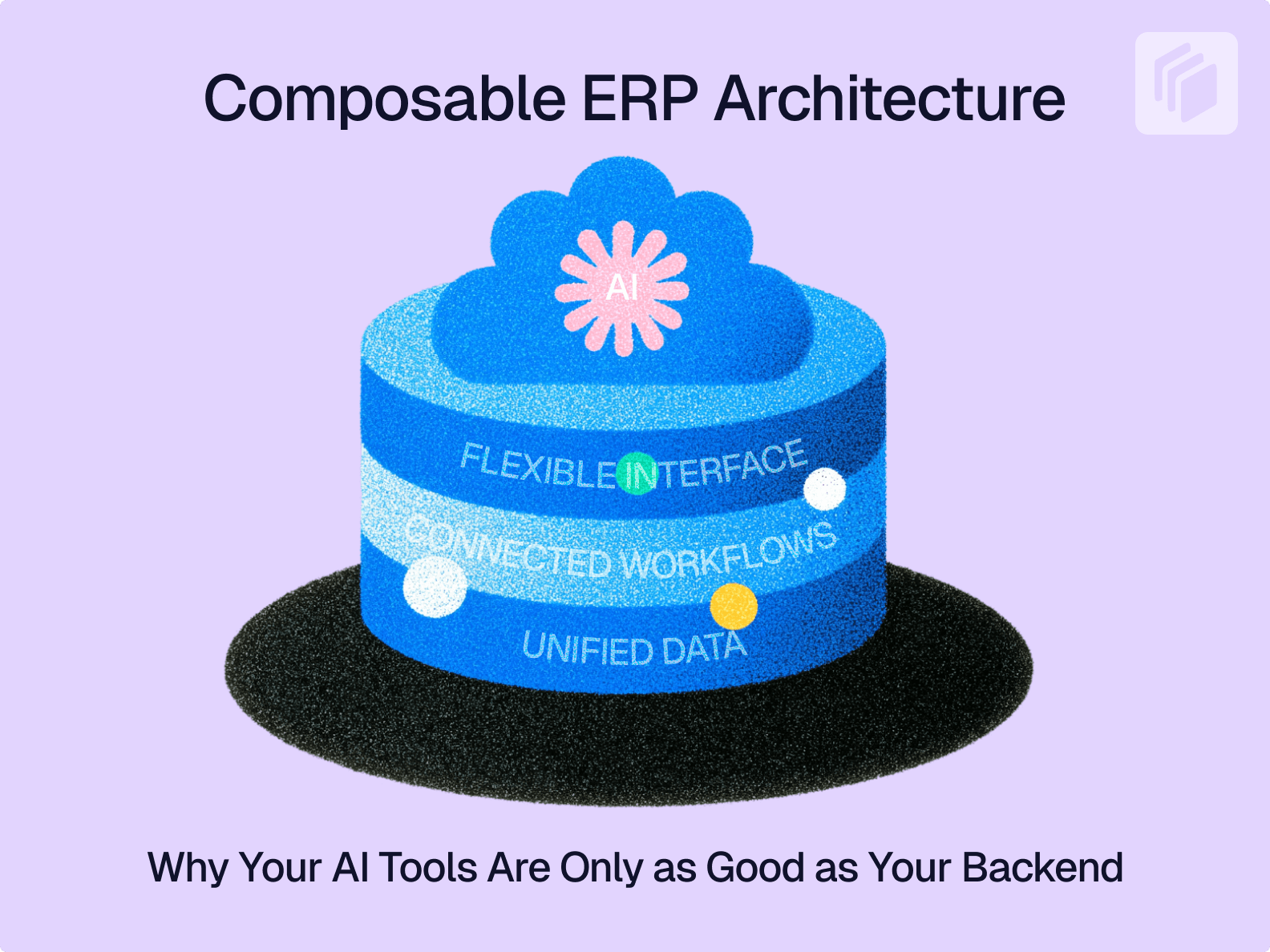
The solution is a composable backend. Composable ERP architecture connects your existing systems into a unified backend, enabling connected workflows and clean data. Ultimately, this unlocks AI’s full capabilities by building on architecture that won’t need to be replaced tomorrow.
What you’ll learn
- Why AI tools underperform in most ERP environments
- The three layers of an AI-ready stack
- What future-proofing actually means for ERP
- How Tailor puts composable ERP architecture into practice
- How to evaluate your AI readiness
Why AI tools underperform in most ERP environments
AI is only as smart as the data it can “see.” And in most ERP environments, it can only see a tiny percentage of the data it needs.
Traditional ERPs are fragmented. Your inventory lives in one module and finance in another, while sales orders might be in a completely separate system. Meanwhile, you’re also dealing with ecommerce platforms, spreadsheets, brittle integrations, and more.
If you try to introduce an AI forecasting tool, but it can’t see information like live warehouse capacity, supplier lead times, or inbound purchase orders, these blind spots will cause it to make inaccurate decisions. You’ll end up with skewed forecasts or inflated safety stock.
Traditional, or monolithic, ERP systems aren’t designed for API-native interoperability or real-time composability. And if you’re continually stacking more best-in-breed tools on top, this is only increasing complexity.
Composable ERP architecture is different. Here, data is no longer trapped in modules. Instead, it’s fully accessible via a unified backend built with interoperable components. A composable architecture enables a unified data model, real-time synchronization, and cross-system visibility, which reduces those AI “blind spots.”
The three layers of an AI-ready stack
AI readiness isn’t a feature you can buy. It’s something your architecture either enables or blocks.
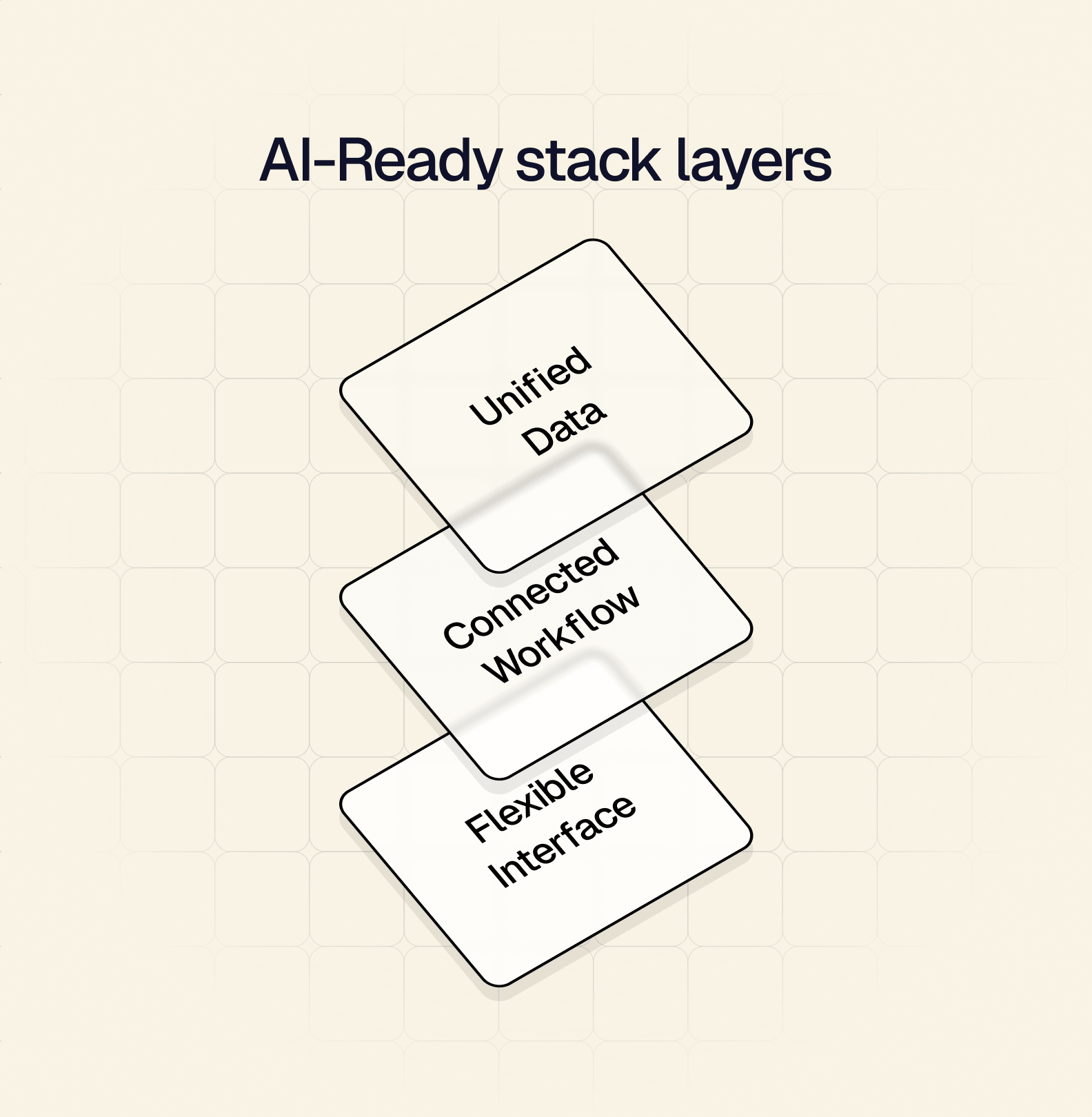
Before any AI tool can work across your business, your infrastructure needs to have three strong layers ready to go.
#1. Unified data layer
First, you must have a single source of truth. Just integrating systems isn’t enough. You need one shared data model, one consistent definition of core subjects, and real-time data consistency. Otherwise, AI won’t work.
Although traditional ERP may claim to be a single source of truth, the reality is that multiple systems live externally. The result is data latency, sync failures, and manual reconciliation — and that isn’t good enough for AI.
Composable ERP architecture, however, is API-first and interoperable, creating a unified backend from the ground up. This gives AI the full data access it needs.
#2. Connected workflow layer
Clean data is only the first step. Next, AI needs to be able to participate in workflows in real-time, triggering actions and updating records across systems.
Traditional ERP workflows are rigid and slow. AI recommendations are likely just going to sit there.
But with composable ERP, AI-driven insights can immediately trigger workflows across purchasing, fulfillment, and finance.
#3. Flexible interface layer
Finally, you need a flexible interface layer so that AI outputs can surface where teams actually work, not just in one vendor’s dashboard.
Monolithic ERPs are inflexible and difficult to customize. But composable ERP architecture is also headless: It separates the backend and the frontend.
When your frontend interface can develop without affecting backend logic, AI outputs can show up anywhere your team needs to see them — ERP dashboards, warehouse tools, ecommerce admin panels, Slack, email.
Tailor Omakase is the pre-built frontend — pre-configured modules for procurement, sales, inventory, and manufacturing, ready to deploy in weeks. Start with the curated experience; build new interfaces as your AI workflows create views you haven’t anticipated yet.
What future-proofing actually means for ERP
There’s a false narrative going around about what “future-proofing” actually means.
It’s not about buying the most sophisticated system you can find. Or locking into the vendor with the longest roadmap.
The real way to future-proof your business is by building an architecture you can adapt without rebuilding.
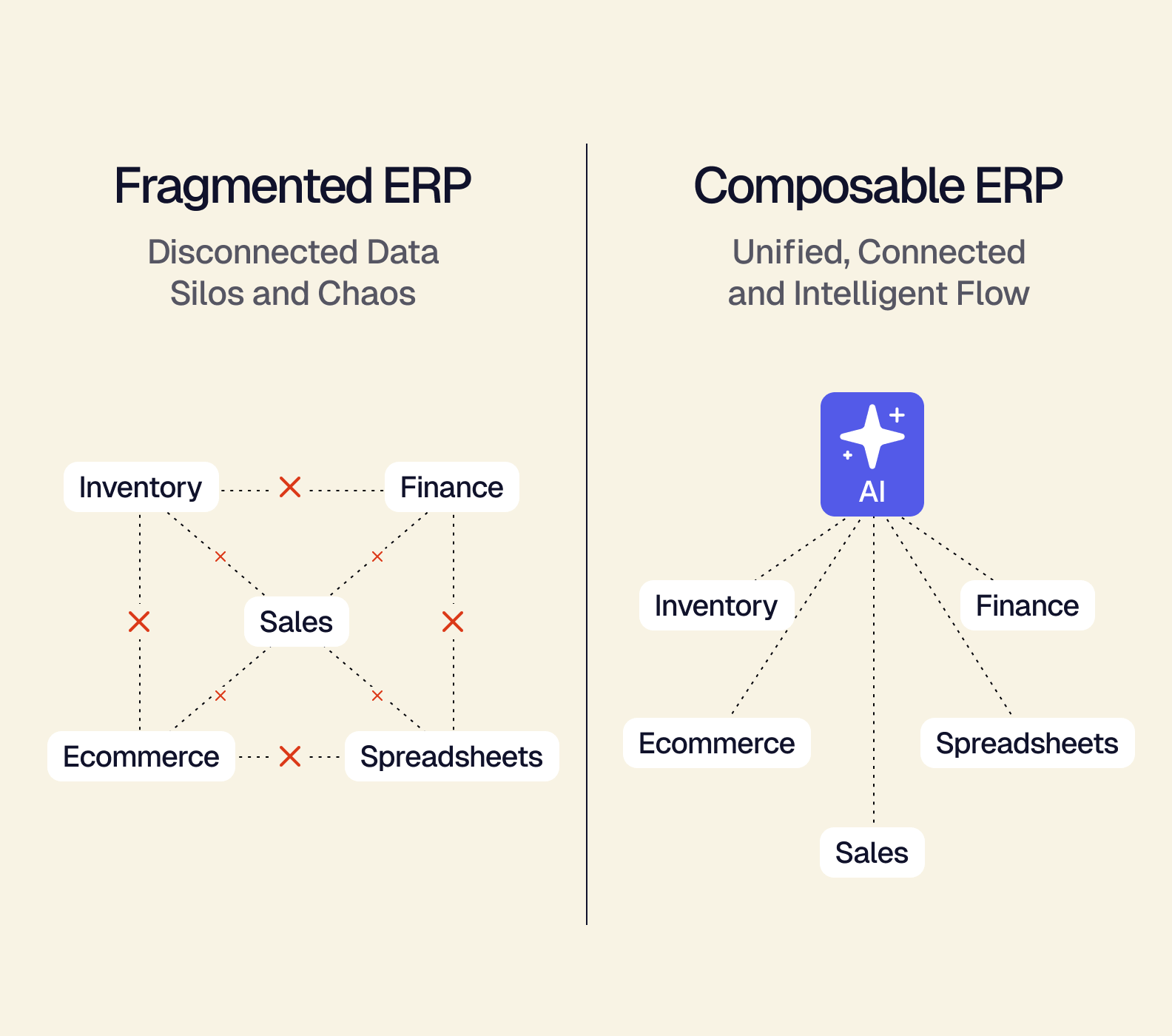
AI developments are moving fast — faster than ERP upgrades. Locking into a single vendor’s ecosystem can be dangerous. You want swappability instead.
With composable ERP, the unified backend and API-first architecture make it simple to swap in whatever tool is best next year. You can replace your AI forecasting tool or try a new warehouse system without the need for a full migration. (Contrast this scenario with traditional ERP, where one change often calls for an entire rip-and-replace.)
Composable architecture future-proofs your business by giving you the ability to adapt. It protects your company by lowering the cost of change.
How Tailor puts composable ERP architecture into practice
Once your composable ERP architecture is up and running, you’re primed to gain an AI investment that actually delivers long-term.
What does that composable architecture actually look like in practice? Here’s a high-level overview of how it all works:
- Connect your existing tools. QuickBooks, ShipStation, Shopify — whatever tools you use right now, Tailor connects them into one unified backend, allowing AI to see everything it needs.
- Layer in AI. With monolithic ERP, AI is usually bolted on, creating limits. For a fully AI-enabled system, opt for composable architecture where AI is layered directly into the backend.
- Swap in the latest tools. Add or replace AI-powered tools (demand forecasting, pricing optimization, predictive inventory) as they come out without disrupting the rest of your stack.
- Accelerate implementation with Omakase. Composable architecture doesn’t require a lengthy, expensive implementation. When your composable, AI-ready backend is in place, Tailor Omakase can be ready to go as your pre-configured frontend in just weeks. It’s all operational right away.
How to evaluate your AI readiness
Remember, AI readiness isn’t a feature you can just “turn on.” It’s how your stack is built.
You can determine whether you’re prepared for AI by asking yourself:
- Do inventory, finance, and fulfillment systems ever report conflicting numbers?
- Is ecommerce data synced in real time with your ERP?
- Can you calculate true margin by SKU across all channels without exporting to spreadsheets?
- How often does your team reconcile data manually?
- Can AI-driven forecasts automatically trigger purchasing or allocation changes?
- Are cross-system updates event-driven, or dependent on batch syncs?
- How many workflows require manual handoffs between teams?
- Does adding a new tool require custom integration work each time?
- Do teams rely on multiple dashboards to complete one process?
- Are AI insights surfaced where teams already work?
- Can you evolve your frontend experience without restructuring your backend?
Composable ERP architecture addresses these gaps — unified data, connected workflows, and a flexible interface — at the structural level. This time, the AI investment you made actually delivers because it can finally see across all your systems. And even better, you can continuously add new AI capabilities as they emerge without ripping everything down for another rebuild.
To learn more about the difference between monolithic and composable ERP, read our helpful guide. Or book a demo to see Tailor’s composable ERP architecture in action.
Tailor Demo