You’ve connected your ERP to Shopify, your 3PL, and your wholesale EDI. Everything is working correctly. But six months later, you find yourself back in the same spot where you started, with someone manually reconciling spreadsheets again.
These ERP integration challenges aren’t just bad luck — they’re a predictable pattern. They indicate something structural.
Your integration challenges keep recurring because most ERPs aren’t addressing the problems you have on an infrastructural level. Until that changes, every fix you attempt will be temporary.
This guide explains why these problems happen, what changes when you get the architecture right, and how a headless, composable operations layer gives you a permanent fix — without replacing the tools that are already working.
What You’ll Learn
-
The real reason ERP integrations keep breaking
-
What gets easier when your ERP data is the real source of truth
-
How headless, composable ERP architecture puts you upstream for good
-
How Tailor solves ERP integration challenges
The Real Reason ERP Integrations Keep Breaking
What do you do when an ERP integration breaks?
If you’re like many companies, you probably try to fix the connection by introducing better middleware or cleaner data mapping.
But these solutions only work if the connector itself is actually the issue. If the same problems reappear six months later, your real problem is architectural — and the fixes you tried were just bandages.
Your ERP should be the system everything else reports to. But when it’s downstream from your other systems, it becomes one of several systems trying to stay current with each other. That’s where your problems begin.
-
When inventory truth lives in Shopify, your ERP is always working from a copy. Copies quickly fall out of date, and the ERP is forced to reconcile afterward instead of orchestrating in real-time.
-
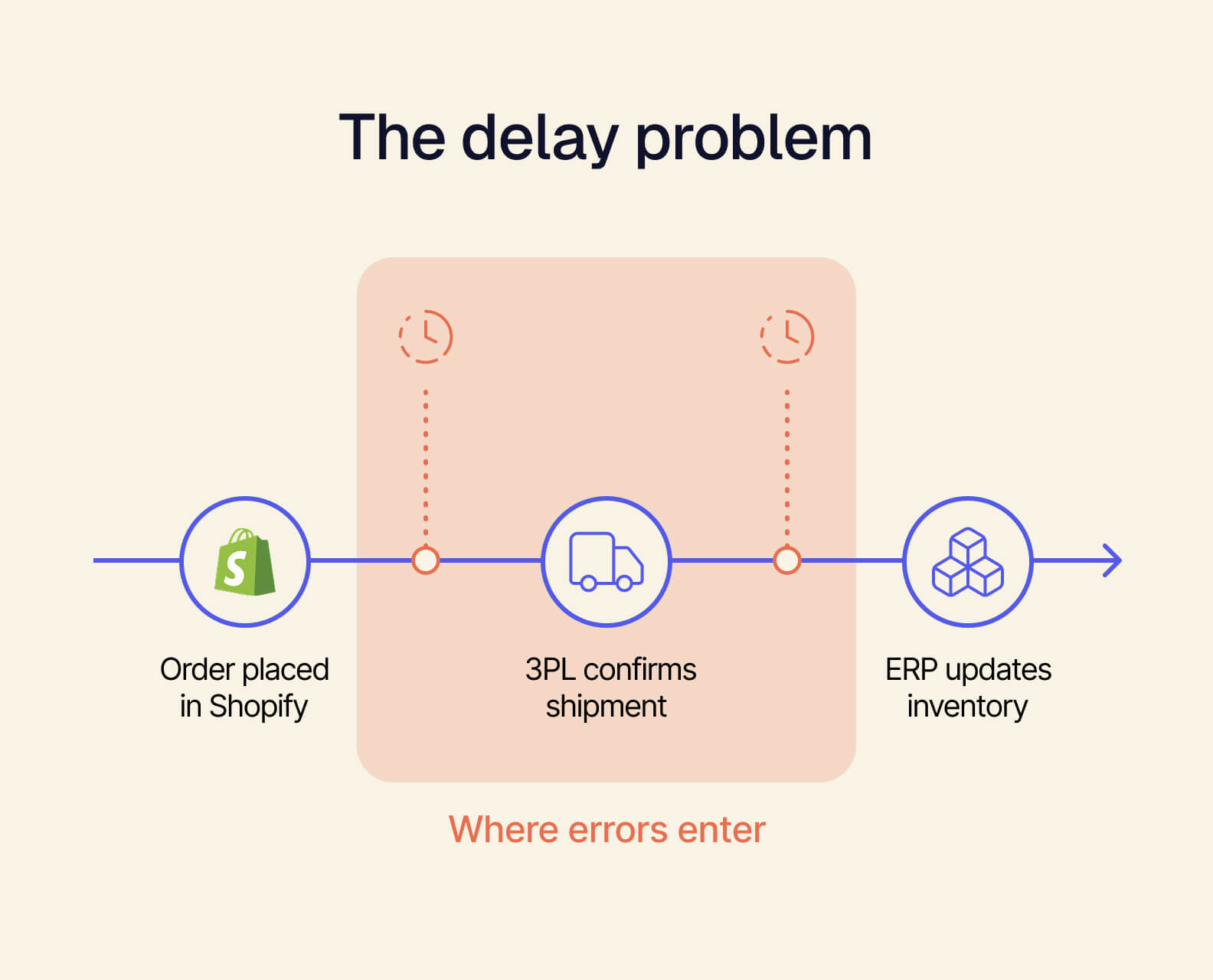
When orders are confirmed at the 3PL before the ERP knows about them, any rule you want to apply (channel allocation, payment gating, B2B credit terms) has to be bolted on after the event instead of built into the flow.
-
When each system keeps its own version of the record, a sync delay in any one of them creates a discrepancy that someone has to manually fix. That’s where spreadsheets come in. You’re working with an architecture that creates reconciliation work as a side effect.
If ERP integration challenges are a structural problem, it only makes sense that they have a structural solution.
To fix them, you need to change which system owns the record.
The ERP Architecture Problem Most Teams Don’t Know They Have
There are two ways an ERP can sit in your stack: as the system everything else reports to, or as one of several systems trying to stay in sync with each other.
The first model is proactive. Orders, inventory movements, receipts, and invoices are captured upstream and distributed to the correct systems.
The second is reactive: the ERP has to wait on other systems to tell it what happened.
Most recurring ERP integration challenges are problems with the second model. The integration itself isn’t broken. But the ERP wasn’t designed to lead.
-
A reactive architecture creates a version-control problem. You have five systems each holding a slightly different version of the truth, with integrations plugging away to reconcile them. Adding more channels and tools only amplifies the problem.
-
A proactive architecture captures events at the source — before they’re confirmed in the storefront, or touch the 3PL. Every downstream system receives a reliable sync.
-
Moving from reactive to proactive doesn’t mean replacing your entire stack. You can still use Shopify as your storefront and let your current accounting tool close the books. The difference is which system captures the event first and owns the record. And the bigger difference is that, as a result, your integration challenges stop coming back.
This is how modern, headless retail ops infrastructure is designed to work. The operations layer sits upstream, and every connected system gets a clean, reliable sync from a single source.
What Gets Easier When Your ERP Data Is the Real Source of Truth
The ERP integration challenges you’ve been facing (like manual work or missed syncs) are completely preventable. **When you change your architecture, your operations change, too.
**
With the operations layer sitting upstream, a whole list of problems no longer requires human intervention. You’ve addressed the source, not just the symptom.
Here’s what changes as a result:
Do you notice any patterns across the rows? When one system owns the truth and everything else syncs from it, the work shifts from finding and fixing discrepancies to actually running the business.
When you get the architecture right, you gain not only cleaner data — you also get back valuable employee time that was previously being sunk into workarounds.
Why ERP Data Synchronization Problems Are Really Ownership Problems
When a return gets processed in Shopify, but the ERP doesn’t reflect it for another two hours, that’s not a sync speed problem. It’s an ownership problem. No one system was clearly responsible for that record — so nothing updated first.
Adding more integrations doesn’t fix this. Then you just have another system that has to navigate the same answer.
Instead, decide which system captures the event first. With a clear answer — one upstream system — the problem is solved.
How Headless, Composable ERP Architecture Puts You Upstream For Good
Repositioning your ERP as the upstream source of truth doesn’t mean replacing every tool you already rely on. It means changing the architecture to a headless, composable model. This type of architecture is designed to orchestrate your existing stack, not compete with it.
Here’s what the terms “headless” and “composable” mean in practice and how they can help with your ERP integration problems:
-
Headless means the ERP functions using an API. You aren’t forced to work through a locked UI. Shopify, your 3PL, your accounting tool, and your warehouse app all plug in cleanly. You can work in whatever way makes sense for your team.
-
Composable means the system is built from independent modules (manufacturing, inventory, purchasing, accounting, sales). They can be deployed separately, without disturbing each other’s workflows, as you put together the capabilities you need.
Together, these two properties make it possible to sit upstream without disrupting the entire stack.
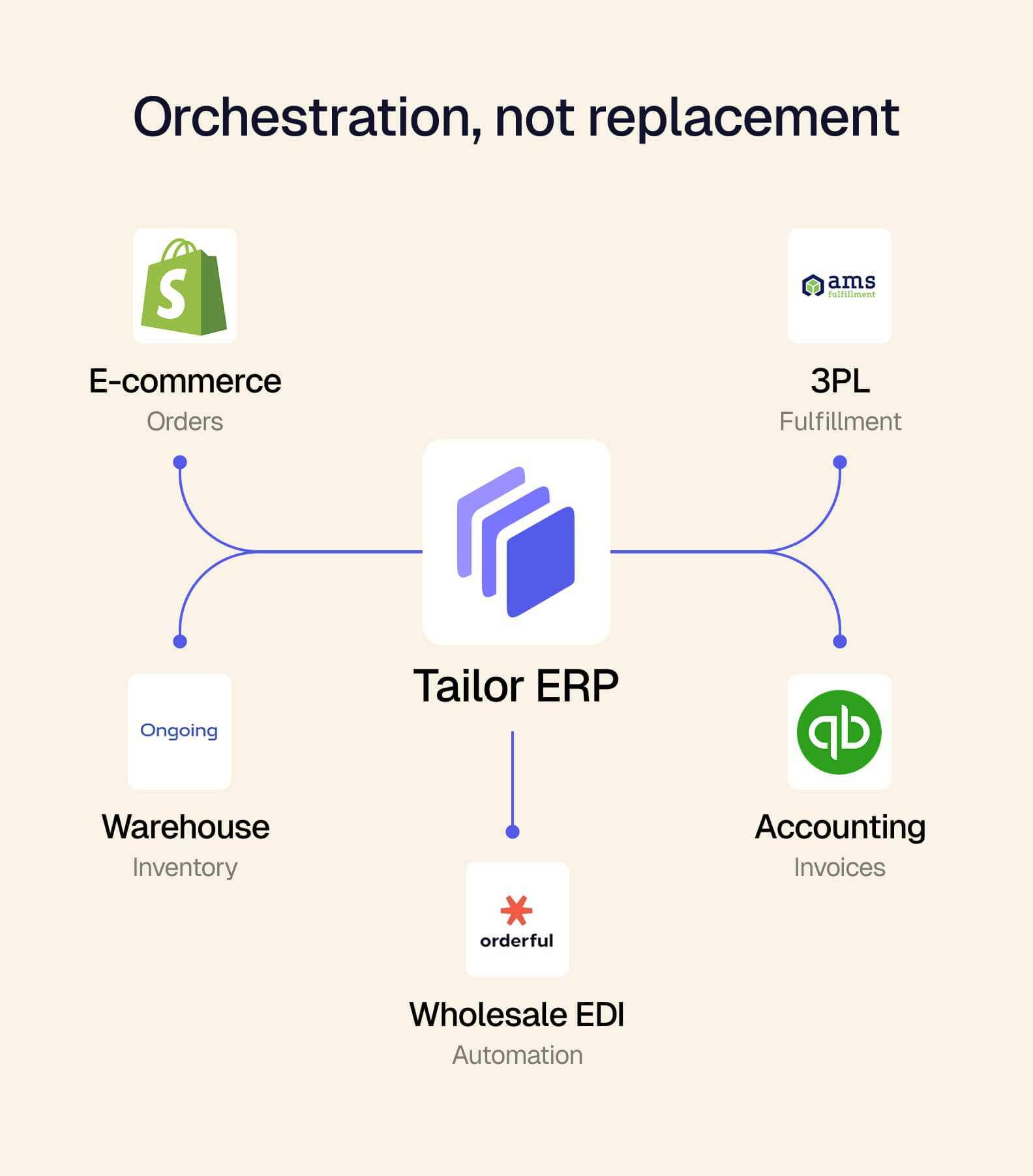
This is the architecture Tailor is built around. Tailor sits upstream as the operations layer. It connects to the tools you already use, owns the record, and syncs outward.
What Best-in-Breed ERP Integration Actually Looks Like
With the composable model, you aren’t replacing your existing tools. Instead, you’re letting the ERP orchestrate them.
-
Tools that already work stay in place. The operations layer connects to all of them through real APIs — not workarounds that are going to break every time you take your eye off them.
-
Connections are stable and bidirectional. Often, integration challenges stem from one-way syncs that malfunction when data flows back the other direction. But with a composable architecture and API-based integrations, data easily flows both ways.
-
Add something new without rebuilding everything. When you introduce a new channel, warehouse, or system, it plugs into the same operations layer. You don’t need to do any custom integration work.
With Tailor, Shopify still runs your storefront, your 3PL still handles fulfillment, and your accounting platform still closes the books. Every connection is a real API integration, not a workaround. Tailor makes sure they talk to each other.
Phased ERP Implementation vs. Big-Bang Migration
One of the biggest reasons teams stay stuck on broken architecture is because fixing it seems like such a massive undertaking.
Luckily, composable architecture instantly relieves those fears.
Because the modules are independent, you don’t have to migrate everything right now. Start with the capability that’s causing the most issues and build from there.
Each phase delivers real operational value before the next one begins. So instead of taking a leap of faith, you’re watching the project pay for itself as it goes.
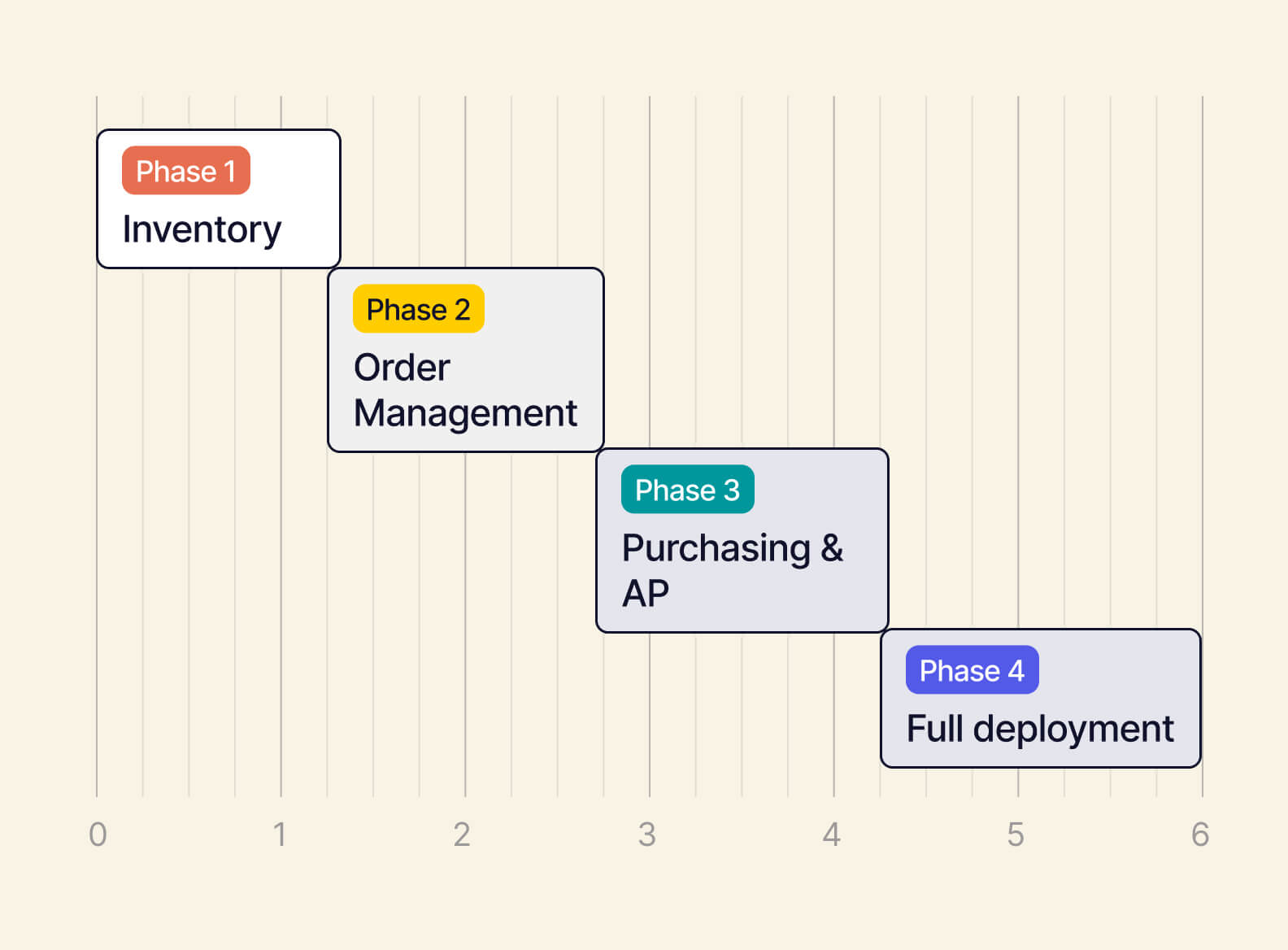
A phased ERP implementation typically looks like this:
-
Start where the pain is most acute. Teams often begin with areas where bad data is immediately expensive, like inventory or purchasing.
-
Build each phase on a stable foundation. The modules are designed to work together without depending on each other — so adding a new capability doesn’t disturb what’s already running.
-
Expect 3-6 months total as a realistic timeline. Phased go-lives happen in six-weeks increments.
-
Feel peace of mind from making lower-stakes decisions. You’re not betting the business. You’re making several smaller moves that add up over time.
Tailor is designed to grow the way your business grows — one capability at a time, with no pushback when you’re ready to expand. Start with the module that solves your most expensive problem today. The rest will be there when you need them.
How Tailor Solves ERP Integration Challenges
ERP integration challenges can be solved. And you don’t have to start over from scratch to get there. The reason they keep coming back isn’t bad luck. It’s an architecture that wasn’t designed to lead. If you fix that, the cycle stops.
Move your operations layer to the right place by introducing a headless, composable ERP. Keep working with the best-in-breed tools you’ve already invested in — but give them a clean source of truth to sync with.
Book a demo to see how Tailor can help solve your specific integration challenges by getting the architecture right.