Predictive replenishment is a powerful tool for retail businesses looking to scale into new markets, take ownership of their current niche, and prepare their operations for agentic commerce innovations.
But what’s the big difference between predictive replenishment and focusing on manual or simple trigger-based replenishment workflows? The short answer is reactivity vs. proactivity. For the longer answer (and more thorough understanding), this blog will give you insight into:
-
What a good predictive replenishment integration looks like
-
How this system helps you win new markets
-
Why headless ERP is important for predictive replenishment integrations
-
The advantages you gain from combining headless ERP and predictive replenishment workflows
The Impact of Good Predictive Replenishment Integration
For some, predictive replenishment could underpin the inventory management for a self-healing supply chain, or it could become the core of a strong closed-loop demand planning system.
These cutting-edge autonomous operations strategies are fueled by machine learning and AI agents, which your business can be prepared to make the most of with proper agentic commerce innovations — predictive replenishment integration being one path you can take.
Accurate Forecasting Creates Opportunities for Higher Revenue
One of the most frequent points of frustration that growing retail brands face is high-friction inventory management — often caused by poor forecasting and overstock eating up operating budgets. While these may seem like easy problems to solve, they endlessly plague retailers of all sizes. What’s the cause, and if you’re dealing with the same problems, how can you overcome them?
The Problem
Poor forecasting is a two-part issue. Many businesses lack the modern tools required to get accurate forecasts, and often rely on outdated methods, such as making projections through data found in a spreadsheet or using old algorithms to calculate demand.
This ties directly into the second part of the problem, which lies with bad, incomplete, or low-context data. Forecasts made in a vacuum with bad data lead to forecasting that may end up being useless in this rapidly changing global commerce environment.
The Predictive Replenishment Difference
The big difference maker here is predictive replenishment’s ability to make forecasts with maximum context. By providing this AI-powered system with historical, seasonal, and present sales data, and contextualizing those results with external factors (marketing conditions, weather, or other events that may impact your business), you’ll be able to reduce how much of your operating budget is tied up in dead stock or slow-moving products.
Because this system will keep your inventory leaner and more predictable, you’ll be able to free up more revenue for exploring new SKUs or pursuing opportunities in new markets.
Predictable Inventory Increases Agility in Chaotic Markets
Another common frustration we regularly see afflicting retail businesses is slow reactions to market chaos. Imagine if the Titanic managed to spot the iceberg in time but still couldn’t steer out of the way because of a series of miscommunications between the crew members — this is what often happens for retail businesses, but at the systems level.
Your agility during market chaos is directly impacted by whether or not your systems can handle change — something that predictive replenishment can help you with. Market chaos cannot always be predicted, and it cannot be prevented; however a good predictive replenishment system can pick up the leading indicators, increasing the odds that you can adjust course before disaster is imminent.
Unfortunately, you’re likely to end up just like the Titanic if your system is inflexible. This is where headless, composable ERP comes into focus. What is it, and what does it do for your agility?
-
A headless, composable ERP is an ERP integration that features a decoupled front-end design and back-end system. This means that your UI and UX can be customized to your needs and your back-end system can be scaled to properly fit your business, while making use of the tools you want to keep using. It can then use API integrations and building-block integrations (called modules) to add new features with low complexity.
-
How a headless ERP supports your agility. The big advantage of a headless ERP is how it brings your system together and gives your tools the ability to talk to each other. When paired with an AI-powered predictive replenishment system, it’ll be able to instantly access accurate information from across your business — directly improving the quality of its forecasting output.
With a headless ERP system in place, you remove communications barriers that might be present in your system, giving you the ability to spot chaos (the iceberg) and rally your teams to pivot in time (steering the Titanic).
How Predictive Replenishment Helps You Find and Win New Markets
When you can operate with higher revenue and more predictable inventory, your business is able to take advantage of new opportunities without being disrupted by roadblocks. While your competitors are struggling to navigate, you can be in a position to dive into new markets.
Let’s compare the process of finding opportunities, overcoming blockers, and unlocking wins both with and without predictive replenishment.
3 Ways Headless ERP Supports Your Predictive Replenishment Workflows
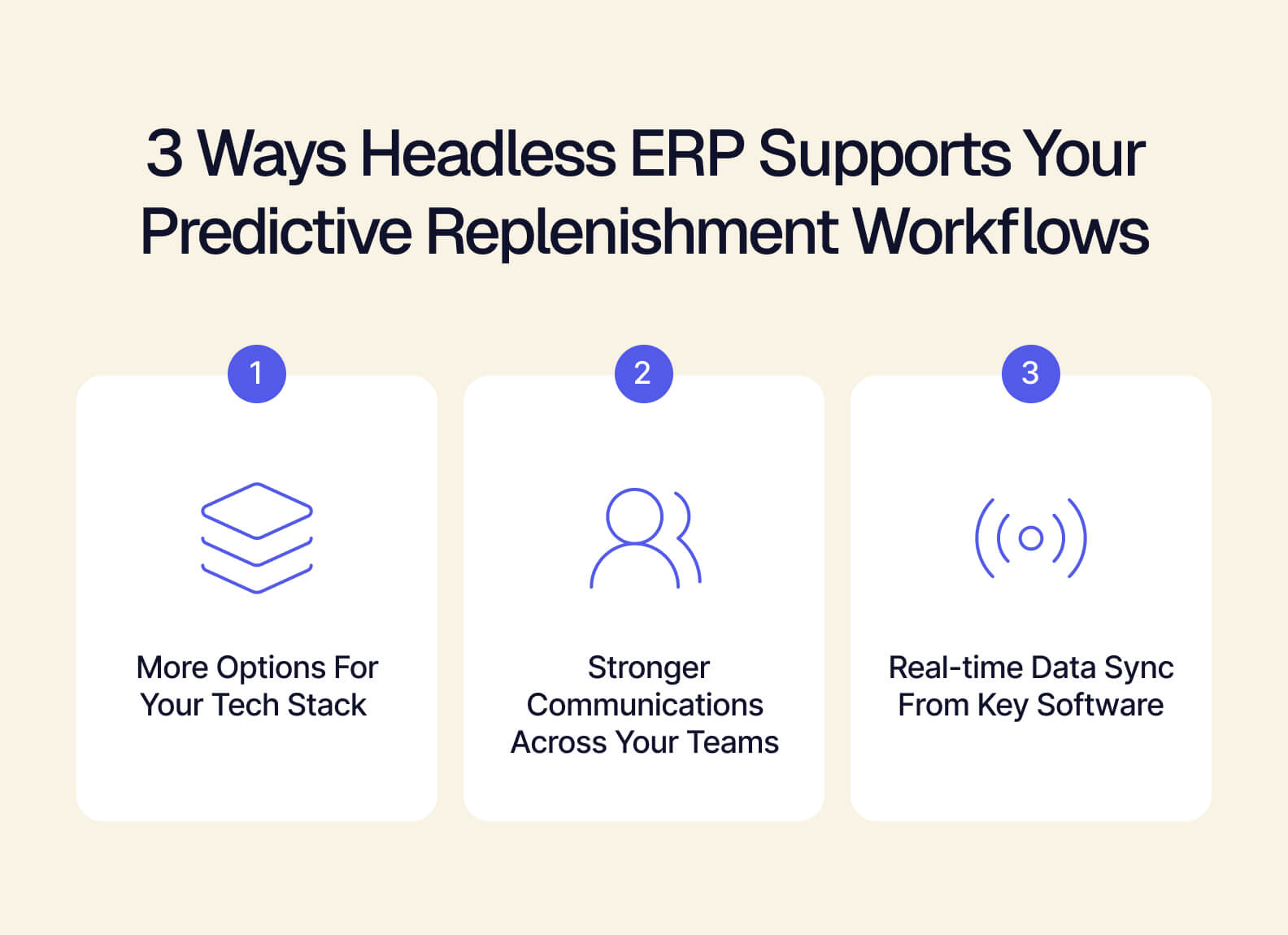
It’s important to consider what predictive replenishment needs to help you not only score your first few wins, but continue winning well into the future. The quality of your predictive replenishment is dictated by the quality of the data the system works with. Let’s look at a few ways headless ERP can make the most of your predictive replenishment workflows:
-
More options for your tech stack. A headless ERP allows you to connect to API-enabled software solutions, enabling fast and seamless integration experiences. This means you can add necessary features without having to worry about their compatibility with other parts of your tech stack.
-
Stronger communication across teams. Because a headless ERP like Tailor acts as a single source of truth for your business, teams are no longer working off conflicting data or getting confused by maze-like spreadsheets. Instead, they’re looking at the same numbers, on the same screen — making problem-solving and collaboration easy.
-
Real-time data sync from key software. A headless ERP can also offer your business the ability to cut out daily reports and remove late-reporting by using APIs to directly plug into your POS and inventory systems — constantly pulling all the data you need into one place to boost the clarity and speed of decision-making.
This results in a predictive replenishment system that’s operating with the best information and delivering forecasts to a more focused Ops team.
The Advantages of Bringing Headless ERP and Predictive Replenishment Together
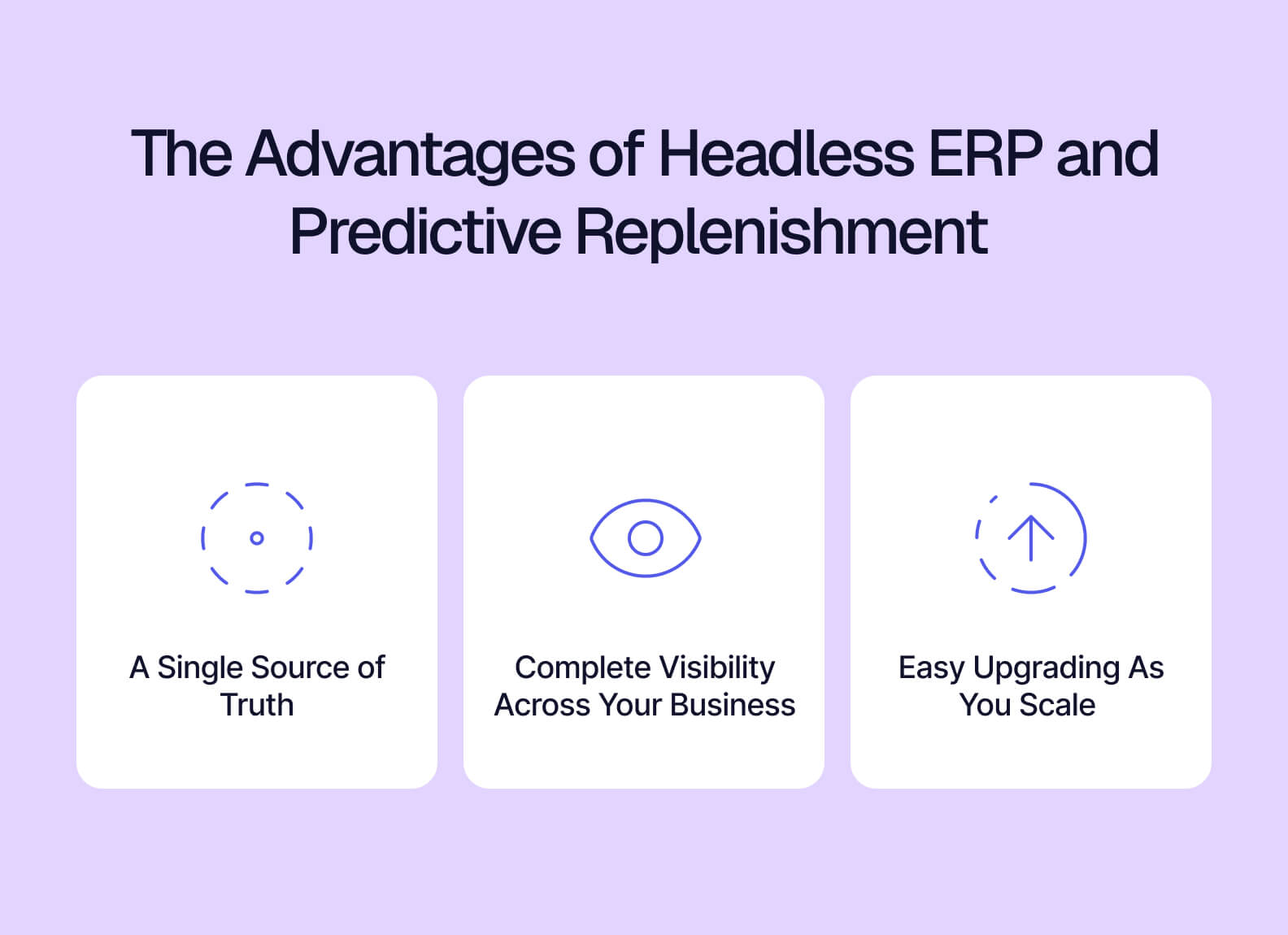
Advantage #1. A Single Source of Truth to Guide Your Strategies
Having a single source of truth for your business is more than just a way to bolster your communications and collaboration across teams. Having a headless ERP like Tailor at the center of your business means that you can connect every part of your business, trust the data you’re working with, and catch problems before they spiral out of control:
-
You can see how your inventory moves in real time, and compare your forecasting to ensure it matches what you’re seeing — allowing for quick iteration based on what’s working and what isn’t.
-
Predictive replenishment helps you anticipate market chaos early, giving you the opportunity to make moves before your competitors with more information than they may have when making critical decisions.
Advantage #2. Complete Visibility Across Your Business Eliminates Data Silos
Because a headless ERP brings all the most important information into a single UI, you don’t have to navigate through multiple different programs just to figure out what’s happening in your warehouse. Instead, the information is right in front of you at all times.
By cutting down the need for manual reporting from teams and no longer needing to pull data from spreadsheets, you won’t have to worry about problems going unnoticed or rapidly spreading without proper communications.
Advantage #3. Headless Architecture Allows Easy Upgrading As You Scale
Scaling with rigid ERPs and patched-together tech stacks can create a logistical nightmare and break the software that keeps your daily operations in motion. These types of systems will cost a lot to upkeep (both in time and finances), and are likely to limit the options you have while you scale. Rather than building your business on a failing foundation, you can use headless architecture to scale with ease — which enables your AI-powered predictive replenishment system to keep calling shots and drive you forward.
Bring Your Business Into the Future with Predictive Replenishment
With the future of commerce being transformed by agentic AI workflows and AI-powered automation, integrating predictive replenishment into your retail business seems like a great way to test if your business is ready for agentic commerce and rapid scaling.
If you’re ready to meet the future head-on, but aren’t sure what you need to do to prepare your business for integrating AI-powered tools, Tailor’s team of AI-integration experts can help.
Schedule a call with us to learn how AI-native, headless ERP integrations and composable modules can help position your operation for embracing agentic commerce and predictive replenishment workflows.