During your early days as a retailer, your ecommerce inventory tracking was simple: fewer SKUs, 1 or 2 storefronts to manage, and simple workflows to match. Inventory problems used to be addressed in an afternoon after a quick manual recount. But, as you’ve scaled your business, it’s likely that your inventory tracking have grown exponentially more complicated.
Now, your old methods don’t quite work like they used to, and you’re getting bogged down by inventory emergencies, incorrect data, and slow reconciliation cycles. There’s a better way to handle your ecommerce inventory tracking, and it starts with your tech stack.
What you’ll learn:
-
The three ways your inventory tracking is going wrong
-
Why your system isn’t set up to support accurate inventory tracking
-
What headless, composable ERP can do to make your ecommerce inventory tracking scalable
3 Reasons Your Inventory Tracking Isn’t Quite Working For Your Retail Brand
On a good week, your inventory numbers check out, and all systems are green — but there’s a catch. These “good” weeks are actually when your traffic is low or within expectations.
Your actual “big picture” good weeks — when you’re managing rushes, huge orders, and exceeding sales projections — are fraught with emergency recounts, unexpected out-of-stock notices, and overselling inventory. As a scaling retailer, this state of affairs is unsustainable and prevents you from operating at peak efficiency.
While these conditions are problematic, they don’t have to become the status quo. Before we identify some solutions, let’s explore the three main reasons your inventory tracking isn’t working for your business.
System Visibility Is Siloed
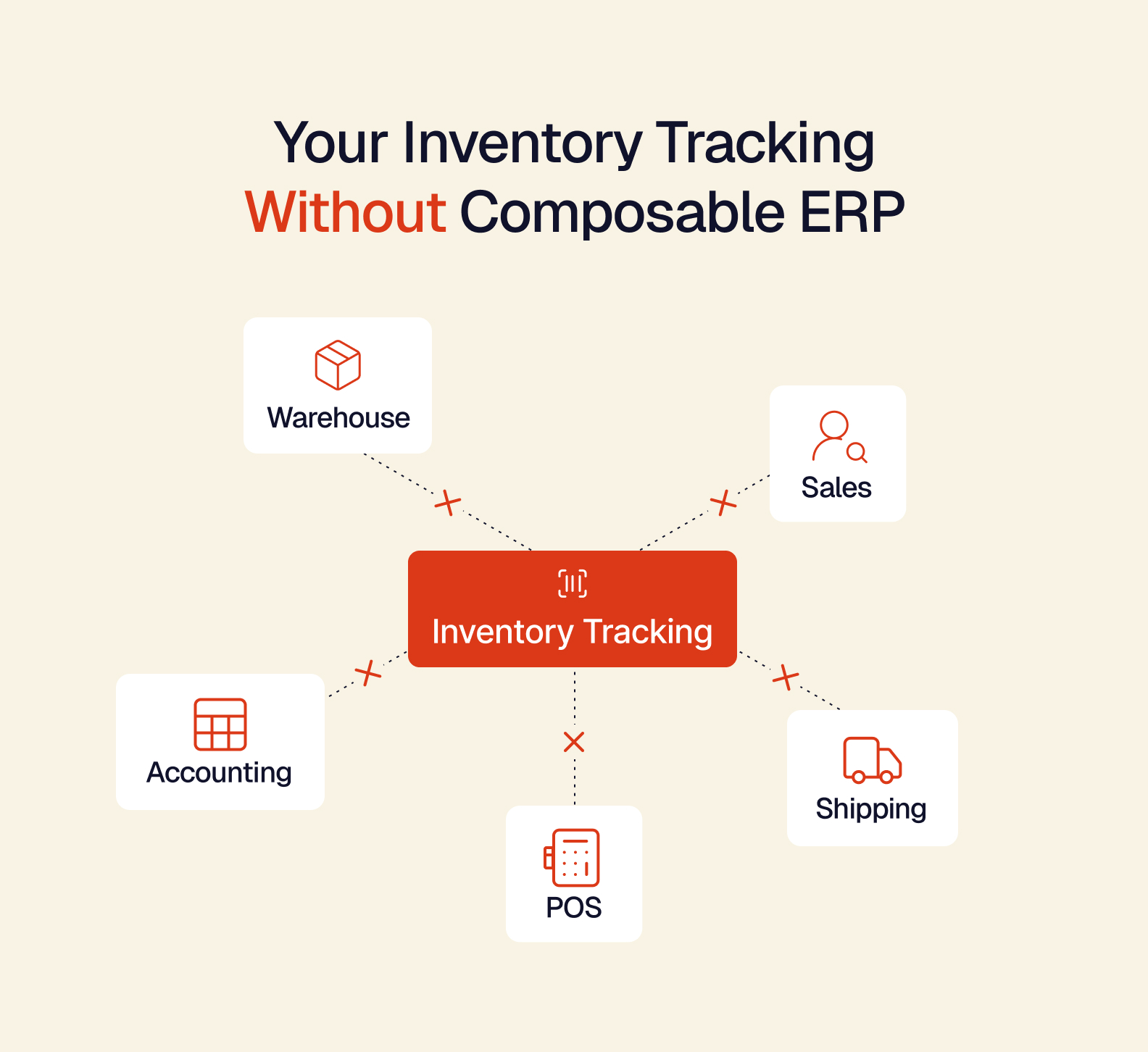
The first reason that your ecommerce inventory tracking might not be working for you is a problem that plagues many growing retail brands: system visibility. In the same way you might struggle to read a road sign in the early hours of a foggy morning, your inventory tracking software struggles to pull accurate data from other parts of your business. When your system visibility is low, it’s because the rest of your tech stack is siloed (or blocked off).
Because your stack is blocked off, each part of your business is isolated, with each part operating in its own bubble. This breaks system cohesion and results in your tech stack having several points of fractured authority — or different batches of data claiming to have the truth about your inventory (without knowing what other parts of the system have).
In order to fix this problem, you need to remove silos from your business and establish a single source of truth.
Data Isn’t Flowing Properly
A knock-on effect of having a siloed tech stack is that none of the data in your business flows as efficiently as it should. Ideally, a growing retailer would have a system where data is automatically reconciled by a single source of truth and automatically moved where it needs to go.
Instead, retailers often end up with stagnant data that’s prone to errors caused by lagging reports and manually reconciling data in spreadsheets. Having to move data between parts of your tech stack with spreadsheets as a translation layer often results in a few major ecommerce inventory tracking issues:
-
Transposed inventory numbers. This leads to discrepancies between actual inventory in the warehouse and what’s on the books.
-
Lost data. When multiple people are working in one spreadsheet, the incident rate for accidentally deleted data goes up — creating opportunities for inventory tracking oversights.
-
Slow system-wide reconciliation. Spreadsheets, while an invaluable and powerful tool, just aren’t meant to do system-wide inventory management. Because data needs to be copied to multiple software, reconciliation delays build up across your system.
Operations Stalled by Disconnected Tools
The final reason your ecommerce inventory tracking isn’t quite working for your business is that your tech stack and necessary tools aren’t fully connected to each other. They may have limited connections between a handful of tools, but they’re cut off from the rest of your tech stack.
This results in having to create workarounds (which are often inefficient and prone to breaking), pay for expensive, custom translation layers, or, once again, rely on spreadsheets to fill the gaps across your business. When any of these temporary solutions break, it causes your day-to-day operations to stall — creating headaches for your Ops team.
How Composable ERPs Wrangle Back Control of Your Inventory Management
The problems that arise from low-performance inventory tracking solutions can spiral out of control quickly. Technical debt, crippling inventory issues, and organizational dysfunction can become a difficult wall to scale if left unchecked for too long. This is where a powerful, composable ERP integration like Tailor can help you wrangle control of your inventory tracking — while supporting the rest of your business.
The benefits of a composable ERP for your ecommerce inventory tracking directly solve the problems explored earlier:
-
Proper data flow aided by architectural improvements
-
A fully connected tech stack supported by a single source of truth
-
System flexibility provided by the removal of silos that blocked visibility
Tailor accomplishes this through headless, composable design. Because it’s headless, you can adjust the backend system without impacting the frontend of the system (also referred to as a decoupled front and backend). This goes hand-in-hand with it being composable, because you can add new features or adjust existing functionality modularly — like building blocks.
This results in a highly flexible, lightweight, and powerful system that brings your entire business together.
Better System Architecture Improves Data Flow
Tailor’s headless, composable ERP supports data delivery across your business by providing a series of architectural improvements:
-
Real-time sync. By connecting every part of your business (including cloud and API-based tools), you’re able to keep data flowing across your business — without having to wait for reports or manually reconcile inventory numbers.
-
Simplified workflows. When every part of your business is connected, and you no longer need to rely on workarounds to get things done, you can reduce your workflows down to their necessary steps — leading to faster task completion, quicker turnaround for your teams, and straightforward troubleshooting when things go wrong.
End-to-End System Connections Boost Inventory Tracking
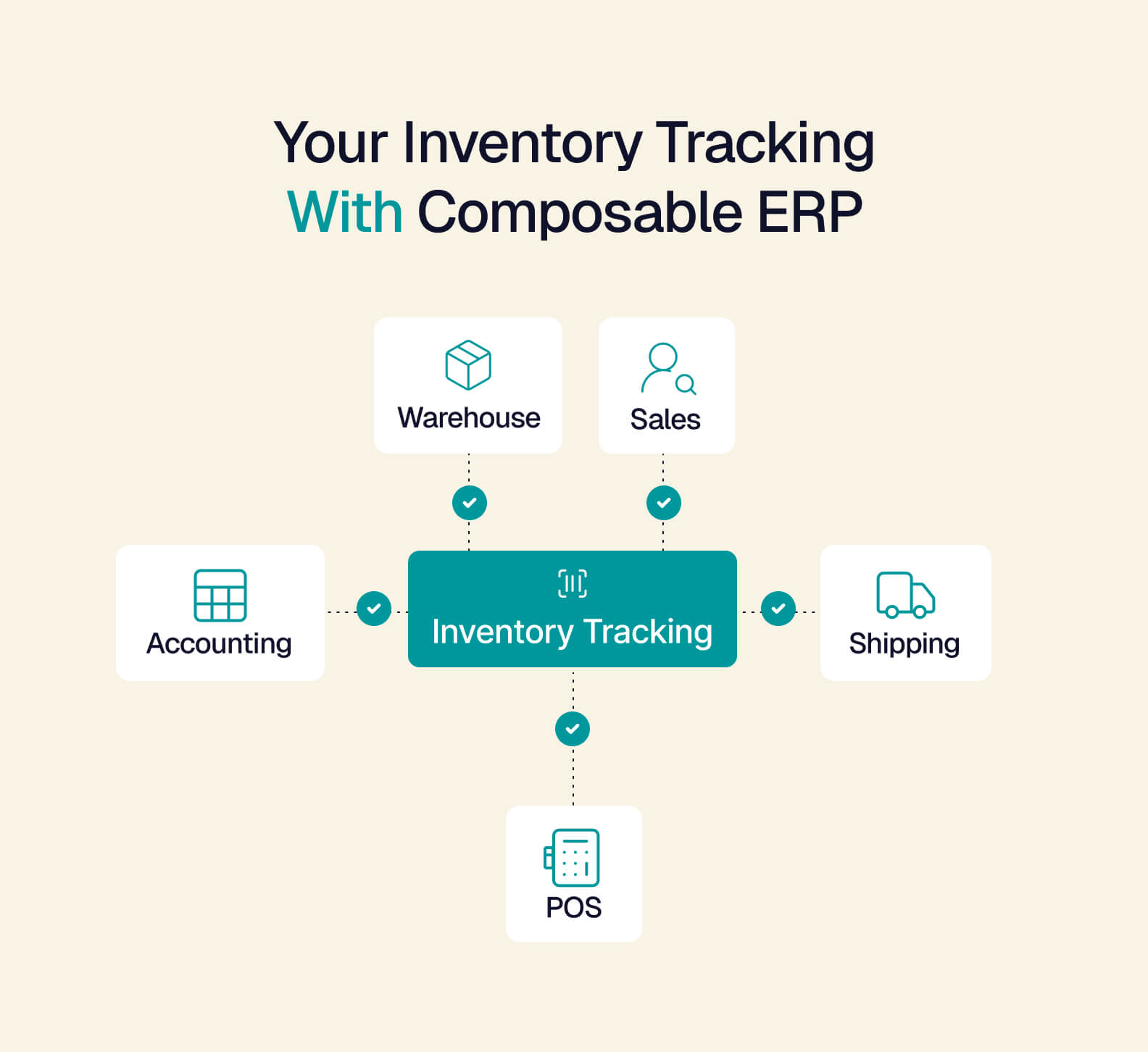
The biggest impact that Tailor can have on your ecommerce inventory tracking is that it connects your entire tech stack end-to-end. In a system without a headless, composable ERP, visibility is low, and data flows slowly — requiring constant intervention to get it from point A to point B. However, with a composable system, visibility is at its highest; no silos in sight.
Here’s what this looks like in practice:
-
Tailor provides a single source of truth that dispels confusion with your ecommerce inventory tracking.
-
Apps, software, and cloud tools you use every day have a centralized way to interface with each other, ensuring data gets where it needs to in real time.
-
A connected system means that you can retire translation layers and spreadsheets that were causing problems in the first place.
How Tailor’s Flexible System Helps You Scale
At its core, Tailor is designed to help retail brands scale — fast. Whether you need an out-of-the-box UI with prebuilt modules that are ready for integration in weeks, or a flexible system that can be easily transformed by your technical team, Tailor’s system can meet your business where it’s at now, and grow with it for years to come.
It’s not just the fast integration and modular design that make fast scaling possible. Our headless, composable ERP helps your retail brand scale by:
-
Letting you set your pace. Each software you integrate influences how you operate. Some feature rigid UI and workflows that are hard to deal with, slowly contorting your business to fit the way these tools were designed to operate (often for the worse). With a headless, composable system, you can make your tools work for you. This means you can set your pace and scale at the rate you want.
-
Keeping your options open. Older, rigid software — like some legacy ERP solutions — force you to grow in certain ways, regardless of whether it’s the right call for your business. However, when your business is built on a composable foundation, you can keep your operations flexible. This enables you to grow exactly how you want and easily branch into new markets when you’re ready.
-
Providing a shield against market chaos. When you don’t have the right tools in your business, you can get stuck in reactivity loops caused by market chaos (or unexpected events that threaten the way you’ve been operating). Something breaks, and you’re spending all your time fixing it. With composability at the heart of your system, you can take the chaos in stride without getting derailed.
Composability’s Secret Ingredient for Sustainable Business Growth
Along with all the benefits and improvements we discussed, there’s a secret ingredient that makes a headless, composable ERP so powerful for scaling retail brands: API & AI connectivity.
Tailor uses APIs to bring your disconnected tools together and provide a single source of truth. Because you can interface with all your tools in a single screen, you can get the most out of their functionality, without convoluted workflows. By being AI-native, Tailor is able to integrate AI-powered tools and powerful AI workflows into your business without them feeling bolted-on — preparing your business to remain on the cutting edge.
Take Control of Your Ecommerce Inventory Tracking
The good news is: your ecommerce inventory tracking can work better for the way your business operates today and in the future. While it’s unlikely that you’ll go back to the simplicity of your early days of inventory tracking, you can make it far easier (and more accurate) than it has been.
The change starts with embracing composable software. By removing the complexity caused by a disconnected system, with poor data flow and low system visibility, you can speed up your entire business, simplify your day-to-day operations, and make your ecommerce inventory tracking something you don’t need to worry about.
Book a demo with us today to see how our headless, composable ERP, out-of-the-box usable UI, and inventory module can get your retail business scaling faster than ever in just a few weeks.