Choosing the best retail manufacturing software for your business used to be about managing inventory and fulfillment. But today, it’s about managing the work that happens in between. As more brands take on light manufacturing tasks like batching, kitting, or custom assembly, the need for smarter, more flexible tools has never been more urgent.
This guide breaks down what light manufacturing really means in a retail context, what retail manufacturing software best supports it, and which platforms stand out across different product categories.
What Kind of Software Is Best for Light Manufacturing?
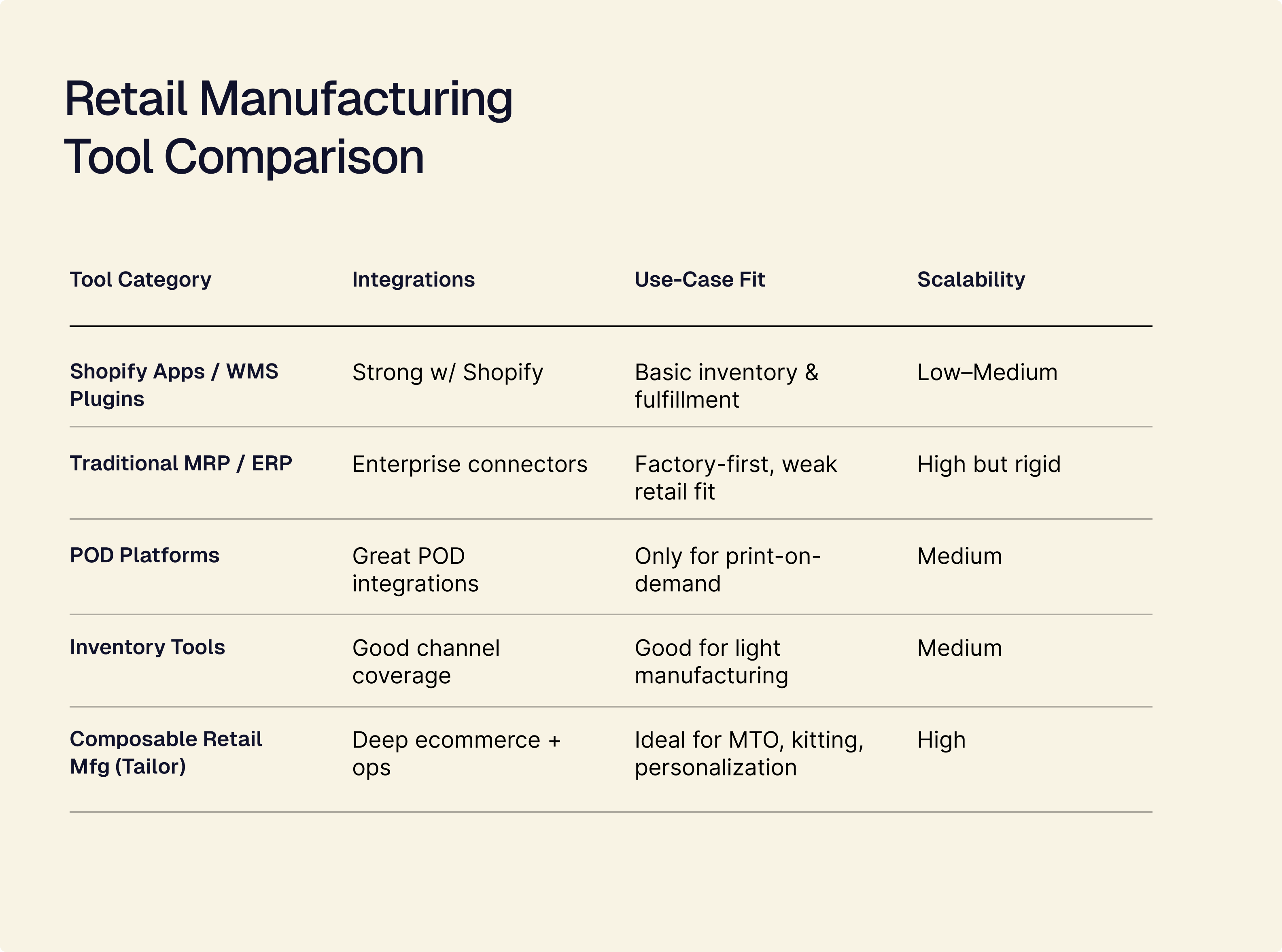
The software you need should be built for a modern retail environment — this means avoiding apps built for heavily scaled factories and Fortune 500 supply chains. Instead, you should be looking for a solution purpose-built to be flexible and stable in the chaotic reality of retail operations.
Here’s what this kind of solution prioritizes:
So what does that look like?
-
Agility: You should be able to tweak your workflows without a developer or a consultant. Need to add a custom step for packaging, QA, or gift-wrapping? Done.
-
End-to-end visibility: Inventory, orders, and production should live under one roof. You shouldn’t need five browser tabs open just to ship a kit.
-
API-first architecture: Your software should talk to Shopify, QuickBooks, ShipStation, and whatever else you rely on. No manual re-entry or duplicate records.
-
Scalability without rigidity: As your SKU count grows and your workflows evolve, your system should evolve too. You shouldn’t need a reimplementation just to add a new fulfillment rule.
The best light manufacturing systems meet you where you are — and grow alongside you. They’re modular, cloud-native, and built to support retail operations, not replace them.
Composable platforms (like Tailor) shine here. Instead of asking you to fit into a rigid system, they provide building blocks you can assemble however you like. Want to track production runs by batch? Create unique labels for each bundle? Sync inventory in real time across DTC and wholesale? These platforms make it happen without disrupting everything else.
When your business needs change every quarter, your software can’t be stuck in place. That’s why composability isn’t a nice-to-have. It’s a survival trait.
Key Features to Look For in Retail Light Manufacturing Software
Ignore the flashy UI and the “AI-powered automation” jargon. What really matters are the features that make your day-to-day easier, especially when your team is simultaneously juggling raw materials, customer orders, and fulfillment deadlines.
Here’s what to actually look for:
BOM Support (Lite)
You don’t need engineering-level specs, just a clear, flexible way to list what components go into your finished products. Whether it’s a custom bracelet or a skincare kit, the system should automatically deduct raw materials when an item is assembled.
Custom Workflows
Your manufacturing flow probably doesn’t look like anyone else’s. Good software should let you build out a process that matches your products and team, not force you to adopt some rigid, factory-style workflow.
Labeling and Compliance Tools
This is especially important in beauty, food, and health-related verticals. Batch numbers, expiration dates, ingredient listings — your system should help you stay compliant, not create more admin work.
Real-Time Inventory and Material Syncing
This one’s non-negotiable. You need a system that syncs your raw materials and finished goods inventory across locations, channels, and workflows — instantly.
Full Order Visibility
Whether you’re fulfilling DTC orders, wholesale POs, or subscription bundles, your ops team should always know what’s in progress, what’s ready to ship, and what’s blocked.
Plug-and-Play Integrations
It should connect easily with Shopify, QuickBooks, ShipStation, and any other tools in your stack. No Frankenstein builds or double entry.
Throughput Tracking
Even basic throughput metrics (like units completed per shift) can quickly uncover inefficiencies. If the software can show you what’s working and what’s stalling, that’s a win.
Top Light Manufacturing Software Picks by Category
No two retail businesses manufacture exactly the same way. What a skincare startup needs is wildly different from a jewelry maker or a custom apparel brand. That’s why the best retail manufacturing software isn’t one-size-fits-all — it’s purpose-built to meet specific industry challenges. Below, we break down the top tools across four key categories, detailing where each one excels and how it supports real retail workflows. 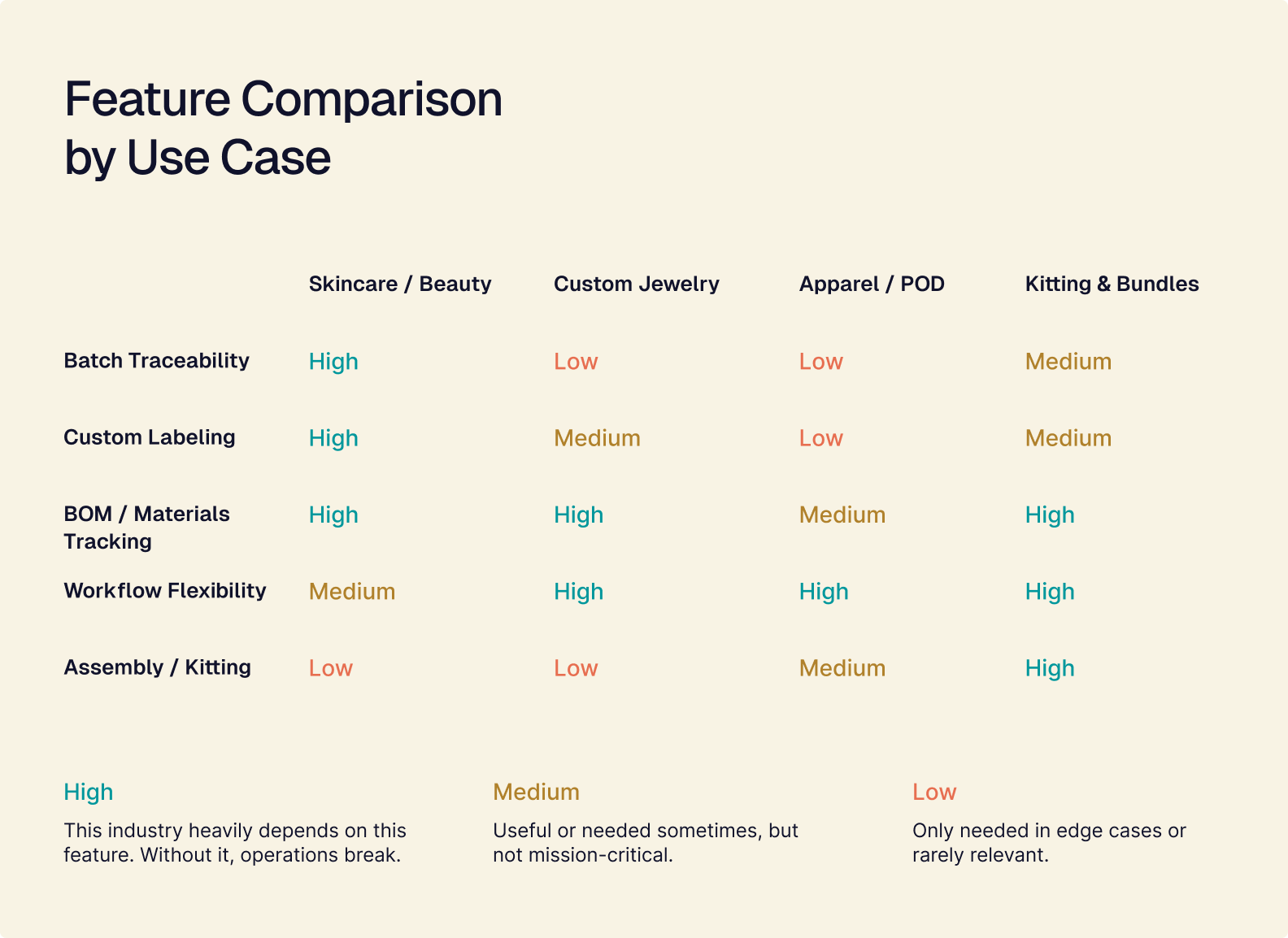
Skincare and Beauty
Skincare and beauty brands operate at the intersection of precision and agility.
These companies often deal with perishable ingredients, complex labeling regulations, and small-batch production. Operators of skincare and beauty brands need tools that offer batch tracking, raw material visibility, and compliance-friendly documentation — all while staying nimble enough to support rapid formulation and packaging changes.
Katana is a popular choice for beauty brands looking to bring more visibility and structure to their manufacturing. With visual production scheduling and intuitive inventory control, it’s well-suited to manage raw ingredients, track batches, and ensure consistent output across micro-runs.
Craftybase is another strong contender, especially for small-batch brands. It combines cost of goods sold (COGS) tracking with compliance reporting, making it easy to manage regulatory labeling, expiration dates, and material usage all in one place. For solo founders or small teams, its maker-focused interface is a huge plus.
Finaloop is a relative newcomer but a helpful tool for smaller ecommerce-native brands. It provides read-only API connections that allow you to sync inventory, sales, and accounting for visibility and build pre-defined workflows across supported platforms (like Shopify).
Unleashed Software brings more robust manufacturing features into the mix, particularly around ingredient-level traceability and shelf life management. If you’re managing multiple product lines with overlapping materials or navigating strict cosmetic regulations, Unleashed can help you stay ahead of compliance and inventory planning.
Tailor is a headless, composable ERP with flexible inventory management and light manufacturing modules built specifically for fast-growing retail brands. Its composable architecture enables operators to designate the exact compliance and batch-tracking workflows they need. Since Tailor is API-first, it integrates seamlessly with ecommerce platforms, marketplaces, existing scanner hardware and downstream reporting tools for analyzing throughput and assembly efficiency.
Custom Jewelry
Jewelry manufacturing may not involve batch production, but it brings its own complexities: custom orders, one-of-a-kind SKUs, and precise material sourcing. You’re not tracking pallets of goods — you’re tracking grams of gold, counts of stones, and hours of skilled labor.
PIRO is purpose-built for jewelry manufacturers and excels where general platforms fall short. It offers detailed material traceability, granular cost-per-piece tracking, and robust job management features that let you track every ring or necklace from raw material to finished product.
Katana works surprisingly well here too, especially for brands doing semi-custom or made-to-order pieces. It supports supplier coordination and visual scheduling, which makes managing individual production timelines easier, even when products differ piece by piece.
Craftybase once again proves its versatility. While it doesn’t offer industry-specific features like Jewelry ERP, it handles the essentials beautifully: COGS, inventory deductions, and simplified BOM management for highly unique or custom SKUs.
Tailor is a favorite among jewelers for its precision and flexibility. You can build workflows that match your operations, from tracking serialized SKUs by gram or stone to managing multi-step routing (CAD design, casting, setting and finishing). It integrates directly with ecommerce platforms and online marketplaces via API, which syncs ecommerce sales with real-time production (ideal for brands selling custom or made-to-order products on Shopify and other channels like Etsy or Amazon).
Odoo: While better known as an inventory tool, Odoo can be a viable option for jewelers (with the right in-house or third-party development resources). It supports custom workflows and detailed inventory tracking, but its complexity and setup requirements may be a barrier for smaller teams or quickly scaling brands.
Apparel and Print-on-Demand
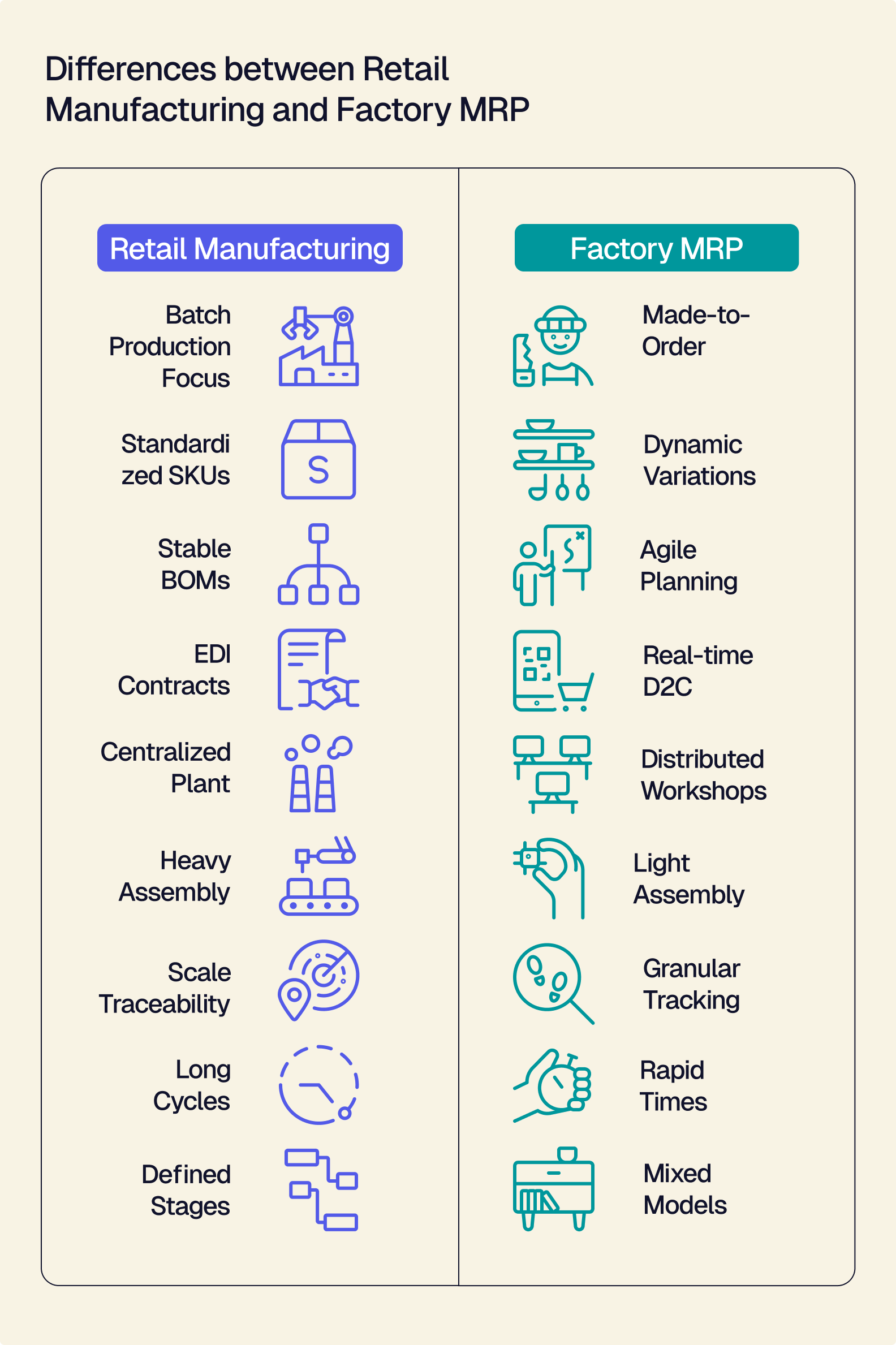
The apparel space is a nightmare of variants — color, size, cut, design — compounded by seasonality and fast-moving trends. Add print-on-demand (POD) workflows or returns logistics, and it’s no surprise apparel brands often outgrow their software stack faster than their customer base.
Printful + Shopify is the quickest way to launch a POD business. The integration is seamless, and for brands focused purely on design and marketing, it removes all operational headaches. That said, it’s not ideal for businesses managing their own inventory or wanting more backend control.
Cin7 Core (formerly DEAR Systems) fills that gap. With advanced inventory management, automated purchase ordering, and strong multi-warehouse support, it’s ideal for DTC apparel brands juggling SKU variants and wholesale complexity. It also supports integrations with popular ecommerce platforms and shipping solutions, giving ops teams the visibility they need to scale without chaos.
Katana stands out again for its ability to handle variant-rich SKUs and multistep fulfillment workflows. If you’re managing both in-house production and outsourcing (say, a third-party printer or embellisher), Katana gives you the tools to orchestrate it all.
Tailor is ideal for brands building custom collections, running limited drops, or managing complex return logic. It allows you to generate dynamic SKUs, map return workflows by sales channel, and adapt your backend to support campaigns, bundles, or wholesale packouts without burning ops time.
Custom Goods and Kitting
For brands that bundle, assemble, or kit products before shipping — like gift boxes, curated product sets, or cross-category ecommerce brands — light manufacturing takes on a fulfillment-heavy shape. You’re not just shipping a product — you’re building it on the fly.
ShipHero is a great option for brands with their own warehouse or 3PL. Its built-in kitting tools, strong pick/pack/ship workflows, and fulfillment visibility make it easy to manage pre-assembly without adding layers of manual oversight.
Extensiv is the evolution of Skubana, and it brings even more firepower to multichannel brands managing complex fulfillment. With built-in bundling logic, automated order routing, and deep analytics, it’s ideal for high-SKU businesses that need visibility across channels and the ability to build, ship, and report on kits without breaking stride.
Flowspace offers a different angle, focusing on flexible, outsourced fulfillment. If you don’t want to manage your own kitting in-house, Flowspace helps coordinate across 3PLs while still offering operational transparency and inventory control.
Tailor excels in this category thanks to its customizable workflows. You can track inventory at the component level, manage assembly tasks across team members or stations, and get real-time throughput metrics — all from a single system designed to scale with your operation.
How Can I Manage Inventory, Orders, and Production in One System?
Imagine having a single source of truth: one dashboard that shows you what raw materials are available, which production runs are in motion, how many orders are waiting on labels, and what needs to ship out today. Stop jumping between spreadsheets, Shopify, Notion checklists, and the occasional sticky note to figure out your fulfillment queue.
A unified system eliminates the gaps that cause operational delays. Instead of manually connecting your order management to your production plan — or worse, relying on someone to remember to update the stock count — your new software takes care of that in real time. When a product is sold, it deducts components. When a bundle is packed, it updates the system. When you’re low on ingredients, it suggests a PO.
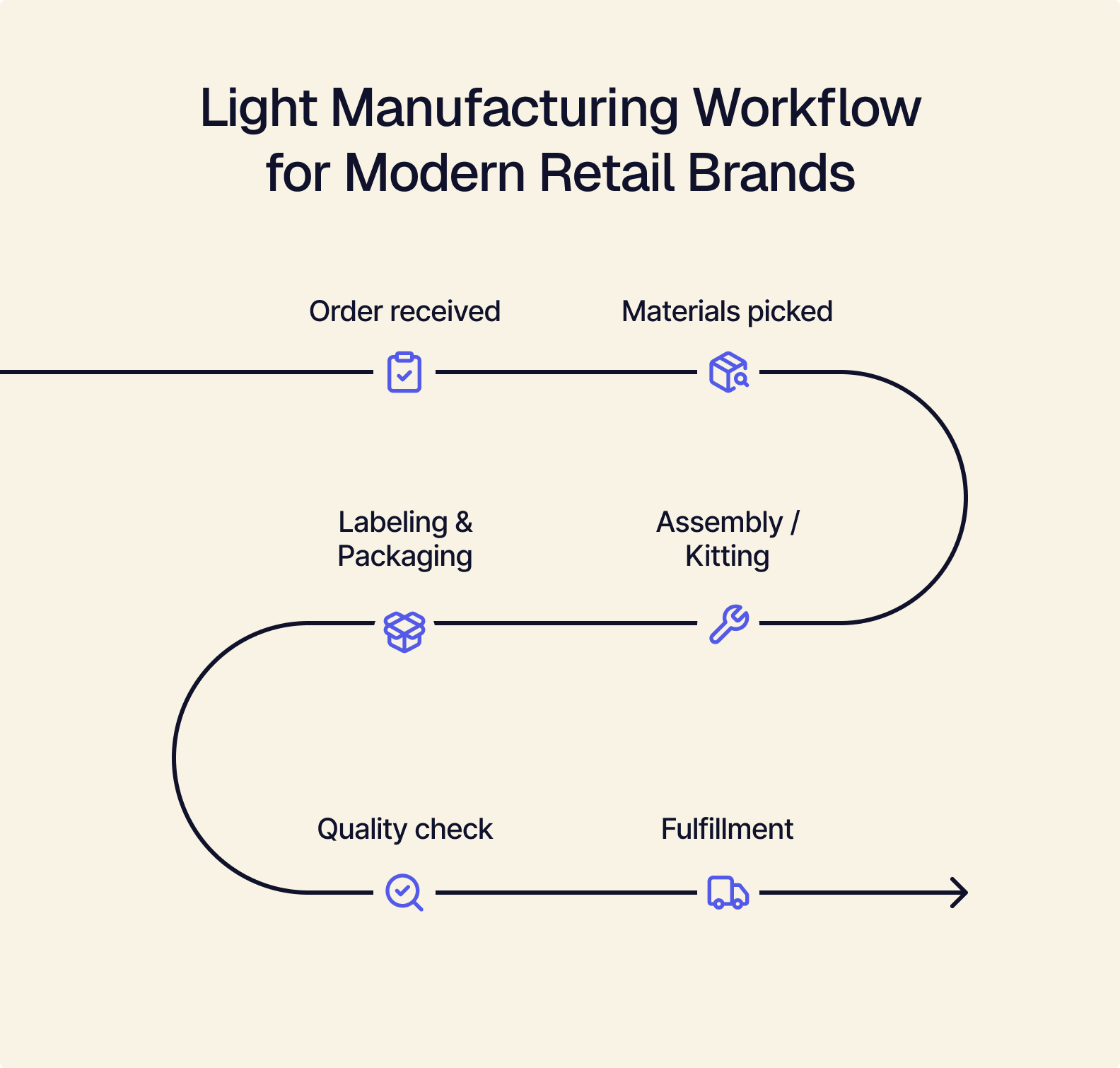
Here’s how you know you’re ready:
-
You’re doing double (or triple) data entry just to keep systems in sync.
-
You’re getting burned by stockouts or over-ordering because your data is stale.
-
You’re not confident your fulfillment team knows what’s ready, what’s pending, and what’s behind.
With the right retail manufacturing software, you can unify your stack without overhauling it. Tailor, for example, slots into your current tools and adds just enough structure to keep things humming without slowing you down — now your inventory, orders, and production can finally speak the same language.
Why Composable Systems Win as You Scale
The way you run your business today won’t be the way you run it six months from now.
Product lines evolve, sales channels multiply, and customers demand new packaging or faster turnaround. If your systems can’t keep up, you either work around them or you start to slow down. Composable software is built to adapt. You start with what you need, maybe just inventory sync and BOM tracking. Then you layer in returns workflows, bundling logic, forecasting tools — whatever your business calls for.
Because platforms like Tailor are API-first, they integrate easily with what you already use — no ripping out Shopify, QuickBooks, or your WMS. You get real-time data, customizable workflows, and smarter operations, without locking yourself into rigid processes.
It's time to future-proof your retail ops and streamline your light manufacturing: schedule your demo with Tailor today.
Other Resources
How Cloud ERP Software Actually Works (Without Forcing You to Replace Everything)The Many Types of ERP Systems and Their Impact on Your Agility