GLDN × Tailor — Connector Case Study
How GLDN Jewelry handles make-to-order operations with Tailor’s real-time inventory sync
The GLDN Jewelry operations team was juggling more than 23,000 SKUs as a custom jewelry brand built on the concept of personalization. But they knew their order workflow needed to change if they wanted to scale.

Brand snapshot

Industry
Custom jewelry

Location
La Conner, Washington, USA

Existing Tools
Shopify, Odoo, ShipStation, QuickBooks Online, TikTok Shop

Tailor Solutions
Shopify + Odoo Connector, Real-Time Inventory Sync
GLDN’s story
1
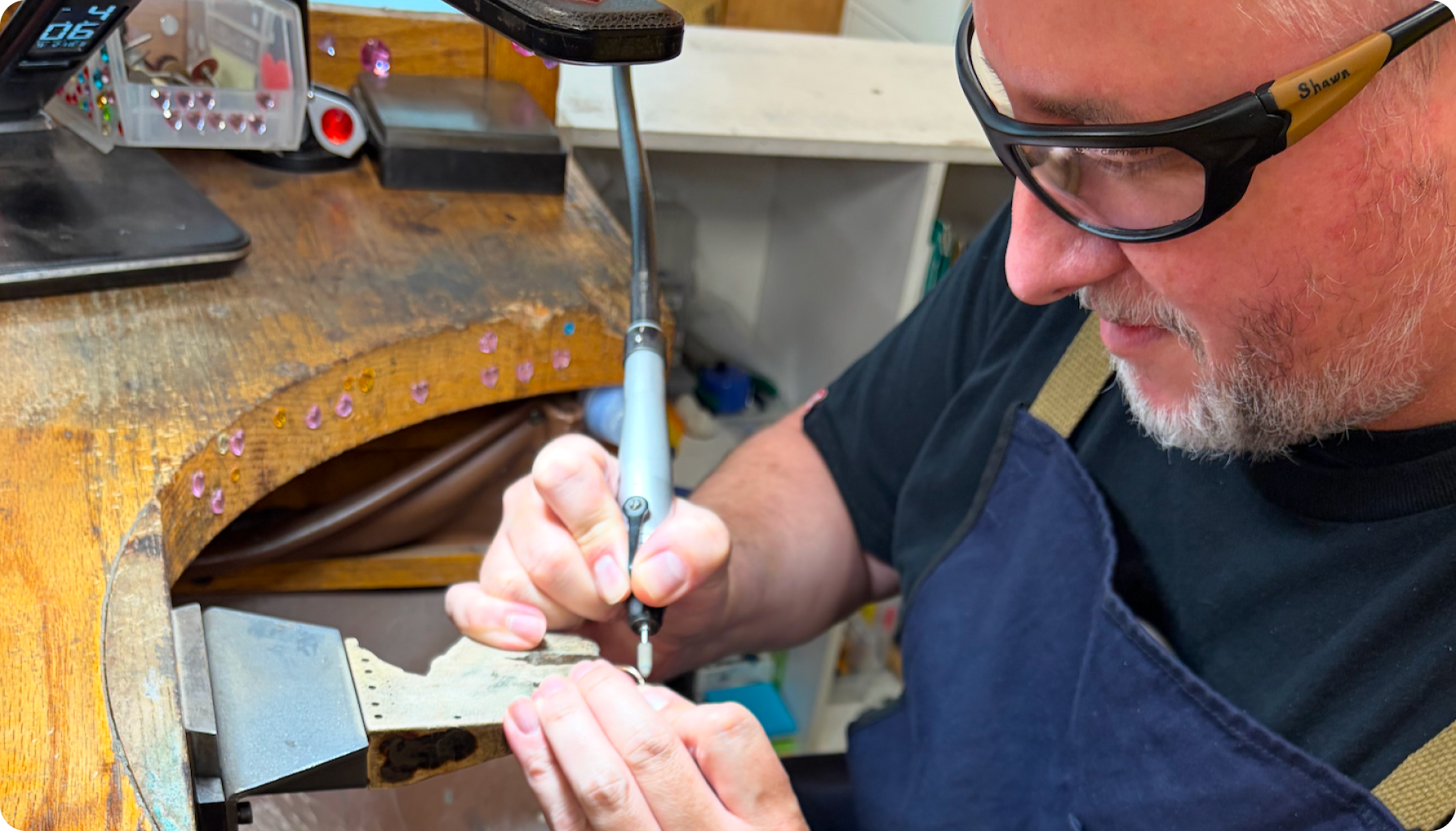
GLDN started with a simple mission: to make jewelry that means something specific to the person wearing it. Founder Chrissy Lavdovsky sold her first piece on Etsy almost 15 years ago — and since then, GLDN has built a strong customer base among ecommerce customers for its distinctive, dainty, and personalized jewelry.
2
But what started as a humble jewelry endeavor has grown into a high-volume, made-to-order jewelry operation. Selling across its own Shopify storefront and third-party marketplaces Etsy, GLDN’s catalog is built almost entirely on personalization. Every order varies, with custom inscriptions across metal type, size, and gemstone. Much of this custom operation still takes place inside the brand’s Washington studio.
3
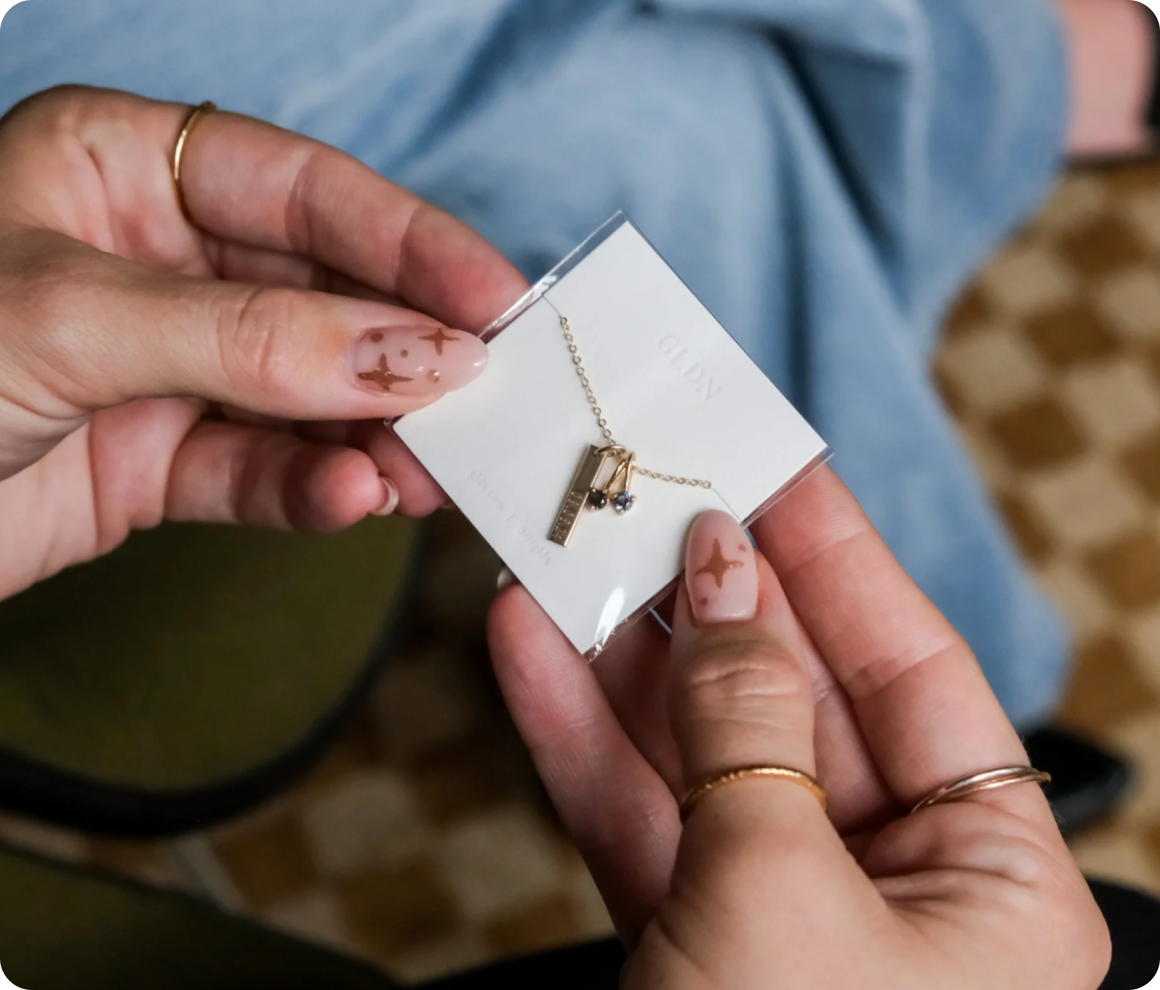
Choice is what customers love about GLDN, but it's also what makes the operation challenging. Every custom attribute multiplies the catalog, which is how the made-to-order jeweler ended up carrying more than 23,000 finished-good SKUs.
4
Deb Taber helped guide the lean internal team handling all of GLDN’s operations and orders before transitioning to focus solely on GLDN’s business systems in 2025. Whether navigating seasonal demand spikes or helping to design a tech stack that can support future growth goals, Deb has always led with a people first, systems based approach.
“At GLDN, we’ve worked very hard to create a team and a company that is open and receptive to change. We’ve built a strong operation by supporting our team through that change, giving as much advance notice as possible when it comes to changes in the business and operational model — and always providing an outlet for feedback.” — Deb Taber, Head of Business Systems at GLDN
Problem
A vendor that vanished, silent system failures, and manual fixes
As GLDN’s order volume and operations grew over the years, the team quickly realized that their manual order flow from Shopify to Odoo wouldn’t cut it. GLDN hired a third-party vendor to build custom connectors between Shopify, Odoo, and Etsy that could handle complex, multi-line orders.
But, about a month before Black Friday and heading into peak sales season, that vendor gave GLDN 30 days' notice that it was shutting down. The scramble landed GLDN on a second Shopify connector with a configurable, workflow-based UI. Eventually, Deb’s team realized they were outgrowing that tool, too.
Keeping an eye out for connector errors and workflow failures became a daily job. So every day, someone on GLDN's team exported orders from Odoo and ShipStation and manually compared both spreadsheets to ensure that every order in one system mapped to the other. When an order was missing, they went looking for it.
“The crosscheck itself took five to ten minutes. The troubleshooting behind it took anywhere from fifteen minutes to two hours, depending on what had broken. And, unfortunately, many underlying failures couldn't be fixed at the source,” — BethAnn, Order Processing Lead at GLDN
The problem with other connectors
1
The system couldn't detect its own failures.
IF GLDN's team didn't manually compare spreadsheets, there was no automatic detection for order issues — no alerts, no root-cause resolution.
2
Large orders broke it
Orders with twenty or more line items had to be manually retriggered, and the team had to import the order's images by hand. GLDN's team even had a warning protocol for large orders to prepare for system issues.
3
International orders failed on country codes
International orders were often missing info — or simply didn't come in, and the team had no insight into where the failure originated.
4
Timeouts wouldn't retry correctly
Despite pre-determined workflows, order failures often sat stagnant until manual intervention. SKU mismatches compounded the issue.
5
The interface kept moving
The connector shipped changes without consistent user communication, making it difficult to use a critical screen or taking hours to debug.
“The problem with so many of these tools is they’re built by people who don’t really understand both the systems and operations of a retail brand. Plus, if the connector went down, we didn’t have a point of contact. We were losing time weekly, sometimes daily, to troubleshooting our own tech issues." — Deb Taber, Head of Business Systems at GLDN

Solution
Automated order flow, built-in recovery, and an embedded partner
GLDN needed a working order management system that wasn’t overly complex or bloated like full-blown enterprise ERP modules. But they also need something flexible that would both scale with their business and handle Odoo’s platform changes without breaking.
“We already have business expertise and have an organized, real-life operational flow. What we needed was a partner with software expertise who could adeptly meld those things together.” — Deb Taber, Head of Business Systems at GLDN
Deb was initially drawn to Tailor’s headless architecture, which enables both out-of-the-box UI and custom workflows for complex scenarios like Make-to-Stock orders.
“There aren’t a lot of tools like Tailor. I quickly realized that other vendors claimed to offer a headless platform or AI capabilities. Still, the tools weren’t actually very customizable or able to handle the strain of real-world order volume,” Deb said.
“The thing with those other apps is sometimes they work, and sometimes they don't. That’s why having access to Tailor’s team of actual engineers, who have built the product, made sense for us.” — Deb Taber, Head of Business
Tailor's Team of operational and engineering specialists pinpointed two of GLDN's immediate challenges:
1
Orders failed to reliably reach Odoo.
Failures were silent, recovery was manual, and someone was reconciling two systems by hand every day.
2
No materials-level inventory visibility in Shopify
Availability was tracked as finished goods in one system and as raw components in the other, so products stayed for sale after the parts to make them had run out.
Tailor implemented two solutions for GLDN: a customized version of its Shopify + Odoo Connector and Real-Time Inventory Sync for Shopify. Both were built on the Tailor Platform's headless, composable, and AI-native architecture.
Unlike other off-the-shelf connectors and Shopify apps, Tailor's solutions act as an integration layer between Shopify and Odoo — reading from each system through its documented interfaces and using AI to intelligently handle order types that generic connectors flag as exceptions.
What Tailor’s Solutions Handle
Shopify + Odoo Order Connector

Real-Time Inventory Sync
Order sync from Shopify into Odoo, including orders with 20+ line items, with no manual retrigger and no manual image import
Calculates how many finished goods GLDN can build from the components actually on hand, using multi-level bills of materials
Automatic new customer creation and order application for existing customers, so a new Shopify product fits existing workflows
Real-time sync for component availability numbers in Shopify
International addresses, including the country-code cases that used to fail outright
Reserves components the moment an order is placed, rather than hours later at order confirmation
Bundle line items and personalization line items, mapped field by field between systems
Per-SKU safety stock buffers that GLDN’s team pre-determines
A managed sync queue tuned to Odoo's API limits, with automatic retry and a daily reconciliation pass that catches anything that previously fell through
Ready-to-Ship items first, then the made-to-order catalog
An operator-facing view of the connector itself — order-level sync status, field-by-field comparison between the two systems, full workflow history, and self-service resync
Shopify + Odoo Order Connector
Order sync from Shopify into Odoo, including orders with 20+ line items, with no manual retrigger and no manual image import
Automatic new customer creation and order application for existing customers, so a new Shopify product fits existing workflows
International addresses, including the country-code cases that used to fail outright
Bundle line items and personalization line items, mapped field by field between systems
A managed sync queue tuned to Odoo's API limits, with automatic retry and a daily reconciliation pass that catches anything that previously fell through
An operator-facing view of the connector itself — order-level sync status, field-by-field comparison between the two systems, full workflow history, and self-service resync
Real-Time Inventory Sync
Calculates how many finished goods GLDN can build from the components actually on hand, using multi-level bills of materials
Real-time sync for component availability numbers in Shopify
Reserves components the moment an order is placed, rather than hours later at order confirmation
Per-SKU safety stock buffers that GLDN’s team pre-determines
Ready-to-Ship items first, then the made-to-order catalog
Just as choice first propelled GLDN's popularity among customers, the GLDN team found the power of choice and flexibility in Tailor's technology solutions — customized for GLDN's operations, and not the other way around.
Built for ops today. Flexible enough for the future.
Deb's approach to change management set the bar for the implementation. Rather than hand over a requirements document, Tailor’s engineers walked the studio floor, interviewed the people who actually process orders, and mapped how work moves through the business before designing anything. This reinforced Deb’s values and GLDN’s team operational culture — providing visibility into what was coming and outlets for feedback when something didn’t work.
Gather Requirements
1-2 weeks
Gather and prioritize requirements. Quantify ROI and success criteria.
Solution proposal
1 week
In-depth custom demo & implementation roadmap based on requirements
Sign agreement
Production Implementation
8 - 10 weeks
Organized into ~4 week milestones with testing and opportunity to share feedback
Make payment
Go Live
2 weeks
Includes data migration & onsite training
Gather Requirements
1-2 weeks
Gather and prioritize requirements. Quantify ROI and success criteria.
Solution proposal
1 week
In-depth custom demo & implementation roadmap based on requirements
• Sign agreement
Production Implementation
8 - 10 weeks
Organized into ~4 week milestones with testing and opportunity to share feedback
• Make payment
Go Live
2 weeks
Includes data migration & onsite training
Tailor's Embedded Implementation
Tailor's embedded implementation process helped build a truly collaborative partnership with the GLDN team, across both virtual and on-site touchpoints.
Co-build deep operational insight
The problem with other software vendors, as Deb observed, was that they were built by people who don't understand both the systems and operations of a retail brand. Through in-person collaboration with GLDN's daily operators, Tailor's engineers and product leaders gained a true understanding of the business's needs.
Hands-on and cross-functional
Tailor was able to deploy a complete cross-functional team (Sales, Product, and Engineering) to GLDN's studio in Washington. Because Tailor's model emphasizes a hands-on workforce based in the US, Tailor's forward-deployed engineers visited GLDN in person multiple times throughout requirements gathering, all the way through Tailor's phased implementation.
Agile, communicative delivery
Being on-site during critical milestones enabled rapid feedback loops, allowing Tailor to continuously iterate and deliver a truly custom-fit connector. They also built the connector against GLDN's growth plan rather than its current volume.

“Something else we've kept in mind throughout the process is GLDN’s growth goals and the company’s trajectory. For example, when we do our load testing, everything isn't to the current state — everything is to where the business wants to be in one, five, or ten years.”
Patrick O'Sullivan
Head of Product, Forward Deployed, Tailor

“One of the things that we really appreciated from Tailor’s team is the way they took the full picture of our business into context. It wasn’t an all-or-nothing ERP sell or huge systems overall. They understood it's not the right tool for the right job as much as the right tool for the right time.”
Deb Taber
Head of Business Systems, GLDN
Go-live week, not go-live day
Tailor's phased approach meant the cutover wasn't a single switch. Orders started flowing on a defined go-live week, with Tailor's engineers monitoring alongside GLDN's team and a lightweight ticket flow standing by for anything that surfaced.
1
The launch itself was uneventful — which, for an operations team that had spent years watching order syncs fail, was the point.
“When we actually first went live, it was like nobody even noticed. It's the smoothest software cutover we've ever had.” — Deb Taber, Head of Business Systems, GLDN
2
A few issues surfaced in the weeks that followed, as Deb expected. GLDN's order patterns mean problems don't always appear on day one.
“With the way our business flows, we don't always see those problems right away. So Tailor understood that go-live day needs to be more like go-live week.' — Deb Taber, Head of Business Systems, GLDN
3
Rather than route any problems through a typical support queue, Tailor set up a shared ticket flow for go-live week. This way, the GLDN team could file issues directly to the engineer who owned the fix.

A partner, not just a vendor

Unlike third-party connector apps, Tailor provides both the product and the implementation team. No frustrating handoff from sales to consultant to rep.

GLDN's shop-floor users aren't “software people,” which pulled Deb away from running ops and into ad hoc training. Tailor’s custom, clean UI and hands-on training eliminated this issue.

Tailor’s hands-on, phased implementation led to a smooth go-live and a streamlined feedback ticket flow for any bugs GLDN’s team found.
Results
Before implementing Tailor, GLDN’s team had all but accepted that peak sales seasons would break their order management system. Their off-the-shelf connector tools were simply not reliable, which led to routine manual processes to ensure that all orders were accounted for across their tech stack.
But now, GLDN’s ops team has a faster connector that can manage a higher payload with built in fail-safe mechanisms that catch all failed order syncs — automatically attempts resolutions before a team member needs to step in.
1
No more 2-hour troubleshooting sessions
GLDN's order processing team no longer exports orders from Odoo and ShipStation to manually verify they match — recovering 5 to 10 minutes every day, plus up to two hours of troubleshooting per incident.
2
Smooth 20+ line orders
The old workflow required an alert, a manual retrigger, and hand-importing the order's images. Now they sync like any other order — which matters most in peak season, when multi-piece orders spike. And if an error doesn't allow for syncing, Tailor's team created a simple Slack channel workflow that notifies GLDN of the error and how to fix it.
3
Country-code failures eliminated
Orders from Japan and other international destinations that previously failed on address formatting now sync without intervention.
4
No more playing detective with SKU errors
When a SKU does need fixing, the team corrects it in Shopify (where it belongs) and reprocesses with a simple tag, rather than hunting for the right screen in a connector UI.
5
Freed-up time for key ops team members
Tailor provided failure scenario documentation specifically for GLDN’s connector and training content that empowered BethAnn to train other team members. What used to be tribal knowledge about one platform's quirks is now a repeatable process.
6
Ongoing support
Tailor provides weekly check-ins with GLDN’s team and post-implementation monitoring of orders syncing via the connectors.
What's next
Now that GLDN is seamlessly syncing orders with Tailor’s Shopify + Odoo Connector, the teams are working together on a custom solution that solves one of GLDN’s biggest pain points: overselling.
For a made-to-order brand, what's available to sell isn't what's sitting on a shelf. A necklace is built from parts (chains, clasps and findings that are shared across dozens of other designs). With complex make-to-order items with multi-level bill of materials (BOMs), GLDN is still facing the challenge of monitoring when items are out of stock.
Tailor is building the solution that closes that gap: calculating buildable quantity from parts on hand and orders already committed, then keeping GDLN’s Shopify storefront updated automatically.


