In this modern, API-powered era there are more applications, platforms, and SaaS (software as a service) products than ever. Individual products are easier to use and integrate, but there are still significant hurdles to getting different parts of your tech stack to sync up and communicate with each other.
Especially with Shopify being one of the largest eCommerce platforms, there needs to be ways for it to smoothly integrate into your workflows without breaking your system or slowing down your sales trajectory.
Every problem has a solution, but not every proposed solution is right for you — context matters quite a bit when figuring out how to best integrate Shopify into your tech stack or ERP. Whether this is your first stop on your search for a solution, or you’re bogged down sorting through sales materials, we’re here to clarify how Shopify integrations work.
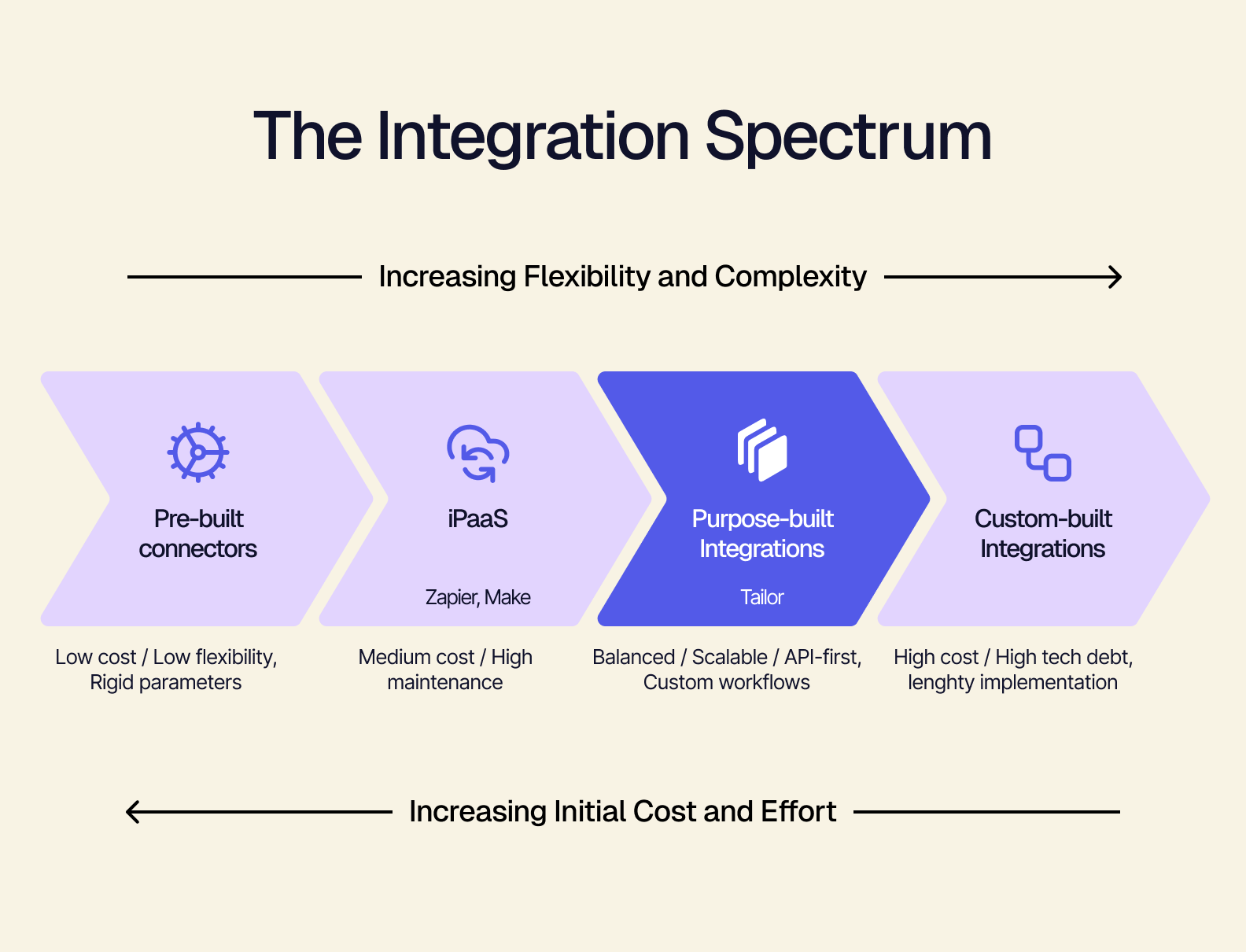
By the end of this guide, you’ll know the difference between pre-built connectors, iPaaS systems, custom-built integrations, and purpose-built solutions.
Pre-Built Connectors and Marketplace Native Apps
If you’re looking to scale your business with Shopify, marketplace native apps and pre-built connectors are an important solution to consider. These tools will help patch Shopify the core of your business — so you can stay focused on serving your customers, rather than putting out fires and struggling through convoluted data migration processes.
Many scaling businesses need to utilize an ERP to manage the different aspects of their operation, and they often have rigid parameters that would ordinarily make it difficult to sync up with a platform like Shopify. However, Shopify has solved this issue by offering native apps that help the eCommerce platform “speak” to popular inventory management systems.
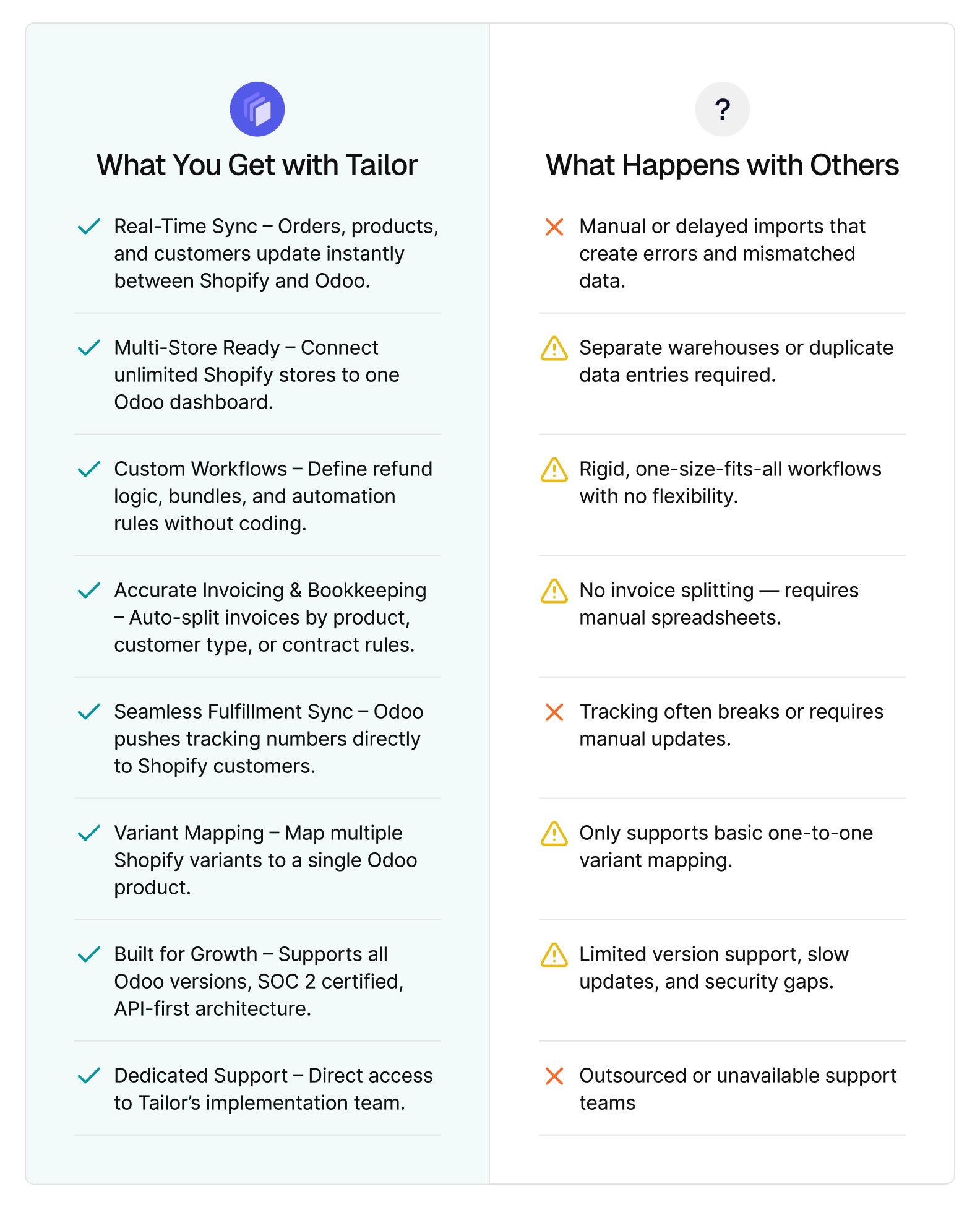
For example, a business may utilize Odoo as an ERP and inventory management solution, but also have their business built on the back of Shopify. Tailor’s pre-built Odoo-Shopify connector allows our customers to level up how they use Shopify:
-
Instant order sync. Centralize your fulfillment, invoicing, and financial tracking by automatically pulling sales orders directly from Shopify.
-
Custom logic. Create conditional workflows that handle things Shopify struggles to do natively, like refund processing and automated invoice updates based on order status.
-
Better bookkeeping. Automatically split invoices by product, customer type, or contract rules.
However, not every business is built from the ground up to maximize the use of pre-built connectors. Scaling can be messy and build technical debt, or create necessarily complicated processes that are difficult to simplify. Because of this reality, sometimes a plug-and-play solution won’t cut it.
In these situations, iPaaS tools, custom-built solutions, and purpose-built integrations become important to explore.
What About iPaaS Tools?
Integration Platform as a Service, or iPaaS, are platforms like Zapier, Make, Workato, and Celigo that offer a variety of eCommerce solutions for their customers. These can range from full-on ERP integration into Netsuite (Celigo is built to make the most of that integration), to powerful solutions that require a dedicated IT team (Workato), or even pay-per-task like Zapier.
iPaaS solutions offer many different ways to connect with Shopify for different sized businesses. Zapier and Make both cater to smaller operations, but Zapier can grow expensive quickly if your tasking processes are multi-step and complicated. Of the two, Make needs fewer add-ons to make full use of the Shopify API — but it also has a much steeper learning curve and requires technical know-how to leverage properly (knowing JSON and how arrays work is a must).
One thing that makes iPaaS integrations for Shopify tricky, is that the larger your business is, the more likely you’re going to run into the “monolithic ERP” problem. What’s a monolithic ERP? Well, it’s an ERP suite that functions more like a walled garden (features apps that are only designed to work with each other or specific platforms — like NetSuite), than an open field (a flexible ecosystem where most API-powered apps can be connected — like Tailor). For some businesses, a rigid system is the silver bullet for their operational difficulties. But for many others, it’s a huge expense that disrupts their scalability and forces them into a business direction that may not be viable long-term.
Celigo tends to push their customers toward adopting monolithic ERP solutions in order to make the most of the tools they offer, while Workato is designed to integrate hundreds of different applications and functions best at enterprise scale. If you’re a scaling business, be sure to keep your future in mind when you’re looking for Shopify ERP integration solutions.
Custom-Built Integrations
One thing that’s near-universally true in the tech sector is “custom equals expensive” (with one exception, more on this later). Large enterprises tend to have extremely unique tech stacks, patchwork backend systems, and labyrinthian databases to account for when they set their sights on developing a solution that connects to Shopify or any other eCommerce platform. These businesses are usually “legacy” enterprises that have been around for more than two decades — meaning they’ve built up significant technical debt with how they operate.
This results in connectors needing to be built from scratch.
From-scratch, custom Shopify solutions will require experienced developers, lengthy implementation and testing phases, and a dedicated IT team to keep the solution working as intended. For large enterprises, this is just the cost of doing business. But for a smaller, scaling business it’s important to stay lean and not build up to the conditions that necessitate custom solutions.
By no means does this mean that custom integrations are a negative consequence; rather it’s a learning opportunity for rapid scalers. By observing the burden that legacy operations undergo to bring their workflows into the modern era, you can avoid the same troubles a decade down the road:
-
Prioritize API integration. Your tech stack can stay flexible if you focus on integrating applications and platforms that are API-first. This will help you scale the way you want to, and shift core parts of your business easily.
-
Avoid monolithic ERP integrations. These lock you into an ecosystem that defines how you scale and can limit your potential and increase costs down the road.
-
Refine your workflows. Custom solutions become a necessity for large enterprises because their workflows bloat and complicate. Routinely revisit your processes and trim what isn’t working.
If you’re a business ready to scale and you need solutions tailored to your daily operations you won’t need to rely on Shopify native apps, iPaaS solutions, or custom-built solutions. This is where Tailor can help.
Purpose-Built Integrations: How Tailor Helps You
Sometimes, a business needs a custom-built solution to solve a specific problem. Unlike the custom solutions for large enterprises, purpose-built integrations are designed for scaling the business rather than maintaining business integrity. Put another way, the difference between purpose-built and custom-built solutions comes down to:
-
Purpose-built solutions drive your business forward. They’re like a gas pump or a charging station — they give you the fuel or energy you need to get where you’re going while keeping your momentum.
-
Custom-built solutions keep the business from breaking down. These are like getting a suspension system replaced. If the custom-built solution isn’t added, the business won’t be able to handle rough roads without sustaining significant damage.
So with this in mind, Tailor specializes in the creation of purpose-built integrations, tools designed from the ground up to serve your business and help you scale.
 Let’s dig into how our Shopify Integration works.
Quick and Seamless Setup
Typical integration of a custom-built solution would take several months to a year (or more) to be ready for integration. But with our purpose-built solutions, we’re able to get solutions that will make a difference in your business designed, built, tested and live in weeks. For simple connectors like our Shopify + Odoo connector, you’re looking at minutes.
Plus, once you’ve integrated one (or many) of our products, we’ll be right beside you to offer support as you need it. We’ll ensure that using Tailor for your business is quick, seamless, and exactly what you need to scale your business.
Custom Workflows and Real-time Sync
When it comes to Shopify integrations, its API output is extremely linear and simple. This is great for smaller, simpler businesses with a very predictable operating structure. However, larger businesses process larger order volumes, and require non-linear workflows. This is where our Shopify integrations come in handy:
-
Custom workflows to maximize Shopify. Our tools allow you to define refund logic, process item bundles easily, and implement automation rules without needing to know how to code.
-
Real-time sync between Shopify and your backend. You don’t want to be waiting hours (or full days!) for your order details to make their way to your desk. Instead, our real-time sync feature allows you to view orders, product details, and customer information as they come in.
The real power of purpose-built solutions — like those we offer — is their ability to scale to meet your needs in any part of your business. Tailor’s solutions are accessible via a central dashboard that can be added to over time, so you can manage Shopify, while also accessing other core parts of your business. We offer a composable, modular approach that sets the stage for your operational growth.
If you’re ready to scale up your business and get the most out of Shopify, book a demo with us to explore purpose-built solutions that won’t lock your trajectory into a rigid ecosystem.