At some point, your business will be large enough to enter into the Kingdom of Giants: the world of established SMBs and Legacy corporations. In this new market, you've got dedicated customers and a flourishing brand, but lots of new competition.
While your goal of stable growth is the same, it's easy to feel like you've got to copy the processes of the biggest and most successful businesses in your niche. It's even easier to end up believing that rigid software suites are the only way to continue growing.
Today, the global marketplace is rarely stable and highly unpredictable. Because of this, it may be more beneficial for your growth trajectory to revolve around your strengths and flexibility — rather than looking at what others are doing. Of course, you'll need the right tools for the job, and you'll need them to break through some significant growth ceilings to reach the heights you're aiming for.
But in order to do that, you'll need to consider what integrating an ERP for your small business would look like.
What You'll Learn
- What growth ceilings are, and how to break through them
- How an ERP built with composable architecture can be used to build the future of your small business
- Why incremental upgrades can help reduce chaos as you grow and adapt to your current market
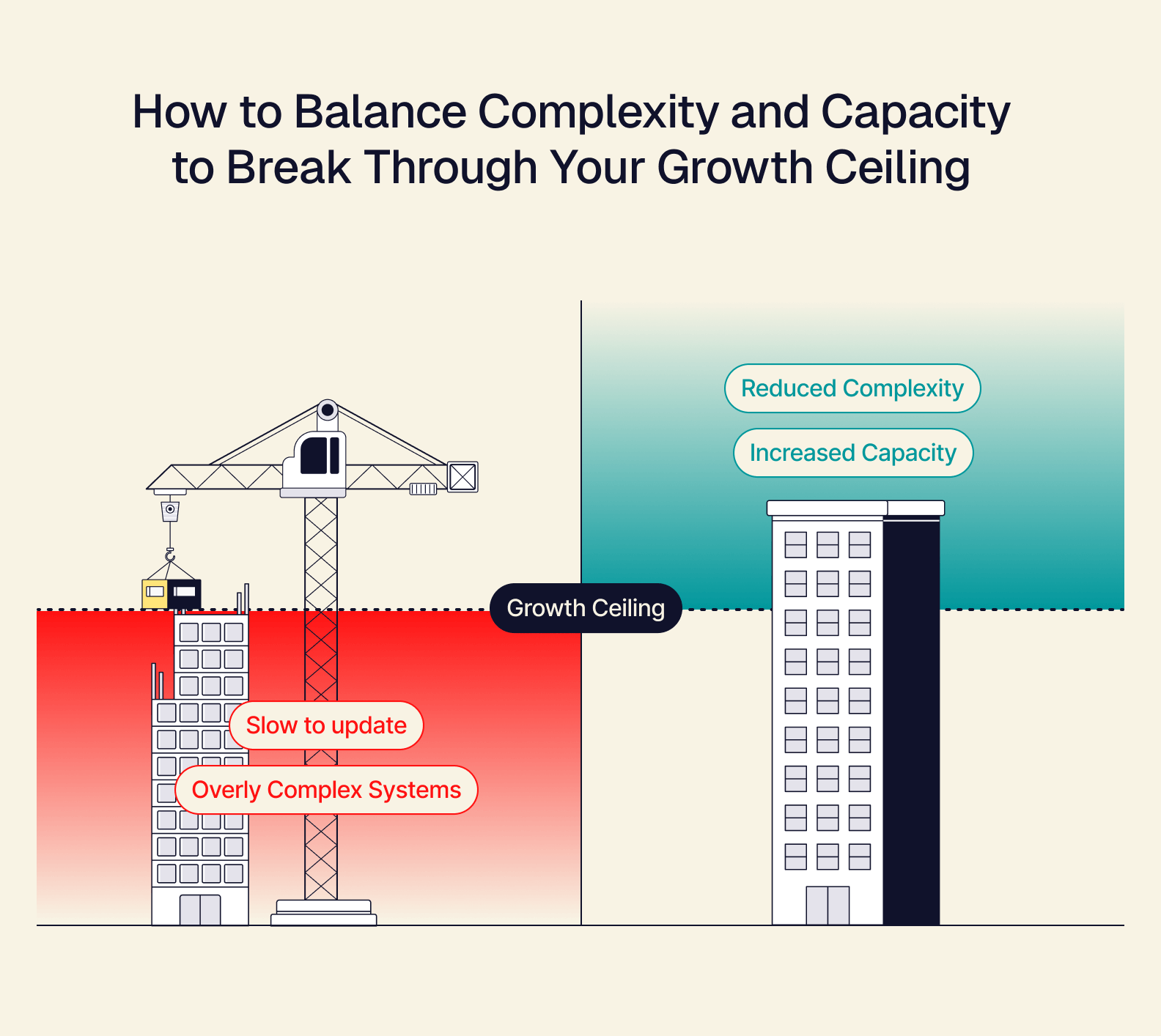
How To Balance Complexity and Capacity to Break Through Your Growth Ceiling
Every business eventually bumps up against a growth ceiling, and the instinct is to push as hard as possible to break through. Unfortunately, just like in real life, breaching a sturdy object requires more than just pushing hard. It takes velocity and a narrow point of force — both of which can be in short supply when that ceiling is first encountered.
Many businesses are bogged down by a small amount of space (capacity to handle tasks) and attacking the ceiling with a huge amount of complexity (a wide point of force). This makes breaking through extremely difficult, and while brute force can work out, it adds serious strain to the business over time.
So rather than brute force it, you can rebalance your level of complexity and capacity to ensure you have a successful breakthrough.
Capacity, Complexity, and How Friction Impacts Your Business
First, let's get clear on what capacity, complexity, and friction mean for your business. Capacity is how much bandwidth your business has for growth. This capacity is absorbed by a few things:
- Tasking time
- Workflow efficiency
- Cost of technological overhead
If your team gets stuck performing hectic and inefficient workflows, slogging through tedious tasks, or finding much of your yearly budget goes to paying for tools you don't use, your capacity for growth is extremely limited.
Complexity is how simple your daily operations are. Your complexity is affected by:
- Tool usability
- Data visibility
- Operational flexibility
If your team struggles to use your core tools, manages important data by moving it between spreadsheets and disconnected applications, or struggles to react to market conditions, your complexity is too high.
Friction is a combination of factors from both complexity and capacity that determines how difficult it is for your business to build up speed. The more friction you have, the harder it is for your business to grow efficiently, which can lead to mountains of technical debt, labyrinthine tasking, and massive data risk.
You increase your capacity by reducing complexity, and in turn, you lessen the amount of friction your business faces. This is what enables you to move fast enough to break through your growth ceiling (once your complexity and capacity are managed).
Break Through Your Growth Ceiling with a Headless Solution
By now, it should be clear what directly impacts your capacity and complexity. But how do you actually solve a lack of capacity and too much complexity? A headless solution can help.
A headless ERP for your small business delivers all the functionality you need — giving you a customizable frontend that only shows you the information you need to see — and unifying all the most important parts of your business. This helps you simplify your tech stack by exposing tools you don't need, cutting out unwieldy spreadsheets, and bringing many workflows into a singular, high-usability interface.
A headless system narrows the point of force you need to get past your growth ceiling by reshaping your operational complexity to fit the size of your business — while freeing up the capacity you need to exponentially grow.
Tailor's headless ERP solution is called Omakase, but let's circle back to that later once composability is covered.
Brick by Brick: How Composable Architecture Builds Your Future
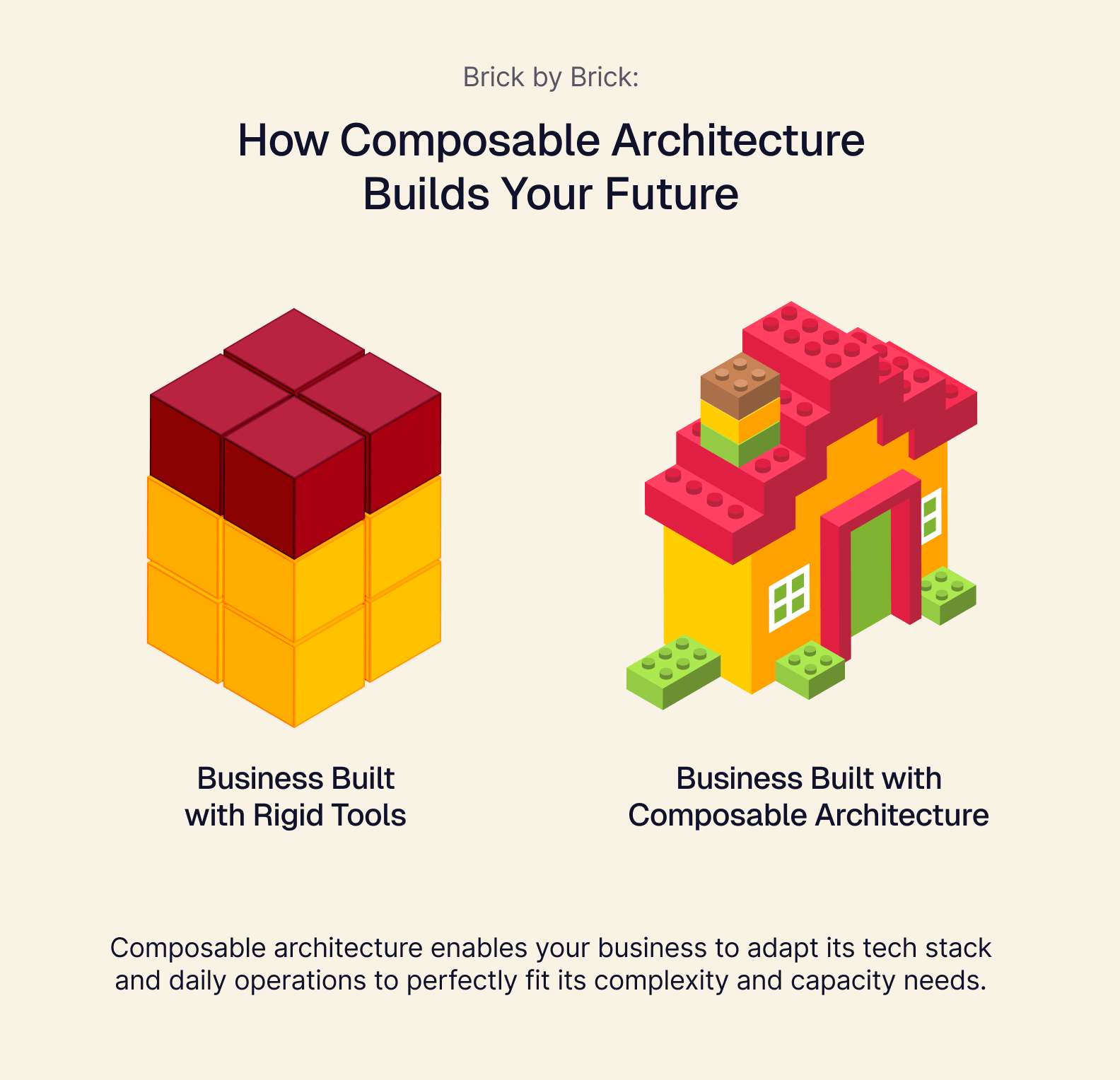
Imagine your company is composed of interlocking bricks — legally distinct from the popular children's toy — and as long as you've got bricks with uniform connection points, you can make anything you could imagine. This is the idea behind composability: any module created with composability in mind can fit into the larger whole with ease.
Composable architecture enables your business to adapt its tech stack and daily operations to perfectly fit its complexity and capacity needs. It's also worth noting that low capacity or a large amount of complexity is not a bad thing. Lots of complexity is only bad when it's working against your business, and low capacity is only bad if the lack of it is causing you to miss opportunities in the market.
So, how does a business develop with a composable architecture?
What It Looks Like to Build with Composability in Mind
The big advantage of building composability is you avoid being locked into building a certain way. What does that mean? Think about popular ERPs like Netsuite or SAP S/4HANA. These are undeniably powerful tools, but they also define exactly how you're going to run your business. These ERP suites have applications you have to use, which means your teams are going to have to relearn workflows, and a lot of money and time will be spent integrating these tools.
Instead, if you build with composable ERP modules designed for a small business, you can shortcut the integration times and keep using the tools that work. You save time on learning new workflows, and spare your yearly budget from the price tag of legacy ERP integration. This also means you can ditch the arduous process of retraining your team how to do their jobs.
The biggest benefit of all? You can remain focused on where you want to end up, rather than where your tools demand you go. And by thinking of your tools like interlocking bricks, you can choose your future integrations much more easily. With composability, every choice you make helps you move forward — which is especially important when you're a small business.
Why Rigid ERP Suites Don't Work for Small Businesses — Your Questions Answered
Q: Why is rigidity a bad thing for small businesses?
A: It all comes down to the size of your business — rigid ERPs are designed for large, legacy businesses that move slowly. Massive enterprises benefit from having set-in-stone tools, since they're built specifically with that large of a business in mind. They can afford to have low capacity for new tools, because the tools they do use are managed completely in-house or via a close partnership with their vendor.
Q: What's the reasoning behind focusing on flexibility when it comes to choosing tools?
A: As tempting as it is to want to focus on treading well-beaten trails (integrating monolithic ERP solutions), the fact of the matter is that in the modern era, you need flexible tools to more easily adapt to unpredictable conditions. You need the ability to easily redraw workflows or retune a core part of your business without it taking months and months. Flexible tools help you do this faster, so you can pivot and get back to your growth strategy.
Q: How does a headless ERP meet the needs of a small business better than an ERP suite that includes everything?
A: This is a three-pronged calculation: cost, time, and usability. ERP suites are far more costly to implement, can take more than a year to properly implement, and fixed graphical UIs mean that your team may struggle to get the most out of an ERP's built-in power. When you add all this up and sprinkle in the possibility of unused ERP modules — suites are an all-in-one package — the calculation is pretty simple: it's too much for too little payoff in a small business.
Scaling without Chaos via Incremental Upgrades and Purpose-Built Results
The big idea being alluded to up till now is that every tool in your business should work toward helping you scale.
Reducing complexity and increasing capacity enables you to scale more effectively. But the inevitable consequence of scaling can be chaos. Chaos comes from adding too many new team members, clients, and tools too fast. Thankfully, this is where our flagship headless ERP solution, Omakase, makes the most impact.
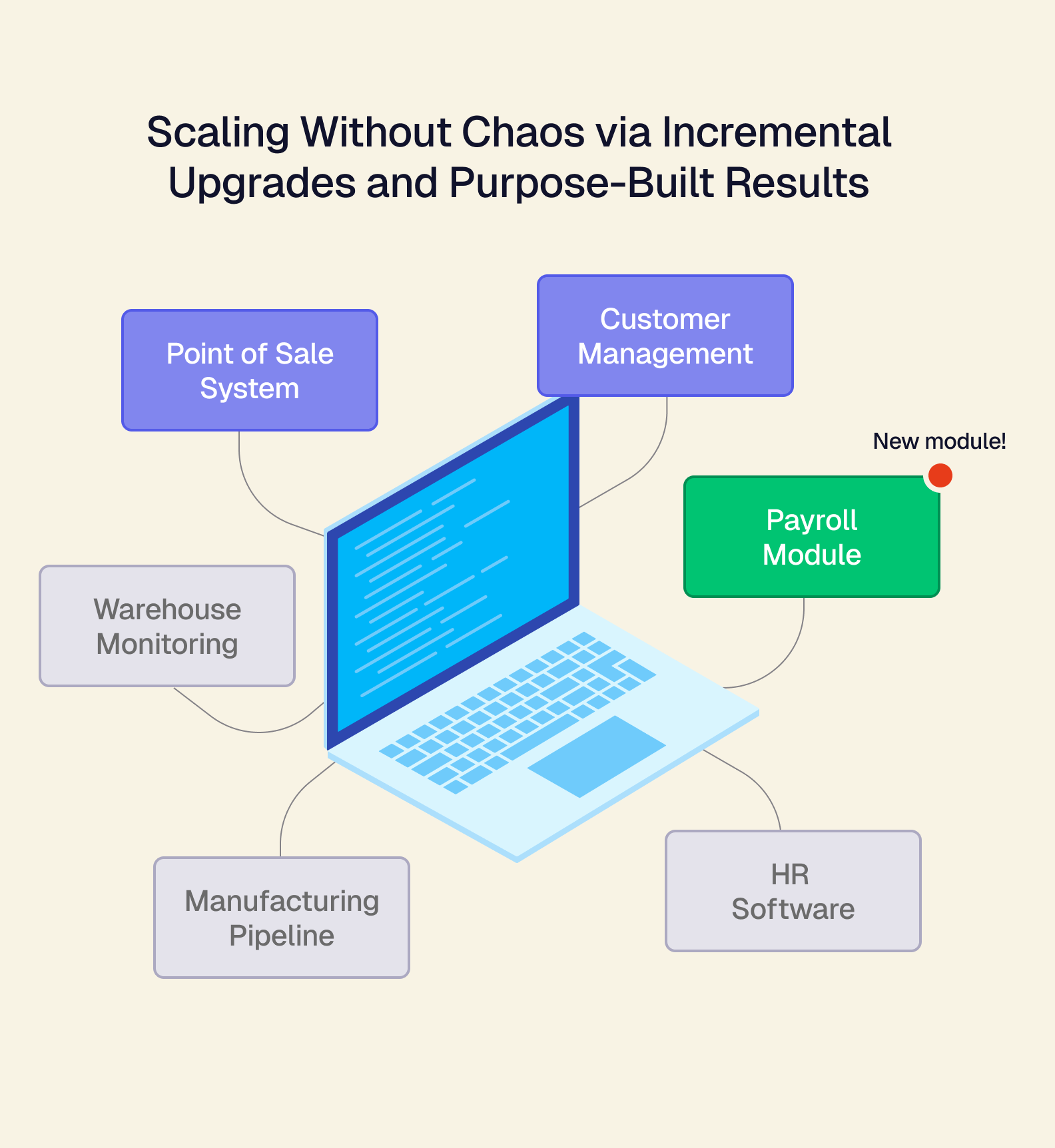
When you need to add new tools, it can be difficult to integrate those tools into your current workflows while you're also trying to do business as usual. However, by incrementally upgrading, you can cut down on integration time with minimal disruption. Rather than spending up to 18 months integrating an ERP suite, you can spend just 45 days getting a high-impact, purpose-built tool operational.
What's even better is that these integrations can be tested before they're sent live. Tailor has designed Omakase to support pilot programs to ensure that your new tools are purpose-built to meet your needs while also working exactly how you need them to when they launch. By using a pilot program approach, Tailor can make tools for your business in an ideal testing environment, iron out the kinks, then push the tool live to your tech stack.
But how does this help cut down the chaos of scaling? By incrementally upgrading your system and core operations, you quickly absorb those changes, and can accurately diagnose what further additions you need — instead of trying to figure out what you need all at once.
The Omakase difference is that you get purpose-built tools that perfectly fit your business, and can continue to add new modules and features when you're ready for them — all with an interface designed to fit your workflows and unique tech stack.
Connecting to a Bigger, Better Future
When you're trying to grow your small business with an ERP solution, it's important to focus on composability.
By prioritizing flexibility, you can better react to unpredictable market conditions, which helps you make better decisions about how to scale your business. When you meet your growth ceilings, you can use headless tools to reduce your complexity and increase your capacity, which reduces friction in your business and increases your speed. All of this works together to massively grow your business and scale without chaos.
What could that look like? Maybe your business can finally launch the wholesale channel that's been on the back burner for over a year. But you won't know until you give composability a shot. It's time to break through your growth ceiling:
Schedule a demo with Tailor today so we can show you how Omakase can set you up for a bigger, better future.